

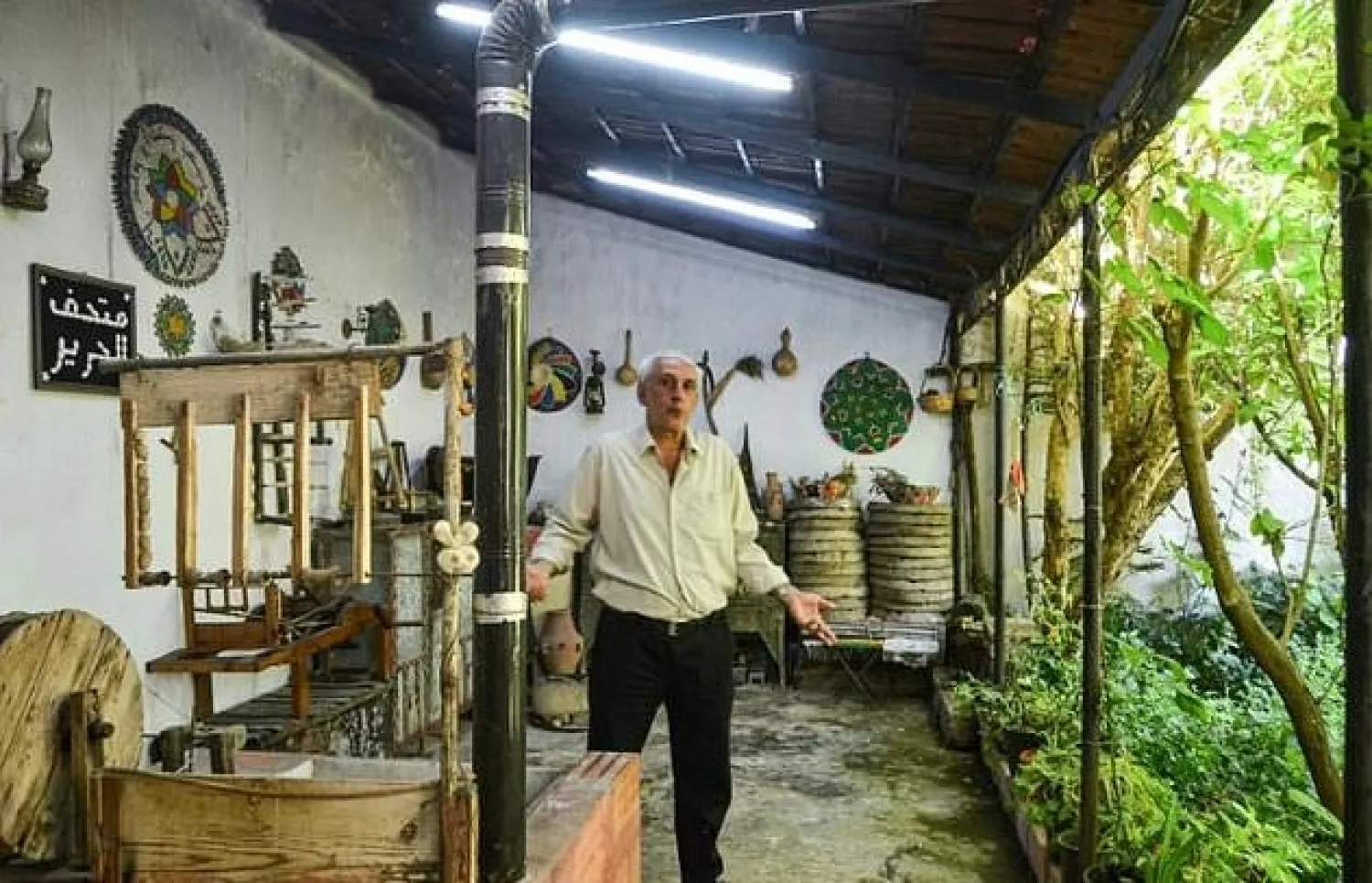

Syrian Turns His Home into a Silk Museum to Celebrate the Ancient Craft

Only a decade ago, the year before the devastating conflict broke out, 16 villages and 48 families across Syria still worked in sericulture. AFP
TT

Syrian Turns His Home into a Silk Museum to Celebrate the Ancient Craft

Only a decade ago, the year before the devastating conflict broke out, 16 villages and 48 families across Syria still worked in sericulture. AFP

After Syria's war whisked away the silkworms from his mulberry trees, 65-year-old Mohammed Saud instead turned his idle home workshop into a silk museum to celebrate the ancient craft.

In the green hills of Deir Mama, Saud, his wife and three sons have been making silk for decades.

They would raise silkworms in the spring, watching them munch on mulberry tree leaves and slowly build their thick cocoons, before spinning the thread and weaving it into fine cloth.

But Syria's nine-year-old war has complicated silkworm imports, and stemmed production for now, AFP reported.

In his courtyard-turned-museum, Saud held up a handful of glistening white silk cocoons the size of large grapes.

Stooping down, he manually yanked around a large wooden spinning wheel used to unfurl the tight coils into long pale thread.

"There are just three families left in Syria working this craft," he said. "Today I am the only one left in this town fighting for its survival."

Sitting at a large wooden loom with his feet on the pedals, he demonstrated weaving, his agile hands gliding from side to side as he weaved weft over warp.

In a corner, off-white silk shawls were displayed on the wall, or draped around mannequins.

A decade ago, the year before the conflict broke out, he had told AFP that 16 villages and 48 families across Syria still worked in sericulture.

Cocoon harvests had already dropped from 60,000 tonnes in 1908 to just 3.1 tonnes in 2010. When fighting erupted in 2011, it all ground to a halt.

"I decided to transform my home into a workshop when I realized it would contain all stages of silk production," Saud explained.

Deir Mama was famous for silk production before the war, with most residents specializing in one stage or another of the process.

Not far from the large Masyaf citadel, the town's mulberry trees stretched across wide swathes of land, drawing in silk fans from Syria and beyond.

On the museum's wall hung some old photos of Saud posing with foreign visitors, and a few of their thank you notes.

"I used to rely mainly on tourists, as they were the ones able to afford the silk," he said.

But these days, even if the museum tour is free, visitors are rare.

Before the conflict the craft was like "a sick man we hoped would heal, but then the war came along and dealt it a final blow".

"I alone am battling for the trade's survival... even if it is clinically dead."

According to AFP, after nine years of war that has killed 380,000 people and devastated the economy, tourism is non-existent.

And for Syrians struggling to put food on the table amid alarming price hikes, fine cloth is the last of their worries.

"Silk has become a luxury in this crisis," Saud said.


Spain and Portugal Continue to Battle Storm Leonardo as New Storm Approaches

 A mountain landslide blocks railway tracks during heavy rains, as storm Leonardo hits parts of Spain, in Benaojan, Spain, February 6, 2026. (Reuters)
A mountain landslide blocks railway tracks during heavy rains, as storm Leonardo hits parts of Spain, in Benaojan, Spain, February 6, 2026. (Reuters)
TT

Spain and Portugal Continue to Battle Storm Leonardo as New Storm Approaches

 A mountain landslide blocks railway tracks during heavy rains, as storm Leonardo hits parts of Spain, in Benaojan, Spain, February 6, 2026. (Reuters)
A mountain landslide blocks railway tracks during heavy rains, as storm Leonardo hits parts of Spain, in Benaojan, Spain, February 6, 2026. (Reuters)

Storm Leonardo continued to batter the Iberian Peninsula on Friday, bringing floods and putting rivers at risk of bursting their banks while thousands of people were evacuated from their homes in Spain and Portugal.

In southern Spain's Andalusia region, some 7,000 people have had to leave their homes due to successive storms.

Among them were around 1,500 people ordered to evacuate the mountain village of Grazalema, where Andalusia's regional leader Juan Manuel Moreno warned that aquifers were "full to the brim with water,” and at risk of collapsing.

“It's raining on already saturated ground. The land is unable to drain," Moreno said. “We urge extreme caution. This is not over.”

Spanish police said Friday they had found a body located 1,000 meters (about 0.6 miles) away from where a woman had disappeared Wednesday after she fell into a river in Malaga province while trying to rescue her dog. Police said they had not yet identified the body, but believed it belonged to the 45-year-old woman.

Another storm front, Marta, was expected to arrive Saturday, with Spain's weather agency AEMET saying it would bring even more rain and heavy winds, including to areas already drenched by Storm Leonardo.

Marta is expected to affect Portugal, too.

Of particular concern was southern Spain's Guadalquivir River, which flows through Córdoba and Seville and eventually into the Atlantic Ocean, and whose water levels have dramatically risen in recent days.

Additional rain Saturday could leave many more homes at risk in Córdoba, local authorities warned.

In Portugal, parts of Alcacer do Sal were submerged after the Sado River overflowed, forcing residents to leave the city located 90 kilometers (about 56 miles) south of Lisbon.

Alerts were issued also for regions near the Tagus River due to rising water levels.

A separate storm in late January left a trail of destruction in Portugal, killing several people, according to Portuguese authorities.


AROYA Cruises Debuts Arabian Gulf Voyages for 2026

AROYA offers a curated experience featuring culturally inspired entertainment and diverse dining options - SPA
TT

AROYA Cruises Debuts Arabian Gulf Voyages for 2026

AROYA offers a curated experience featuring culturally inspired entertainment and diverse dining options - SPA

AROYA Cruises, a subsidiary of the PIF-owned Cruise Saudi, has officially launched its inaugural season in the Arabian Gulf.

Running from February 21 to May 8, the season marks a milestone in regional tourism by blending authentic Saudi hospitality with international maritime standards, SPA reported.

AROYA offers a curated experience featuring culturally inspired entertainment and diverse dining options.

The season is designed to provide guests with a dynamic way to explore the Gulf, setting a new benchmark for luxury travel that reflects the Kingdom's heritage on a global stage.


Snowstorm Brings Much of Denmark to a Halt

A car drives in heavy snow at Store Heddinge in South Zealand, Denmark, 05 February 2026.  EPA/Mads Claus Rasmussen
A car drives in heavy snow at Store Heddinge in South Zealand, Denmark, 05 February 2026. EPA/Mads Claus Rasmussen
TT

Snowstorm Brings Much of Denmark to a Halt

A car drives in heavy snow at Store Heddinge in South Zealand, Denmark, 05 February 2026.  EPA/Mads Claus Rasmussen
A car drives in heavy snow at Store Heddinge in South Zealand, Denmark, 05 February 2026. EPA/Mads Claus Rasmussen

Denmark authorities halted public transport, closed schools and cancelled flights on Friday as heavy snowfall blanketed much of the country.

The Nordic country's meteorological institute DMI warned that heavy snow would likely continue until Friday evening in the east, where the capital Copenhagen is located.

Police said people should avoid going outdoors unless necessary and stay indoors in the capital and the surrounding region.

Copenhagen's airport cancelled flights to Paris and Berlin and warned of "delay and cancellation risks because of snowy conditions." Many schools were closed.

In the second-largest city of Aarhus, bus services were cancelled.
