Turkey Escalates in Libya with Naval, Air Maneuvers

Turkish Defense Minister Hulusi Akar visits operations center with Interior Minister of Libya’s Government of National Accord Fathi Ali Bashagha before leaving Libya in Misrata, Libya on July 04, 2020. ( Arif Akdogan - Anadolu Agency )
TT

Turkey Escalates in Libya with Naval, Air Maneuvers

Turkish Defense Minister Hulusi Akar visits operations center with Interior Minister of Libya’s Government of National Accord Fathi Ali Bashagha before leaving Libya in Misrata, Libya on July 04, 2020. ( Arif Akdogan - Anadolu Agency )

Turkish and Russian chiefs of staff have discussed the latest developments in Libya in addition to Moscow's call on Ankara to mediate with the Government of National Accord to agree on a ceasefire and join the peace process.

Their talks came as the Turkish Navy announced that it would conduct massive naval exercises off Libya.

The expected maneuvers would be called “Naftex” and would take place off the Libyan coast in three different regions.

The Turkish naval drills will occur in international waters with the participation of 17 warplanes and eight naval vessels to “prove Turkey’s ability to control the region by air and sea.”

The maneuvers were announced following the visit of Turkish Naval Forces Commander Adm. Adnan Ozbal to Tripoli last week.

Turkish Defense Minister Hulusi Akar and Chief of Staff Yasar Guler visited Tripoli as well and inspected the Turkish warship ‘TCG Giresun’ off Libya.

"Turkey is with the Libyan brothers. No one should doubt it, we will not give up on it," Akar said.

Turkey does not rule out the possibility of striking Al-Jufrah airbase, learned BulgarianMilitary.com, citing military experts.

Such suspicions came after a video of the exercises was circulated online showing Turkish Air Force F-16 aircraft refueling in the air.

Military expert Yuri Lyamin believes that the conflict in Libya continues to develop along the path of further escalation, especially after the recent destruction of Hawk anti-aircraft missile systems at Al-Watiya airbase.

The Turkish presidency described the attack on the air defense system at the base as a “legal violation.”

Guler and his Russian counterpart Valery Gerasimov discussed Libya on Wednesday, during a phone call. This followed a statement by Russian Foreign Minister Sergei Lavrov that Turkey and Russia are working on an immediate ceasefire in Libya.


Western Warnings about Muslim Brotherhood Bolster Egypt’s Crackdown on Group

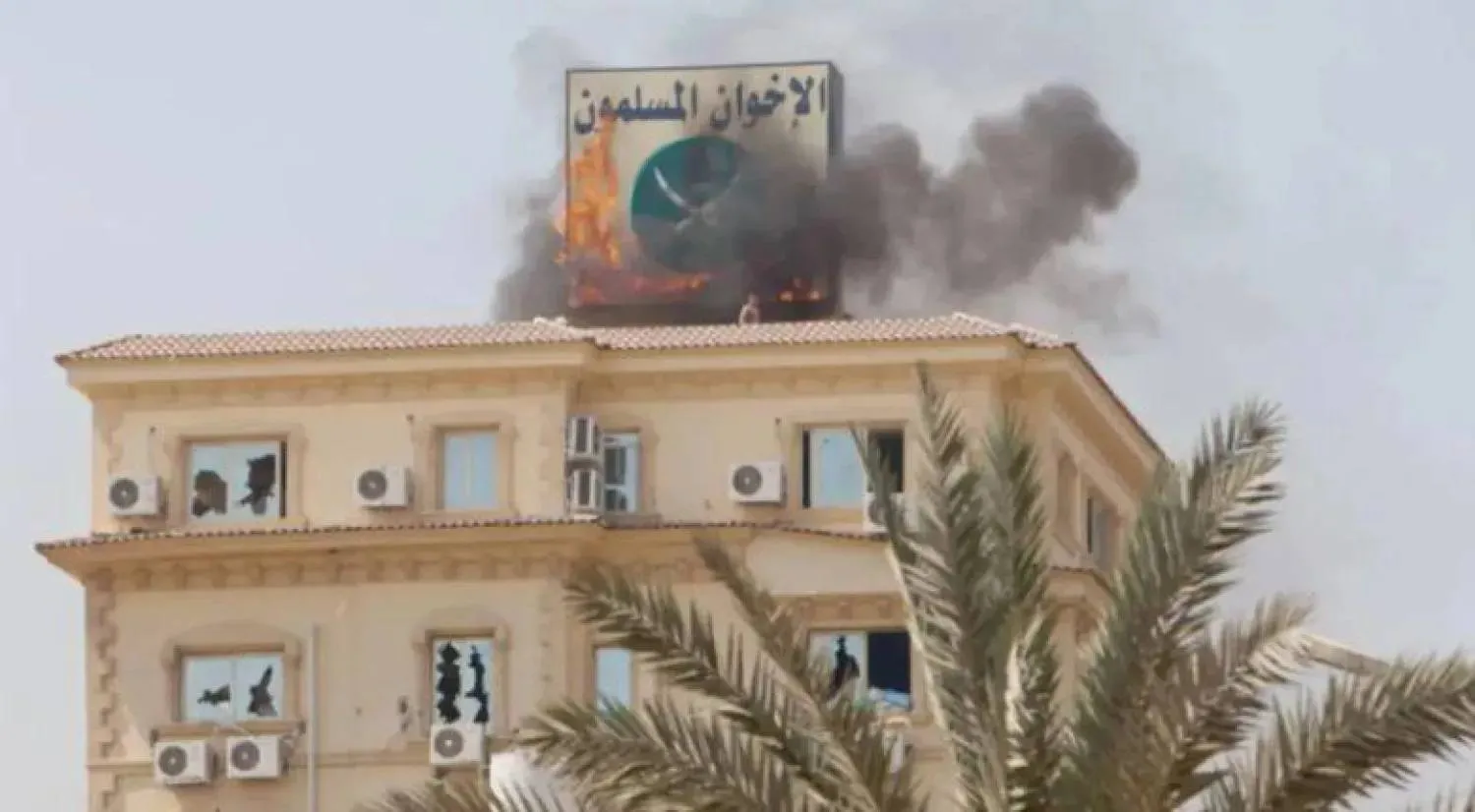
The Muslim Brotherhood’s headquarters after being set ablaze in Cairo in the summer of 2013. (Getty Images)
TT

Western Warnings about Muslim Brotherhood Bolster Egypt’s Crackdown on Group

The Muslim Brotherhood’s headquarters after being set ablaze in Cairo in the summer of 2013. (Getty Images)

US President Donald Trump’s warnings about the Muslim Brotherhood could strengthen Egypt’s efforts to restrict the group’s activities at home and abroad, researchers told Asharq Al-Awsat, following a series of Egyptian and Western measures targeting its networks.

Speaking to Salem News Channel on Thursday, Trump said the Brotherhood posed risks extending to the United States and Europe. Asked whether it or communists were more dangerous, he described both as major threats but suggested the Brotherhood currently posed the greater danger.

Mounir Adib, a researcher specializing in extremist movements and international terrorism, said Trump’s remarks reflected growing Western awareness of transnational networks.

Their significance lay in their timing, as Washington increasingly moved beyond warnings toward legal and financial measures against specific Brotherhood branches, he added.

Adib said the shift reinforced Egypt’s longstanding position that the organization uses institutions and affiliated entities to advance its political objectives.

Hesham al-Naggar, a researcher specializing in jihadist groups, described Trump’s comments as recognition of Egypt’s approach since 2013, although he considered Western measures insufficient.

He said Cairo’s initial efforts to dismantle the Brotherhood domestically and pursue its overseas networks encountered Western resistance, partly because of earlier expectations surrounding political Islam.

Attitudes have since shifted, including among some left-wing intellectuals, he noted.

On November 24, 2025, Trump signed an executive order directing the State and Treasury departments to consider terrorist designations for Brotherhood branches in Egypt, Jordan and Lebanon.

In January, Washington designated the Egyptian and Jordanian branches as Specially Designated Global Terrorists, while the Lebanese branch was also designated a Foreign Terrorist Organization.

The Sudanese Brotherhood received terrorist designations in March.

In May, the Trump administration outlined a counterterrorism strategy focusing on the Brotherhood as what it described as an ideological source of modern jihadist terrorism.

Argentina also designated the Egyptian, Jordanian and Lebanese branches earlier this year, while the European Parliament approved an October 8 resolution calling for a common EU strategy against Brotherhood networks.

Adib said these developments strengthened Cairo’s case for targeting financing channels and overseas operations, but stressed that international cooperation should rely on intelligence, evidence and legal procedures rather than political labels alone.

Al-Naggar said even limited Western measures would reinforce Egypt’s efforts.

Trump’s remarks followed Egypt’s decision to place the Brotherhood permanently on its terrorism list under a final court ruling published in the Official Gazette on Monday, after years of temporary designations.

Several Brotherhood leaders, including Supreme Guide Mohamed Badie, remain imprisoned in cases involving violence, terrorism and murder.

The following day, a Cairo criminal court issued a first-instance ruling placing 35 entities and 36 individuals based in Europe on Egypt’s terrorism lists for five years.

Adib said the next phase could bring closer US-European cooperation in intelligence sharing, monitoring financial flows and reviewing organizations linked to prohibited activities.

Al-Naggar called for a broader international response, including stronger security and intelligence cooperation, arguing that the issue extended beyond the Arab region to global security and stability.


PMF-Led Government Committee Enters Iraq’s Jurf al-Sakhar

Members of the committee in Jurf al-Sakhar on Friday in this photo released by platforms close to the PMF.
TT

PMF-Led Government Committee Enters Iraq’s Jurf al-Sakhar

Members of the committee in Jurf al-Sakhar on Friday in this photo released by platforms close to the PMF.

An Iraqi security committee began investigating suspected fuel smuggling in Jurf al-Sakhar, north of the Babil province, on Friday, amid mounting tensions between the government and Kataib Hezbollah over the area and efforts to bring weapons under state control.

Troops deployed around the area to secure the committee’s entry, but political mediation reportedly halted their advance amid disagreements over how the investigation would proceed.

Footage showed a large military deployment before committee members met commanders believed to be from the pro-Iran Kataib Hezbollah. Sabereen News, an outlet close to armed factions, broadcast a Kataib Hezbollah commander addressing Interior Ministry officers.

Security Media Cell chief Saad Maan denied that political groups or armed factions were represented on the committee, saying it had begun fieldwork early Friday.

A security source told Shafaq News that the committee conducted an initial inspection after agreeing with faction representatives on investigative procedures and field visits.

Prime Minister Ali al-Zaidi formed the committee Thursday, placing it under the Popular Mobilization Forces (PMF). Its members represent the prime minister’s office, intelligence and anti-corruption bodies, the Oil Ministry, security agencies, forensic authorities and the Energy Police.

The November 12 order was signed by Lt. Gen. Abdul Amir al-Shammari, director of the commander-in-chief’s office.

The decision followed a three-hour meeting between al-Zaidi, Badr Organization leader Hadi al-Amiri, PMF chairman Falih al-Fayyadh and chief of staff Abdul Aziz al-Muhammadawi, known as Abu Fadak.

According to Shafaq News, al-Zaidi demanded enforcement of Iraqi law against offenders, while al-Amiri and al-Fayyadh proposed giving the parties concerned time to reorganize and resume dialogue over weapons.

The proposal included continuing negotiations through a four-member committee seeking to resolve disputes and preserve stability.

A government adviser told Asharq Al-Awsat that Baghdad’s changing approach reflected the armed groups’ growing political influence.

“The state is not merely confronting forces that possess weapons; these forces have also become capable of influencing political decision-making,” the adviser said.

The government prioritizes restoring sovereignty without confronting society or its communities, he stressed.

Disputes over Kataib Hezbollah had already disrupted a planned Monday meeting between al-Zaidi and Coordination Framework leaders, while negotiations over bringing weapons under state control had produced no progress.

Separately, Babil Governor Ali Turki, affiliated with Asaib Ahl al-Haq, resigned after publicly denying oil smuggling in Jurf al-Sakhar.

Informed sources said his remarks were made without the federal government’s knowledge or coordination with Asaib’s leadership, prompting movement chief Qais al-Khazali to order his resignation.

Jurf al-Sakhar has been a major armed-faction stronghold since 2014. It is believed to contain military camps, prisons, weapons depots and rocket and drone manufacturing facilities.

Many also believe the area serves as an operations center for Iran’s Revolutionary Guard Corps, an allegation denied by faction representatives and parties in Iraq’s governing coalition.


Lebanese Army Seizes Weapons Cache in Beirut’s Southern Suburbs, Raising Questions about Their Origins

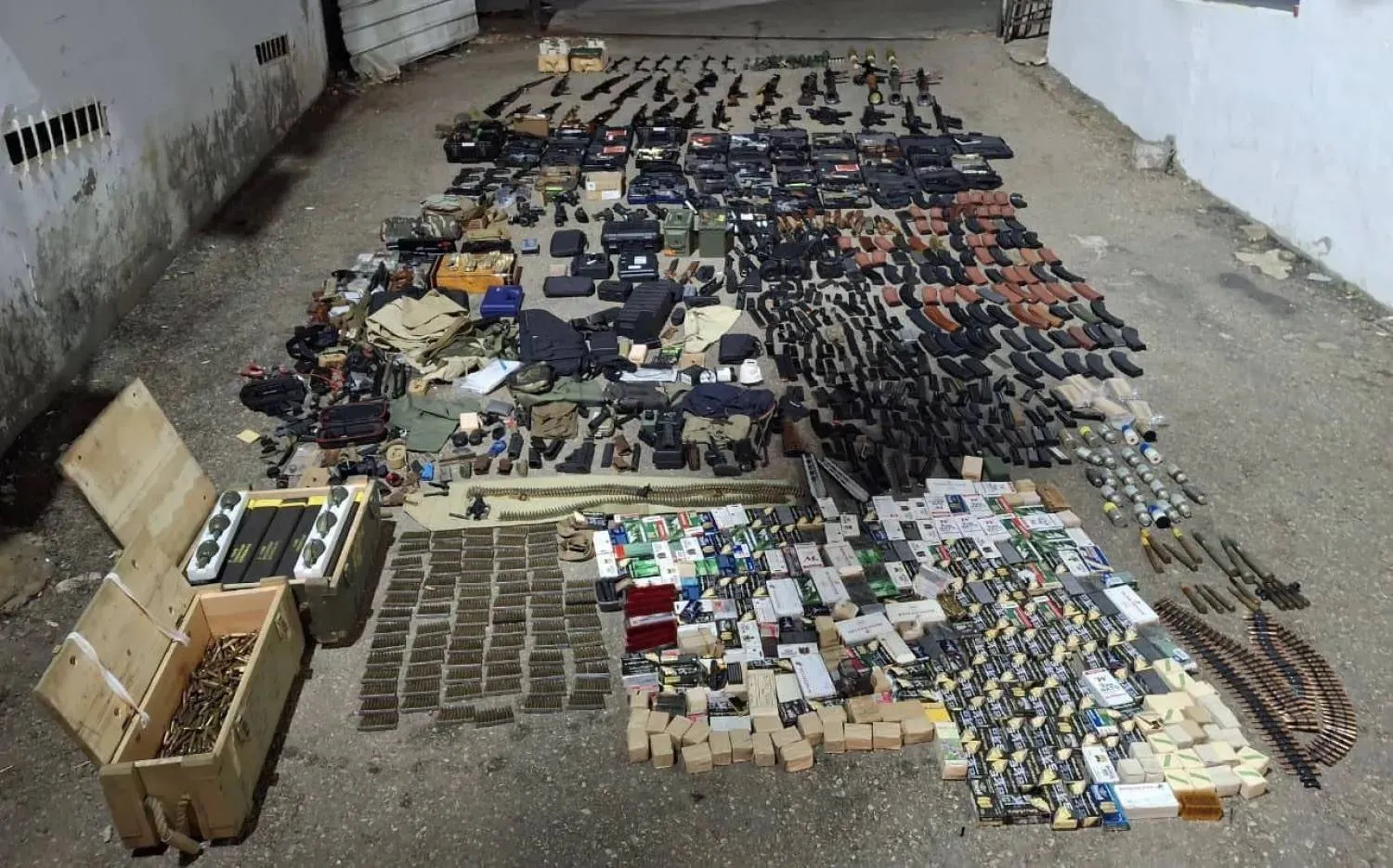
The seized weapons in this photo released by the Lebanese Army.
TT

Lebanese Army Seizes Weapons Cache in Beirut’s Southern Suburbs, Raising Questions about Their Origins

The seized weapons in this photo released by the Lebanese Army.

The Lebanese Army seized a large cache of weapons and ammunition during a raid on a warehouse in Musharrafieh, in Beirut’s southern suburbs.

Although the warehouse does not appear to belong to Hezbollah, the operation drew attention because it took place in the group’s stronghold, reviving debate over the state’s efforts to impose monopoly on arms.

The army said the raid followed “surveillance and monitoring of activities linked to weapons transportation and trafficking.” The seized weapons and ammunition were handed over, and an investigation into a detained suspect was launched under judicial supervision.

The army arrested a Lebanese citizen identified by the initials “A.A.” Its statement did not identify the warehouse’s owner or indicate any organizational affiliation.

According to information obtained by Asharq Al-Awsat, the owner belongs to a family from the Chiyah area and went into hiding immediately after the raid.

Retired Brig. Gen. Fadi Daoud told Asharq Al-Awsat that the raid was a preemptive security operation based on surveillance rather than a reaction to an immediate incident.

He noted that the army’s statement referred to weapons trafficking and transportation without attributing the warehouse to any particular organization.

“We therefore cannot hold any specific party responsible before the investigation is completed,” he said.

Daoud also warned that storing ammunition in the densely populated southern suburbs posed a direct threat to residents.

“This raid carries a dual message: domestically, that weapons fall exclusively under state authority, and internationally, that the army is serious and capable,” he said.

He described the raid as part of a broader process that began with the government’s decision to establish a state monopoly on arms, stressing the importance of awaiting the investigation’s findings and applying the same standards across all regions.

“The army has once again demonstrated its capabilities and will continue this approach consistently and transparently,” he added.

Possible sources

Military affairs observer Mustafa al-Asaad examined photographs of the seized weapons and suggested that the collection was more consistent with the activities of an experienced arms dealer than with preparations for direct military confrontation.

Speaking to Asharq Al-Awsat, he considered it unlikely that the weapons formed part of military shipments sent from Iran to Lebanon.

“The variety of the weapons on display and their different origins indicate that the dealer does not rely on a single source but has an extensive network of contacts allowing him to obtain various types of firearms,” he said.

Al-Asaad noted that some of the pistols visible in the photographs are legally imported into Lebanon through established channels, while others appeared to have been smuggled or stolen from Iraq.

He pointed in particular to several Glock pistols, especially beige-colored models, resembling firearms used by Iraqi military and security agencies, including the police, army and special forces.

They may have reached Lebanon through a smuggling route from Iraq via Syria, although he cautioned that their origins could not be established without examining their serial numbers and identifying marks.

Al-Asaad also drew attention to a gold-plated Kalashnikov rifle, suggesting that some of the dealer’s customers might be collectors seeking distinctive firearms rather than weapons for combat.

He said the variety and quantity of weapons indicated considerable experience and connections within Lebanon’s arms trade, which has operated through established networks for decades.

Grenades and night-vision equipment

Al-Asaad also identified hand grenades and materials that could be used to manufacture explosives, although the quantities visible did not suggest an unusually large stockpile.

The collection included scopes and night-vision equipment used for military purposes but also available on the arms market.

He pointed to small automatic firearms resembling pistols, including models from the Skorpion family, which have historically been used in assassinations, including during the 1980s.

However, he stressed that their presence did not indicate preparations for assassinations, as such weapons could also appeal to collectors.

Al-Asaad compared the cache with arms seized by the Lebanese Army during previous raids in the Bekaa Valley, including rocket launchers and anti-armor weapons more clearly associated with direct military use.

He said that the latest photographs did not show any particularly unusual weapons that would be difficult to obtain on the Lebanese market.