


We Face Famine or Virus: Syria's Displaced Alarmed at Aid Impasse

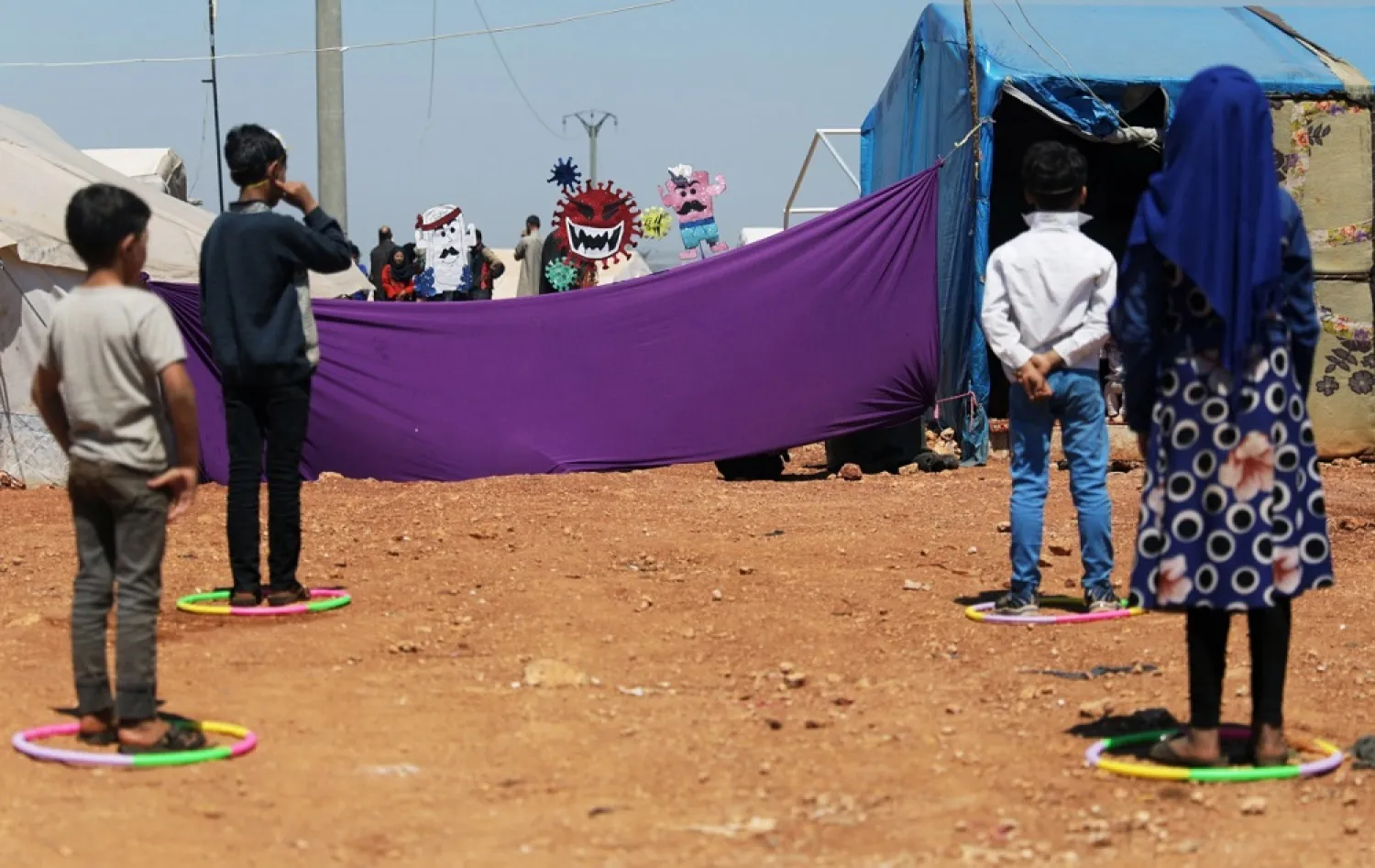
Displaced children attend a puppet show during an event aimed at spreading awareness amid COVID-19 fears, at a camp in the town of Maarat Masrin in Idlib, Syria, on April 14, 2020. (Reuters)
TT

We Face Famine or Virus: Syria's Displaced Alarmed at Aid Impasse

Displaced children attend a puppet show during an event aimed at spreading awareness amid COVID-19 fears, at a camp in the town of Maarat Masrin in Idlib, Syria, on April 14, 2020. (Reuters)

After surviving months of bombardment, Nasr Sultan now fears his 10 children may starve or catch coronavirus as a divided UN holds up a renewal of cross-border humanitarian aid to opposition-held northwest Syria.

A UN Security Council resolution authorizing aid deliveries through the Turkish border expired on Friday as Russia and China vetoed an extension.

The world body's failure to agree on a compromise formula has threatened humanitarian assistance to an estimated 2.8 million people who depend on such handouts.

Germany and Belgium are still working on an initiative to rescue the authorization in place since 2014, with hopes of bringing it to a vote this weekend.

But regime-ally Russia is pushing for reduced access on the grounds of sovereignty, prompting outrage in northwest Syria's Idlib province, which this week recorded its first coronavirus cases.

In a crowded Idlib displacement camp, 45-year-old Nasr said life without aid would plunge into hunger many of those who had already lost their homes in Syria's nine-year war.

"We have abandoned our home, our land and our livelihoods. The aid they give us is all we have," he said from inside his tent near the town of Maaret Misrin.

"If the assistance is scrapped, we will face famine."

'Coronavirus will get us'

The Idlib region, Syria's last major opposition bastion, is home to some three million people, nearly half of whom have been displaced from other regions.

Nasr's family fled their hometown in southern Idlib to safer areas near the border with Turkey after a regime offensive that displaced nearly a million people between December and March.

A truce has stemmed the Russia-backed campaign on Idlib, a region dominated by Hayat Tahrir al-Sham (HTS), an extremist group led by Syria's former al-Qaeda affiliate, and their opposition allies.

Apart from food insecurity, Idlib has recorded at least three cases of COVID-19 since Thursday, sparking fears of a health catastrophe if the pandemic hits overcrowded displacement camps.

The confirmed cases are all medical personnel working in hospitals near the Turkish border.

"If medical assistance is not delivered to the camps, then we will be finished" said Nasr. "The coronavirus will get us."

Abed al-Salam Youssef, also displaced, said camp residents will be more vulnerable to the coronavirus if aid is halted, especially since many will have to venture out to seek food and work.

"How can we commit to confinement inside the camps if people can't even secure their basic daily needs without humanitarian assistance?" he asked.

"Most of the displaced rely entirely on monthly food baskets" distributed by aid groups to survive, Youssef added.

'Politicizing' aid

Save the Children also condemned the UN's failure so far to renew the authorization for aid distribution to the displaced without having to pass through Damascus.

"The border crossings were the only meaningful way for vital humanitarian aid ... to reach families in northwest Syria," it said in a statement.

"If the border crossings are not reinstated, many families will not be able to eat, will not receive healthcare, and will not find shelter" said the charity's CEO, Inger Ashing.

European countries and the US want to maintain two crossings on the Turkish border -- at Bab al-Salama, which leads to the Aleppo region, and Bab al-Hawa, serving Idlib.

An alternative proposal submitted by Russia would keep only the Bab al-Hawa access point open, for one year.

Moscow says more than 85 percent of aid has been going through Bab al-Hawa and that Bab al-Salama can be closed.

In January, Moscow succeeded in reducing the crossing points from four to two, and in limiting the extension to six months.

The International Crisis Group accuses Russia of "politicizing cross-border aid" to Syria and warns that the policy could backfire.

"Continuing to attempt to make a political point at the expense of the most vulnerable could drive Western states to revert to a pre-2014 modus operandi, bypass multilateral mechanisms and deliver aid directly to northern Syria," said its senior Syria analyst, Dareen Khalifa.

Standing in front of his tent in the Maaret Misrin camp, Abed al-Salam fears for the future.

Millions of Syrians will face "a huge catastrophe in front of the eyes of the world", he said.


Libya Says UK to Analyze Black Box from Crash That Killed General

Military personnel carry portraits of the Libyan chief of staff, General Mohamed al-Haddad (2-R), and his four advisers, who were killed in a plane crash in Türkiye, during an official repatriation ceremony at the Ministry of Defense headquarters in Tripoli, Libya, 27 December 2025. (EPA)
TT

Libya Says UK to Analyze Black Box from Crash That Killed General

Military personnel carry portraits of the Libyan chief of staff, General Mohamed al-Haddad (2-R), and his four advisers, who were killed in a plane crash in Türkiye, during an official repatriation ceremony at the Ministry of Defense headquarters in Tripoli, Libya, 27 December 2025. (EPA)

Libya said on Thursday that Britain had agreed to analyze the black box from a plane crash in Türkiye on December 23 that killed a Libyan military delegation, including the head of its army.

General Mohammed al-Haddad and four aides died after a visit to Ankara, with Turkish officials saying an electrical failure caused their Falcon 50 jet to crash shortly after takeoff.

Three crew members, two of them French, were also killed.

The aircraft's black box flight recorder was found on farmland near the crash site.

"We coordinated directly with Britain for the analysis" of the black box, Mohamed al-Chahoubi, transport minister in the Government of National Unity (GNU), said at a press conference in Tripoli.

Haddad was very popular in Libya despite deep divisions between west and east.

Haddad was chief of staff for the Tripoli-based GNU.

Chahoubi told AFP a request for the analysis was "made to Germany, which demanded France's assistance" to examine the aircraft's flight recorders.

"However, the Chicago Convention stipulates that the country analyzing the black box must be neutral," he said.

"Since France is a manufacturer of the aircraft and the crew was French, it is not qualified to participate. The United Kingdom, on the other hand, was accepted by Libya and Turkey."

After meeting the British ambassador to Tripoli on Tuesday, Foreign Minister Taher al-Baour said a joint request had been submitted by Libya and Türkiye to Britain "to obtain technical and legal support for the analysis of the black box".

Chahoubi told Thursday's press briefing that Britain "announced its agreement, in coordination with the Libyan Ministry of Transport and the Turkish authorities".

He said it was not yet possible to say how long it would take to retrieve the flight data, as this depended on the state of the black box.

"The findings will be made public once they are known," Chahoubi said, warning against "false information" and urging the public not to pay attention to rumors.


STC Says Handing over Positions to National Shield Forces in Yemen's Hadhramaut, Mahra

National Shield forces in Hadhramaut. (National Shield forces)
TT

STC Says Handing over Positions to National Shield Forces in Yemen's Hadhramaut, Mahra

National Shield forces in Hadhramaut. (National Shield forces)

Southern Transitional Council (STC) forces in Yemen began on Thursday handing over military positions to the government’s National Shield forces in the Hadhramaut and al-Mahra provinces in eastern Yemen.

Local sources in Hadhramaut confirmed to Asharq Al-Awsat that the handover kicked off after meetings were held between the two sides.

Speaking on condition of anonymity, the sources said the National Shield commanders met with STC leaderships to discuss future arrangements. The sourced did not elaborate, but they confirmed that Emirati armored vehicles, which had entered Balhaf port in Shabwah were seen departing on a UAE vessel, in line with a Yemeni government request.

The National Shield is overseen by Presidential Leadership Council (PLC) Chairman Dr. Rashad al-Alimi.

A Yemeni official described Thursday’s developments as “positive” step towards uniting ranks and legitimacy against a common enemy – the Houthi groups.

The official, also speaking on condition of anonymity, underscored to Asharq Al-Awsat the importance of “partnership between components of the legitimacy and of dialogue to resolve any future differences.”

Meanwhile, on the ground, Yemeni military sources revealed that some STC forces had refused to quit their positions, prompting the forces to dispatch an official to Hadhramaut’s Seiyun city to negotiate the situation.


One Dead as Israeli Forces Open Fire on West Bank Stone-Throwers

Israeli troops during a military operation in the Palestinian village of Qabatiya, near the West Bank city of Jenin, 27 December 2025. (EPA)
TT

One Dead as Israeli Forces Open Fire on West Bank Stone-Throwers

Israeli troops during a military operation in the Palestinian village of Qabatiya, near the West Bank city of Jenin, 27 December 2025. (EPA)

The Israeli military said its forces killed a Palestinian in the occupied West Bank in the early hours on Thursday as they opened fire on people who were throwing stones at soldiers.

Two other people were hit on a main ‌road near the ‌village of Luban ‌al-Sharqiya ⁠in Nablus, ‌the military statement added. It described the people as militants and said the stone-throwing was part of an ambush.

Palestinian authorities in the West Bank said ⁠a 26-year-old man they named as ‌Khattab Al Sarhan was ‍killed and ‍another person wounded.

Israeli forces had ‍closed the main entrance to the village of Luban al-Sharqiya, in Nablus, and blocked several secondary roads on Wednesday, the Palestinian Authority's official news agency WAFA reported.

More ⁠than a thousand Palestinians were killed in the West Bank between October 2023 and October 2025, mostly in operations by security forces and some by settler violence, the UN has said.

Over the same period, 57 Israelis were killed ‌in Palestinian attacks.
