


NZ Mosque Shooter to Represent Himself at Sentencing

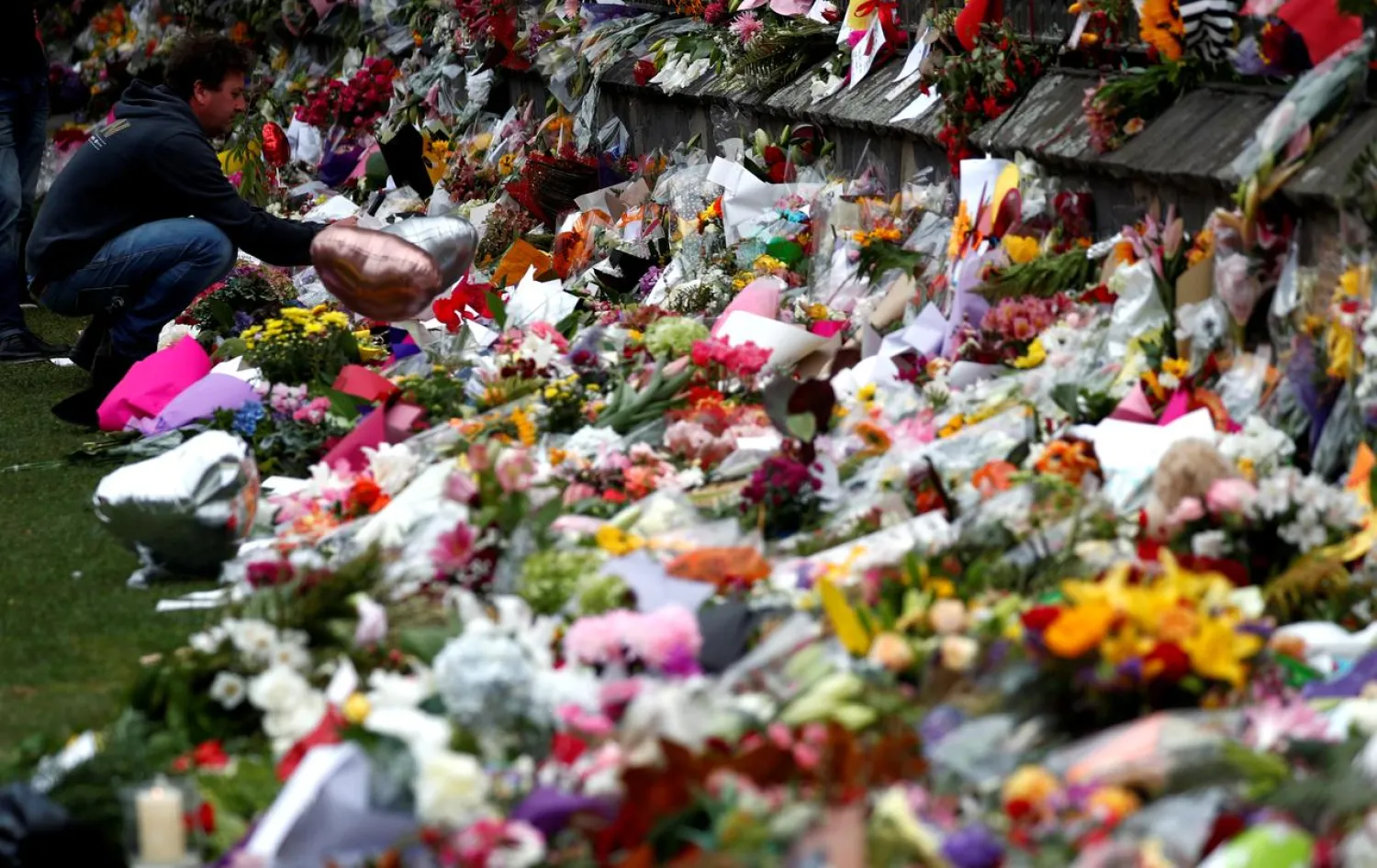
A man places flowers at a memorial site for victims of the mosque shootings at the Botanic Gardens in Christchurch, New Zealand, March 18, 2019. REUTERS/Edgar Su
TT

NZ Mosque Shooter to Represent Himself at Sentencing

A man places flowers at a memorial site for victims of the mosque shootings at the Botanic Gardens in Christchurch, New Zealand, March 18, 2019. REUTERS/Edgar Su

The gunman behind New Zealand's Christchurch mosque shootings sacked his lawyers Monday and opted to represent himself, a month ahead of the sentencing hearing, the court said on Monday.

Australian national Brenton Tarrant will be sentenced on August 24 on 51 murder convictions, 40 of attempted murder and one of terrorism arising from last year's massacre, the worst mass shooting in New Zealand's modern history.

He has pleaded guilty to the charges.

At a pre-sentencing hearing on Monday, High Court judge Cameron Mander allowed Tarrant's lawyers, Shane Tait and Jonathan Hudson, to withdraw from proceedings at the request of their client.

However, the judge ordered "standby counsel" to be available next month in case Tarrant -- who appeared in the Christchurch court via video link from an Auckland prison -- changes his mind.

New Zealand Muslim Association president Ikhlaq Kashkari questioned Tarrant's motives, saying victims could be re-traumatized if the gunman were allowed to spout far-right rhetoric from the dock.

"My first concern when I read this was 'Oh my God, what's this guy up to, is he going to use this as a platform to promote his views and thoughts?'," he told AFP.

"A lot of people are still going through trauma and this was seen as one of those events that would give them closure. I hope it's not going to be something that will trigger more pain instead."

In March 2019, Tarrant gunned down Muslim worshipers during Friday prayers at two Christchurch mosques, live-streaming the killings as he went.

His victims included children, women and the elderly.

The former gym instructor unexpectedly reversed his not-guilty plea in March this year, removing the need for a lengthy trial.

The terror and murder charges all carry life sentences, setting a minimum non-parole period of 17 years while also giving the judge power to imprison without the possibility of release. New Zealand does not have the death penalty.

Survivors and the families of victims will be present during the three-day sentencing hearing and Islamic Women's Council of New Zealand spokeswoman Anjum Rahman said many would not want to hear from Tarrant.

Tarrant's lawyers said there was no "conflict or relationship breakdown" between them and Tarrant, and that the request was consistent with his rights.

"We are not disappointed by Mr, Tarrant's decision,” they said in an emailed statement.



German Court Rejects Palestinian's Claim over Weapons Exports

A view shows the front of the Reichstag building, the seat of the German parliament, the Bundestag, in Berlin, Germany March 5, 2025. REUTERS/Annegret Hilse/File Photo
TT

German Court Rejects Palestinian's Claim over Weapons Exports

A view shows the front of the Reichstag building, the seat of the German parliament, the Bundestag, in Berlin, Germany March 5, 2025. REUTERS/Annegret Hilse/File Photo

Germany's highest court on Thursday threw out a case brought by a Palestinian civilian from Gaza seeking to sue the German government over its weapons exports to Israel.

The complainant, supported by the European Center for Constitutional and Human Rights (ECCHR), had been seeking to challenge export licences for German parts used in Israeli tanks deployed in Gaza.

After his case was rejected by lower courts in 2024 and 2025, he had appealed to the Federal Constitutional Court.

But the court in Karlsruhe dismissed the case, stating that "the complainant has not sufficiently substantiated that the specialized courts misjudged or arbitrarily denied a possible duty to protect him", AFP reported.

While Germany is obliged to protect human rights and respect international humanitarian law, this does not mean the state is necessarily obliged to take specific action on behalf of individuals, the court said.

"It is fundamentally the responsibility of the state authorities themselves to decide how they fulfil their general duty of protection," it added.

The ECCHR called the decision "a setback for civilian access to justice".

"The court acknowledges the duty to protect but only in the abstract and refuses to ensure its practical enforcement," said Alexander Schwarz, co-director of the NGO's International Crimes and Legal Accountability program.

"For people whose lives are endangered by the consequences of German arms exports, access to justice remains effectively closed," he said.

The ECCHR had been hoping for a successful appeal after the Constitutional Court ruled last year that Germany had "a general duty to protect fundamental human rights and the core norms of international humanitarian law, even in cases involving foreign countries".

In that case, two Yemenis had been seeking to sue Berlin over the role of the US Ramstein airbase in a 2012 drone attack.

The complainant was one of five Palestinians who initially brought their case against the German government in 2024.


2 Israelis Charged with Using Classified Military Information to Place Bets

The Israeli Iron Dome air defense system intercepts missiles during an Iranian attack on Tel Aviv, Israel, June 18, 2025. (AP Photo/Leo Correa, File)
TT

2 Israelis Charged with Using Classified Military Information to Place Bets

The Israeli Iron Dome air defense system intercepts missiles during an Iranian attack on Tel Aviv, Israel, June 18, 2025. (AP Photo/Leo Correa, File)

Two Israelis have been charged with using classified military information to place bets on how future events will unfold, Israeli authorities said Thursday, accusing the individuals of “serious security offenses.”

A joint statement by the Israeli Ministry of Defense, domestic security service Shin Bet and police said that a civilian and a reservist are suspected of placing bets on the US-based prediction market Polymarket on future military operations based on information that the reservist had access to, The AP news reported.

Israel’s Attorney General’s Office decided to prosecute the two individuals following a joint investigation by police, military intelligence and other security agencies that resulted in several arrests. The two face charges including bribery and obstruction of justice.

Authorities offered no details on the identity of the two individuals or the reservist's rank or position in the Israeli military but warned that such actions posed a “real security risk” for the military and the Israeli state.

Israel’s public broadcaster Kan had reported earlier that the bets were placed in June ahead of Israel’s war with Iran and that the winnings were roughly $150,000.

Israel's military and security services “view the acts attributed to the defendants very seriously and will act resolutely to thwart and bring to justice any person involved in the activity of using classified information illegally,” the statement said.

The accused will remain in custody until the end of legal proceedings against them, the Prosecutor's Office said.

Prediction markets are comprised of typically yes-or-no questions called event contracts, with the prices connected to what traders are willing to pay, which theoretically indicates the perceived probability of an event occurring.

Their use has skyrocketed in recent years, but despite some eye-catching windfalls, traders still lose money everyday. In the US, the trades are categorized differently than traditional forms of gambling, raising questions about transparency and risk.


WhatsApp Accuses Russia of Trying to Fully Block its Service

FILED - 21 January 2022, Berlin: The icon of Whatsapp is seen on the screen of a smartphone. Photo: Fabian Sommer/Deutsche Presse-Agentur GmbH/dpa
TT

WhatsApp Accuses Russia of Trying to Fully Block its Service

FILED - 21 January 2022, Berlin: The icon of Whatsapp is seen on the screen of a smartphone. Photo: Fabian Sommer/Deutsche Presse-Agentur GmbH/dpa

US messenger app WhatsApp, owned by Meta Platforms, accused authorities in Russia on Thursday of trying to fully block its service in order to drive Russians to a state-owned app, which it alleged was used for surveillance.

"Trying to isolate over 100 million users from private and secure communication is a backwards step and can only lead to less safety for people in Russia," WhatsApp said in a statement.

"We continue to do everything we can ‌to keep users connected."

Some ‌domain names associated with WhatsApp on Thursday disappeared from Russia's ‌national ⁠register of domain ⁠names, meaning that devices inside Russia stopped receiving its IP addresses from the app and that it could be accessed only by using a virtual private network (VPN), Reuters reported.

Roskomnadzor, the state communications regulator, and the Kremlin did not immediately respond to a request for comment.

Roskomnadzor first began restricting WhatsApp and other messenger services in August, making it impossible to complete phone calls on them, accusing the foreign-owned platforms of failing ⁠to share information with law enforcement in fraud and terrorism ‌cases.

It said in December it was taking ‌new measures to gradually restrict the app, which it accused of continuing to violate Russian ‌law and of being a platform used "to organize and carry out terrorist acts ‌on the territory of the country, to recruit their perpetrators and to commit fraud and other crimes."

Since then, many Russians have been able to use WhatsApp only in conjunction with a virtual private network and have switched to using rival messenger apps, though some ‌of those - like Telegram - are also under pressure from the authorities for the same reasons.

In a video published by state ⁠news agency ⁠TASS on Wednesday, Kremlin spokesman Dmitry Peskov said there was a possibility of reaching an agreement if Meta entered into dialogue with the Russian authorities and complied with the law.

"If the corporation (Meta) sticks to an uncompromising position and, I would say, shows itself unready to align with Russian legislation, then there is no chance," Peskov said.

Russian authorities, who also block or restrict social media platforms such as Snapchat, Facebook, Instagram and YouTube, are heavily pushing a state-backed messenger app called MAX, which critics say could be used to track users.

The authorities have dismissed those accusations as false and say MAX, which integrates various government-related services into it, is designed to simplify and improve the everyday lives of citizens.
