China, UAE, US to Send Spacecraft to Mars

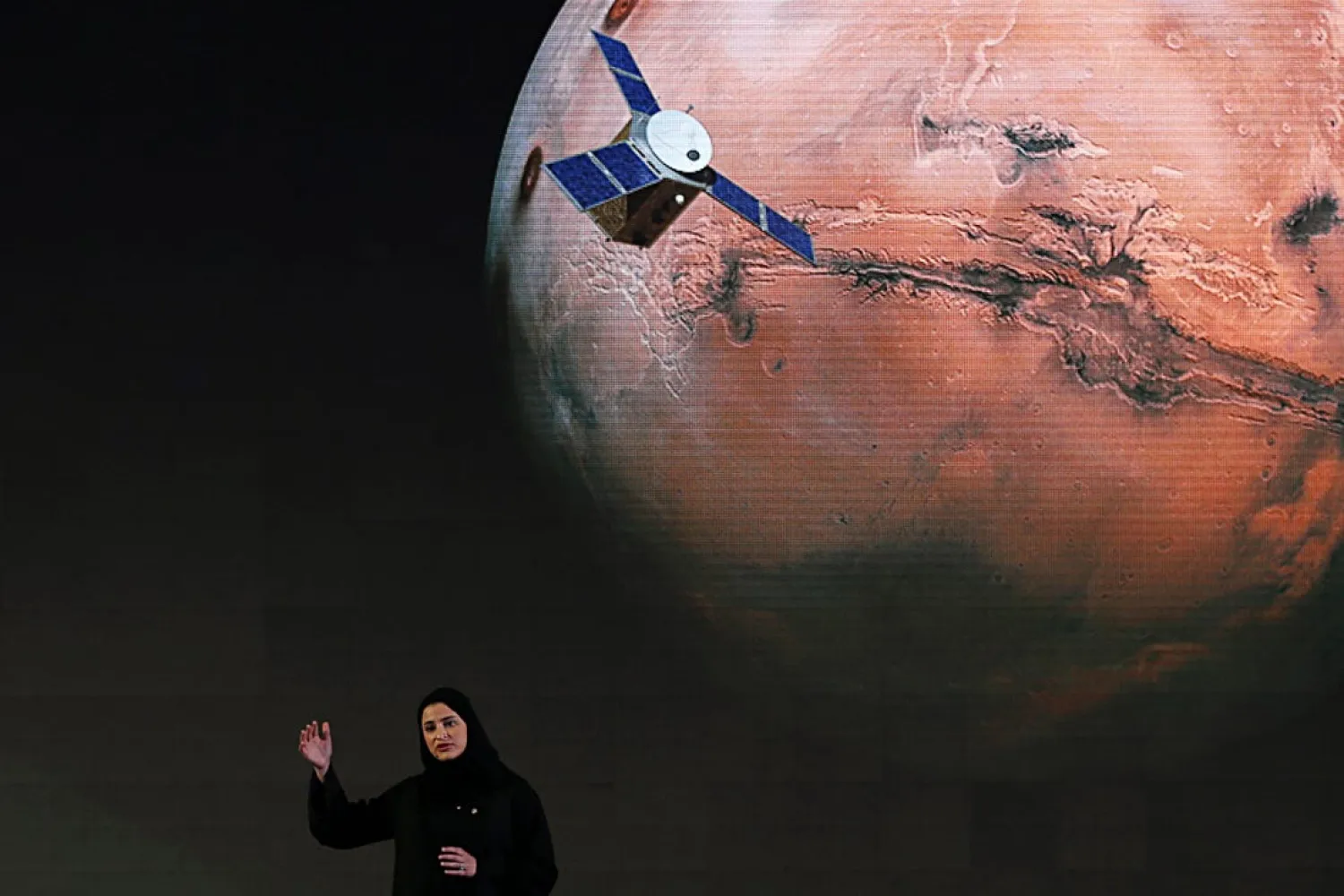
In this Wednesday, May 6, 2015 file photo, Sarah Amiri, deputy project manager of the United Arab Emirates Mars mission, talks about the project named "Hope," or "al-Amal" in Arabic, which is scheduled for launch in 2020, during a ceremony in Dubai, UAE. Three countries - the United States, China and the United Arab Emirates - are sending unmanned spacecraft to the red planet in quick succession beginning in July 2020. (AP Photo/Kamran Jebreili, File)
TT

China, UAE, US to Send Spacecraft to Mars

In this Wednesday, May 6, 2015 file photo, Sarah Amiri, deputy project manager of the United Arab Emirates Mars mission, talks about the project named "Hope," or "al-Amal" in Arabic, which is scheduled for launch in 2020, during a ceremony in Dubai, UAE. Three countries - the United States, China and the United Arab Emirates - are sending unmanned spacecraft to the red planet in quick succession beginning in July 2020. (AP Photo/Kamran Jebreili, File)

Mars is about to be invaded by planet Earth - big time.

Three countries - the United States, China, and the United Arab Emirates - are sending unmanned spacecraft to the red planet in quick succession beginning this week, in the most sweeping effort yet to seek signs of ancient microscopic life while scouting out the place for future astronauts.

The US, for its part, is dispatching a six-wheeled rover the size of a car, named Perseverance, to collect rock samples that will be brought back to Earth for analysis in about a decade.

"Right now, more than ever, that name is so important," NASA Administrator Jim Bridenstine said as preparations went on amid the coronavirus outbreak, which will keep the launch guest list to a minimum.

Each spacecraft will travel more than 300 million miles (483 million kilometers) before reaching Mars next February. It takes six to seven months, at the minimum, for a spacecraft to loop out beyond Earth's orbit and sync up with Mars' more distant orbit around the sun.

Scientists want to know what Mars was like billions of years ago when it had rivers, lakes, and oceans that may have allowed simple, tiny organisms to flourish before the planet morphed into the barren, wintry desert world it is today.

"Trying to confirm that life existed on another planet, it´s a tall order. It has a very high burden of proof," said Perseverance´s project scientist, Ken Farley of Caltech in Pasadena, California.

The three nearly simultaneous launches are no coincidence: The timing is dictated by the opening of a one-month window in which Mars and Earth are in ideal alignment on the same side of the sun, which minimizes travel time and fuel use. Such a window opens only once every 26 months.

Mars has long exerted a powerful hold on the imagination but has proved to be the graveyard for numerous missions. Spacecraft have blown up, burned up, or crash-landed, with the casualty rate over the decades exceeding 50%. China's last attempt, in collaboration with Russia in 2011, ended in failure.

Only the US has successfully put a spacecraft on Mars, doing it eight times, beginning with the twin Vikings in 1976. Two NASA landers are now operating there, InSight and Curiosity. Six other spacecraft are exploring the planet from orbit: three US, two European and one from India.

The United Arab Emirates and China are looking to join the elite club.

The UAE spacecraft, named Amal, which is Arabic for Hope, is an orbiter scheduled to rocket away from Japan on Wednesday, local time, on what will be the Arab world´s first interplanetary mission. The spacecraft, built in partnership with the University of Colorado Boulder, will arrive at Mars in the year the UAE marks the 50th anniversary of its founding.

"The UAE wanted to send a very strong message to the Arab youth," project manager Omran Sharaf said. "The message here is that if the UAE can reach Mars in less than 50 years, then you can do much more. ... The nice thing about space, it sets the standards really high."

Controlled from Dubai, the celestial weather station will strive for an exceptionally high Martian orbit of 13,670 miles by 27,340 miles (22,000 kilometers by 44,000 kilometers) to study the upper atmosphere and monitor climate change.

China will be up next, with the flight of a rover and an orbiter sometime around July 23; Chinese officials aren´t divulging much. The mission is named Tianwen, or Questions for Heaven.

NASA, meanwhile, is shooting for a launch on July 30 from Cape Canaveral.

Perseverance is set to touch down in an ancient river delta and lake known as Jezero Crater, not quite as big as Florida´s Lake Okeechobee. China´s much smaller rover will aim for an easier, flatter target.

To reach the surface, both spacecraft will have to plunge through Mars' hazy red skies in what has been dubbed "seven minutes of terror" - the most difficult and riskiest part of putting spacecraft on the planet.

Jezero Crater is full of boulders, cliffs, sand dunes and depressions, any one of which could end Perseverance´s mission. Brand-new guidance and parachute-triggering technology will help steer the craft away from hazards. Ground controllers will be helpless, given the 10 minutes it takes radio transmissions to travel one-way between Earth and Mars.

Jezero Crater is worth the risks, according to scientists who chose it over 60 other potential sites.

Where there was water - and Jezero was apparently flush with it 3.5 billion years ago - there may have been life, though it was probably only simple microbial life, existing perhaps in a slimy film at the bottom of the crater. But those microbes may have left telltale marks in the sediment layers.

Perseverance will hunt for rocks containing such biological signatures, if they exist.

It will drill into the most promising rocks and store a half-kilogram (about 1 pound) of samples in dozens of titanium tubes that will eventually be fetched by another rover. To prevent Earth microbes from contaminating the samples, the tubes are super-sterilized, guaranteed germ-free by Adam Stelzner, chief engineer for the mission at NASA's Jet Propulsion Laboratory in Pasadena.

"Yep, I´m staking my reputation on it," he said.

While prowling the surface, Perseverance as well as China´s rover will peek below, using radar to locate any underground pools of water that might exist. Perseverance will also release a spindly, 4-pound (1.8-kilogram) helicopter that will be the first rotorcraft ever to fly on another planet.

Perseverance's cameras will shoot color video of the rover´s descent, providing humanity´s first look at a parachute billowing open at Mars, while microphones capture the sounds.

The rover will also attempt to produce oxygen from the carbon dioxide in the thin Martian atmosphere. Extracted oxygen could someday be used by astronauts on Mars for breathing as well as for making rocket propellant.

NASA wants to return astronauts to the moon by 2024 and send them from there to Mars in the 2030s. To that end, the space agency is sending samples of spacesuit material with Perseverance to see how they stand up against the harsh Martian environment.

The tab for Perseverance´s mission, including the flight and a minimum two years of Mars operations, is close to $3 billion. The UAE's project costs $200 million, including the launch but not mission operations. China has not disclosed its costs. Europe and Russia dropped plans to send a life-seeking rover to Mars this summer after falling behind in testing and then getting slammed by COVID-19.

Perseverance's mission is seen by NASA as a comparatively low-risk way of testing out some of the technology that will be needed to send humans to the red planet and bring them home safely.

"Sort of crazy for me to call it low risk because there´s a lot of hard work in it and there are billions of dollars in it," Farley said. "But compared to humans, if something goes wrong, you will be very glad you tested it out on a half-kilogram of rock instead of on the astronauts."


An Iconic Puzzle Comes Home as Production of the Rubik’s Cube Returns to Hungary

Hungarian architect and inventor Ernő Rubik attends the opening event of Rubik's Cube production line of the Jasz-Plasztik plastic processing company in Jaszbereny, Hungary, 10 November 2026. (EPA)
TT

An Iconic Puzzle Comes Home as Production of the Rubik’s Cube Returns to Hungary

Hungarian architect and inventor Ernő Rubik attends the opening event of Rubik's Cube production line of the Jasz-Plasztik plastic processing company in Jaszbereny, Hungary, 10 November 2026. (EPA)

More than half a century ago, a Hungarian architect, sculptor and professor invented what would become one of the world's most popular and beloved puzzles whose appeal has spanned generations: the colorful, mind-bending, six-sided Rubik's Cube.

Now, after selling more than half a billion units and becoming a worldwide cultural touchstone, production of the cube is returning to Hungary, where its inventor, Ernő Rubik, first conceived of the iconic object that bears his name.

Hungary “is the home of the cube. The cube was born here,” Rubik, 82, said on Tuesday at the opening of a new, fully automated Rubik's Cube production line in the Hungarian city of Jászberény.

The journey of the Rubik's Cube began in 1974, when Rubik was teaching design at the Academy of Applied Arts and Design in Budapest. Seeking to create a three-dimensional object that was “infinite,” he said, he completed a prototype — then made of wood — of a cube that could rotate on multiple axes and was made up of 27 blocks.

Recognizing its consumer value, Rubik soon began producing more of the puzzles. Beginning in 1977, an initial 5,000 units of what was then called the “Magic Cube” were sold at specialty shops in the Hungarian capital.

The invention — or what Rubik prefers to describe as a “discovery” — gained popularity, and after having difficulties procuring materials for the cubes in then-socialist Hungary, he realized: “We were not prepared for that size of production ... We can’t fulfill the needs of the market worldwide.”

The cube was licensed to a British and then a US toy company, and its production was moved abroad. By the early 1980s, its popularity had exploded in what Rubik called “the first big wave,” in which he said 200 million units were sold between 1980 and 1983.

While sales of the cube dipped after its initial success, it still attracts plenty of users eager to try their hand at solving the puzzle. Millions are sold every year.

At the new production line in Hungary, a series of robotic arms assembles the cubes and tests them for functionality and durability — a level of automation Rubik said was “very different” than in the early days when the cubes were assembled by hand.

The new line in Jászberény plans to produce 1 million cubes annually.

Steve Radewych, a senior vice president with Canadian toy company Spin Master, which owns the Rubik's Cube trademark, said at Tuesday's opening that the theme of the day was: “Back to its roots: The cube comes home.”

“Ernő, your discovery is more than a toy,” Radewych told Rubik. “It's a global social phenomenon.”

Radewych noted the “incredible staying power” of the Rubik's Cube, and the fact that the puzzle continues to hold the fascination of young people even today.

“The cube represents an intellectual journey, a symbol of intelligence, problem-solving and cognitive discipline,” he added, which “has brought joy — and frustration — to many generations.”

The cube has enjoyed another surge in popularity in recent years as global competitions have proliferated, measuring who can solve the puzzle the fastest.

The current record, set only last month in China by nine-year-old Xuanyi Geng, is 2.51 seconds, according to the World Cube Association, which organizes and certifies competitions across the world.

Rubik, who does not consider himself a speed competitor, said that for him, the cube represents a “transformable sculpture,” the place where art and engineering meet and users can manipulate and change the cube in nearly endless variations.

“If you are doing something, creating something, you have the chance to do something that is meaningful — that’s one part — and beautiful,” he said.


SpaceX Starship Test to Attempt First-Ever Spaceship ‘Catch'

SpaceX's mega rocket Starship is stacked and prepared for a test flight from Starbase, Texas, Thursday, Nov. 12, 2026. (AP)
TT

SpaceX Starship Test to Attempt First-Ever Spaceship ‘Catch'

SpaceX's mega rocket Starship is stacked and prepared for a test flight from Starbase, Texas, Thursday, Nov. 12, 2026. (AP)

Elon Musk's SpaceX was poised Friday to carry out its latest test of the world's biggest and most powerful rocket, the Starship, with plans for a groundbreaking "catch" of the spaceship following a day in orbit.

A successful capture of the Starship upper stage would mark a significant milestone in the space industry's decades-long pursuit of fully reusable spacecraft that can drastically reduce mission costs and make frequent travel possible.

"If successful, this will mark the first full recovery of an orbital launch system and a breakthrough moment in making Starship a reliable, rapidly reusable rocket," SpaceX said.

For the 15th Starship test flight Friday, SpaceX aims to recover both stages of the massive 124-meter (407-foot) launch vehicle.

The company has caught the booster, dubbed Super Heavy, on three previous occasions, with the first stage descending vertically back to the launch site shortly after blastoff and nestling into mechanical "chopstick" arms.

It will now attempt to do the same with the spaceship. Some versions of the vessel are designed to launch internet satellites and data centers into orbit, while others will be made to ferry people to the Moon and Mars.

A spacecraft that can be fully reused is the "Holy Grail" of the space industry, said Clayton Swope, an aerospace expert at the Center for Strategic and International Studies.

"No one's really been able to do that so far," he said. "People have been trying to do that since the (NASA) space shuttle. But the space shuttle ended up being kind of a compromise because a lot of the vehicle wasn't reusable."

Reusing the Starship spacecraft would require the vessel to withstand the extreme heat of reentering Earth's atmosphere and then return to service without extensive refurbishment.

- Refueling challenge -

Musk, the world's richest person, has already revolutionized the space sector with the partially reusable Falcon rockets, which are regularly employed to launch satellites and carry astronauts to the International Space Station.

The Starship project, however, has been plagued by years-long delays as SpaceX grapples with novel engineering challenges -- even as NASA is counting on the spaceship to serve as a lunar lander for its Artemis program.

Other technical challenges include transferring fuel to Starship in orbit -- a requirement for any journey to the Moon or Mars.

Following SpaceX's high-profile stock market debut in June, the company carried out the first orbital flight of Starship in September, though the mission was cut short due to an engine issue.

It is also investing heavily in additional launch sites for its mega-rocket in Louisiana and Florida.

- Complex capture -

Friday's launch is scheduled to take place at SpaceX's "Starbase" in southern Texas at 4:45 pm (2245 GMT).

Following liftoff and the mid-air separation of the two stages, SpaceX plans to bring Super Heavy back to Earth six and a half minutes later, catching it at the launch site on the Gulf of Mexico coastline.

The spaceship will continue to reach Earth's orbit, where it will deploy 26 satellites into Musk's Starlink satellite internet constellation that has become a major revenue stream for SpaceX.

It will then circle the planet 14 times, before returning 22 hours later and -- SpaceX hopes -- descending safely into the chopstick arms.

This capture attempt is more complex than that of the booster, as the spaceship will be descending much faster and from a much greater altitude.

SpaceX has said it would proceed with these maneuvers only if conditions are optimal, and in the past has made last-minute changes to test flights under Musk's "fail fast" strategy of learning through crashes, explosions and other mishaps.

As of late Thursday, the US Federal Aviation Administration had not yet given its final approval for the test flight.


Delhi Overtakes Lahore as World’s Most Polluted City as Air Quality Drops

Traffic moves on a smoggy morning as air pollution spikes in New Delhi, India, November 13, 2026. (Reuters)
TT

Delhi Overtakes Lahore as World’s Most Polluted City as Air Quality Drops

Traffic moves on a smoggy morning as air pollution spikes in New Delhi, India, November 13, 2026. (Reuters)

India's capital Delhi overtook Lahore in Pakistan to become the world's most polluted city on Friday, with air quality reaching hazardous levels and visibility dropping as smog blanketed the city of 20 million people.

Air quality index (AQI) in Delhi was "hazardous" at 334, making ‌it the ‌most polluted global major ‌city, ⁠according to Swiss group ⁠IQAir, which measures air quality levels based on the concentration of toxins.

An AQI reading up to 50 is considered good with little or no ⁠health risk.

India's official ‌Central Pollution ‌Control Board pegged the AQI higher at ‌403 and rated it "severe".

The ‌Swiss and Indian readings vary due to the different AQI scales and methodologies used to calculate and ‌classify air pollution levels.

Cars and motorcycles emerged from dense ⁠smog, ⁠which also appeared to obscure streetlights on the city's main roads, videos from news agency ANI showed.

Pollution is a seasonal problem in many parts of northern India and neighboring Pakistan, as the cold, heavy air of winter traps vehicle emissions, construction dust and smoke from agricultural burning.