

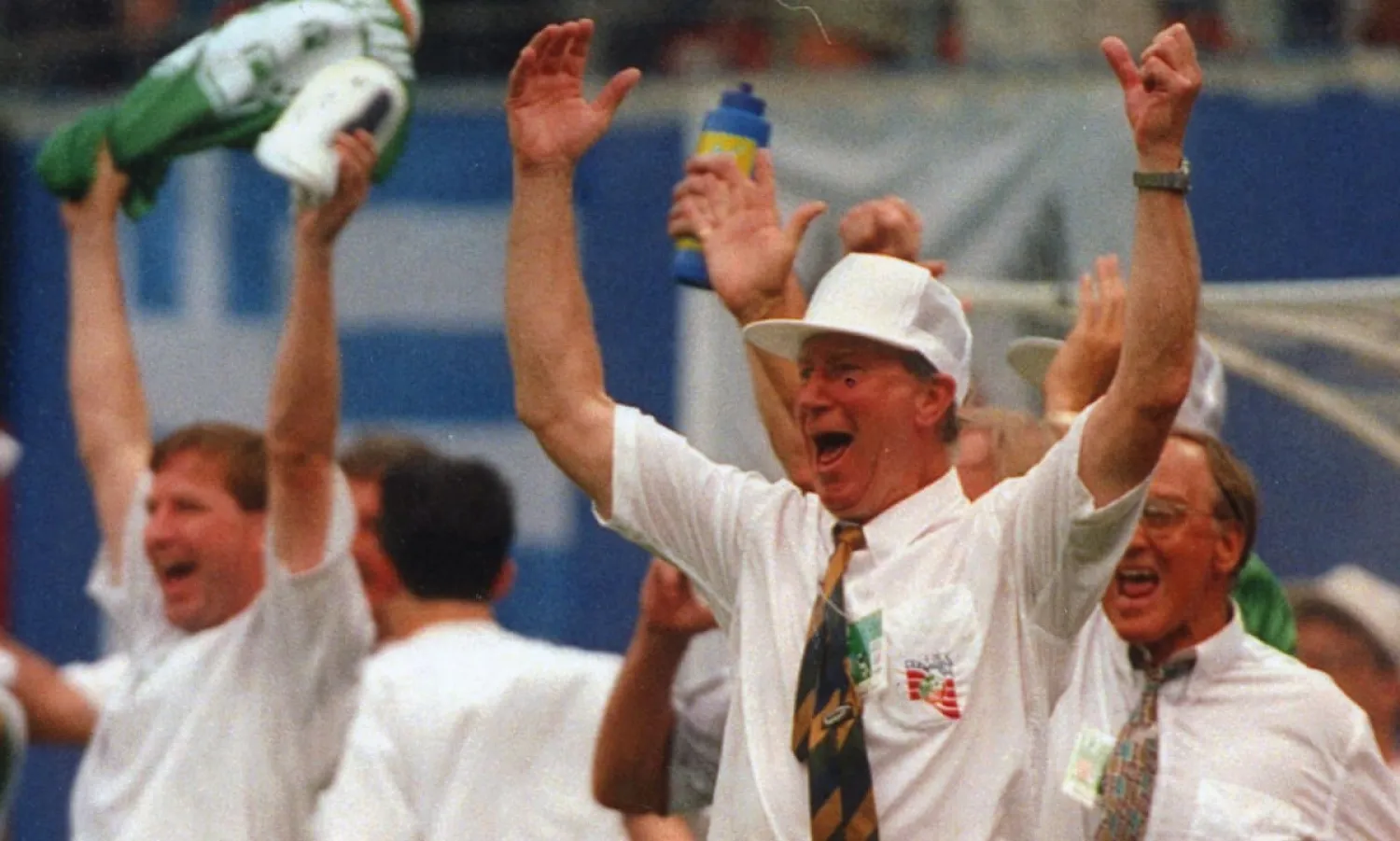

Jack Charlton: An Exceptional Leader Who Had Ireland Dancing in the Streets

Jack Charlton
Jack Charlton
TT

Jack Charlton: An Exceptional Leader Who Had Ireland Dancing in the Streets

Jack Charlton
Jack Charlton

Jack Charlton was to the Republic of Ireland what Pelé was to Brazil. He defined the national team to the world, establishing a style against which all of the country’s sides since have been measured, for better or worse. Charlton, Ireland’s first foreign manager, even helped to alter society.

The beauty of a game depends on the beholder. For nearly 10 years Charlton’s Ireland were hard to watch and harrowing to play against, yet they gave unprecedented joy to millions. He was fortunate that during his reign Ireland had some of the greatest players in their history but it took an exceptional leader to rally them. The manager, a surprising appointment, brought a charisma and a clarity of vision that had been missing.

From the start he showed he would do it his way. At his introduction in Dublin in February 1986, Charlton stormed out after arguing with a journalist and upbraiding the FAI’s general secretary. “If points have to be made,” he later explained, “they are more effectively made on day one.” His manner, like his style of play, split opinion but had the merit of being unambiguous. Players and spectators had to choose whether to join the ride or stay away.

Barely 15,000 fans attended his first match, a 1-0 home friendly defeat by Wales, but by the time of his departure he had earned honorary citizenship after leading the country to two World Cups and a European Championship, inspiring unheard of public jubilation and a cultural expansion.

The celebrations are more memorable than the matches. Charlton unapologetically preached a strategy based on long balls and relentless harassment of opponents. It was not high-brow but it was well thought out. Every player knew his role and if he did not perform it to Charlton’s liking he was ditched, no matter his stature. Liam Brady, an all-time Ireland great, was humiliatingly hauled off 35 minutes into what turned out to be his final international, a friendly against West Germany.

Against Scotland at Hampden Park in 1987, he fielded an unorthodox lineup and achieved Ireland’s most significant away win for nearly 40 years, paving the way for Ireland’s first appearance at a major tournament.

Euro 88 began with an extraordinary triumph against their oldest rivals, England, the country with whom Charlton had won the World Cup as a player but whose Football Association had never given him the courtesy of a reply when he applied for the position of manager after the departure of Don Revie, once his mentor at Leeds. Ray Houghton’s winning goal served as payback and a new dawn.

Charlton’s tactics made even the best teams uncomfortable but his greatest achievement was to get his players to implement his plan with gusto even though many of them were asked to play against the instincts that had made them successful at club level, from John Aldridge being converted from a goal-getter to a ball-fetcher, Ronnie Whelan being made more a runner than a passer and Paul McGrath, like Mark Lawrenson before him, being recast as an outstanding midfielder rather than a world-class center-back. Such players enjoyed playing under Charlton because, as much as his system was rigid and the FAI’s support often shambolic, reporting for international duty felt like going to a theme park. There was a giddiness around the Boys in Green.

While other teams were cloistered away, Ireland’s players were allowed to party in the same pubs and clubs frequented by fans. When they trained it was with a definite purpose but little sophistication: their preparation for the anticipated heat of the 1990 World Cup in Italy involved running around wearing three tracksuits and a big overcoat.

“Under Jack we were mostly ramshackle and part of what made us tick was the disorganization and the joy we got from pretending to the world that we weren’t to be taken seriously,” Niall Quinn wrote in his autobiography.

Being seen to work hard and have fun, while gaining results, made them lovable. A nation was happy to identify with them.

That identification also had liberating implications. Since long before Charlton’s arrival football had been the people’s game in Ireland, especially in urban areas, but many in authority – in schools and churches – had denied that reality, insisting football was an impostor and Gaelic sports were the only true mode of Irish expression. That lie was exposed in the Charlton years, impossible to uphold when the whole country stopped to watch the team play and poured into the streets to welcome them home.

The team’s popularity helped to propagate a more inclusive definition of Irishness in other ways. Charlton was not the first manager to recruit foreign-born players with Irish ancestry but he did so more than any other. There were some heckles about players with English accents but most of the sneers about “plastic Paddies” came from the British media. Generally in Ireland the foreign-born players who chose to represent the country were embraced as sons of the diaspora, especially as the spirit with which they performed invalidated allegations of opportunism.

In later years decisions by Jack Grealish and Declan Rice triggered a sad and hypocritical narrowing of some minds in Ireland but Charlton’s side were seen mostly as every bit as Irish as the London‑born Shane MacGowan, whose band, the Pogues, provided the soundtrack to many a hooley.

With the fairytale of New York in Ireland’s opening match of the 1994 World Cup, they reached their sporting and cultural pinnacle. The Big Apple practically became the capital of Ireland as millions tried to get tickets for a meeting in the Giants Stadium with Italy, another country that had a huge exclave in the US. In the end there were far more Irish in the crowd of 75,000 and Houghton again ignited sessions that are still talked about today.

Ireland did not win another game at USA 94, where they ultimately suffered from the heat and a lack of quality in a couple of key areas. While Charlton benefited from a vintage crop of players, he never had a great goalkeeper and suggestions he should have delivered even better results are not strengthened by the fact Ireland’s best performances – matches in which his side outplayed decent opponents instead of ambushing them – yielded only draws: with the USSR at Euro 88 and away against England and Poland in the qualifiers for Euro 92.

Charlton would have liked to have concluded his reign by taking his team to a tournament in his native country but Ireland, with precious players missing or waning, failed to reach Euro 96.

With more limited players Charlton’s style looked more limited. He showed little inclination to evolve, whereas expectations had changed. After defeat by the Netherlands in a play-off in December 1995, fans sang him a ballad that felt like farewell. Then, with a lack of sentiment that surprised Charlton but of which he might have grudgingly approved, the FAI sacked him just short of his 10th anniversary.

(The Guardian)


Hospital: Vonn Had Surgery on Broken Leg from Olympics Crash

This handout video grab from IOC/OBS shows US Lindsey Vonn crashing during the women's downhill event at the Milano Cortina 2026 Winter Olympic Games on February 8, 2026. (Photo by Handout / various sources / AFP)
TT

Hospital: Vonn Had Surgery on Broken Leg from Olympics Crash

This handout video grab from IOC/OBS shows US Lindsey Vonn crashing during the women's downhill event at the Milano Cortina 2026 Winter Olympic Games on February 8, 2026. (Photo by Handout / various sources / AFP)

Lindsey Vonn had surgery on a fracture of her left leg following the American's heavy fall in the Winter Olympics downhill, the hospital said in a statement given to Italian media on Sunday.

"In the afternoon, (Vonn) underwent orthopedic surgery to stabilize a fracture of the left leg," the Ca' Foncello hospital in Treviso said.

Vonn, 41, was flown to Treviso after she was strapped into a medical stretcher and winched off the sunlit Olimpia delle Tofane piste in Cortina d'Ampezzo.

Vonn, whose battle to reach the start line despite the serious injury to her left knee dominated the opening days of the Milano Cortina Olympics, saw her unlikely quest halted in screaming agony on the snow.

Wearing bib number 13 and with a brace on the left knee she ⁠injured in a crash at Crans Montana on January 30, Vonn looked pumped up at the start gate.

She tapped her ski poles before setting off in typically aggressive fashion down one of her favorite pistes on a mountain that has rewarded her in the past.

The 2010 gold medalist, the second most successful female World Cup skier of all time with 84 wins, appeared to clip the fourth gate with her shoulder, losing control and being launched into the air.

She then barreled off the course at high speed before coming to rest in a crumpled heap.

Vonn could be heard screaming on television coverage as fans and teammates gasped in horror before a shocked hush fell on the packed finish area.

She was quickly surrounded by several medics and officials before a yellow Falco 2 ⁠Alpine rescue helicopter arrived and winched her away on an orange stretcher.


Meloni Condemns 'Enemies of Italy' after Clashes in Olympics Host City Milan

Demonstrators hold smoke flares during a protest against the environmental, economic and social impact of the Milano-Cortina 2026 Winter Olympics in Milan, Italy, February 7, 2026. REUTERS/Kevin Coombs
TT

Meloni Condemns 'Enemies of Italy' after Clashes in Olympics Host City Milan

Demonstrators hold smoke flares during a protest against the environmental, economic and social impact of the Milano-Cortina 2026 Winter Olympics in Milan, Italy, February 7, 2026. REUTERS/Kevin Coombs

Italian Prime Minister Giorgia Meloni has condemned anti-Olympics protesters as "enemies of Italy" after violence on the fringes of a demonstration in Milan on Saturday night and sabotage attacks on the national rail network.

The incidents happened on the first full day of competition in the Winter Games that Milan, Italy's financial capital, is hosting with the Alpine town of Cortina d'Ampezzo.

Meloni praised the thousands of Italians who she said were working to make the Games run smoothly and present a positive face of Italy.

"Then ⁠there are those who are enemies of Italy and Italians, demonstrating 'against the Olympics' and ensuring that these images are broadcast on television screens around the world. After others cut the railway cables to prevent trains from departing," she wrote on Instagram on Sunday.

A group of around 100 protesters ⁠threw firecrackers, smoke bombs and bottles at police after breaking away from the main body of a demonstration in Milan.

An estimated 10,000 people had taken to the city's streets in a protest over housing costs and environmental concerns linked to the Games.

Police used water cannon to restore order and detained six people.

Also on Saturday, authorities said saboteurs had damaged rail infrastructure near the northern Italian city of Bologna, disrupting train journeys.

Police reported three separate ⁠incidents at different locations, which caused delays of up to 2-1/2 hours for high-speed, Intercity and regional services.

No one has claimed responsibility for the damage.

"Once again, solidarity with the police, the city of Milan, and all those who will see their work undermined by these gangs of criminals," added Meloni, who heads a right-wing coalition.

The Italian police have been given new arrest powers after violence last weekend at a protest by the hard-left in the city of Turin, in which more than 100 police officers were injured.


Liverpool New Signing Jacquet Suffers 'Serious' Injury

Soccer Football - Ligue 1 - RC Lens v Stade Rennes - Stade Bollaert-Delelis, Lens, France - February 7, 2026  Stade Rennes' Jeremy Jacquet in action REUTERS/Benoit Tessier
Soccer Football - Ligue 1 - RC Lens v Stade Rennes - Stade Bollaert-Delelis, Lens, France - February 7, 2026 Stade Rennes' Jeremy Jacquet in action REUTERS/Benoit Tessier
TT

Liverpool New Signing Jacquet Suffers 'Serious' Injury

Soccer Football - Ligue 1 - RC Lens v Stade Rennes - Stade Bollaert-Delelis, Lens, France - February 7, 2026  Stade Rennes' Jeremy Jacquet in action REUTERS/Benoit Tessier
Soccer Football - Ligue 1 - RC Lens v Stade Rennes - Stade Bollaert-Delelis, Lens, France - February 7, 2026 Stade Rennes' Jeremy Jacquet in action REUTERS/Benoit Tessier

Liverpool's new signing Jeremy Jacquet suffered a "serious" shoulder injury while playing for Rennes in their 3-1 Ligue 1 defeat at RC Lens on Saturday, casting doubt over the defender’s availability ahead of his summer move to Anfield.

Jacquet fell awkwardly in the second half of the ⁠French league match and appeared in agony as he left the pitch.

"For Jeremy, it's his shoulder, and for Abdelhamid (Ait Boudlal, another Rennes player injured in the ⁠same match) it's muscular," Rennes head coach Habib Beye told reporters after the match.

"We'll have time to see, but it's definitely quite serious for both of them."
Liverpool agreed a 60-million-pound ($80-million) deal for Jacquet on Monday, but the 20-year-old defender will stay with ⁠the French club until the end of the season.

Liverpool, provisionally sixth in the Premier League table, will face Manchester City on Sunday with four defenders - Giovanni Leoni, Joe Gomez, Jeremie Frimpong and Conor Bradley - sidelined due to injuries.
