

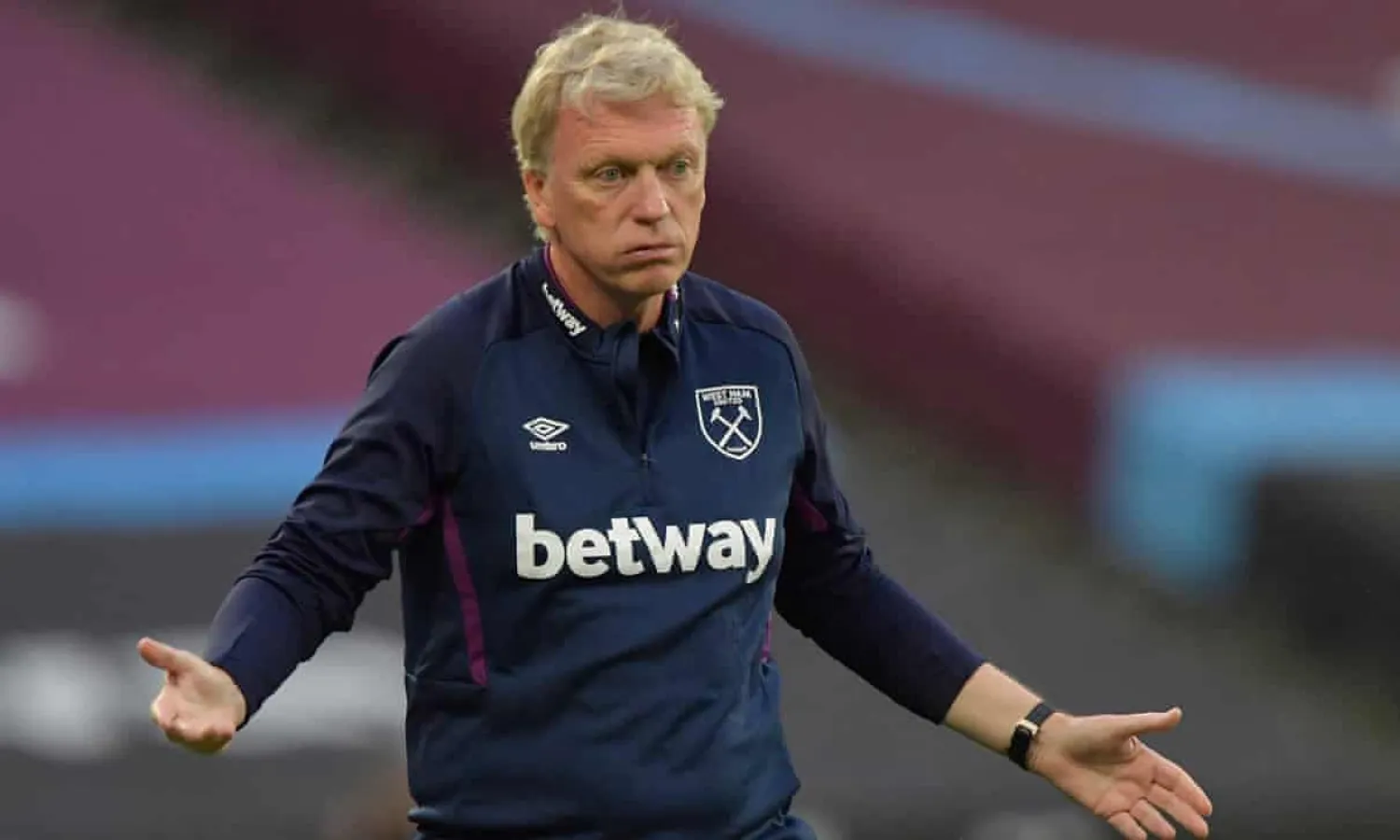

David Moyes's Sorry Sunderland Saga Bodes Ill for West Ham

David Moyes saw his West Ham side gain a vital victory against Chelsea but questions remain over whether he is the best person to lead the club. Photograph: Arfa Griffiths/West Ham United FC/Getty Images
TT

David Moyes's Sorry Sunderland Saga Bodes Ill for West Ham

David Moyes saw his West Ham side gain a vital victory against Chelsea but questions remain over whether he is the best person to lead the club. Photograph: Arfa Griffiths/West Ham United FC/Getty Images

Perhaps this time the Ferryman will not accept the fare. Wednesday’s unlikely victory over Chelsea, allied to the abjection of Norwich and Bournemouth and the struggles of Aston Villa and Watford, means West Ham may survive this season, but that doesn’t mean there aren’t major questions for the club to answer, foremost among them who should be their manager.

Wednesday’s Premier League game turned out to be a clash of two managerial flaws, the inability of Frank Lampard sides to defend set‑pieces or counterattacks winning out over the tendency of David Moyes sides to drop deeper and deeper, particularly when they have something to defend. The victory may end up being decisive, but there can be no long-lasting sense of wellbeing.

Since Moyes’s return to the club at the end of last year, West Ham have picked up 11 points from 13 games. To point out the club are badly run is true, but the return of Moyes after the dalliance with Manuel Pellegrini is a part of that.

In their penultimate game of the 2015-16 season, Sunderland beat Everton 3-0 to seal yet another great escape. It was their last great night. Sam Allardyce danced on the pitch, downed two bottles of lager during his press conference and carried on drinking with the club legend Jim Montgomery in the bar at the nearby Hilton Garden Inn.

Sunderland ended that season with a run of 11 games when they lost once, but, more than that, three of Allardyce’s January signings – Lamine Koné, Jan Kirchhoff and Wahbi Khazri – had made an impact and there was, for the first time in a long time, a sense Sunderland had not only survived but also had a clear vision of where they were going.

Four months later, Sunderland played Everton at home again, in their fourth game of the new season. This time they lost 3-0 and the mood couldn’t have been more different. Khazri had been sidelined. Koné, who had scored twice in the May game and had been well on the way to cult status, played in a fug of disillusionment. Papy Djilobodji and Didier Ndong had inexplicably been signed; Yann M’Vila, despite an impressive year on loan, inexplicably hadn’t.

Nobody paid a bigger price for England’s collapse against Iceland in the Euros than Sunderland. Allardyce had already been chuntering about a lack of transfer funds when Roy Hodgson was ousted, but he was never going to turn the England job down. So Sunderland turned to Moyes.

The line between realism and negativity is fine, but Moyes very quickly slipped to the wrong side of it. Before the Everton defeat, he gave an extraordinarily pessimistic interview. Not unreasonably, fans asked what had changed since the last time they had played Everton, how a boisterous 3-0 win had in four months become a dismal 3-0 defeat. From a Sunderland point of view, the difference was Moyes.

That October, Sunderland went to the London Stadium. It was a miserable scrap but Sunderland were holding out and threatening sporadically when Moyes took off Steven Pienaar for Paddy McNair. From nowhere a siege was generated and, with a grim inevitability, Winston Reid banged in an injury-time winner. It was the fourth goal Sunderland had conceded after the 85th minute in nine games, squandering five points they couldn’t afford. The probability of relegation became a near-certainty.

The pattern will be familiar to West Ham this season, in the leads lost against Liverpool and, more damagingly, Brighton. Against Chelsea, they were 2-1 up when Moyes brought on Jack Wilshere for Manuel Lanzini. They conceded four minutes later. The introduction of Andriy Yarmolenko turned one point back into three but if every game Moyes had been in charge of this season had ended at the moment he made his first tactical substitution, West Ham would be six points better off.

It may be the issue is less the changes themselves than fitness (a reminder of his reported disagreements with Phil Neville over conditioning even in his days at Everton) and that perhaps also explains the tendency to drop back, but that again is Moyes’s responsibility.

That there were deep-rooted problems of finance, personnel and culture at Sunderland is undeniable. There has been a consequent tendency to absolve Moyes, to regard the club as having been essentially unmanageable – a theory the high turnover of coaches tends to support. But it wasn’t Roy Keane, Ricky Sbragia, Steve Bruce, Martin O’Neill, Paolo Di Canio, Gus Poyet, Dick Advocaat or Allardyce who took Sunderland down: it was Moyes – and he was the only one who took over with the club on an apparent upswing.

It may be that his confidence has never recovered from his failure at Manchester United, although that looks less damning in hindsight. But there’s a more fundamental issue than that, in what he represents and how that tallies with West Ham’s image of themselves.

They have a recent habit of ambitious signings, as befits a club looking to build on the advantages of moving to a large – if deeply unpopular – stadium. Some have been experienced players looking to re-establish themselves – Wilshere, Samir Nasri; some have arrived from major foreign clubs – Yarmolenko, Felipe Anderson; some are promising players looking to take a step up – Sébastien Haller, Pablo Fornals.

However, the problem when you buy above yourself is that those categories of players will generally not have patience. If things look like they’re not working out, they’ll understandably be wanting to move on before they get dragged down with the club.

Is Moyes, with his conservatism, his old-fashioned retreats to the bunker to protect a lead, really the manager to get the best out of that tier of player? Perhaps not surprisingly the players who have done well under him, those such as Michail Antonio and Jarrod Bowen, have had a grounding in the English lower leagues.

In the long-term, though, a club cannot function with divergent camps of grafters and sophisticates. Charon may not lead West Ham to the Championship this season, but the boat is pointing in one direction.

The Guardian Sport


Tottenham Hotspur Sack Head Coach Thomas Frank

(FILES) Tottenham Hotspur's Danish head coach Thomas Frank gestures on the touchline during the English Premier League football match between Burnley and Tottenham Hotspur at Turf Moor in Burnley, north-west England on January 24, 2026. (Photo by Oli SCARFF / AFP)/
TT

Tottenham Hotspur Sack Head Coach Thomas Frank

(FILES) Tottenham Hotspur's Danish head coach Thomas Frank gestures on the touchline during the English Premier League football match between Burnley and Tottenham Hotspur at Turf Moor in Burnley, north-west England on January 24, 2026. (Photo by Oli SCARFF / AFP)/

Thomas Frank was fired by Tottenham on Wednesday after only eight months in charge and with his team just five points above the relegation zone in the Premier League.

Despite leading Spurs to the round of 16 in the Champions League, Frank has overseen a desperate domestic campaign. A 2-1 loss to Newcastle on Tuesday means Spurs are still to win in the league in 2026.

“The Club has taken the decision to make a change in the Men’s Head Coach position and Thomas Frank will leave today,” Tottenham said in a statement. “Thomas was appointed in June 2025, and we have been determined to give him the time and support needed to build for the future together.

“However, results and performances have led the Board to conclude that a change at this point in the season is necessary.”

Frank’s exit means Spurs are on the lookout for a sixth head coach in less than seven years since Mauricio Pochettino departed in 2019.


Marseille Coach De Zerbi Leaves After Humiliating 5-0 Loss to PSG 

Marseille's Italian coach Roberto De Zerbi looks on from the technical area during the French Cup round of 32 football match between FC Bayeux and Olympique de Marseille (OM) at the Michel-d'Ornano Stadium in Caen on January 13, 2026. (AFP) 
TT

Marseille Coach De Zerbi Leaves After Humiliating 5-0 Loss to PSG 

Marseille's Italian coach Roberto De Zerbi looks on from the technical area during the French Cup round of 32 football match between FC Bayeux and Olympique de Marseille (OM) at the Michel-d'Ornano Stadium in Caen on January 13, 2026. (AFP) 

Marseille coach Roberto De Zerbi is leaving the French league club in the wake of a 5-0 thrashing at the hands of PSG in French soccer biggest game.

The nine-time French champions said on Wednesday that they have ended “their collaboration by mutual agreement.”

The heavy loss Sunday at the Parc des Princes restored defending champion PSG’s two-point lead over Lens after 21 rounds, with Marseille in fourth place after the humiliating defeat.

De Zerbi's exit followed another embarrassing 3-0 loss at Club Brugge two weeks ago that resulted in Marseille exiting the Champions League.

De Zerbi, who had apologized to Marseille fans after the loss against bitter rival PSG, joined Marseille in 2024 after two seasons in charge at Brighton. After tightening things up tactically in Marseille during his first season, his recent choices had left many observers puzzled.

“Following consultations involving all stakeholders in the club’s leadership — the owner, president, director of football and head coach — it was decided to opt for a change at the head of the first team,” Marseille said. “This was a collective and difficult decision, taken after thorough consideration, in the best interests of the club and in order to address the sporting challenges of the end of the season.”

De Zerbi led Marseille to a second-place finish last season. Marseille did not immediately announce a replacement for De Zerbi ahead of Saturday's league match against Strasbourg.

Since American owner Frank McCourt bought Marseille in 2016, the former powerhouse of French soccer has failed to find any form of stability, with a succession of coaches and crises that sometimes turned violent.

Marseille dominated domestic soccer in the late 1980s and early 1990s. It was the only French team to win the Champions League before PSG claimed the trophy last year. It hasn’t won its own league title since 2010.


Olympic Fans Hunt for Plushies of Mascots Milo and Tina as They Fly off Shelves 

Fans take selfies with the Olympic mascot Tina at the finish area of an alpine ski, slalom portion of a women's team combined race, at the 2026 Winter Olympics, in Cortina d'Ampezzo, Italy, Tuesday, Feb. 10, 2026. (AP)
TT

Olympic Fans Hunt for Plushies of Mascots Milo and Tina as They Fly off Shelves 

Fans take selfies with the Olympic mascot Tina at the finish area of an alpine ski, slalom portion of a women's team combined race, at the 2026 Winter Olympics, in Cortina d'Ampezzo, Italy, Tuesday, Feb. 10, 2026. (AP)

For fans of the Milan Cortina Olympic mascots, the eponymous Milo and Tina, it's been nearly impossible to find a plush toy of the stoat siblings in Milan and Cortina d’Ampezzo.

Many of the official Olympics stores in the host cities are already sold out, less than a week into the Winter Games.

“I think the only way to get them is to actually win a medal,” Julia Peeler joked Tuesday in central Milan, where Tina and Milo characters posed for photos with fans.

The 38-year-old from South Carolina is on the hunt for the plushies for her niece. She's already bought some mascot pins, but she won't wear them on her lanyard. Peeler wants to avoid anyone trying to swap for them in a pin trade, a popular Olympic pastime.

Tina, short for Cortina, is the lighter-colored stoat and represents the Olympic Winter Games. Her younger brother Milo, short for Milano, is the face of the Paralympic Winter Games.

Milo was born without one paw but learned to use his tail and turn his difference into a strength, according to the Olympics website. A stoat is a small mustelid, like a weasel or an otter.

The animals adorn merchandise ranging from coffee mugs to T-shirts, but the plush toys are the most popular.

They're priced from 18 to 58 euros (about $21 to $69) and many of the major official stores in Milan, including the largest one at the iconic Duomo Cathedral, and Cortina have been cleaned out. They appeared to be sold out online Tuesday night.

Winning athletes are gifted the plush toys when they receive their gold, silver and bronze medals atop the podium.

Broadcast system engineer Jennifer Suarez got lucky Tuesday at the media center in Milan. She's been collecting mascot toys since the 2010 Vancouver Games and has been asking shops when they would restock.

“We were lucky we were just in time,” she said, clutching a tiny Tina. “They are gone right now.”

Friends Michelle Chen and Brenda Zhang were among the dozens of fans Tuesday who took photos with the characters at the fan zone in central Milan.

“They’re just so lovable and they’re always super excited at the Games, they are cheering on the crowd,” Chen, 29, said after they snapped their shots. “We just are so excited to meet them.”

The San Franciscan women are in Milan for the Olympics and their friend who is “obsessed” with the stoats asked for a plush Tina as a gift.

“They’re just so cute, and stoats are such a unique animal to be the Olympic mascot,” Zhang, 28, said.

Annie-Laurie Atkins, Peeler's friend, loves that Milo is the mascot for Paralympians.

“The Paralympics are really special to me,” she said Tuesday. “I have a lot of friends that are disabled and so having a character that also represents that is just incredible.”
