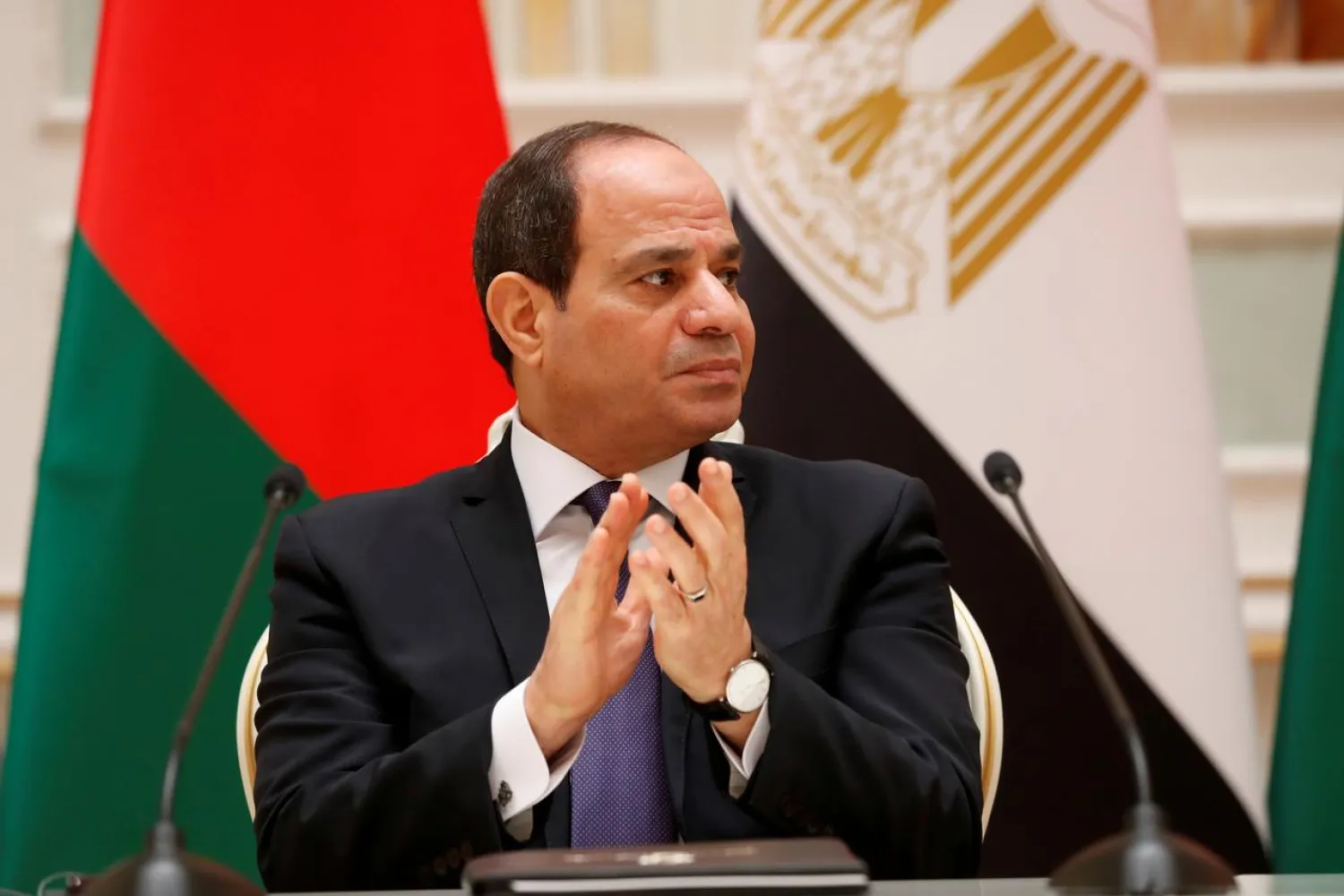
Egyptian Parliament Gives Sisi Mandate to Deploy Troops Abroad

Egyptian President Abdul Fattah al-Sisi. (Reuters)
TT

Egyptian Parliament Gives Sisi Mandate to Deploy Troops Abroad

Egyptian President Abdul Fattah al-Sisi. (Reuters)

Egypt's parliament on Monday approved the deployment of armed forces abroad to fight "criminal militias" and "foreign terrorist groups" on a "western front", after President Abdul Fattah al-Sisi said Cairo could intervene in Libya.

Parliament said in a statement that the troops would be defending national security, without giving further details or naming Libya directly.

Sisi and US President Donald Trump agreed on Monday on the need to maintain a ceasefire in Libya and avoid an escalation between the forces fighting there, Egypt’s presidency said.

Sisi said last week Egypt would not stand idle in the face of threats to Egyptian and Libyan security.

"Egypt will spare no efforts to support the sister Libya ... to overcome the current critical crisis," the Egyptian presidency said in a statement after a meeting of the National Defense Council on Sunday that was chaired by Sisi.

Egypt is concerned about instability in Libya and Turkey’s support for the Government of National Accord in Tripoli, whose fighters have moved closer to the central city of Sirte in the hope of recapturing it from the eastern-based Libyan National Army (LNA) of Khalifa Haftar.

Sisi last month declared the Sirte and Jufra frontlines a red line for Egypt.

Libya´s east-based parliament, the sole elected body in the country, also urged Sisi to send troops.

Sisi and Trump also discussed Ethiopia’s planned Blue Nile dam, the Egyptian presidency said. Cairo is worried that Ethiopia will start filling the dam without an agreement with Cairo and Sudan, which would also be affected.


Positive Signs Emerge on Gaza Deal after Mladenov-Hamas Talks

Palestinian Mahmoud Nofal combs the hair of Raneen, his 3-year-old granddaughter, whom he is caring for after her parents were killed in an Israeli strike in Khan Younis. (AP)
TT

Positive Signs Emerge on Gaza Deal after Mladenov-Hamas Talks

Palestinian Mahmoud Nofal combs the hair of Raneen, his 3-year-old granddaughter, whom he is caring for after her parents were killed in an Israeli strike in Khan Younis. (AP)

A source from the team of Board of Peace envoy Nickolay Mladenov and another from Hamas said there were “positive” signs toward completing implementation of the fragile ceasefire agreement in Gaza, announced last October.

The two sources spoke separately to Asharq Al-Awsat about the mood around meetings Mladenov held in Cairo with a Hamas delegation and representatives of the mediator states, Egypt, Qatar, and Türkiye.

The talks aimed to advance US President Donald Trump’s Gaza plan, which the UN Security Council adopted in a resolution last November.

The source from Mladenov’s team said the meeting with Hamas had ended with “very positive” results and that gaps had been bridged on all provisions of the road map, referring to the first version presented by Mladenov.

The source said Hamas told Mladenov it would respond to the proposals after internal consultations, before the middle of next week.

New amendments from Mladenov

Asharq Al-Awsat learned from factional sources and others close to the Cairo talks that Mladenov made new amendments before his meetings, in light of the latest response from Hamas and the Palestinian factions, which the mediators received days ago.

Indirect talks between Israel on one side and Hamas and the factions on the other had been stalled over moving to new stages of the ceasefire agreement, which Israel has repeatedly breached. Israel has killed nearly 1,000 Palestinians since then.

The Palestinian side insists on implementing the requirements of the first phase, including the withdrawal of the Israeli army from the territory it occupies and the entry of aid and goods into the enclave. Israel, meanwhile, is pressing for the disarmament of the factions, the most prominent item in the second phase.

A Hamas source told Asharq Al-Awsat that the Egyptian mediator delivered the amended wording to the movement’s leadership in Cairo after midnight Tuesday into Wednesday. The leadership has been in the Egyptian capital for about 10 days.

Hamas meeting with Mladenov

According to the same source, the Hamas delegation met Mladenov in Cairo on Wednesday afternoon to explain the importance of the amendments made to the road map and try to speed up the movement’s response. The source said the amendments would be discussed with the Palestinian factions before a reply is given.

Later Wednesday, after the source’s comments, Hamas announced it had met Mladenov. In a statement, it said discussions with the mediators had produced “broad understandings” and that Tuesday had seen “significant convergence” toward ensuring implementation of what remains of the first phase, alongside discussion of second-phase files.

Hamas said it discussed the entry of the “national committee” into Gaza, international forces and the handling of Palestinian weapons “within a logical and reasonable approach acceptable to all parties.”

A source from a Palestinian faction in Cairo confirmed that Hamas had notified them of the meeting with Mladenov and of comments that would be presented to the factions later in the day.

A source from Mladenov’s team said the meeting was held as a procedural step to brief Hamas on the amendments required for approval.

The source said, “These amendments were made in coordination with US envoy Jared Kushner and the mediators, with the aim of narrowing the gap between the Palestinian and Israeli positions in a way that allows negotiations to move forward.”

The source said amendments had been made to all 15 provisions of the road map, not only Article 8 on weapons, “where it can be said that the gaps have been fully closed.”

Article 8 focuses on how to carry out a gradual process to inventory and store weapons in Gaza. Hamas has insisted that this be done under the supervision and custody of a Palestinian party and in parallel with Israel’s withdrawal from the areas it occupies in Gaza, which account for more than 60% of the enclave.

Last month, public differences between Hamas and Mladenov were sharp, and a meeting between the two sides had been considered unlikely.

But the sources said, “positive developments during the Cairo meetings pushed toward this meeting, with the support of the mediators.”

Mediators, the US want to push the agreement forward

The Hamas source said the movement received assurances from the mediators on Tuesday evening that “the atmosphere is positive, and that there are some comments from the Board of Peace representative, which require more time.”

The source said, “The mediators want to accelerate reaching an agreement, and representatives of most of the factions taking part in the meetings therefore remained in place to settle the matter more quickly.”

The source assessed that “there is a strong desire among the mediators, Mladenov and the US administration to push toward an agreement as quickly as possible, in a way that would bring stability to the entire region.” The source added that “there are moves and Arab support from other countries with no direct role in the mediation to advance an agreement that would fully end the war on Gaza.”

From midday Tuesday until this report was prepared at midday Wednesday, Gaza time, the Gaza Strip saw noticeable calm on the ground, with no new casualties recorded.

Asharq Al-Awsat asked the source from Mladenov’s team whether arrangements had been made between the Board of Peace representative and Israel to halt strikes on the enclave. The source said the Israelis “gave us 48 hours of calm.”


Trump Says Netanyahu Could Use ‘Softer Touch’ in Lebanon

Israel's Prime Minister Benjamin Netanyahu gives a news conference in Jerusalem on June 15, 2026. (AFP)
TT

Trump Says Netanyahu Could Use ‘Softer Touch’ in Lebanon

Israel's Prime Minister Benjamin Netanyahu gives a news conference in Jerusalem on June 15, 2026. (AFP)

US President Donald Trump said on Wednesday that Israeli Prime Minister Benjamin Netanyahu could use a "softer touch" in Lebanon in comments ‌made at the ‌close of ‌a G7 ⁠summit in France.

Netanyahu ⁠and Trump have repeatedly clashed over Israel's refusal to constrain its pursuit of Iran-backed Hezbollah in Lebanon, where a cessation ⁠of hostilities is a ‌key ‌Iranian demand.

"Netanyahu happens to be a ‌good man, gets a ‌little excited sometimes," Trump told reporters on Wednesday.

"We have a little dispute over Lebanon. I ‌say you can do a little softer touch, ⁠Bibi. ⁠You don't have to knock down a building every time somebody walks into it that's from Hezbollah."

Trump added that he agreed with the description of Israel as being "the very small partner" of the United States.


Fresh Syria Protests Call for Accountability for Assad-Era Loyalists

 A large Syrian flag flutters above Tishreen Park in Damascus, June 4, 2025. (AFP)
A large Syrian flag flutters above Tishreen Park in Damascus, June 4, 2025. (AFP)
TT

Fresh Syria Protests Call for Accountability for Assad-Era Loyalists

 A large Syrian flag flutters above Tishreen Park in Damascus, June 4, 2025. (AFP)
A large Syrian flag flutters above Tishreen Park in Damascus, June 4, 2025. (AFP)

Dozens of Syrians protested in Damascus overnight into Wednesday demanding accountability for supporters of ousted ruler Bashar al-Assad, the latest such demonstrations in a country still recovering after years of civil war.

Syria's new authorities have repeatedly vowed to provide justice and accountability for Assad-era atrocities, and have regularly announced the arrest of former military and security figures, launching trials for some while warning against acts of "revenge".

Video footage posted on social media and confirmed by the Syrian Observatory for Human Rights monitor appeared to show dozens of people protesting in the capital's Mazzeh 86 neighborhood.

A protest also erupted in front of a nearby mosque before security forces restored order.

An AFP photographer saw a similar demonstration on Monday night on the outskirts of the capital.

"Assad's shabiha forced us to leave in green buses" for tented displacement camps in the country's north, said protester Abdel-Rahman al-Qadri, 38, a former opposition fighter.

He was referring to militiamen who helped crush dissent under Assad, and to evacuation deals imposed on some opposition-held areas during Syria's civil war, which erupted in 2011 and ended with the longtime ruler's 2024 ouster.

"We deserve the houses they live in, we deserve the positions and public sector jobs," said Qadri, who is unemployed.

Neighborhoods considered strongholds of the former authorities in the major cities of Aleppo and Idlib have seen similar protests in recent days, with participants calling for so-called "regime remnants" and "shabiha" to be put on trial.

Local residents there said some protests have involved vandalism of private property, raising tensions and fears of vigilante justice.

On Monday, interior ministry spokesperson Noureddine al-Baba said authorities were committed to bringing perpetrators of Assad-era crimes to justice through legal avenues, but "the state categorically rejects turning the demand for accountability into an act of revenge".

Last week, President Ahmed al-Sharaa warned that "it is important not to use transitional justice as a pretext for revenge".

Lawyer Aref al-Shaal said on social media that authorities were "caught between street pressure demanding accountability immediately, and efforts to control the issue and to fight the 'shabiha' through an established legal framework that prevents a slippage towards chaos".