


Benin Tech Innovation Hub Sees Bright Future

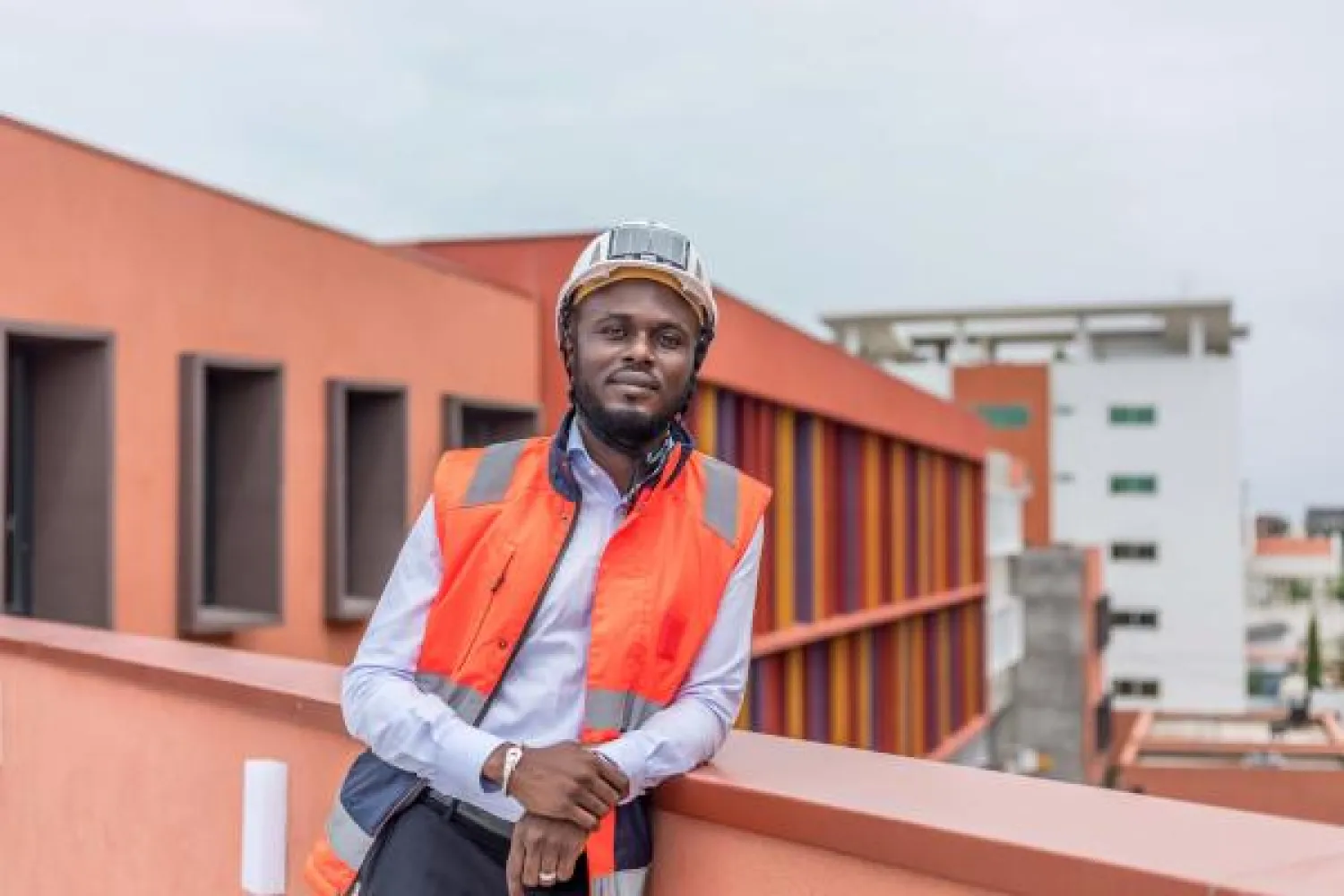
Abdoul Halim Assouma, responsible for planning and construction management, poses for a photograph at the Sèmè-One building, an incubator for Beninese start-ups, in Cotonou on July 8, 2020. (Photo by Yanick Folly / AFP)
TT

Benin Tech Innovation Hub Sees Bright Future

Abdoul Halim Assouma, responsible for planning and construction management, poses for a photograph at the Sèmè-One building, an incubator for Beninese start-ups, in Cotonou on July 8, 2020. (Photo by Yanick Folly / AFP)

With crimson walls and violet, yellow and red awnings, it's a building that few people in Cotonou, the tranquil economic capital of Benin, are likely to miss.

And that's the point. The bright colors of the Seme-One center, designed to be a cradle for researchers and tech entrepreneurs, "arouse the senses and stimulate innovation", said Abdoul Halim Asouma, in charge of construction work.

Masons and painters are putting the finishing touches to the 4,250-square-metre (45,750-square-foot) building -- an area roughly equivalent to a hypermarket -- that seeks to be flexible in use, low in energy consumption and nurturing of ideas, talent and networking.

The site is part of Seme-City, a project that President Patrice Talon hopes will help turn his small West African country into a regional tech hotspot like Kenya or Rwanda, on the other side of the continent.

The center has for the last two years been housed in premises adjoining the presidential residence -- as a hub for students, researchers, developers, the heads of companies large and small, and others who can work there and attend conferences.

For its director Claude Borna, Seme-City is "a unique place that supports and trains the talent of tomorrow, and which promotes innovation made in Africa".

Borna studied in Los Angeles and Montreal, and for many years worked for international companies as a consultant on innovation and commercial strategy before returning to Benin in 2016.

"People come to Seme-City seeking potential colleagues, training and backing," said Borna, who is in her 40s.

"Young people are often full of ideas but lack the framework and the backup."

The spread of the COVID-19 pandemic to Benin makes fresh ideas even more welcome -- and above all, their rapid implementation.

With financial support from the UN Population Fund (UNFPA) in Benin, 15 national and international organizations have created a task force to find ways of fighting the virus, in line with West African resources and needs.

Donald Tchaou, 29, and five of his friends developed X-over, an app that encourages social distancing and makes it possible to trace the chain of contacts made by an infected person.

While it is not the only program of its kind, developing the app in Benin saves money and strengthens local control over data.

Habib Meme, an architect, has been working with engineers and computer scientists to develop a project called COM-Finement, to make mobile medical facilities that can be swiftly erected or dismantled in an epidemic.

The facilities are interconnected and linked remotely to doctors who can provide expertise from afar.

In Seme-City, "they pointed us in the direction of potential financial donors and gave us highly relevant technical feedback," Meme said.

His innovation has won over several governments in West Africa and a number of prototypes are in an experimental phase, he said.

Developing new projects and launching start-ups require not just funding, but partnerships and knowledge of marketing, laws and regulation.

Armelle Dossa, 25, a specialist in agri-tech, is working on a marketing project for organic vegetables.

"If this framework had existed in Benin 10 years ago, we would have many young entrepreneurs and a lower rate of unemployment," she said.



Microsoft to Invest $10 bn for Japan AI Data Centers

Microsoft's Vice Chair and President Brad Smith (4th L) and (L-R) Sakura Internet Inc President and CEO Kunihiro Tanaka, SoftBank Corp. President and CEO Junichi Miyakawa, Microsoft Japan President Miki Tsusaka, hold a meeitng with Japan's Prime Minister Sanae Takaichi (2nd R) and Vice Minister of Economy, Trade and Industry Toshiro Ino (R) at the Prime Minister's Office in Tokyo on April 3, 2026. Kazuhiro NOGI / POOL/AFP
TT

Microsoft to Invest $10 bn for Japan AI Data Centers

Microsoft's Vice Chair and President Brad Smith (4th L) and (L-R) Sakura Internet Inc President and CEO Kunihiro Tanaka, SoftBank Corp. President and CEO Junichi Miyakawa, Microsoft Japan President Miki Tsusaka, hold a meeitng with Japan's Prime Minister Sanae Takaichi (2nd R) and Vice Minister of Economy, Trade and Industry Toshiro Ino (R) at the Prime Minister's Office in Tokyo on April 3, 2026. Kazuhiro NOGI / POOL/AFP

Microsoft said Friday it will invest $10 billion in Japan over the next four years to build artificial intelligence data centers and related infrastructure.

Power-hungry data centers -- warehouse-like facilities that power AI tools from chatbots to image generators -- are springing up worldwide, and the sector is growing particularly fast in Asia.

Microsoft President Brad Smith met Japanese Prime Minister Sanae Takaichi at her office on Friday to announce the investment, said AFP.

Smith said in a statement that it was a "response to Japan's growing need for cloud and AI services".

Businesses in Japan, the world's fourth-largest economy, are keen to get ahead in the fast-moving AI field.

But data centers expansion there is constrained by limited space and relatively expensive electricity.

The US tech giant will collaborate with Japan's SoftBank Group and Sakura Internet to expand domestic tech infrastructure, it said in a press release.

It follows a $2.9 billion two-year investment Microsoft announced in 2024 to bolster the country's push into AI and strengthen its cyber defenses.

The investment unveiled Friday also includes funds to enhance cybersecurity partnerships with Japanese government agencies, and to train one million engineers in cooperation with telecom and tech giants NTT and NEC.

A rush to build data centers in the Asia-Pacific region, especially in India and Southeast Asia, has sparked concerns over the facilities' environmental impact.

That includes increased demand on electricity grids that are often reliant on fossil fuels, and on local water supplies used to cool the hot servers inside.

Microsoft says it has pledged to become carbon negative, zero-waste and "water positive" by 2030.

On Tuesday, the company announced plans to invest more than $1 billion in cloud and AI data center infrastructure and operations in Thailand over the next two years.


Kia to Sell Lower-priced Electric Vehicle in US

A KIA logo on an electric vehicle is seen on display at the Canadian International AutoShow in Toronto, Ontario, Canada, February 13, 2025. REUTERS/Carlos Osorio
TT

Kia to Sell Lower-priced Electric Vehicle in US

A KIA logo on an electric vehicle is seen on display at the Canadian International AutoShow in Toronto, Ontario, Canada, February 13, 2025. REUTERS/Carlos Osorio

Kia said Wednesday it will begin selling a lower-priced electric vehicle in the United States later this year as automakers work to recharge EV sales.

The Korean automaker said at the New York Auto Show it will offer the EV3 in the US market starting later this year, Reuters reported.

Automakers are facing a tougher EV market in the United States after Congress repealed the $7,500 EV tax credit last year but higher gasoline prices in recent weeks has prompted new interest in the EVs.


Passengers Stranded in Moving Traffic after Robotaxi Outage in China

This file photo taken on August 1, 2024 shows a general view of a driverless robotaxi autonomous vehicle developed as part of tech giant Baidu's Apollo Go self-driving project, in Wuhan, in central China's Hubei province. (Photo by PEDRO PARDO / AFP)
TT

Passengers Stranded in Moving Traffic after Robotaxi Outage in China

This file photo taken on August 1, 2024 shows a general view of a driverless robotaxi autonomous vehicle developed as part of tech giant Baidu's Apollo Go self-driving project, in Wuhan, in central China's Hubei province. (Photo by PEDRO PARDO / AFP)

Some robotaxi passengers were left stranded in the middle of fast-moving traffic in a major Chinese city after their driverless vehicles stopped running, according to police and media reports on Wednesday.

A preliminary investigation indicates more than 100 robotaxis came to a halt because of a “system malfunction,” police in the city of Wuhan said in a statement, without elaborating. No injuries were reported.

One passenger told Chinese media that their robotaxi stopped after turning a corner. An instruction on a screen read: “Driving system malfunction. Staff are expected to arrive in 5 minutes.” After no one showed up, the passenger pushed an SOS button and was told that staff were on their way. The car door could be opened, so the passenger got out on their own.

It is the first time a mass shutdown of robotaxis has been reported in China, The Associated Press said. In December, many of Waymo’s self-driving cars came to a stop in San Francisco because of a power outage.

The taxis in Wuhan are operated by Baidu, a major Chinese internet and AI company that is expanding its Apollo Go robotaxi business to overseas locations in Europe and the Mideast.

Baidu did not have any immediate comment.

Police said reports that taxis were coming to a halt started coming in around 9 p.m., while media reports said multiple people were rescued.

While some passengers were able to exit their taxis on their own, others were afraid to get out because their vehicle had stopped in the middle lane of a ring road with other vehicles passing on both sides, the reports said. Ring roads are elevated roads without traffic lights designed to move traffic quickly in urban areas.

Baidu operates hundreds of robotaxis in Wuhan, which hosted an early pilot project for the company.