


Monica Seles – Warrior Queen Whose Reign Was Shattered

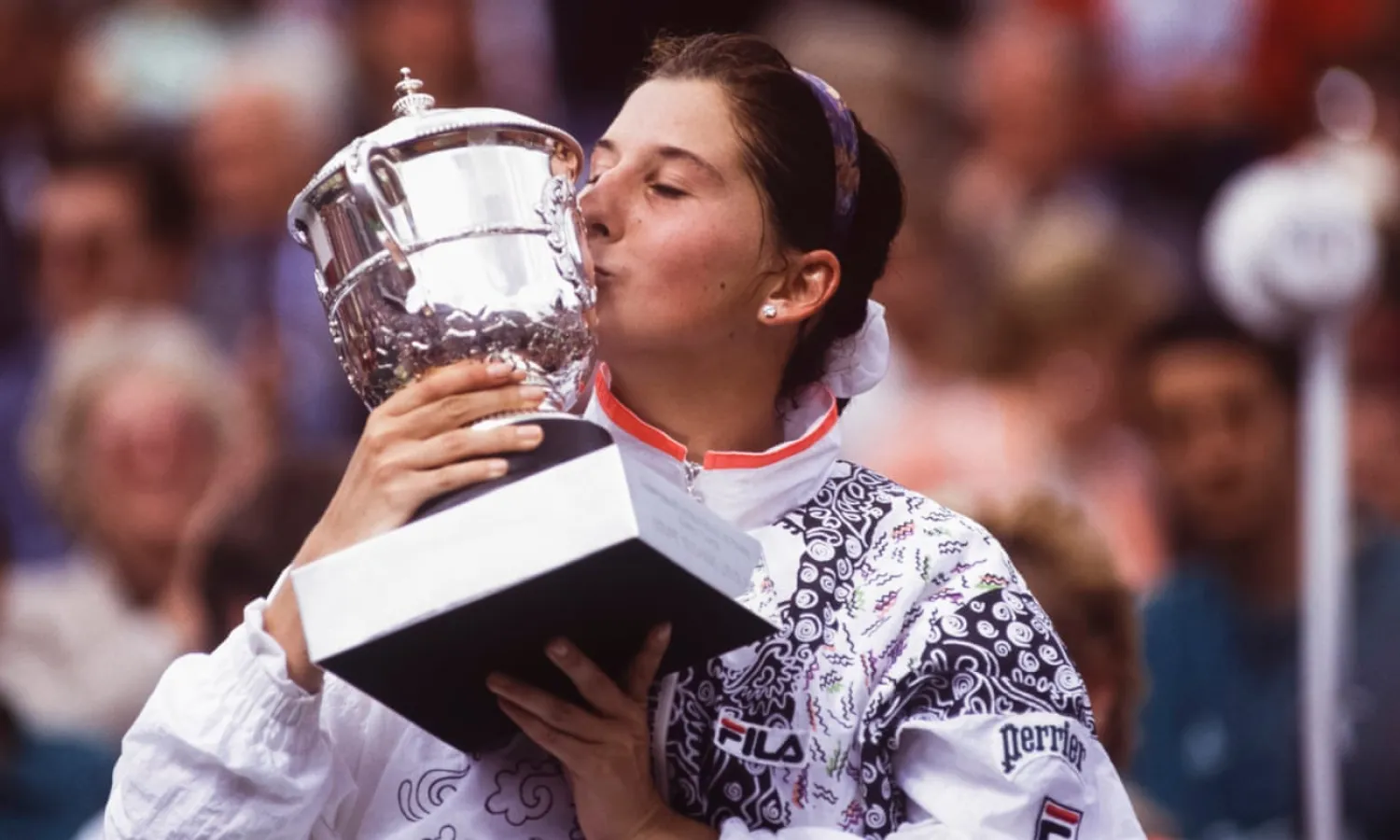
 Monica Seles after winning the French Open in 1992. She was statistically the greatest teenager in history. Photograph: Pool BOLCINA/SAMPERS/Gamma-Rapho/Getty Images
Monica Seles after winning the French Open in 1992. She was statistically the greatest teenager in history. Photograph: Pool BOLCINA/SAMPERS/Gamma-Rapho/Getty Images
TT

Monica Seles – Warrior Queen Whose Reign Was Shattered

 Monica Seles after winning the French Open in 1992. She was statistically the greatest teenager in history. Photograph: Pool BOLCINA/SAMPERS/Gamma-Rapho/Getty Images
Monica Seles after winning the French Open in 1992. She was statistically the greatest teenager in history. Photograph: Pool BOLCINA/SAMPERS/Gamma-Rapho/Getty Images

Shortly before his death in 1990, the tennis fashion designer, historian and author Ted Tinling, whose immersion in the women’s game began as Suzanne Lenglen’s personal umpire in the 1920s and who knew all the greats from Helen Wills Moody to Steffi Graf, delivered an extraordinary prophecy.

“Monica Seles is the most electric happening in tennis since Lenglen,” he said. “She lights up the court and can hit the ball harder than anyone I have ever seen.”

Seles was 16 and had yet to win a grand slam but Tinling knew his tennis and with every murderous double-fisted forehand and malicious double-handed backhand the teenager quickly set about proving him right.

Martina Navratilova was the first exalted player to succumb to Seles’s power in the 1990 Italian Open final when she was thumped 6-1, 6-1. Navratilova likened the experience to being “run over by a truck”. And with good reason: Seles’s brand of heavy metal tennis featured 37 winners and only six unforced errors.

A month later Seles became the youngest winner in the history of the French Open by beating Graf 7‑6, 6‑4. The German had won nine of the 10 previous grand slams behind a huge serve and forehand, while such was her lung capacity that scientists once predicted she could have been a European 1500m champion on the track.

Yet Seles refused to be intimidated. Her forceful returns blunted Graf’s serve, the quality of her groundstrokes pinned her opponent back and her astonishing mental fortitude – another of her many skills – enabled her to save four set points in the first set tie-break before fending off her illustrious opponent to win the match.

Soon winning became second nature. Incredibly from 1991 to 1993 Seles won seven of the eight grand slam tournaments in which she played, posting a 55-1 record, and also reached the finals of 33 out of 34 tournaments. And then – in one of the most shocking moments in sports history – the 19-year-old was stabbed in the back by a deranged Graf fan while playing in Hamburg.

She was never the same player again. How could she be, when she was out for more than two years? And when stepping on the court felt like returning to the scene of the crime? As Seles admitted to the Observer’s Tim Adams in 2009: “I had grown up on a tennis court – it was where I felt most safe, most secure – and that day everything was taken away from me. My innocence. My rankings, all my income, endorsements – they were all cancelled.”

Seles’s biggest battles were no longer between the tramlines. Depression hit her hard and she was diagnosed with post-traumatic stress disorder. On top of that, her father – who would endlessly watch her hit balls in a car park as a child with a net strung between two vehicles – was diagnosed with cancer. In her moving autobiography, Seles talks of how she began to binge on chocolate pretzels, crisps, Pop-Tarts and ice cream – a problem that often led to her weight ballooning after she returned to the tour in 1995.

She was still an excellent player, winning a final grand slam title in 1996 and an Olympic bronze medal in 2000, but she no longer hit the very highest notes.

Yet if the wheels of history had spun in a different direction we could be easily talking of Seles as the most successful player of all time. She was statistically the greatest teenager in history, having raced to eight grand slams barely a month after turning 19. To put that number in context her nearest rival, Graf, had won six by the time she was 20. Margaret Court had four, Chris Evert two. Serena and Venus Williams had only one between them, while Navratilova was yet to get off the mark.

Who could have stopped Seles motoring along at a similar rate for another six or seven years by which point she would have raced past Court’s record of 24? Not the Williams sisters: as great as they are they only started winning slams around the turn of the millennium. And while Graf would have remained a major threat, in their seven encounters between 1990 and 1993 Seles had the edge, winning four.

It’s also highly likely Seles would have kicked on again in her early 20s. As her former coach Nick Bollettieri once put it: “She will not accept that she can’t do something and she’ll spend 40, 50, 70 hours working just to get one shot. I used to tell her: ‘Your boyfriend is your Prince ball machine’, she spent so much time with the thing … I find it very difficult to pick out any weakness in her or her game.”

Perhaps volleying was one area that needed honing and sharpening. When she beat Navratilova in a Wimbledon classic in 1992, for instance, she made only one volley winner. Not that it mattered given she hit 48 successful passing shots. That year she reached the final at SW19 despite the British tabloids hounding her over grunting. Peter Ustinov cruelly joked: “I pity Monica’s neighbours on her wedding night.” Imagine being a teenager and hearing that?

Seles ended her career ranked eighth on the list of grand slam winners. Navratilova believes that, without the horrific stabbing incident, “we’d be talking about Monica with the most grand slam titles. This guy changed the course of tennis history, no doubt about that.”

It’s hard to argue. At her peak Seles had dynamite on her strings and ice in her veins – and was undoubtedly tennis’s original warrior queen.

The Guardian Sport


Hospital: Vonn Had Surgery on Broken Leg from Olympics Crash

This handout video grab from IOC/OBS shows US Lindsey Vonn crashing during the women's downhill event at the Milano Cortina 2026 Winter Olympic Games on February 8, 2026. (Photo by Handout / various sources / AFP)
TT

Hospital: Vonn Had Surgery on Broken Leg from Olympics Crash

This handout video grab from IOC/OBS shows US Lindsey Vonn crashing during the women's downhill event at the Milano Cortina 2026 Winter Olympic Games on February 8, 2026. (Photo by Handout / various sources / AFP)

Lindsey Vonn had surgery on a fracture of her left leg following the American's heavy fall in the Winter Olympics downhill, the hospital said in a statement given to Italian media on Sunday.

"In the afternoon, (Vonn) underwent orthopedic surgery to stabilize a fracture of the left leg," the Ca' Foncello hospital in Treviso said.

Vonn, 41, was flown to Treviso after she was strapped into a medical stretcher and winched off the sunlit Olimpia delle Tofane piste in Cortina d'Ampezzo.

Vonn, whose battle to reach the start line despite the serious injury to her left knee dominated the opening days of the Milano Cortina Olympics, saw her unlikely quest halted in screaming agony on the snow.

Wearing bib number 13 and with a brace on the left knee she ⁠injured in a crash at Crans Montana on January 30, Vonn looked pumped up at the start gate.

She tapped her ski poles before setting off in typically aggressive fashion down one of her favorite pistes on a mountain that has rewarded her in the past.

The 2010 gold medalist, the second most successful female World Cup skier of all time with 84 wins, appeared to clip the fourth gate with her shoulder, losing control and being launched into the air.

She then barreled off the course at high speed before coming to rest in a crumpled heap.

Vonn could be heard screaming on television coverage as fans and teammates gasped in horror before a shocked hush fell on the packed finish area.

She was quickly surrounded by several medics and officials before a yellow Falco 2 ⁠Alpine rescue helicopter arrived and winched her away on an orange stretcher.


Meloni Condemns 'Enemies of Italy' after Clashes in Olympics Host City Milan

Demonstrators hold smoke flares during a protest against the environmental, economic and social impact of the Milano-Cortina 2026 Winter Olympics in Milan, Italy, February 7, 2026. REUTERS/Kevin Coombs
TT

Meloni Condemns 'Enemies of Italy' after Clashes in Olympics Host City Milan

Demonstrators hold smoke flares during a protest against the environmental, economic and social impact of the Milano-Cortina 2026 Winter Olympics in Milan, Italy, February 7, 2026. REUTERS/Kevin Coombs

Italian Prime Minister Giorgia Meloni has condemned anti-Olympics protesters as "enemies of Italy" after violence on the fringes of a demonstration in Milan on Saturday night and sabotage attacks on the national rail network.

The incidents happened on the first full day of competition in the Winter Games that Milan, Italy's financial capital, is hosting with the Alpine town of Cortina d'Ampezzo.

Meloni praised the thousands of Italians who she said were working to make the Games run smoothly and present a positive face of Italy.

"Then ⁠there are those who are enemies of Italy and Italians, demonstrating 'against the Olympics' and ensuring that these images are broadcast on television screens around the world. After others cut the railway cables to prevent trains from departing," she wrote on Instagram on Sunday.

A group of around 100 protesters ⁠threw firecrackers, smoke bombs and bottles at police after breaking away from the main body of a demonstration in Milan.

An estimated 10,000 people had taken to the city's streets in a protest over housing costs and environmental concerns linked to the Games.

Police used water cannon to restore order and detained six people.

Also on Saturday, authorities said saboteurs had damaged rail infrastructure near the northern Italian city of Bologna, disrupting train journeys.

Police reported three separate ⁠incidents at different locations, which caused delays of up to 2-1/2 hours for high-speed, Intercity and regional services.

No one has claimed responsibility for the damage.

"Once again, solidarity with the police, the city of Milan, and all those who will see their work undermined by these gangs of criminals," added Meloni, who heads a right-wing coalition.

The Italian police have been given new arrest powers after violence last weekend at a protest by the hard-left in the city of Turin, in which more than 100 police officers were injured.


Liverpool New Signing Jacquet Suffers 'Serious' Injury

Soccer Football - Ligue 1 - RC Lens v Stade Rennes - Stade Bollaert-Delelis, Lens, France - February 7, 2026  Stade Rennes' Jeremy Jacquet in action REUTERS/Benoit Tessier
Soccer Football - Ligue 1 - RC Lens v Stade Rennes - Stade Bollaert-Delelis, Lens, France - February 7, 2026 Stade Rennes' Jeremy Jacquet in action REUTERS/Benoit Tessier
TT

Liverpool New Signing Jacquet Suffers 'Serious' Injury

Soccer Football - Ligue 1 - RC Lens v Stade Rennes - Stade Bollaert-Delelis, Lens, France - February 7, 2026  Stade Rennes' Jeremy Jacquet in action REUTERS/Benoit Tessier
Soccer Football - Ligue 1 - RC Lens v Stade Rennes - Stade Bollaert-Delelis, Lens, France - February 7, 2026 Stade Rennes' Jeremy Jacquet in action REUTERS/Benoit Tessier

Liverpool's new signing Jeremy Jacquet suffered a "serious" shoulder injury while playing for Rennes in their 3-1 Ligue 1 defeat at RC Lens on Saturday, casting doubt over the defender’s availability ahead of his summer move to Anfield.

Jacquet fell awkwardly in the second half of the ⁠French league match and appeared in agony as he left the pitch.

"For Jeremy, it's his shoulder, and for Abdelhamid (Ait Boudlal, another Rennes player injured in the ⁠same match) it's muscular," Rennes head coach Habib Beye told reporters after the match.

"We'll have time to see, but it's definitely quite serious for both of them."
Liverpool agreed a 60-million-pound ($80-million) deal for Jacquet on Monday, but the 20-year-old defender will stay with ⁠the French club until the end of the season.

Liverpool, provisionally sixth in the Premier League table, will face Manchester City on Sunday with four defenders - Giovanni Leoni, Joe Gomez, Jeremie Frimpong and Conor Bradley - sidelined due to injuries.
