


Iran Says Foreign States Carried Out Cyberattacks on Its Infrastructure

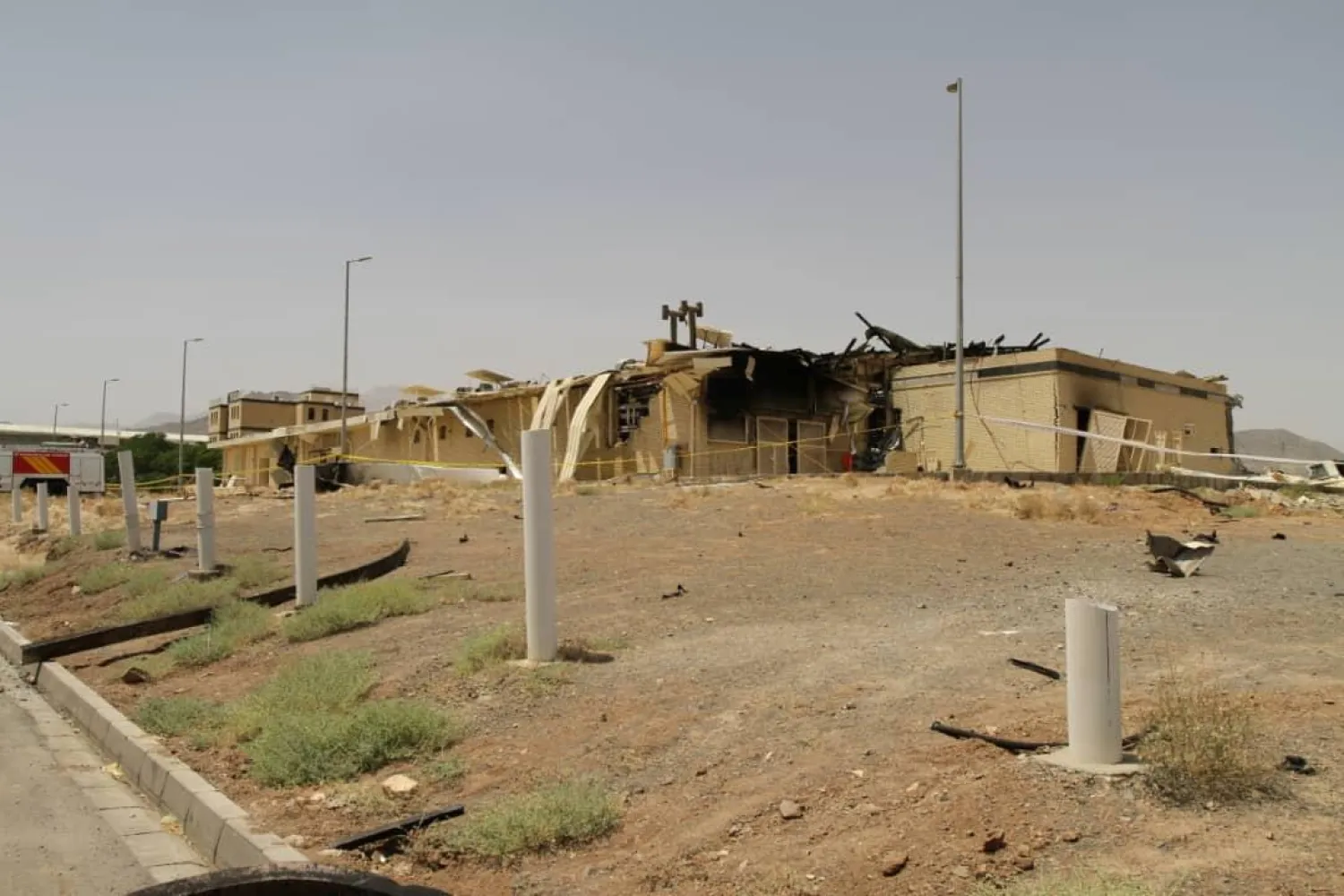
A view of a damaged building after a fire broke out at Iran's Natanz Nuclear Facility | Reuters
TT

Iran Says Foreign States Carried Out Cyberattacks on Its Infrastructure

A view of a damaged building after a fire broke out at Iran's Natanz Nuclear Facility | Reuters

Iran’s foreign ministry said on Thursday foreign governments may have been behind recent cyberattacks on Iranian facilities, but played down the possibility of them having a role in a series of fires and explosions at military and other installations.

Since late June, several fires or explosions have been reported at military, industrial and nuclear sites in Iran as well as at oil refineries, power plants, factories and businesses.

“There are thousands of cyberattacks on the country’s infrastructure on a daily basis - which is nothing new - most of which are repelled by our defence systems,” Iranian media quoted Foreign Ministry spokesman Abbas Mousavi as telling reporters.

This came following statements by member of the parliamentary national security committee, Javad Karimi-Ghodousi, who said the blast at Iran's nuclear establishment in Natanz, center of the country, on July 2 was caused by a “security breach.”

Ghodousi indicated that a “security breach is our definitive conclusion,” according to the parliament’s website, ICANA. He ruled out that “an object from outside” struck the nuclear facility.

He explained that if an external object had hit the facility, there should have been shrapnel, but based on the investigations, absolutely nothing has been found.

Ghodousi did not provide details on a breach within the security team of the facility, indicating that the members of the parliament inspected Natanz.

Earlier in July, the MP said the incident in Natanz was “sabotage”, but at that time he accused IAEA inspectors of being behind it, pointing out that the site witnessed six rounds of visits by international inspectors visits.

The New York Times quoted on July 5 a member of the Islamic Revolutionary Guard Corps (IRGC) as saying that investigators do not yet know how or when the explosives were sneaked in, “but the attack clearly demonstrated a hole in the facility’s security.”

In addition, a Middle Eastern intelligence official told the newspaper that Israel was responsible for the explosion, adding that it had nothing to do with the other recent incidents.

He said Israel planted a huge bomb in the building where advanced centrifuges were being developed.

Iran’s Supreme National Security Council announced that investigations determined the exact cause of the Natanz incident, but refused to give further information due to security considerations.

Tehran did not accuse Israel directly, but said it would respond in the appropriate time if the investigation showed that external forces played a role in the attack.

Hours after the authorities confirmed the incident at the nuclear facility, “Homeland Panthers” claimed responsibility for the explosion, according to BBC Persian.

The website of BBC Persian said that before any news of the incident had emerged, emails were sent to its journalists claiming they had attacked the facility.

Meanwhile, the spokesperson for the Atomic Energy Organization of Iran (AEOI), Behrouz Kamalvandi, warned that the blast could “slow down Iran’s development and production of advanced centrifuges,” announcing that his country would work to build another larger facility equipped with more advanced equipment instead of the damaged one.

Earlier this month, government Spokesman Ali Rabiei said that the cause of the incident will be announced after experts complete their investigations. He noted that all hypotheses are possible, including the use of drones or electronic attacks.

Over the past two months, Iran witnessed a number of mysterious bombings and incidents in military and industrial facilities.

The incident in Natanz came less than a week after the bombing of the strategic Parchin military base, in eastern Tehran. Although Iranian official reports insist that an explosion occurred due to a gas leak, satellite images later showed an explosion at a military-industrial complex, 24 kilometers away from the base.

On July 10, Iranian officials denied reports of an explosion in “Qods” of Garmdareh region, west of Tehran, after social media users reported hearing explosions in the area.

But satellite imagery obtained by BBC Persian showed fires on a hilltop equivalent to three football fields, saying it was in a military zone.



Iran, US Race to Find Crew Member of Crashed American Fighter Jet

A US Air Force F-16 Fighting Falcon aircraft refuels from a KC-135 Stratotanker aircraft during a mission supporting Operation Epic Fury during the Iran war at an undisclosed location, April 2, 2026.  US Air Force/Handout via REUTERS
A US Air Force F-16 Fighting Falcon aircraft refuels from a KC-135 Stratotanker aircraft during a mission supporting Operation Epic Fury during the Iran war at an undisclosed location, April 2, 2026. US Air Force/Handout via REUTERS
TT

Iran, US Race to Find Crew Member of Crashed American Fighter Jet

A US Air Force F-16 Fighting Falcon aircraft refuels from a KC-135 Stratotanker aircraft during a mission supporting Operation Epic Fury during the Iran war at an undisclosed location, April 2, 2026.  US Air Force/Handout via REUTERS
A US Air Force F-16 Fighting Falcon aircraft refuels from a KC-135 Stratotanker aircraft during a mission supporting Operation Epic Fury during the Iran war at an undisclosed location, April 2, 2026. US Air Force/Handout via REUTERS

Iranian and American forces raced each other Saturday to recover a crew member from the first US fighter jet to go down inside Iran since the start of the war.

Tehran said it had shot down the F-15 warplane and US media reported United States special forces had rescued one of its two crew members, with the other was still missing.

Iran's military also said it downed a US A-10 ground attack aircraft in the Gulf, with US media saying the pilot of that plane was rescued, reported AFP.

The war erupted more than a month ago with US-Israeli strikes on Iran that killed supreme leader Ali Khamenei, triggering retaliation that spread the conflict throughout the Middle East, convulsing the global economy and impacting millions of people worldwide.

US Central Command did not immediately respond to a request for comment on the loss of the F-15, but White House Press Secretary Karoline Leavitt said: "The president has been briefed."

President Donald Trump told NBC the F-15 loss would not affect negotiations with Iran, saying: "No, not at all. No, it's war."

On Saturday, there were fresh strikes on Israel, Lebanon and Iran, as well as on Gulf states.

An AFP journalist saw a thick haze of grey smoke covering Tehran's skyline after hearing several blasts over the capital. It was not immediately clear what had been targeted.

- 'Valuable reward' -

A spokesperson for the Iranian military's central operational command earlier said "an American hostile fighter jet in central Iranian airspace was struck and destroyed by the IRGC Aerospace Force's advanced air defense system".

"The jet was completely obliterated, and further searches are ongoing."

An Iranian television reporter on a local official channel said anyone who captured a crew member alive would "receive a valuable reward".

Retired US brigadier general Houston Cantwell, who has 400 hours of combat flight experience, said a pilot's training would likely kick in before he or she parachutes to the ground.

"My priority would be, first of all, concealment, because I don't want to be captured," he told AFP.

Mohammad Ghalibaf, the speaker of Iran's parliament, mocked the Trump administration.

He wrote on X: "After defeating Iran 37 times in a row, this brilliant no-strategy war they started has now been downgraded from 'regime change' to 'Hey! Can anyone find our pilots? Please?'

"Wow. What incredible progress. Absolute geniuses."


Explosion Hits Pro-Israel Center in the Netherlands

Rotterdam Police officers. (Getty Images/AFP)
TT

Explosion Hits Pro-Israel Center in the Netherlands

Rotterdam Police officers. (Getty Images/AFP)

A blast hit a pro-Israeli center in the Netherlands, police said Saturday, adding it caused minimal damage and no injuries.

A police spokeswoman told AFP no one was inside the site run by Christians for Israel, a non-profit, in the central city of Nijkerk when the explosion went off outside its gate late on Friday.

An investigation was ongoing.

The incident comes after a string of similar night-time attacks on Jewish sites in the Netherlands and neighboring Belgium in recent weeks that has heightened concerns in the wake of the war in the Middle East.


Iran Says Strike Hit Close to Its Bushehr Nuclear Facility, Killing a Guard and Damaging a Building

Iran's Bushehr nuclear reactor (Reuters)
TT

Iran Says Strike Hit Close to Its Bushehr Nuclear Facility, Killing a Guard and Damaging a Building

Iran's Bushehr nuclear reactor (Reuters)

Iran’s atomic agency says an airstrike has hit near its Bushehr nuclear facility, killing a security guard and damaging a support building. It is the fourth time the facility has been targeted during the war.

The agency announced Saturday’s attack on social media.

The US AP’s military pressed ahead Saturday in a frantic search for a missing pilot after Iran shot down an American warplane, as Iran called on people to turn the pilot in, promising a reward.

The plane, identified by Iran as a US F-15E Strike Eagle, was one of two attacked on Friday, with one service member rescued and at least one missing. It was the first time the United States lost aircraft in Iranian territory during the war, now in its sixth week, and could mark a new turning point in the campaign.

The conflict, launched by the US and Israel on Feb. 28, has rippled across the region. It has so far killed thousands, upended global markets, cut off key shipping routes, spiked fuel prices and shows no signs of slowing as Iran responds to US and Israeli airstrikes with attacks across the region.