


Putin Says Russian Navy to Get Hypersonic Nuclear Strike Weapons

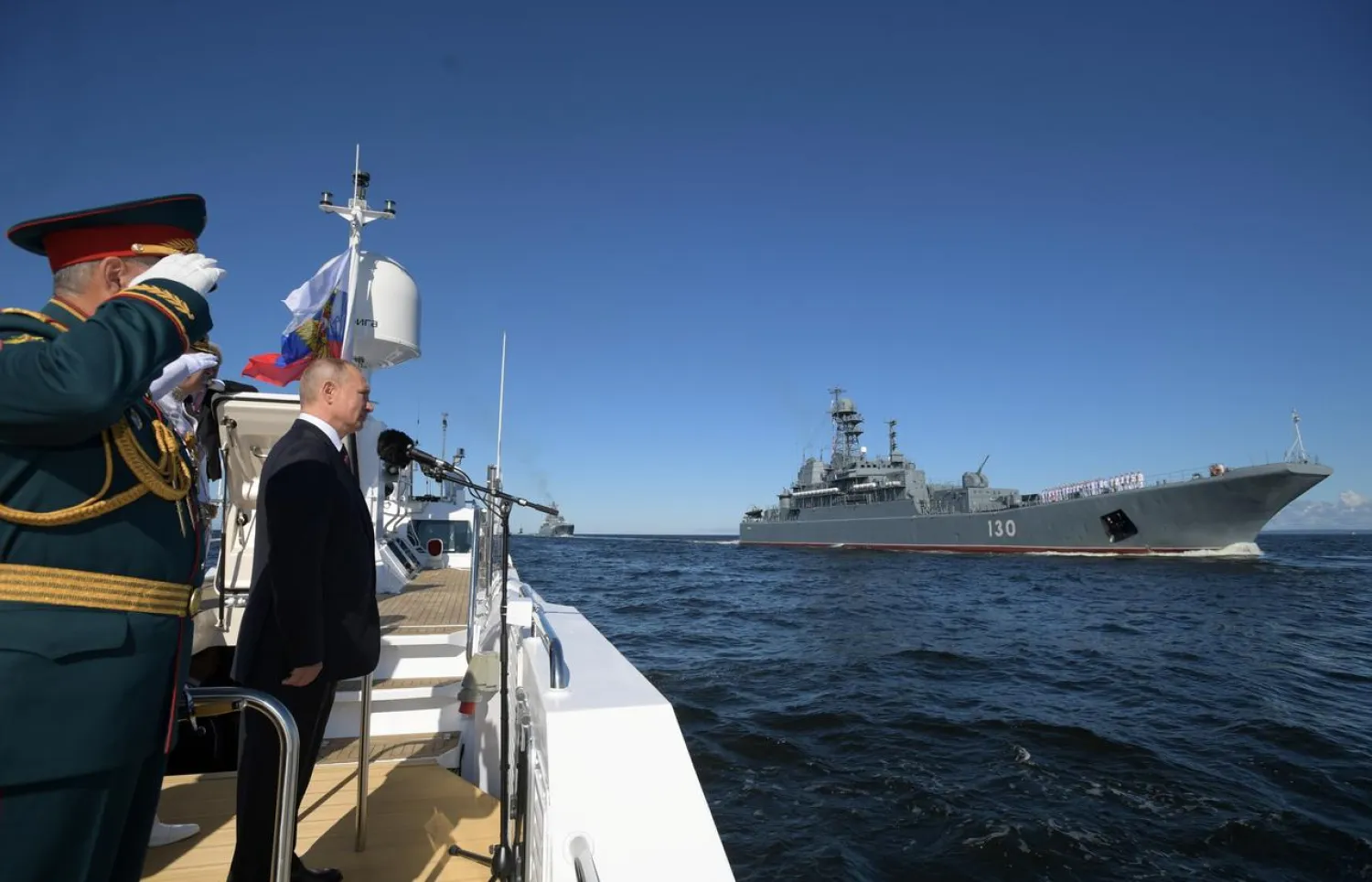
Russia's President Vladimir Putin inspects warships before the Navy Day parade in Saint Petersburg, Russia July 26, 2020. (Reuters)
TT

Putin Says Russian Navy to Get Hypersonic Nuclear Strike Weapons

Russia's President Vladimir Putin inspects warships before the Navy Day parade in Saint Petersburg, Russia July 26, 2020. (Reuters)

Russian President Vladimir Putin said on Sunday the Russian Navy would be armed with hypersonic nuclear strike weapons and underwater nuclear drones, which the defense ministry said were in their final phase of testing.

Putin, who says he does not want an arms race, has often spoken of a new generation of Russian nuclear weapons that he says are unequalled and can hit almost anywhere in the world. Some Western experts have questioned how advanced they are.

The weapons, some of which have yet to be deployed, include the Poseidon underwater nuclear drone, designed to be carried by submarines, and the Tsirkon (Zircon) hypersonic cruise missile, which can be deployed on surface ships.

The combination of speed, maneuverability and altitude of hypersonic missiles, capable of travelling at more than five times the speed of sound, makes them difficult to track and intercept.

Speaking in St. Petersburg at an annual naval parade that showcases Russia’s best ships, nuclear submarines and naval aviation, Putin said the navy’s capabilities were growing and it would get 40 new vessels this year.

He did not specify when it would receive new hypersonic weapons, but suggested that day was drawing closer.

“The widespread deployment of advanced digital technologies that have no equals in the world, including hypersonic strike systems and underwater drones, will give the fleet unique advantages and increased combat capabilities,” Putin said.

In a separate statement released via Russian news agencies, the defense ministry said testing of the Belgorod, the first submarine capable of carrying the Poseidon drones, was underway and testing of the weapons systems was nearing completion.

“Work is being successfully completed to create modern weapons systems for the Navy,” it was cited as saying.

Putin last year threatened to deploy hypersonic missiles on ships and submarines that could lurk outside US territorial waters if the United States moved to deploy intermediate-range nuclear weapons in Europe.

Washington has not deployed such missiles in Europe, but Moscow is worried it might.


US Judge Rules Pentagon Press Restrictions Unconstitutional

The Pentagon and the surrounding area is seen in this aerial view in Washington, Jan. 26, 2020. (AP)
TT

US Judge Rules Pentagon Press Restrictions Unconstitutional

The Pentagon and the surrounding area is seen in this aerial view in Washington, Jan. 26, 2020. (AP)

A federal judge on Friday ruled that the Pentagon's press access overhaul, which saw accreditations from a host of prominent media outlets withdrawn, violated the constitution.

Elements of the policy are "unlawful because they violate the First and Fifth Amendments of the United States Constitution," a judge in Washington said in response to a lawsuit brought by The New York Times.

US media including the Times and Fox News, and a host of international news outlets such as AFP and AP, declined to sign the new policy in mid-October, resulting in the stripping of their Pentagon credentials.

It was the latest in a series of measures by President Donald Trump and top officials against journalists and outlets that are often derided as "fake news" when their reporting displeases the administration.

The ruling striking down the policy comes amid the US-Israeli bombing campaign against Iran that began on February 28.

The court said that while national security must be protected, it was vital for the public to have information in light of the US war with Iran and its recent intervention in Venezuela.

"It is more important than ever that the public have access to information from a variety of perspectives about what its government is doing -- so that the public can support government policies, if it wants to support them; protest, if it wants to protest," the ruling said.

"And decide based on full, complete, and open information who they are going to vote for in the next election."

- 'Learning opportunity' -

The Pentagon Press Association (PPA) hailed the ruling and demanded the "immediate reinstatement" of accreditations for journalists who refused to sign on to the new policy.

"This is a great day for freedom of the press in the United States. It is also hopefully a learning opportunity for Pentagon leadership, which took extreme steps to limit press access to information in wartime," the association said in a statement.

"We look forward to returning to the Pentagon and providing the public, including the members of the military currently involved in conflicts around the world, information about why and how the Defense Department is waging war," it said.

The new policy, enforced in October last year, was the latest in a series of moves restricting journalists' access to information from the Defense Department, the nation's single largest employer, with a budget in the hundreds of billions of dollars a year.

The department had announced earlier last year that eight media organizations including The Times, The Washington Post, CNN, NBC and NPR had to vacate their dedicated office spaces in the Pentagon, alleging that there was a need to create room for other -- predominantly conservative -- outlets.

It also required journalists to be accompanied by official escorts if they go outside a limited number of areas in the Pentagon -- another new restriction on the press.

And in January, Trump said he would sue what he has called the "failing" New York Times over an unfavorable opinion poll, after initially filing a $15 billion defamation suit last year.

He has fired off multiple defamation lawsuits against media companies, including the BBC, CNN, The Wall Street Journal, CBS and ABC. Some have ended in multimillion-dollar settlements.


Britain Condemns Iran’s ‘Reckless Attacks’ on Diego Garcia Air Base

Joint Direct Attack Munitions (JDAMs) are taken from a US Air Force B-1 Lancer bomber at RAF Fairford in south-west England on March 15, 2026. (AFP)
TT

Britain Condemns Iran’s ‘Reckless Attacks’ on Diego Garcia Air Base

Joint Direct Attack Munitions (JDAMs) are taken from a US Air Force B-1 Lancer bomber at RAF Fairford in south-west England on March 15, 2026. (AFP)

Britain has condemned “Iran’s reckless attacks” after its military fired missiles at the UK-US air base on the island of Diego Garcia in the Indian Ocean.

UK officials have not given details of the attempted strike, which was unsuccessful. It’s unclear how close the missiles came to the base, which is about 2,500 miles (4,000 kilometers) from Iran.

The Ministry of Defense said Saturday that Iran’s “lashing out across the region and holding hostage the Strait of Hormuz, are a threat to British interests and British allies.”

Britain has not participated in US Israeli attacks on Iran, but has allowed American bombers to use UK bases to attack Iran’s missile sites.

On Friday, the British government said US bombers can also use UK bases, including Diego Garcia, in operations to prevent Iran attacking ships in the Strait of Hormuz.

Iran targeted the base before that UK statement.


Iranian Man, Romanian Woman Charged Over Attempt to Enter UK Submarine Base

A photograph shows a general view of HM Naval Base Clyde at Faslane, north-west of Glasgow, Scotland on March 14, 2026. (AFP)
TT

Iranian Man, Romanian Woman Charged Over Attempt to Enter UK Submarine Base

A photograph shows a general view of HM Naval Base Clyde at Faslane, north-west of Glasgow, Scotland on March 14, 2026. (AFP)

An Iranian man and a Romanian woman have been charged after attempting to enter Britain's nuclear submarine base in Scotland, Police Scotland said on Saturday.

The two, who British media have ‌called suspected ‌Iranian spies, were ‌arrested ⁠on Thursday.

The charges ⁠come three weeks into the US-Israeli war on Iran. While Britain has not taken part in the ⁠attacks on Iran, the ‌country's ‌forces have downed Iranian missiles ‌and drones in the ‌Gulf region.

HM Naval Base Clyde is located on the west coast of ‌Scotland and is key to Britain's security, hosting ⁠the ⁠country's nuclear-armed submarine fleet, as well as its attack submarines.

Police Scotland said the Iranian man, 34, and the Romanian woman, 31, are due to appear at Dumbarton Sheriff Court on March 23.
