


Eusebio Leal, who Oversaw Renewal of Old Havana, Dies at 77

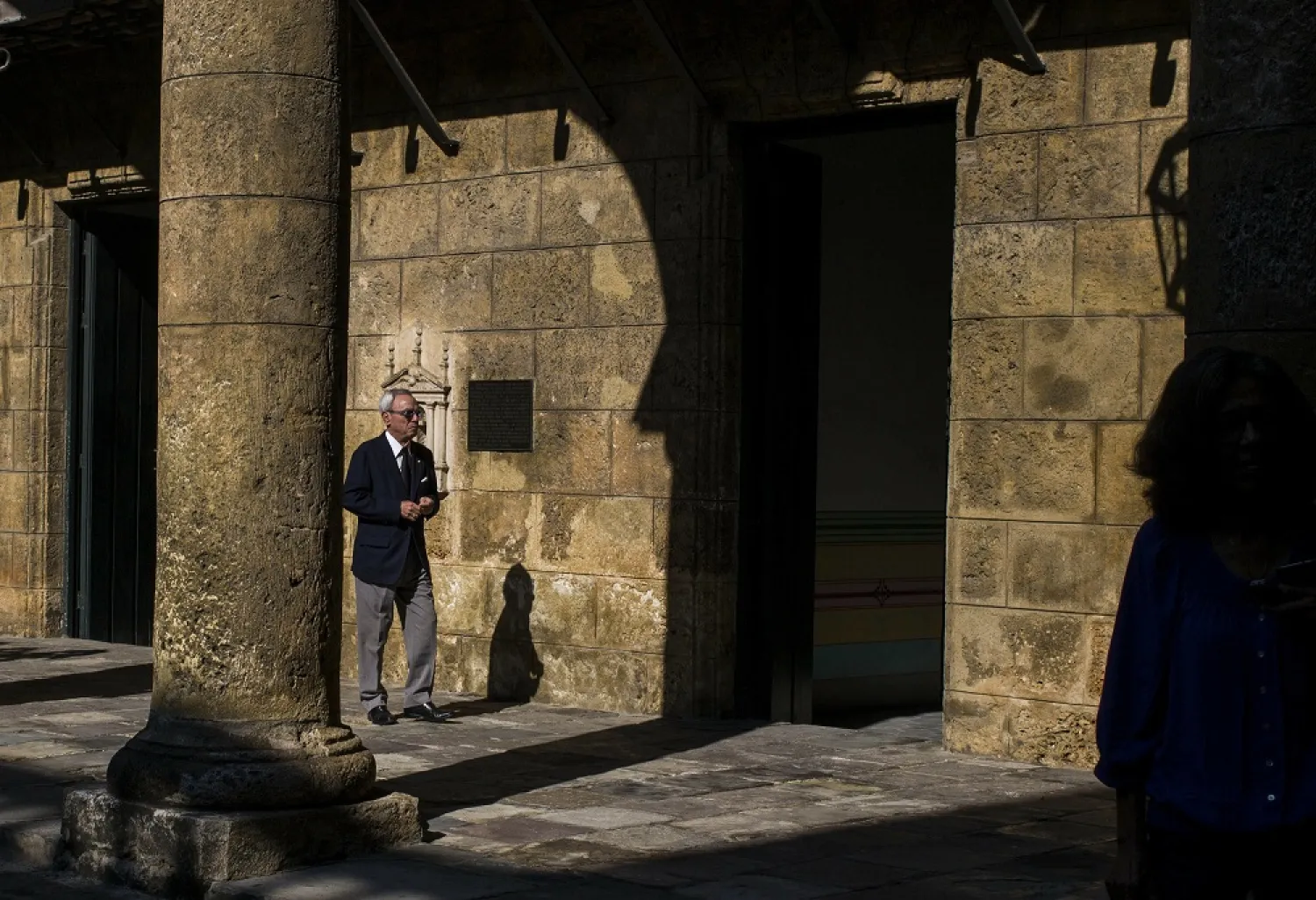
In this Nov. 23, 2018 file photo, Havana City Historian Eusebio Leal Spengler walks in the courtyard of the City Museum in Havana, Cuba. (AP)
TT

Eusebio Leal, who Oversaw Renewal of Old Havana, Dies at 77

In this Nov. 23, 2018 file photo, Havana City Historian Eusebio Leal Spengler walks in the courtyard of the City Museum in Havana, Cuba. (AP)

Eusebio Leal Spengler, who oversaw the transformation of crumbling Old Havana to an immaculately restored colonial tourist attraction, becoming the de-facto mayor of the historic city center and one of the nation’s most prominent public intellectuals, has died. He was 77.

He had been fighting cancer.

Leal and his restoration efforts became so famous along the crowded streets of Havana that it often felt like he was holding court when he appeared in public, usually in his trademark, simple gray dress shirts and slacks.

Elderly women would tell Leal that the water that had stopped working in their apartment was back on thanks to him. Others would lodge complaints about their living situation or praise him for reviving Old Havana.

“To call it reconstruction of something that seemed dead and buried may draw dirty looks and dismissals that ours is a romantic crusade,” Leal wrote in a city bulletin in 2010. “But if that were the case, we wouldn’t feel embarrassed to be seen as romantics in times that are so apocalyptic.”

Born in Havana on Sept. 11, 1942, Leal earned a doctorate in historical sciences from the University of Havana, honing his skills as an intellectual entrepreneur who recognized that the resurrection of the city’s historic district could be a moneymaker. That became especially important when communist Cuba embraced foreign tourism en masse after the disbanding of the Soviet Union and the loss of its billions of dollars in annual subsidies to the island brought the economy to the brink of total collapse.

After a series of nationwide economic reforms and the Dec. 2014 declaration of detente with the US, Leal’s government-driven restoration of Old Havana gained momentum with the opening of hundreds of private businesses from elegant restaurant to art galleries that filled with tourists as visits to the country soared.

The boom raised worries about gentrification as expatriate Cubans or those with ties to foreign capital bought out longtime residents and turned their homes into businesses.

Leal spoke little about the new phenomenon, but consistently argued for respecting Old Havana’s past without being trapped by it.

“I’ve always spoken out against the mummification of the city,” he said in 2016. “It wouldn’t be wise to show off the past under glass.”

In 1967, Leal became city historian, replacing his mentor, Emilio Roig de Leushenring. He oversaw the reconstruction of the old municipal government building on the stately Plaza de Armas, then used a mix of charisma and diplomacy to get all of Old Havana designated as a UNESCO world heritage site in 1982.

That distinction brought international funding to revitalize the area, but Leal was also granted unprecedented autonomy by government superiors, allowing him to levy taxes in the neighborhood and keep the profits his projects generated to reinvest in new rebuilding efforts.

Leal was a member of Cuba’s parliament, but enjoyed more power serving on the Central Committee of the Communist Party. It was not uncommon for him to travel to the airport to greet arriving foreign heads of state, as well as oversee public political and cultural events.

By February 2008, Leal’s name was mentioned as a candidate for major promotion when Raul Castro succeeded Fidel as Cuba’s president — especially given the city historian’s generally moderate political views.

Instead, Leal stayed at the helm of Old Havana, the heart of a city founded in 1519 by the Spanish. Once ringed by a city wall, the historic district is a mix of Baroque and neoclassical monuments, crammed up against colonial-style homes and apartment buildings with balconies and courtyards — most of which was decaying since Castro’s government couldn’t afford the upkeep.

Before Leal’s work, Old Havana had become a tangled collection of dark streets, winding past buildings in ruins, many propped up by poles to prevent their collapse. While pockets of open decay can still be found, they are now outnumbered by the regally restored plazas and colonial structures.

Leal rebuilt tourist-friendly sites such as El Floridita, frequented by Ernest Hemingway, and another famous watering hole, El Bodeguita del Medio. He oversaw restoration of some of the faded facade of the Malecon, the city’s famous seawall, and El Morro, the Spanish fort that guards the entrance to Havana Harbor.

Leal’s office also returned many restored buildings to their original functions, such as refurbished docks and tourist sites focused on specific themes — like the El Conde de Villanueva, a hotel that caters to cigar aficionados. Today, Old Havana’s cobblestone streets are jammed with art galleries and museums, churches, shady parks and alleyways reminiscent of Rome or Barcelona.

Leal’s office refurbished more than 300 buildings, and maintenance crews ensure restored structures don’t lose their splendor despite unrelenting tropical sunlight, sea-air humidity and coastal flooding that punishes all Havana infrastructure. Leal won many international awards, including Spain’s International Queen Sofia Prize for restoration in 2007.

One of his largest projects was the restoration of the domed Capitol building to become the seat of the Cuban parliament as it was before Cuba’s 1959 revolution.

Part of the rebuilding effort also created nursing homes and dining rooms for government workers, as well as daycare centers, schools and drug rehabilitation clinics. Thousands of Cubans were forced from their tenament-like homes to make room for rehabilitation projects, but Leal said none were displaced without being offered comparable places to live.

But the on-the-surface charm of Leal’s efforts belied the problems of Cubans who live in grinding poverty mere blocks from tourist areas.

Indeed, islanders call Old Havana “the Vatican” since the streets are kept especially clean and free of petty thefts and small crime so as not to spook tourists. Even the power lines have been laid underground, meaning the neighborhood is spared many of the frequent power outages that plague the rest of the city.

When the New York Times wrote a largely favorable 2007 article saying that Leal’s work had far more aesthetic benefits than real value for Old Havana residents, a visibly angry city historian organized a press conference to denounce the article, the reporter who wrote it and the newspaper.

“The question is, ‘Isn’t culture a positive? Isn’t the state of (Cuban) culture a positive?’” Leal demanded to know.

US Astronaut to Take her 3-year-old's Cuddly Rabbit Into Space

FILE PHOTO: An evening launch of a SpaceX Falcon 9 rocket carrying 20 Starlink V2 Mini satellites, from Space Launch Complex at Vandenberg Space Force Base is seen over the Pacific Ocean from Encinitas, California, US, June 23, 2024. REUTERS/Mike Blake/File Photo
TT

US Astronaut to Take her 3-year-old's Cuddly Rabbit Into Space

FILE PHOTO: An evening launch of a SpaceX Falcon 9 rocket carrying 20 Starlink V2 Mini satellites, from Space Launch Complex at Vandenberg Space Force Base is seen over the Pacific Ocean from Encinitas, California, US, June 23, 2024. REUTERS/Mike Blake/File Photo

When the next mission to the International Space Station blasts off from Florida next week, a special keepsake will be hitching a ride: a small stuffed rabbit.

American astronaut and mother, Jessica Meir, one of the four-member crew, revealed Sunday that she'll take with her the cuddly toy that belongs to her three-year-old daughter.

It's customary for astronauts to go to the ISS, which orbits 250 miles (400 kilometers) above Earth, to take small personal items to keep close during their months-long stint in space.

"I do have a small stuffed rabbit that belongs to my three-year-old daughter, and she actually has two of these because one was given as a gift," Meir, 48, told an online news conference.

"So one will stay down here with her, and one will be there with us, having adventures all the time, so that we'll keep sending those photos back and forth to my family," AFP quoted her as saying.

US space agency NASA says SpaceX Crew-12 will lift off on a SpaceX Falcon 9 rocket from Cape Canaveral in Florida to the orbiting scientific laboratory early Wednesday.

The mission will be replacing Crew-11, which returned to Earth in January, a month earlier than planned, during the first medical evacuation in the space station's history.

Meir, a marine biologist and physiologist, served as flight engineer on a 2019-2020 expedition to the space station and participated in the first all-female spacewalks.

Since then, she's given birth to her daughter. She reflected Sunday on the challenges of being a parent and what is due to be an eight-month separation from her child.

"It does make it a lot difficult in preparing to leave and thinking about being away from her for that long, especially when she's so young, it's really a large chunk of her life," Meir said.

"But I hope that one day, she will really realize that this absence was a meaningful one, because it was an adventure that she got to share into and that she'll have memories about, and hopefully it will inspire her and other people around the world," Meir added.

When the astronauts finally get on board the ISS, they will be one of the last crews to live on board the football field-sized space station.

Continuously inhabited for the last quarter century, the aging ISS is scheduled to be pushed into Earth's orbit before crashing into an isolated spot in the Pacific Ocean in 2030.

The other Crew-12 astronauts are Jack Hathaway of NASA, European Space Agency astronaut Sophie Adenot, and Russian cosmonaut Andrey Fedyaev.


iRead Marathon Records over 6.5 Million Pages Read

Participants agreed that the number of pages read was not merely a numerical milestone - SPA
TT

iRead Marathon Records over 6.5 Million Pages Read

Participants agreed that the number of pages read was not merely a numerical milestone - SPA

The fifth edition of the iRead Marathon achieved a remarkable milestone, surpassing 6.5 million pages read over three consecutive days, in a cultural setting that reaffirmed reading as a collective practice with impact beyond the moment.

Hosted at the Library of the King Abdulaziz Center for World Culture (Ithra) and held in parallel with 52 libraries across 13 Arab countries, including digital libraries participating for the first time, the marathon reflected the transformation of libraries into open, inclusive spaces that transcend physical boundaries and accommodate diverse readers and formats.

Participants agreed that the number of pages read was not merely a numerical milestone, but a reflection of growing engagement and a deepening belief in reading as a daily, shared activity accessible to all, free from elitism or narrow specialization.

Pages were read in multiple languages and formats, united by a common conviction that reading remains a powerful way to build genuine connections and foster knowledge-based bonds across geographically distant yet intellectually aligned communities, SPA reported.

The marathon also underscored its humanitarian and environmental dimension, as every 100 pages read is linked to the planting of one tree, translating this edition’s outcome into a pledge of more than 65,000 trees. This simple equation connects knowledge with sustainability, turning reading into a tangible, real-world contribution.

The involvement of digital libraries marked a notable development, expanding access, strengthening engagement, and reinforcing the library’s ability to adapt to technological change without compromising its cultural role. Integrating print and digital reading added a contemporary dimension to the marathon while preserving its core spirit of gathering around the book.

With the conclusion of the iRead Marathon, the experience proved to be more than a temporary event, becoming a cultural moment that raised fundamental questions about reading’s role in shaping awareness and the capacity of cultural initiatives to create lasting impact. Three days confirmed that reading, when practiced collectively, can serve as a meeting point and the start of a longer cultural journey.


Imam Turki bin Abdullah Royal Reserve Launches Fifth Beekeeping Season

Jazan’s Annual Honey Festival - File Photo/SPA
TT

Imam Turki bin Abdullah Royal Reserve Launches Fifth Beekeeping Season

Jazan’s Annual Honey Festival - File Photo/SPA

The Imam Turki bin Abdullah Royal Nature Reserve Development Authority launched the fifth annual beekeeping season for 2026 as part of its programs to empower the local community and regulate beekeeping activities within the reserve.

The launch aligns with the authority's objectives of biodiversity conservation, the promotion of sustainable environmental practices, and the generation of economic returns for beekeepers, SPA reported.

The authority explained that this year’s beekeeping season comprises three main periods associated with spring flowers, acacia, and Sidr, with the start date of each period serving as the official deadline for submitting participation applications.

The authority encouraged all interested beekeepers to review the season details and attend the scheduled virtual meetings to ensure organized participation in accordance with the approved regulations and the specified dates for each season.