


'Gnarly' Tumor Shows Dinosaurs Got Cancer, Too

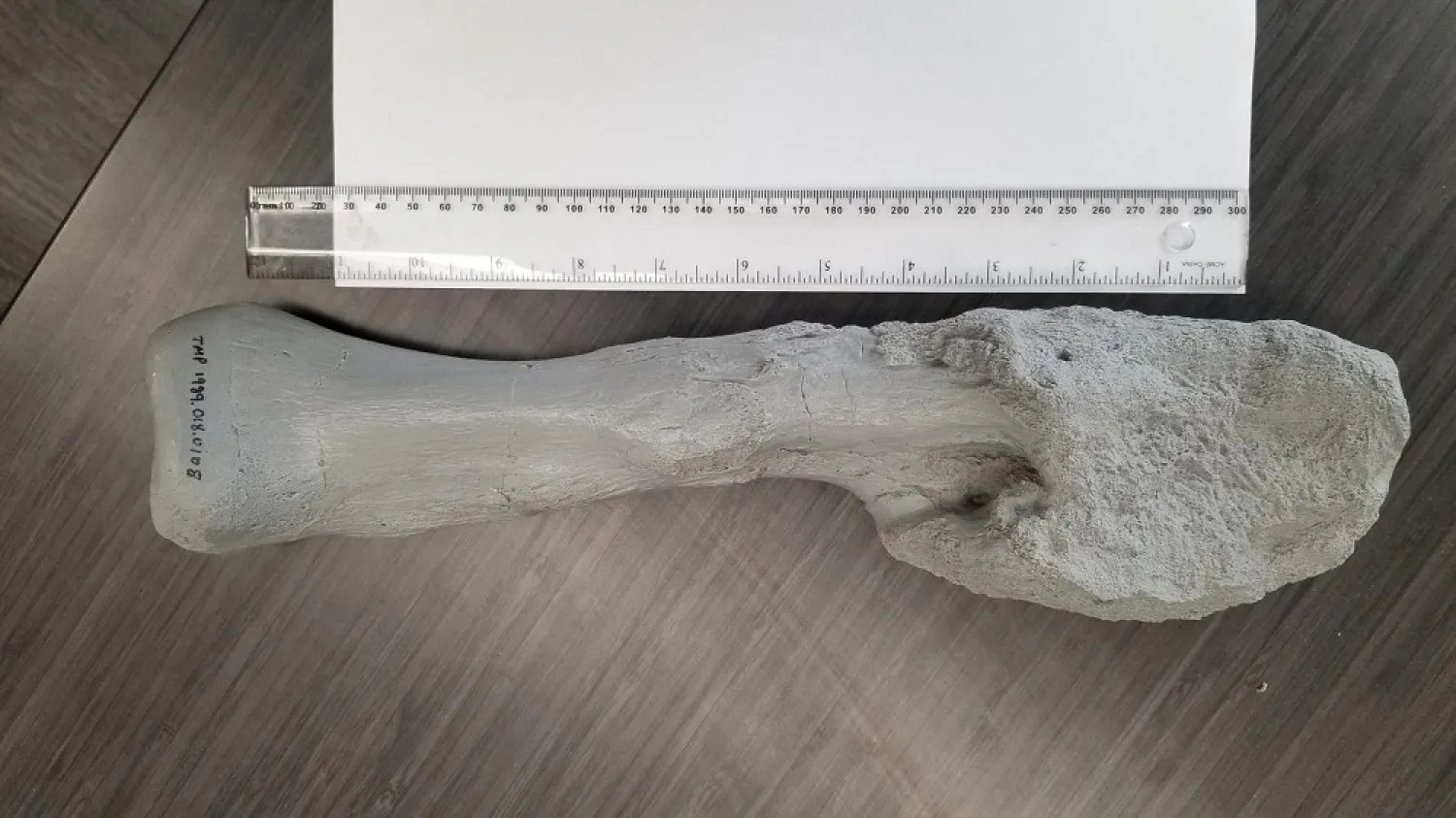
A cast of the fibula from Centrosaurus apertus is seen disfigured by aggressive malignant bone cancer - an osteosarcoma Ð in this image released on August 3, 2020. (Reuters)
TT

'Gnarly' Tumor Shows Dinosaurs Got Cancer, Too

A cast of the fibula from Centrosaurus apertus is seen disfigured by aggressive malignant bone cancer - an osteosarcoma Ð in this image released on August 3, 2020. (Reuters)

When scientists first unearthed fossils of a horned dinosaur called Centrosaurus in the badlands of Dinosaur Provincial Park in Canada’s Alberta province in 1989, they spotted a badly malformed leg bone they figured was a healed fracture.

A fresh examination, researchers said on Monday, shows something different. The malformation was a manifestation of osteosarcoma, an aggressive bone cancer, making this Centrosaurus, which lived 76 million years ago, the first known example of a dinosaur afflicted by malignant cancer.

About 20 feet (6 meters) long, Centrosaurus was a four-legged beaked plant-eating Cretaceous Period dinosaur possessing a long horn above its nose and a bony frill above its neck with two smaller hooked horns.

The Centrosaurus fibula, a lower leg bone, contained “a massive gnarly tumor larger than an apple,” said paleontologist David Evans of the Royal Ontario Museum in Toronto, one of the researchers in the study published in the journal Lancet Oncology.

“This particular Centrosaurus was likely weak and lamed by the cancer prior to its death. This remarkable find shows that no matter how big or powerful some dinosaurs may seem, they were affected by many of the same diseases we see in humans and other animals today, including cancer. Dinosaurs seem like mythical beasts, but they were living, breathing animals that suffered through horrible injuries and diseases,” he added.

Because most tumors occur in soft tissue that does not readily fossilize, there is scant evidence of cancer in the fossil record.

“This finding speaks to the biology of cancer. It is not something novel or new, but probably has occurred since time immemorial and is an expected complication in all animals,” said study co-author Dr. Mark Crowther, a professor of medicine, pathology and molecular medicine at McMaster University in Ontario.

“Osteosarcoma generally occurs in rapidly growing bones and as such is found in children and young adults. Presumably dinosaurs were also at risk because of the fact that they grew at enormous rates,” Crowther added.

The tumor destroys the bone and can spread to other tissues, Crowther said. In people, treatment consists of chemotherapy and surgery that sometimes involves amputation.

The researchers confirmed it was a tumor using high-resolution CT scans and by looking at thin sections of it under the microscope. “We were not only able to demonstrate that the bone tissue showed the hallmarks of osteosarcoma, but that the tumor spiraled through the cortex of bone, discounting its original identification of a healed fracture,” Evans said.

Cancer, however, may not have killed the Centrosaurus. Its body was found in a vast bonebed containing the remains of hundreds of Centrosaurus individuals, suggesting they died as part of a herd caught in a flood, Evans said.

Its cancer may have reduced its mobility to make it an inviting target for big predators like Gorgosaurus and Daspletosaurus. But living within a large herd, Evans said, may have provided safety in numbers that enabled the Centrosaurus to avoid predation as the cancer progressed.




US Astronaut to Take her 3-year-old's Cuddly Rabbit Into Space

FILE PHOTO: An evening launch of a SpaceX Falcon 9 rocket carrying 20 Starlink V2 Mini satellites, from Space Launch Complex at Vandenberg Space Force Base is seen over the Pacific Ocean from Encinitas, California, US, June 23, 2024. REUTERS/Mike Blake/File Photo
TT

US Astronaut to Take her 3-year-old's Cuddly Rabbit Into Space

FILE PHOTO: An evening launch of a SpaceX Falcon 9 rocket carrying 20 Starlink V2 Mini satellites, from Space Launch Complex at Vandenberg Space Force Base is seen over the Pacific Ocean from Encinitas, California, US, June 23, 2024. REUTERS/Mike Blake/File Photo

When the next mission to the International Space Station blasts off from Florida next week, a special keepsake will be hitching a ride: a small stuffed rabbit.

American astronaut and mother, Jessica Meir, one of the four-member crew, revealed Sunday that she'll take with her the cuddly toy that belongs to her three-year-old daughter.

It's customary for astronauts to go to the ISS, which orbits 250 miles (400 kilometers) above Earth, to take small personal items to keep close during their months-long stint in space.

"I do have a small stuffed rabbit that belongs to my three-year-old daughter, and she actually has two of these because one was given as a gift," Meir, 48, told an online news conference.

"So one will stay down here with her, and one will be there with us, having adventures all the time, so that we'll keep sending those photos back and forth to my family," AFP quoted her as saying.

US space agency NASA says SpaceX Crew-12 will lift off on a SpaceX Falcon 9 rocket from Cape Canaveral in Florida to the orbiting scientific laboratory early Wednesday.

The mission will be replacing Crew-11, which returned to Earth in January, a month earlier than planned, during the first medical evacuation in the space station's history.

Meir, a marine biologist and physiologist, served as flight engineer on a 2019-2020 expedition to the space station and participated in the first all-female spacewalks.

Since then, she's given birth to her daughter. She reflected Sunday on the challenges of being a parent and what is due to be an eight-month separation from her child.

"It does make it a lot difficult in preparing to leave and thinking about being away from her for that long, especially when she's so young, it's really a large chunk of her life," Meir said.

"But I hope that one day, she will really realize that this absence was a meaningful one, because it was an adventure that she got to share into and that she'll have memories about, and hopefully it will inspire her and other people around the world," Meir added.

When the astronauts finally get on board the ISS, they will be one of the last crews to live on board the football field-sized space station.

Continuously inhabited for the last quarter century, the aging ISS is scheduled to be pushed into Earth's orbit before crashing into an isolated spot in the Pacific Ocean in 2030.

The other Crew-12 astronauts are Jack Hathaway of NASA, European Space Agency astronaut Sophie Adenot, and Russian cosmonaut Andrey Fedyaev.


iRead Marathon Records over 6.5 Million Pages Read

Participants agreed that the number of pages read was not merely a numerical milestone - SPA
TT

iRead Marathon Records over 6.5 Million Pages Read

Participants agreed that the number of pages read was not merely a numerical milestone - SPA

The fifth edition of the iRead Marathon achieved a remarkable milestone, surpassing 6.5 million pages read over three consecutive days, in a cultural setting that reaffirmed reading as a collective practice with impact beyond the moment.

Hosted at the Library of the King Abdulaziz Center for World Culture (Ithra) and held in parallel with 52 libraries across 13 Arab countries, including digital libraries participating for the first time, the marathon reflected the transformation of libraries into open, inclusive spaces that transcend physical boundaries and accommodate diverse readers and formats.

Participants agreed that the number of pages read was not merely a numerical milestone, but a reflection of growing engagement and a deepening belief in reading as a daily, shared activity accessible to all, free from elitism or narrow specialization.

Pages were read in multiple languages and formats, united by a common conviction that reading remains a powerful way to build genuine connections and foster knowledge-based bonds across geographically distant yet intellectually aligned communities, SPA reported.

The marathon also underscored its humanitarian and environmental dimension, as every 100 pages read is linked to the planting of one tree, translating this edition’s outcome into a pledge of more than 65,000 trees. This simple equation connects knowledge with sustainability, turning reading into a tangible, real-world contribution.

The involvement of digital libraries marked a notable development, expanding access, strengthening engagement, and reinforcing the library’s ability to adapt to technological change without compromising its cultural role. Integrating print and digital reading added a contemporary dimension to the marathon while preserving its core spirit of gathering around the book.

With the conclusion of the iRead Marathon, the experience proved to be more than a temporary event, becoming a cultural moment that raised fundamental questions about reading’s role in shaping awareness and the capacity of cultural initiatives to create lasting impact. Three days confirmed that reading, when practiced collectively, can serve as a meeting point and the start of a longer cultural journey.


Imam Turki bin Abdullah Royal Reserve Launches Fifth Beekeeping Season

Jazan’s Annual Honey Festival - File Photo/SPA
TT

Imam Turki bin Abdullah Royal Reserve Launches Fifth Beekeeping Season

Jazan’s Annual Honey Festival - File Photo/SPA

The Imam Turki bin Abdullah Royal Nature Reserve Development Authority launched the fifth annual beekeeping season for 2026 as part of its programs to empower the local community and regulate beekeeping activities within the reserve.

The launch aligns with the authority's objectives of biodiversity conservation, the promotion of sustainable environmental practices, and the generation of economic returns for beekeepers, SPA reported.

The authority explained that this year’s beekeeping season comprises three main periods associated with spring flowers, acacia, and Sidr, with the start date of each period serving as the official deadline for submitting participation applications.

The authority encouraged all interested beekeepers to review the season details and attend the scheduled virtual meetings to ensure organized participation in accordance with the approved regulations and the specified dates for each season.