

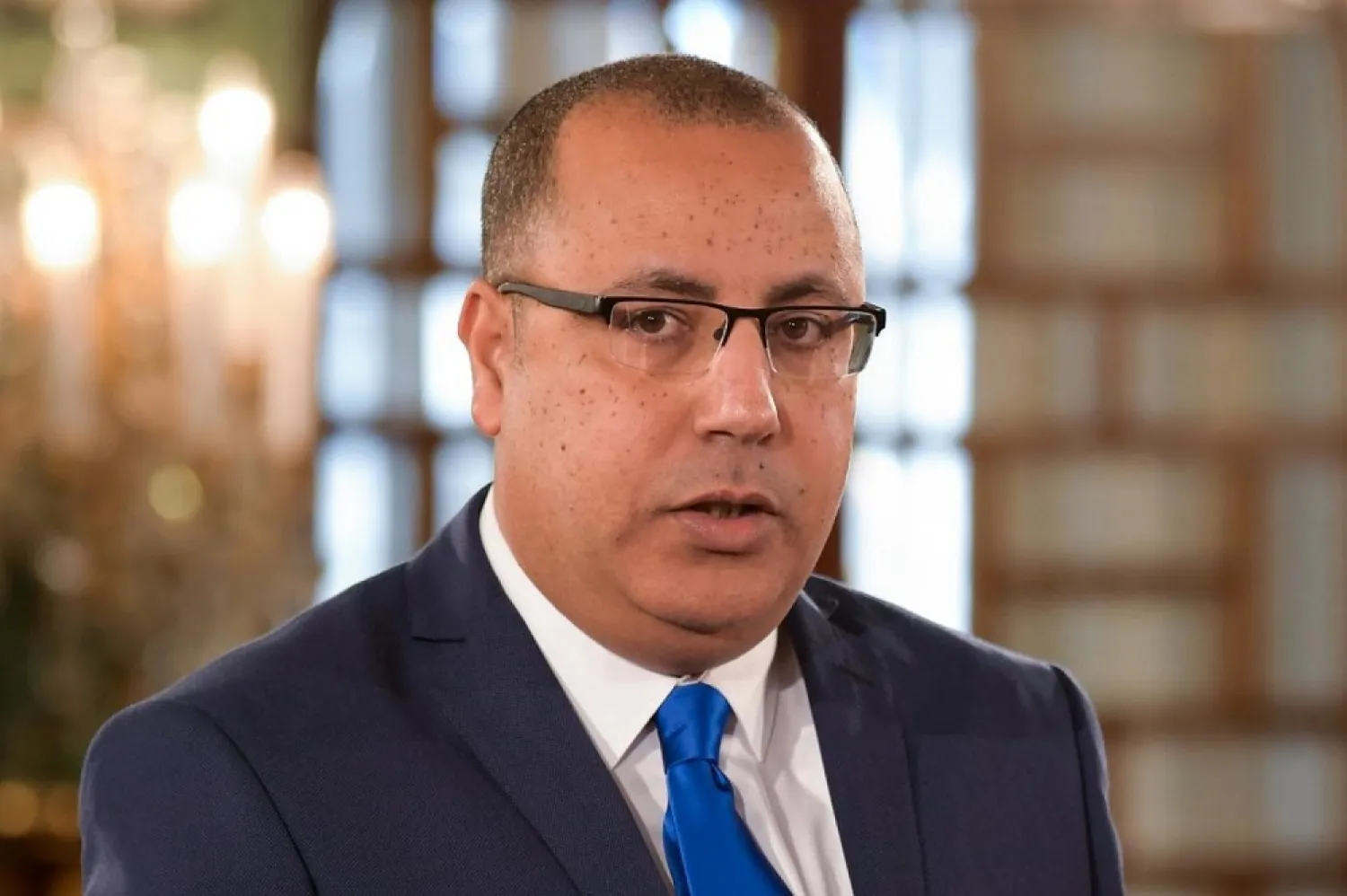

Tunisian Parties Demand New Govt. that Excludes Ennahda

Tunisian Prime Minister-designate Hichem Mechichi. (AFP)
TT

Tunisian Parties Demand New Govt. that Excludes Ennahda

Tunisian Prime Minister-designate Hichem Mechichi. (AFP)

Tunisian Prime Minister-designate Hichem Mechichi has continued his efforts and consultations with various political parties to form a new government.

Media leaks from these talks have revealed a growing number of parties’ objection to the inclusion of the moderate Islamist Ennahda party in the new government coalition.

The objections have been expressed by the Democratic Current and People’s Movement, whose leader Zouhair Maghzaoui said that opponents of Ennahda are mulling the possibility of forming a government without it.

Other opponents of Speaker Rached al-Ghannouchi’s movement include the Free Destourian Party, which boasts 17 seats at parliament. The Democratic Current and People’s Movement boast 38 lawmakers at the legislature. These parties were able to secure the vote of 97 MPs during a recent no-c-confidence vote against the speaker.

They were short of the 109 needed to oust him, but they managed to form a new opposition front that will rally behind calls to keep Ennahda out of government.

The Free Destourian Party, one of Ennahda’s fiercest opponents, has announced that it would not take part in Mechichi’s government-formation efforts unless they are aimed at keeping Ghannouchi’s movement out of power.

On the other side of the divide, head of Ennahda’s parliamentary bloc, Noureddine al-Bhiri, said the movement will welcome all suggestions that meet the aspirations of the Tunisian people.

Ennahda is ready to work with all political parties, except those who have taken themselves out of the equation, he said, referring to the Free Destourian Party.



Israeli Settlers Keep Up Siege of Palestinian Homes Despite Army Intervention

Israeli settlers besiege a Palestinian home for the fourth consecutive day in the town of Qusra, south of Nablus, 12 August 2026. (EPA)
TT

Israeli Settlers Keep Up Siege of Palestinian Homes Despite Army Intervention

Israeli settlers besiege a Palestinian home for the fourth consecutive day in the town of Qusra, south of Nablus, 12 August 2026. (EPA)

The Israeli military failed in an attempt on Wednesday to remove occupied West Bank settlers who for days have blockaded Palestinian homes, an eyewitness and an AFP photographer reported.

The siege began on Sunday, when a group of settlers set up a makeshift tent near houses in the Palestinian village of Qusra, just south of Nablus, blocking essential supplies from entering.

"We have received no food and no medicine," Qusai Abu Rida, a Palestinian trapped inside one of the houses, told AFP by telephone, adding that he had only managed to secure electricity thanks to solar panels.

The Israeli military condemned the settlers' actions and declared the area a "closed military zone", before on Wednesday morning removing the tent where the settlers had been staying.

Security forces "are working to evacuate the civilians who were staying there," the military said in a statement.

By mid-afternoon, an AFP photographer at the scene said the military had left and the tent had been removed, but that the settlers were still at the site.

Abu Rida confirmed the situation remained unchanged, with the settlers still in possession of chairs and blankets.

"The army has withdrawn, and so far we are still besieged, with the settlers at our doorstep," he told AFP.

Violence by Israeli settlers towards Palestinians in the West Bank has persisted for years, often with little or no legal consequence, but recent months have seen a surge in attacks.

Israel has occupied the West Bank since 1967.

More than 500,000 Israelis live in settlements in the Palestinian territory, which are illegal under international law, among some three million Palestinians.

The Israeli military said Tuesday it had received several reports of settlers entering and taking control of Palestinian homes and land in the area.

"This is illegal, reprehensible and unacceptable activity that harms the residents of the areas and disrupts their daily lives," it said.

It also said that disciplinary action would be taken against security personnel who had been filmed at the site days earlier.

According to an AFP tally based on data from the Palestinian health ministry, Israeli soldiers or settlers have killed at least 1,097 Palestinians, including both gunmen and civilians, since the start of the Gaza war in October 2023.

Israeli figures show at least 48 Israelis, including civilians and security personnel, have been killed in Palestinian attacks or during Israeli military operations during the same period.


Syria Receives First Shipments at Pier Previously Used by Russia

A drone view shows a vessel at Berth NO. 4, which was handed over by Russian forces to the Syrian government, at the port of Tartus in Tartus, Syria, August 12, 2026. (Reuters)
TT

Syria Receives First Shipments at Pier Previously Used by Russia

A drone view shows a vessel at Berth NO. 4, which was handed over by Russian forces to the Syrian government, at the port of Tartus in Tartus, Syria, August 12, 2026. (Reuters)

Syria received its first shipments of wheat and cement materials this week at a berth previously used by Russian forces, according to officials at the Tartus port, where Reuters reporters saw Russian forces packing up materials and moving out of parts of the pier.

Both shipments arrived on Tuesday, two days after Damascus announced it had reached an agreement with Moscow on the future of Russian bases at Tartus and the Hmeimim airport, ‌both in Syria's northwestern ‌coastal regions.

Syria's foreign ministry said the deal would ‌see ⁠Syria take over management ⁠of civilian facilities, including Hmeimim airport and the commercial berth at Tartus port, and that military facilities would be repurposed as joint training facilities.

"We began operating berth 4 yesterday after taking it over from the Operations Department. Work commenced immediately with the reception of two vessels in succession," Youssef Arnous, the head of Tartus port's operations and investment department, told Reuters on Wednesday.

He said that specific berth could ⁠accommodate up to three vessels simultaneously and that storage yards ‌directly opposite the pier could reduce vessel ‌waiting time during anchorage.

LSEG data showed that both vessels had come from Turkish ports, but ‌it was not immediately clear where they had originated.

Reuters reporters at the ‌port on Wednesday saw Russian forces moving out of a building near the pier and relocating material to another military facility nearby.

It was not immediately clear how many Russian forces remain at Tartus or in Hmeimim. A Syrian source familiar with the arrangement ‌said some Russian military forces would stay in Syria as part of the deal.

The future of the bases ⁠became uncertain after ⁠Russian ally Bashar al-Assad fled the country in 2024. The memorandum followed 18 months of intensive negotiations.

Russia's foreign ministry said on Tuesday that it saw the deal as "an important step aimed at further improving bilateral cooperation in the military sphere".

Russia has long viewed its naval and air bases in Syria as a key source of geopolitical clout in the Middle East and power projection across the Mediterranean and into Africa.

The Tartus facility is Russia's only Mediterranean repair and replenishment hub, and Moscow has used Syria as a staging post to fly its military contractors in and out of Africa.

Reuters reported in July that parts of the fourth berth in Tartus that had been used by Russia's military would be transformed into a commercial and logistics hub.


Report: UK, Italy Among States Considered to Verify Hezbollah Disarmament

A photograph taken from the southern Lebanese village of Zawtar al-Gharbiyeh shows Israeli tanks as they maneuver in the nearby village of Zawtar al-Sharkiyeh on August 8, 2026. (AFP)
TT

Report: UK, Italy Among States Considered to Verify Hezbollah Disarmament

A photograph taken from the southern Lebanese village of Zawtar al-Gharbiyeh shows Israeli tanks as they maneuver in the nearby village of Zawtar al-Sharkiyeh on August 8, 2026. (AFP)

Israel and Lebanon have agreed on Britain, Italy, Switzerland and Indonesia as potential contributors to a proposed mechanism that could see foreign troops deployed to Lebanon to verify Hezbollah's disarmament, people familiar with the matter said.

The shortlist emerged from US-mediated talks in Rome last week, the latest round of negotiations between Israel and Lebanon on implementing a June agreement that ties Israel's phased withdrawal from Lebanon to the disarmament of Hezbollah.

The countries could help define the mechanism's scope, provide personnel to oversee its implementation or contribute troops to observe or take part ‌in inspections ‌verifying disarmament, three sources said.

A Lebanese official told Reuters on ‌Friday ⁠that Israel and Lebanon ⁠had agreed on a list of potential countries that could send troops to verify disarmament, but declined to identify them, saying the US would decide which of them would take part.

Israel and Lebanon in late June agreed to a US-mediated framework as part of Washington's efforts to end the latest round of conflict between Israel and Hezbollah, triggered in March when the Iran-backed Lebanese armed group attacked Israel following US and Israeli war against Iran.

A ⁠source with direct knowledge of the matter said discussions surrounding ‌the shortlisted countries were in the early stages but ‌said that they were "cautiously optimistic" the effort would proceed.

The Israeli prime minister's office, the Lebanese ‌presidency and the British, Italian, and Indonesian foreign ministries did not immediately respond to requests ‌for comment. Switzerland's foreign ministry had no immediate comment.

ISRAEL SEEKING SEARCHES OF PRIVATE HOMES

Israel's military occupies what it describes as a security zone extending 10 kilometers into southern Lebanon and has said it will not withdraw unilaterally until Hezbollah is disarmed.

Two sources said that under the ‌proposed mechanism, villages in southern Lebanon would be inspected and verified as being free of weapons. Israel wants those inspections to ⁠include private homes, they ⁠said.

Lebanon's army has resisted pressure over the last year to search private properties, fearing such searches could spark tensions in the south and with Hezbollah more broadly. Security officials have told Reuters the army would need warrants for each house.

A foreign security official said the question of private properties would need addressing, including how and by whom they would be searched. The official said the extent of foreign troops' freedom of movement would also need to be clearly established.

A mandate for the presence of foreign troops in Lebanon would have to be agreed, the sources said, with the most likely scenario being that they would be formally invited by the Lebanese government under a framework endorsed by Israel.

The US and Israel were unlikely to accept UN involvement, the sources said, while European nations may oppose oversight by US President Donald Trump's Board of Peace.