


'Armageddon' at Beirut Hospitals after Blast Hurt Medics, Patients Alike

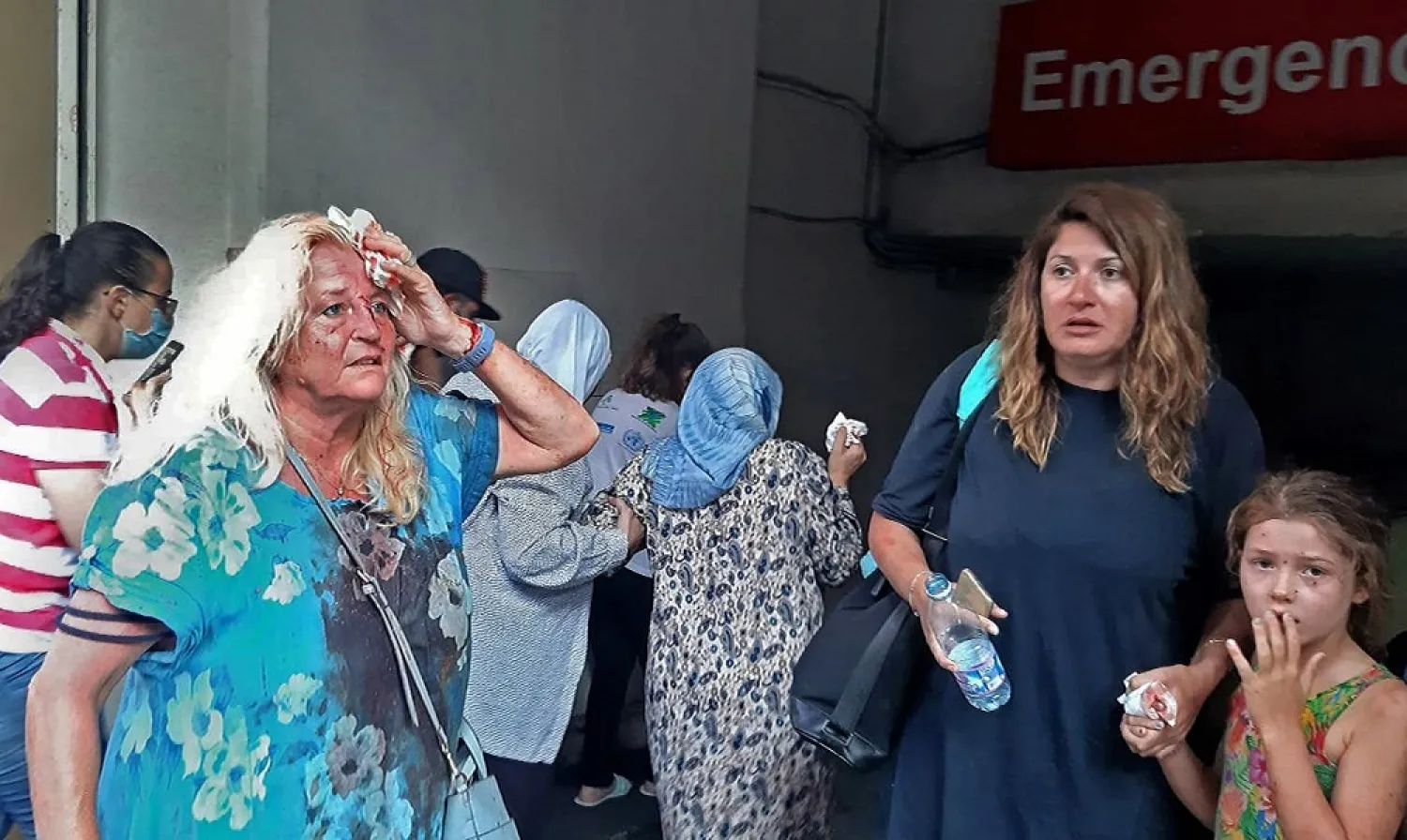
Valarie Fakhoury, a British grandmother with her Lebanese daughter and granddaughter, stand outside the emergency ward of a hospital in the Hamra district of central Beirut. (AFP)
TT

'Armageddon' at Beirut Hospitals after Blast Hurt Medics, Patients Alike

Valarie Fakhoury, a British grandmother with her Lebanese daughter and granddaughter, stand outside the emergency ward of a hospital in the Hamra district of central Beirut. (AFP)

His head bandaged just like his patients, Dr Antoine Qurban said Tuesday's enormous blast brought "Armageddon" to Beirut's overwhelmed hospitals in chaotic scenes reminiscent of a war zone.

"Wounded people bleeding out in the middle of the street, others lying on the ground in the hospital courtyard -- it reminded me of my missions with Doctors Without Borders (MSF) in Afghanistan many years ago," he said of his volunteer stint with the medical charity.

The surgeon was among more than 4,000 wounded people who staggered or were taken into badly damaged and massively crowded hospitals across the devastated Lebanese capital on Tuesday evening.

The huge explosion has piled even more pressure on Lebanon's strained health sector, which before the disaster was already struggling with a wave of coronavirus cases and a severe economic crisis.

"It was Armageddon," Qurban, who is in his late sixties, told AFP outside the Hotel Dieu Hospital in central Beirut.

The facility is normally his place of work, but on Wednesday he was among throngs of patients, following up on a gash he suffered Tuesday night.

Qurban was at a nearby coffee shop when the blast hit around 6:00 pm local time, flinging him some 20 meters (60 feet) across the room.

His own hospital was overflowing within minutes with wounded, so a stranger on a motorcycle zipped him to another facility.

After an hours-long wait, a medic stitched up his head wound in the street.

'She's already dead'

The scenes were no less chaotic on Wednesday, as people wounded overnight by falling shards of glass sought treatment, weaving between smashed equipment and piles of debris in Hotel Dieu's hallways.

Mothers asked desperately about the fates of their wounded sons. An elderly man begged for news of his wife, who had been transferred from another hospital.

A cacophony of cellphones rang, and fragments of exhausted conversations could be heard, usually retelling survival stories.

"A miracle kept him alive," one woman was heard saying, while a man with a bandaged leg handed a blinking cellphone to his sister, telling her simply that "I can't talk anymore".

Hotel Dieu treated at least 300 wounded Tuesday and registered 13 dead, according to its medical director Dr. George Dabar, who was a medical student there during Lebanon's 15-year civil war.

"Even then, I didn't see anything like what I saw yesterday," he said.

His voice cracking with emotion, Dabar told AFP the hardest moment was telling families their loved ones had died, with nothing left to be done.

"It's so hard to tell a father carrying his young daughter and trying to save her that she's already dead."

According to Lebanon's health ministry, two hospitals were rendered completely out of service and two more were partly unusable.

At least five nurses died, and several medics and patients were severely hurt.

"The medical teams were already exhausted by everything that has happened in this country and by the coronavirus pandemic," Dabar said.

"But to face yesterday's crisis, they came together with amazing solidarity."

From cooks to maintenance workers, Dabar said, the entire staff was working side by side so Hotel Dieu could stay open.

Evacuating COVID-19 patients

The St. George Hospital was not so lucky. The blast left the facility, one of Beirut's oldest, with collapsed ceilings and electrical wires hanging over beds showered with glass.

"We are not in service anymore," said St. George Hospital's chief of staff Eid Azar.

"Amid the current economic situation, I don't know how much time it will take to repair," he told AFP.

Staff worked until just before dawn to evacuate patients, equipment and files.

"We did a hospital evacuation, which very rarely happens," and which included the highly sensitive transfer of 20 patients being treated for COVID-19, he said.

Azar said the emergency operation reminded him of Hurricane Katrina, the devastating natural disaster that hit the US in 2005.

The courtyard was turned into a field clinic, where doctors in bloodied medical robes treated shell-shocked people in the open.

"There's nothing harder than evacuating a hospital filled to the brim with patients while even more wounded are coming," said Azar.

"The hospital staff itself was wounded and we needed to transfer our own employees."

Medics carried patients from nine separate floors one by one on stretchers, as the blast had knocked out the elevators.

Without electricity or water, nurses took great risks to provide whatever life-saving support they could.

"The hospital lights are usually on 24 hours a day -- it was completely dark," said clinical nurse specialist Lara Daher.

"We stitched up patients by the light of our cellphones last night. I don't know how we did it. I've never seen anything like it."



Sudan Drone Attack on Darfur Market Kills 10

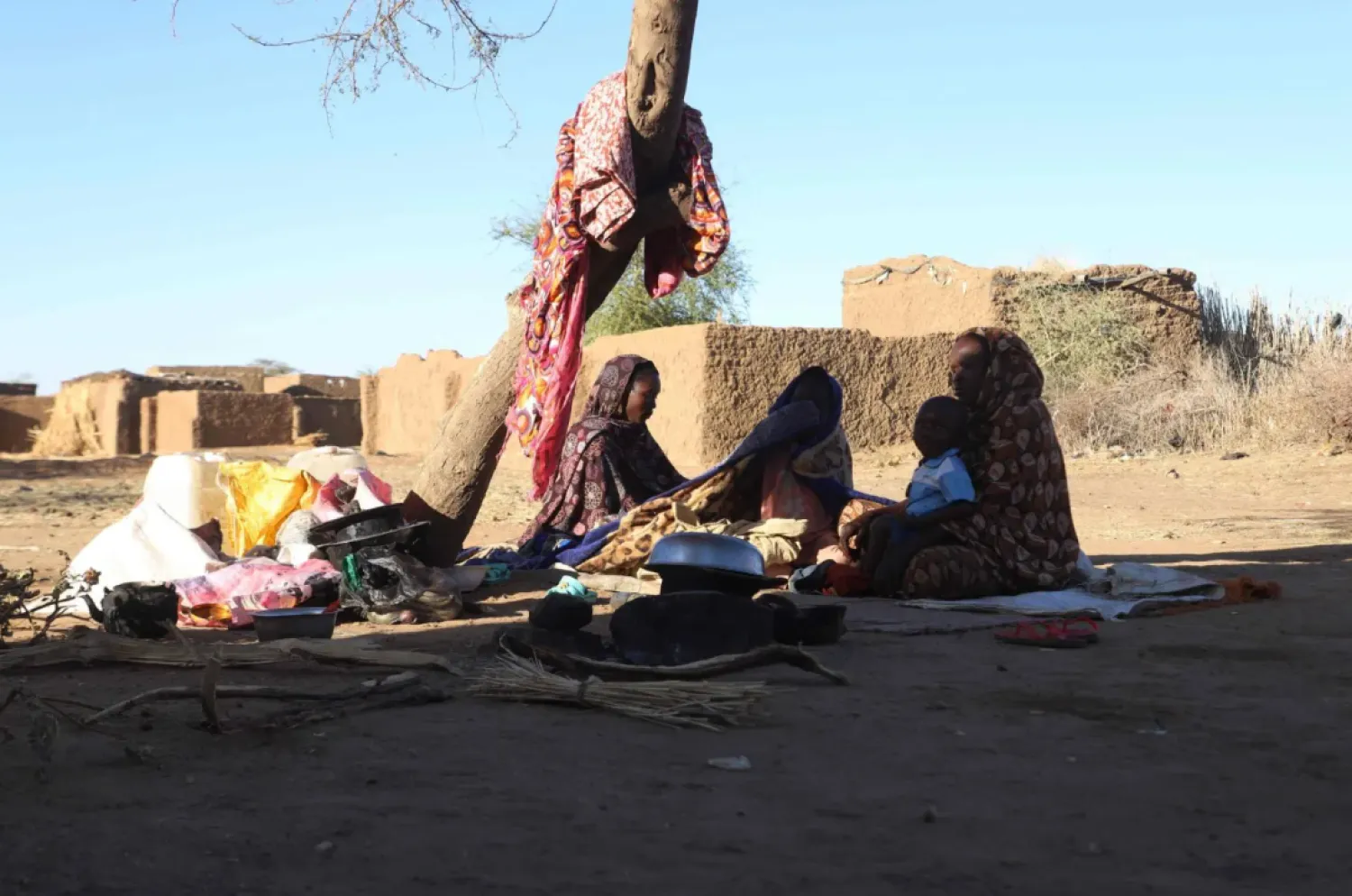
Sudanese refugee girls carry water supplies near a polling station in the refugee camp of Zamzam, on the outskirts of el-Fasher, Darfur, Sudan, on April 13, 2010. (AP)
TT

Sudan Drone Attack on Darfur Market Kills 10

Sudanese refugee girls carry water supplies near a polling station in the refugee camp of Zamzam, on the outskirts of el-Fasher, Darfur, Sudan, on April 13, 2010. (AP)

A drone attack on a busy market in Sudan's North Darfur state killed 10 people over the weekend, first responders said on Sunday, without saying who was responsible.

The attack comes as fighting intensified elsewhere in the country, leading aid workers to be evacuated on Sunday from Kadugli, a besieged, famine-hit city in the south.

Since April 2023, Sudan's army and the paramilitary Rapid Support Forces have been locked in a conflict which has killed tens of thousands of people, displaced nearly 12 million and created the world's largest displacement and hunger crisis.

The North Darfur Emergency Rooms Council, one of hundreds of volunteer groups coordinating aid across Sudan, said a drone strike hit Al-Harra market in the RSF-controlled town of Malha on Saturday.

The attack killed 10 people, it said.

The council did not identify who carried out the attack, which it said had also sparked "fire in shops and caused extensive material damage".

There was no immediate comment from either the Sudanese army or the RSF.

The war's current focal point is now South Kordofan and clashes have escalated in Kadugli, the state capital, where a drone attack last week killed eight people as they attempted to flee the army-controlled city.

A source from a humanitarian organization operating in Kadugli told AFP on Sunday that humanitarian groups had "evacuated all their workers" from the city because of the security conditions.

The evacuation followed the United Nations' decision to relocate its logistics hub from Kadugli, the source said on condition of anonymity, without specifying where the staff had gone.

- Measles outbreak -

Kadugli and nearby Dilling have been besieged by paramilitary forces since the war erupted.

Last week, the RSF claimed control of the Brno area, a key defensive line on the road between Kadugli and Dilling.

After dislodging the army in October from the western city of el-Fasher -- its last stronghold in the Darfur region -- the RSF has shifted its focus to resource-rich Kordofan, a strategic crossroads linking army-held northern and eastern territories with RSF-held Darfur in the west.

Like Darfur, Kordofan is home to numerous non-Sudanese Arab ethnic groups. Much of the violence that followed the fall of el-Fasher was reportedly ethnically targeted.

Communications in Kordofan have been cut, and the United Nations declared a famine in Kadugli last month.

According to the UN's International Organization for Migration, more than 50,000 civilians have fled the region since the end of October.

Residents have been forced to forage for food in nearby forests, according to accounts gathered by AFP.

Doctors without Borders (MSF) said on Sunday that measles was spreading in three of the four states in Darfur, a vast region covering much of western Sudan.

"A preventable measles outbreak is spreading across Central, South and West Darfur," the organization said in a statement.

"Since September 2025, MSF teams have treated more than 1,300 cases. Delays in vaccine transport, approvals and coordination, by authorities and key partners are leaving children unprotected."


Foreign Press Group Welcomes Israel Court Deadline on Gaza Access

A Palestinian man carries the body of his 5-month-old brother, Ahmed Al-Nader, who was reportedly killed the previous day along with other family members in an Israeli shelling on a school-turned-shelter in the Tuffah neighborhood of Gaza City, ahead of his funeral on December 20, 2025. (AFP)
TT

Foreign Press Group Welcomes Israel Court Deadline on Gaza Access

A Palestinian man carries the body of his 5-month-old brother, Ahmed Al-Nader, who was reportedly killed the previous day along with other family members in an Israeli shelling on a school-turned-shelter in the Tuffah neighborhood of Gaza City, ahead of his funeral on December 20, 2025. (AFP)

The Foreign Press Association in Jerusalem on Sunday welcomed the Israeli Supreme Court's decision to set January 4 as the deadline for Israel to respond to its petition seeking media access to Gaza.

Since the start of the Gaza war in October 2023, sparked by Palestinian group Hamas's attack on Israel, Israeli authorities have prevented foreign journalists from independently entering the devastated territory.

Israel has instead allowed, on a case-by-case basis, a handful of reporters to accompany its troops into the blockaded Palestinian territory.

The Foreign Press Association (FPA), which represents hundreds of foreign journalists in Israel and the Palestinian territories, filed a petition to the supreme court last year, seeking immediate access for international journalists to the Gaza Strip.

On October 23, the court held a first hearing on the case, and decided to give Israeli authorities one month to develop a plan for granting access.

Since then, the court has given several extensions to the Israeli authorities to come up with their plan, but on Saturday it set January 4 as a final deadline.

"If the respondents (Israeli authorities) do not inform us of their position by that date, a decision on the request for a conditional order will be made on the basis of the material in the case file," the court said.

The FPA welcomed the court's latest directive.

"After two years of the state's delay tactics, we are pleased that the court's patience has finally run out," the association said in a statement.

"We renew our call for the state of Israel to immediately grant journalists free and unfettered access to the Gaza Strip.

"And should the government continue to obstruct press freedoms, we hope that the supreme court will recognize and uphold those freedoms," it added.


One Dead in Israeli Strikes on South Lebanon

Smoke rises from the site of a series of Israeli airstrikes that targeted the outskirts of the southern Lebanese village of al-Katrani on December 18, 2025. (AFP)
TT

One Dead in Israeli Strikes on South Lebanon

Smoke rises from the site of a series of Israeli airstrikes that targeted the outskirts of the southern Lebanese village of al-Katrani on December 18, 2025. (AFP)

Israeli strikes in south Lebanon on Sunday killed one person and wounded another, the Lebanese health ministry said, as Israel's military said it targeted Hezbollah members.

Israel has kept up regular strikes on Lebanon, usually saying it is targeting Hezbollah infrastructure or operatives, despite a November 2024 ceasefire that sought to end more than a year of hostilities with the Iran-backed group that erupted over the Gaza war.

It has also kept troops in five south Lebanon areas that it deems strategic.

The health ministry in Beirut said "two Israeli enemy strikes today, on a vehicle and a motorbike in the town of Yater" killed one person and wounded another.

Yater is around five kilometers (three miles) from the border with Israel.

In separate statements, the Israeli military said it "struck a Hezbollah terrorist in the area of Yater", adding shortly afterwards that it "struck an additional Hezbollah terrorist" in the same area.

Also on Sunday, Lebanon's army said in a statement that troops had discovered and dismantled "an Israeli spy device" in Yaroun, elsewhere in south Lebanon near the border.

Under heavy US pressure and amid fears of expanded Israeli strikes, Lebanon has committed to disarming Hezbollah and plans to do so south of the Litani River, about 30 kilometers from the border with Israel, by year end.

Israel has questioned the Lebanese military's effectiveness and has accused Hezbollah of rearming, while the group itself has rejected calls to surrender its weapons.

During a visit to Israel on Sunday, US Senator Lindsey Graham also accused Hezbollah of rearming.

"My impression is that Hezbollah is trying to make more weapons... That's not an acceptable outcome," Graham said in a video statement issued by Israeli Prime Minister Benjamin Netanyahu's office.

More than 340 people have been killed by Israeli fire in Lebanon since the ceasefire, according to an AFP tally of Lebanese health ministry reports.

This week at talks in Paris, Lebanon's army chief agreed to document the military's progress in disarming Hezbollah, the French foreign ministry said.

On Friday, Lebanese and Israeli civilian representatives took part in a meeting of the ceasefire monitoring committee for a second time, after holding their first direct talks in decades earlier this month under the committee's auspices.

Israel said Friday's meeting was part of broader efforts to ensure Hezbollah's disarmament and strengthen security in border areas.