


Furious Lebanese Count their Losses from Blast, Plan Demonstration

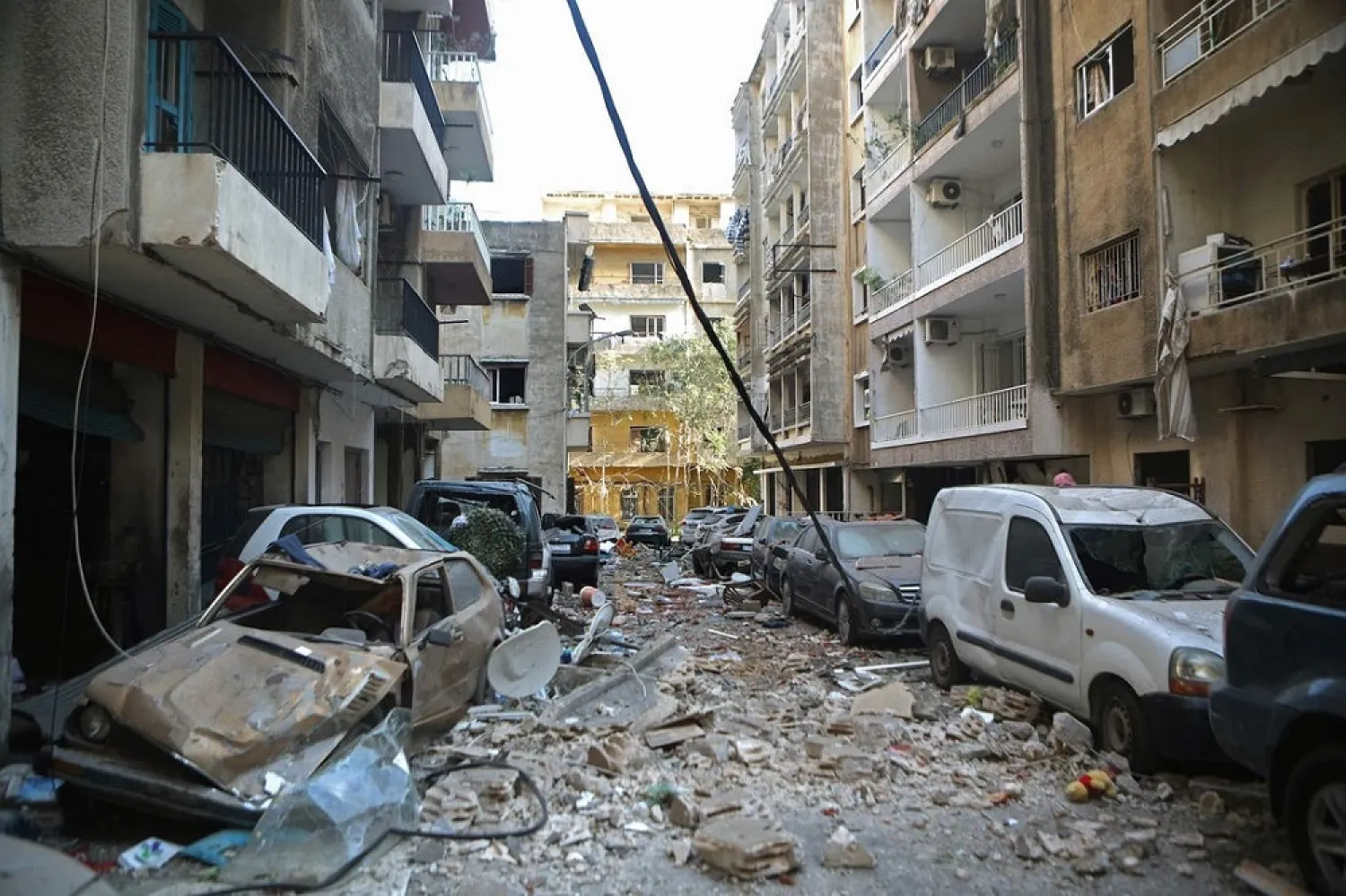
A view of the damaged Beirut neighborhood of Mar Mikhael on Wednesday in the aftermath of the explosion. (Getty Images)
TT

Furious Lebanese Count their Losses from Blast, Plan Demonstration

A view of the damaged Beirut neighborhood of Mar Mikhael on Wednesday in the aftermath of the explosion. (Getty Images)

As Beirut mourns its dead and grapples with the scale of rebuilding after this week's massive blast, some Lebanese activists planned to demonstrate in the city on Saturday, angered by the government's response to the disaster.

Tuesday's port explosion, the biggest in Beirut's history, killed 154 people, injured 5,000 and destroyed a swathe of the city.

Some residents, struggling to clean up shattered homes, complain the state they see as corrupt - there had been months of protests against the government's handling of a deep economic crisis before this week's disaster - has let them down again.

The demonstration was planned for Saturday afternoon.

"The people are doing your work, shame," someone wrote on the dust covering a car window, referring to Lebanese leaders.

The prime minister and presidency have said 2,750 tons of highly explosive ammonium nitrate, which is used in making fertilizers and bombs, had been stored for six years without safety measures at the port warehouse.

President Michel Aoun said on Friday an investigation would also examine whether it was caused by a bomb or other external interference. Aoun said the investigation would also weigh if the blast was due to negligence or an accident. Twenty people had been detained so far, he added.

'We can't afford to rebuild'
Some residents wondered how they would ever rebuild their lives.

Tearing up, Bilal Hassan used his bare hands to try to remove debris from his home located a few hundred meters from where the port blast hit. He has been sleeping on a dusty couch besides pieces of splintered glass.

When his three wounded teenage children ran for their lives they left blood stains on the staircase and walls.

"There is really nothing we can do. We can't afford to rebuild and no one is helping us," he said, standing beside a large teddy bear that was blown across his home, and a damaged photograph of him and his wife.

Bulldozers ploughed through the wreckage of mangled homes and long rows of flattened cars as soldiers stood by. Volunteers with shovels streamed through streets.

Danielle Chemaly said her charity organization, whose headquarters was destroyed, had provided assistance to 70 families who were left homeless by the explosion.

"We have given people initial help but we don't know what we can do for families in the future. It requires major projects," she said.

Officials have said the blast could have caused losses amounting to $15 billion. That is a bill that Lebanon cannot pay after already defaulting on a mountain of debt - exceeding 150% of economic output - and with talks stalled on a lifeline from the International Monetary Fund.

43 Syrians among victims
Syria’s state TV said 43 Syrian citizens were killed in the blast.

The TV quoted the Syrian embassy in Lebanon as saying that the number is not final as search operations for dozens of missing are still ongoing.

Lebanon is home to more than a million Syrians many of them refugees who fled civil war in their country.

The wife of the Dutch ambassador to Lebanon died on Saturday after being seriously injured in the massive explosion, the Dutch Foreign Ministry said.

Hedwig Waltmans-Molier, 55, was injured by the explosion as she stood next to her husband, ambassador Jan Waltmans, in the living room of their house in Beirut, the ministry said.

Tuesday’s blast caused extensive damage to the Dutch embassy, injuring four other people connected to it.

Aid from abroad
France and other countries have rushed emergency aid to Lebanon, including doctors, and tons of health equipment and food. The blast destroyed Lebanon's only major grain silo and UN agencies are helping provide emergency food and medical aid.

US President Donald Trump said on Friday he would join a conference call with Lebanon's president and other world leaders on Sunday to discuss aid to the country.

For ordinary Lebanese, the scale of destruction is overwhelming.

"It felt like a mini atomic bomb," said George Rohana, sitting beside a supermarket that was demolished.

A few onions were left in the debris of the blast that tore a huge hole through the shop into an adjacent apartment.

"Now we have a situation where people are stealing metals and other items from the destruction," said Rohana. "The other day someone walked away with a broken toaster."



World Defense Show in Riyadh Witnesses Signing of Important Agreements

Saudi Minister of Defense Prince Khalid bin Salman bin Abdulaziz signs an agreement with his Slovakian counterpart. SPA
TT

World Defense Show in Riyadh Witnesses Signing of Important Agreements

Saudi Minister of Defense Prince Khalid bin Salman bin Abdulaziz signs an agreement with his Slovakian counterpart. SPA

Saudi Minister of Defense and Vice Chairman of the Board of Directors of the General Authority for Military Industries (GAMI) Prince Khalid bin Salman bin Abdulaziz inaugurated in Riyadh the third edition of the World Defense Show, organized by GAMI until February 12.

At the Saudi Arabian Military Industries (SAMI) Group pavilion, the Defense Minister launched on Sunday SAMI Land Company, SAMI Autonomous Company, SAMI Land Industrial Complex, and the HEET Program.

He also unveiled the SAMI Local Content Program (RUKN), the group's flagship supply chain program.

Prince Khalid and his South Korean counterpart witnessed the signing of a memorandum of understanding between the Saudi General Authority for Defense Development and the Korean Agency for Defense Development.

The agreement focuses on defense research, development, and innovation in advanced military technologies and systems.

The Saudi Defense Minister also signed three defense cooperation agreements with Slovakia, Malaysia, and Somalia.

Furthermore, the National Industrial Development Center signed a cooperation memorandum with European aerospace corporation Airbus to explore opportunities for developing and localizing the aviation and helicopter industry in Saudi Arabia.

Under the memorandum, the two sides aim to strengthen collaboration to establish an integrated aviation industrial base in the Kingdom. They will study the creation of an engineering center to develop national capabilities in manufacturing, assembly, maintenance, and repair, alongside a supporting logistics network.

The agreement also covers technology and knowledge transfer, encouraging global suppliers to invest in Saudi Arabia, and developing Saudi talent through educational and training partnerships with domestic institutions. It includes coordination with relevant authorities to examine procurement options, support the shift toward exports, and explore incentives and financing mechanisms to enhance project readiness and competitiveness.

GE Aerospace and the Middle East Propulsion Company Ltd. (MEPC) announced signing three new agreements to enhance operational readiness for the Royal Saudi Air Force (RSAF) F110 fleet and build in-country capabilities.

Leveraging their decade-old partnership, are focused on the RSAF’s F110-129 engines and will also support F110-129 customers across the broader region.

These agreements represent Phase 3 of a long-term initiative, building on the success of similar Phase 1 and 2 agreements, which saw GE Aerospace providing repair and overhaul services support to MEPC.

The agreements seek to ensure sustained material supply and comprehensive maintenance and repair services support for the RSAF F110 Engine Structural Integrity Program (ENSIP).

They highlight the shared vision of both companies to advance the safety, efficiency, and operational excellence of defense aircraft in the wider Middle East.

MEPC Managing Director Mohammed Alnawkhani said: “These agreements represent the next phase of our strategic partnership with GE Aerospace and a major step forward in enhancing readiness for the RSAF F110 fleet.”

“Together, we are expanding in-Kingdom F110-129 sustainment capabilities, ensuring long-term material availability, and delivering the high standards of safety and performance required by our customers in the Kingdom and across the region.”

“This milestone also strengthens localization efforts in support of Saudi Vision 2030, contributing to national industrial development and building sovereign aerospace sustainment capabilities,” he added.

Salim Mousallam, Vice President, Defense & Systems for the Middle East, Africa, and Türkiye at GE Aerospace said that the enduring partnership with MEPC is a testament to the company’s shared vision of enhancing in-country capabilities and ensuring peak operational readiness through maximized availability for its customers.

“These agreements will significantly increase engine availability, streamline MRO processes, and directly support the RSAF’s critical missions. As a trusted partner to the Kingdom, we are proud to provide high-quality services to MEPC, reducing maintenance burden and service disruptions for their mission-critical F110 fleet,” he said.

Under the F110-129 Material Support Agreement, GE Aerospace will provide essential ENSIP Kits (F110-129 parts) to support MEPC in performing the necessary overhaul of RSAF F110-129 engines within the Kingdom.

The F110-129 repair and overhaul agreement further solidifies the provision of comprehensive repair and overhaul services specifically for the Royal Saudi Air Force fleet. GE Aerospace also signed a new F110-129 services agreement to extend critical repair and overhaul capabilities to support other F110 customers across the region.


Prime Minister Takaichi’s Party Wins a Supermajority in Japan's Lower House

TOPSHOT - Japan's Prime Minister and President of the Liberal Democratic Party (LDP) Sanae Takaichi reacts as she speaks with media on the House of Representatives election day at the LDP headquarters in Tokyo on February 8, 2026. (Photo by Kim Kyung-Hoon / POOL / AFP)
TT

Prime Minister Takaichi’s Party Wins a Supermajority in Japan's Lower House

TOPSHOT - Japan's Prime Minister and President of the Liberal Democratic Party (LDP) Sanae Takaichi reacts as she speaks with media on the House of Representatives election day at the LDP headquarters in Tokyo on February 8, 2026. (Photo by Kim Kyung-Hoon / POOL / AFP)

Japanese Prime Minister Sanae Takaichi 's governing party secured a two-thirds supermajority in parliamentary elections, Japanese media reported, citing preliminary results. The landslide victory was due, in large part, to the extraordinary popularity of Japan's first female prime minister, and allows her to pursue a significant conservative shift in Japan’s security, immigration and other policies.

Takaichi, in a televised interview with public television network NHK following her victory, said she will emphasize policies meant to make Japan strong and prosperous, The Associated Press said.

NHK, citing vote count results, said Takaichi’s Liberal Democratic Party, or LDP, alone secured 316 seats by early Monday, comfortably surpassing a 261-seat absolute majority in the 465-member lower house, the more powerful of Japan's two-chamber parliament. That marks a record since the party's foundation in 1955 and surpasses the previous record of 300 seats won in 1986 by late Prime Minister Yasuhiro Nakasone.

With 36 seats won by its new ally, Japan Innovation Party, Takaichi's ruling coalition has won 352 seats.

A smiling Takaichi placed a big red ribbon above each winner’s name on a signboard at the LDP's headquarters, as accompanying party executives applauded.

Despite the lack of a majority in the upper house, the huge jump from the preelection share in the superior lower house would allow Takaichi to make progress on a right-wing agenda that aims to boost Japan’s economy and military capabilities as tensions grow with China and she tries to nurture ties with the United States.

Takaichi said she would try to gain support from the opposition while firmly pushing forward with her policy goals.

“I will be flexible,” she said.

Takaichi is popular, but the LDP, which has ruled Japan for most of the last seven decades, has struggled with funding and religious scandals in recent years. She called Sunday’s early election after only three months in office, hoping to turn that around while her popularity is high.

Popular leader

The ultraconservative Takaichi, who took office as Japan’s first female leader in October, pledged to “work, work, work,” and her style, which is seen as both playful and tough, has resonated with younger fans who say they weren't previously interested in politics.

The opposition, despite the formation of a new centrist alliance and a rising far-right, was too splintered to be a real challenger. The new opposition alliance of LDP’s former coalition partner, Buddhist-backed dovish Komeito, and the liberal-leaning Constitutional Democratic Party of Japan, is projected to sink to half of their combined preelection share of 167 seats.

Takaichi was betting with this election that her LDP party, together with its new partner, the JIP, would secure a majority.

Trump in a post on his Truth Social platform Sunday congratulated Takaichi "on a LANDSLIDE Victory in today’s very important Vote. She is a highly respected and very popular Leader. Sanae’s bold and wise decision to call for an Election paid off big time.”

Akihito Iwatake, a 53-year-old office worker, said he welcomed the big win by the LDP because he felt the party went too liberal in the past few years. “With Takaichi shifting things more toward the conservative side, I think that brought this positive result,” he said.

Takaichi's policies

The LDP's right-wing partner, JIP leader Hirofumi Yoshimura, has said his party will serve as an “accelerator” for Takaichi's push to conservative policies.

Japan has recently seen far-right populists gain ground, such as the anti-globalist and surging nationalist party Sanseito. Exit polls projected a big gain for Sanseito.

The first major task for Takaichi when the lower house reconvenes in mid-February is to work on a budget bill, delayed by the election, to fund economic measures that address rising costs and sluggish wages.

Takaichi has pledged to revise security and defense policies by December to bolster Japan’s offensive military capabilities, lifting a ban on weapons exports and moving further away from the country’s postwar pacifist principles.

She has been pushing for tougher policies on foreigners, anti-espionage and other measures that resonate with a far-right audience, but ones that experts say could undermine civil rights.

Takaichi also wants to increase defense spending in response to US President Donald Trump’s pressure for Japan to loosen its purse strings.

She now has time to work on these policies, without an election until 2028.

Divisive policies

Though Takaichi said that she's seeking to win support for policies seen as divisive in Japan, she largely avoided discussing ways to fund soaring military spending, how to fix diplomatic tension with China and other issues.

Despite her rightward shift, Takaichi is expected to maintain good relations with South Korea, given shared worries about threats from North Korea and China. But Seoul would worry about a Japanese attempt to revise the country's pacifist constitution or to further build up its military because of Japan's wartime past, said Leif-Eric Easley, professor of international studies at Ewha Womans University in Seoul.

In her campaign speeches, Takaichi enthusiastically talked about the need for government spending to fund “crisis management investment and growth,” such as measures to strengthen economic security, technology and other industries. Takaichi also seeks to push tougher measures on immigration, including stricter requirements for foreign property owners and a cap on foreign residents.

Sunday's election “underscores a problematic trend in Japanese politics in which political survival takes priority over substantive policy outcomes,” said Masato Kamikubo, a Ritsumeikan University politics professor. “Whenever the government attempts necessary but unpopular reforms ... the next election looms.”


Saudi Arabia Participates in Drafting the International AI Safety Report 2026

General view of Riyadh, Saudi Arabia. (SPA)
TT

Saudi Arabia Participates in Drafting the International AI Safety Report 2026

General view of Riyadh, Saudi Arabia. (SPA)

The Kingdom of Saudi Arabia, represented by the Saudi Data and Artificial Intelligence Authority (SDAIA), participated for the second consecutive year in the preparation of the International AI Safety Report 2026, reinforcing its international efforts to advance AI safety and support responsible innovation worldwide, the Saudi Press Agency said on Monday.

The report, emerging from the 2023 AI Safety Summit at Bletchley Park, provides a scientific assessment of advances in advanced AI systems, examines associated risks, and outlines practical approaches to strengthening safety standards and global governance, serving as a key reference for policymakers, regulators, and researchers.

The report is a comprehensive global document assessing AI risks and related challenges and serves as a trusted scientific reference to support regulatory policies and the development of governance frameworks for the safe and responsible use of advanced technologies.

The report was developed by a distinguished group of international scientists and experts in AI safety and technology governance, featuring specialists from prestigious universities and research centers, as well as representatives from over 30 countries and major international organizations, including the United Nations, the Organization for Economic Co-operation and Development, and the European Union.

The report highlights several key messages, notably the importance of keeping pace with the rapidly growing capabilities of AI through advanced regulatory and scientific frameworks, the need to invest in safety and technical compliance research to ensure systems remain under effective human oversight, and the promotion of international coordination to establish common standards supporting the safe and responsible use of advanced technologies.

It also emphasizes the need to consider economic and social dimensions to ensure the fair distribution of AI benefits and reduce inequality gaps.

Saudi Arabia’s participation in this international effort aligns with the objectives of Saudi Vision 2030, which aims to establish the Kingdom as a global hub for technological innovation while upholding the highest standards of responsibility and technical security.

It reflects the Kingdom’s commitment to actively shaping the global future of AI, promoting sustainable development, safeguarding community security, and enhancing international cooperation toward a safer, more stable technological future.