
New York’s Sidewalk Prophets Are Heirs of the Artisans of France’s Lascaux Caves

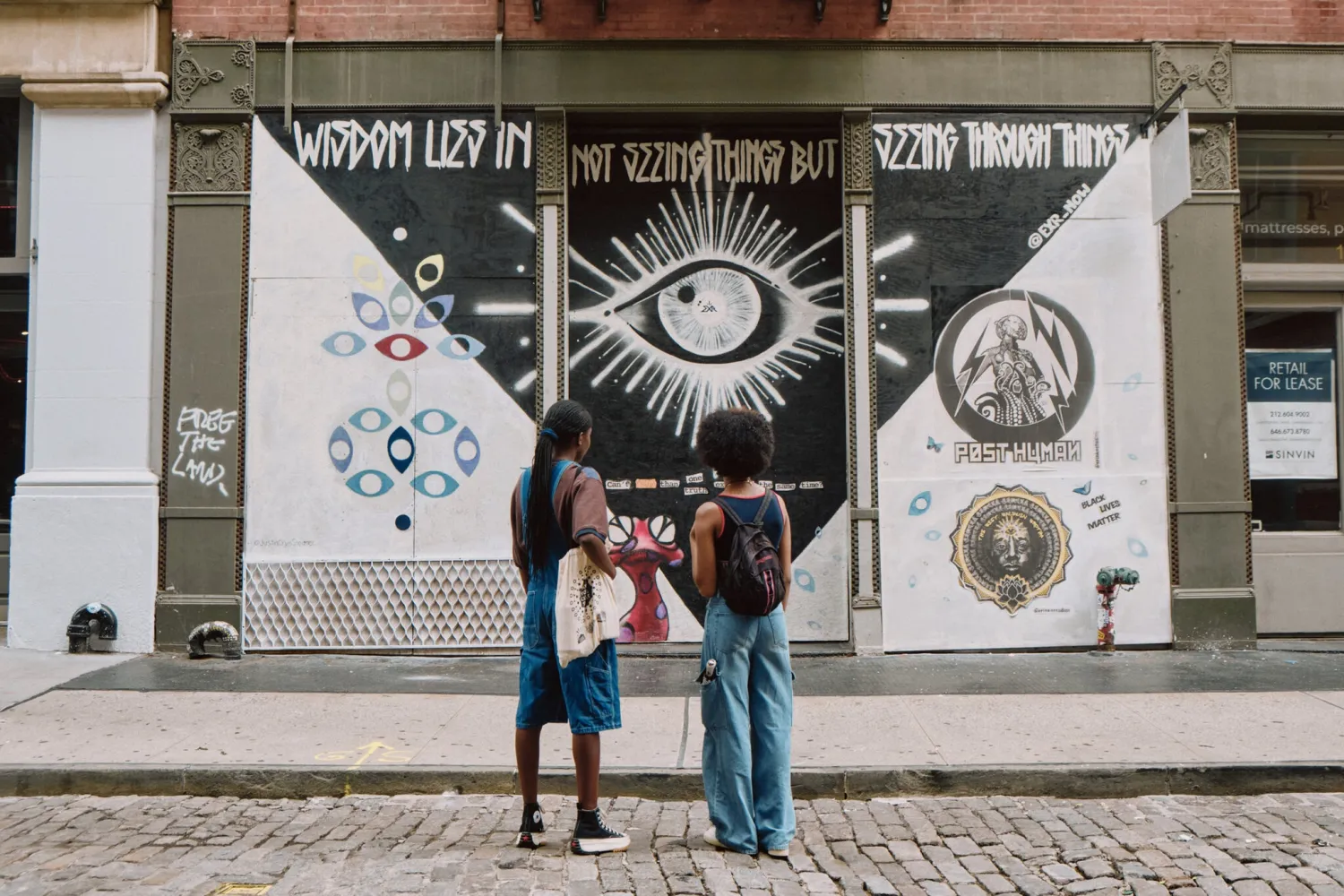
On Wooster Street, a mural emerged during the unplanned collaboration of five artists, Erin Ko, Justin Orvis Steimer, the artist known as EXR, Antennae and Helixx C. Armageddon.Credit...Simbarashe Cha for The New York Times
TT

New York’s Sidewalk Prophets Are Heirs of the Artisans of France’s Lascaux Caves

On Wooster Street, a mural emerged during the unplanned collaboration of five artists, Erin Ko, Justin Orvis Steimer, the artist known as EXR, Antennae and Helixx C. Armageddon.Credit...Simbarashe Cha for The New York Times

About 17,000 years ago, in the caves of Lascaux, France, ancestors drew on grotto walls, depicting equines, stags, bison, aurochs and felines. They wanted to convey to other humans a political reality crucial to their survival: They shared their environment with other beings that looked and behaved differently from them.

Those early artisans drew these creatures over and over, likely fascinated by their forms and their powers, but also intuiting that whatever happened to the animals would almost certainly be a harbinger of what would happen to humans. The presence of the bison and stags, their physical fitness and numbers, their mass migrations would have indicated the onset of plagues or cataclysmic weather systems. Containing some 15,000 paintings and engravings from the Upper Paleolithic era, the caves in Southwestern France were not simply an exhibition space for local talent. They essentially constituted a public square where a community shared critical knowledge.

These portraits and discrete stories are not very different from our contemporary forums: the street art adorning boarded-up storefronts in New York City. They tell us about our shared political realities, the people we coexist with in social space and the ways in which our stories and fates are tied together. If you walk the streets of SoHo, the alleys of the Lower East Side, and heavily trafficked avenues in Brooklyn, as I did over the last few weeks, you will see these symbols and signs and might wonder at their meanings. What became apparent to me is that in the intervening millenniums between those cave paintings and the killing of George Floyd, the messages we share, like the sociopolitical circumstances that impel them, have become more complex.

Now street artists take account of the qualified legal immunity protecting police officers, the Black Lives Matter movement and the ramifications of a dysfunctional democracy, among other realities, using a well-developed visual language of cultural memes that illustrate the ideological battles among regional, racial and cultural factions.

When we see the image of thin, green-skinned, bipedal beings with teardrop-shaped black apertures for eyes, we typically read “alien.” But when I see the image of such a creature holding a sign that reads “I can’t breathe,” I grok an urgent message: Even aliens visiting from light years away understand the plight of Black people in the United States because this situation is so obviously dire.

Today’s street paintings contain dispatches that proliferate across the city sphere — lovely, challenging, angry, remonstrative and even desperate. There are two critical things to note about them. They are different from graffiti, which to my eyes is egocentric and monotone, mostly instantiating the will of the tagger over and over again. I am here and you must see me, is the message.

The street artists in these works point beyond the self, to larger, collective issues. The other pressing point is that these images in chalk, paint and oil stick are ephemeral. Between the time I walked these districts and alerted the photographer to document them, five images had already disappeared. One was a depiction of the transgender freedom fighter Marsha P. Johnson, whose image was marked in chalk on the sidewalk in the ad hoc tent city created near Chambers Street a few weeks ago. It’s since been cleared out by police officers.

Unlike the caves of Lascaux (which are on the UNESCO World Heritage Sites list) most of this work won’t be protected or anthologized — but it should be. The lingual messages and coded images on these plywood facades are the means by which future historians and researchers will come to understand this time and give our generation a proper name.

In SoHo the artist Nick C. Kirk serialized images of Donald Trump standing in for over-militarized police officers in a work constituting a visual indictment of a commander in chief who claims to deploy state forces only to quell violence and enforce the peace. The “VIP” sign on each shield seems to allude to his widely documented narcissism and suggests that the deployment of police is a self-serving ploy to burnish his public image. More, the running banner of “Demilitarize the Police” suggests that in the artist’s eyes, the police do not come to make peace.

On Wooster Street an unplanned collaboration by Erin Ko, Justin Orvis Steimer, EXR, Antennae and Helixx C. Armageddon reads “Wisdom Lies In/ Not Seeing Things But/ Seeing Through Things.” This reminds us that it’s incumbent on those of us who want to survive this time to learn to read the signs around us, the messages conveyed by street artists, ad hoc journalists, digital sources, and by legacy media. It suggests we need to read these communiqués critically, while not falling into the abyss of conspiracy theories.

Nearby, on Spring Street, this anonymous artist reminds us of the deeply problematic inequities between police officers and civilians. I think of the similar cases from several years ago: John Crawford III, Tamir Rice, Stephon Clark, and of course, Breonna Taylor, who was only 26 when she was killed by police in her own home in March.

This sign by an unnamed artist means to stir up the anger that is simmering. The artist, quoting Frederick Douglass’s fiery 1852 speech titled “The Meaning of July Fourth for the Negro,” recognizes that this moment in our history is an inflection point, a decisive pivot and what comes after this may not bring the cessation of hostilities, but a storm of social and political upheaval. Perhaps this is what is required to finally begin to build a just and equitable society.

The green aliens depicted on Canal Street in Manhattan made me both happy and sad. The Brooklyn-based artist, Gazoo ToTheMoon, no doubt understood that using aliens to make the point of the simultaneous precariousness and importance of Black lives would be an effective strategy. Seeing aliens advocating the Black Lives Matter campaign cleverly makes the point that even extraterrestrial observers can see our world needs to change.

On the other hand, this image of a raised fist by David Hollier at Fourth Avenue in Brooklyn offers a universal message by Frederick Douglass for a reborn America, one not pervaded by racism and greed. It proclaims that “A smile or a tear has no nationality; joy and sorrow speak alike to all nations, and they, above all the confusion of tongues, proclaim the brotherhood of man.” We tend to process and comprehend hardship through the lens of ethnic, gender, and national differences. This sign is like a light illuminating a cave most people never enter.

The photographer Simbarashe Cha introduced me to this image, on Crosby Street, by Manuel Pulla, of Ella, a young organizer who holds a large megaphone. This is an apt metaphor for the activist’s voice. She calls for our attention, saying that those who give their commitment to bodily action can transform this country in ways our ancestors could only dream of.

On Union Street in Brooklyn I found a mural with the characters from the Peanuts comic strip carrying Black Lives Matter signs. It lifted me to see Franklin Armstrong, Charlie Brown, and Snoopy joyously and resolutely marching together, as if the movement were the most normative reason to take to the streets. Peanuts, while a cartoon, is also a measure of the degree to which BLM has become an American cause rather than a minority issue.

On the Lower East Side I found a mural by Conor Harrington that both intrigued and flummoxed me. There is a figure that I take to be a man, in colonial era clothing (the red coat of what would have, in 1776, been the British faction) twirling a flag that seems to be changing from a blue and white striped field to a red and white scheme — as if the figure’s touch has sparked a revolution. This is perhaps a version of the received, hackneyed idea of the lone hero who can change the course of human history (the 19th-century “great man” theory of leadership promulgated by Thomas Carlyle, among others). Or perhaps it’s an attempt to demonstrate how quickly the flame of revolution can spark a fire that spreads everywhere.

Last, there is a bifurcated mural, “Sad Contrast,” on Mercer Street in SoHo that depicts a tearful Statue of Liberty. In the portrait, executed in a colorful expressionistic style, one side of the face is painted by Calicho Arevalo and the other by Jeff Rose King. Mr. King’s side suggests an Indigenous woman in a headdress, composed to mirror the crowned Roman goddess. Both figures look steadily at the viewer, essentially asking: How will you see us, and what will we mean to you?

(The New York Times)


Rain Further Batters Storm-Hit Portugal, Thousands Evacuated

 A flooded area in Ceira, Coimbra, Portugal, February 11, 2026. (Reuters)
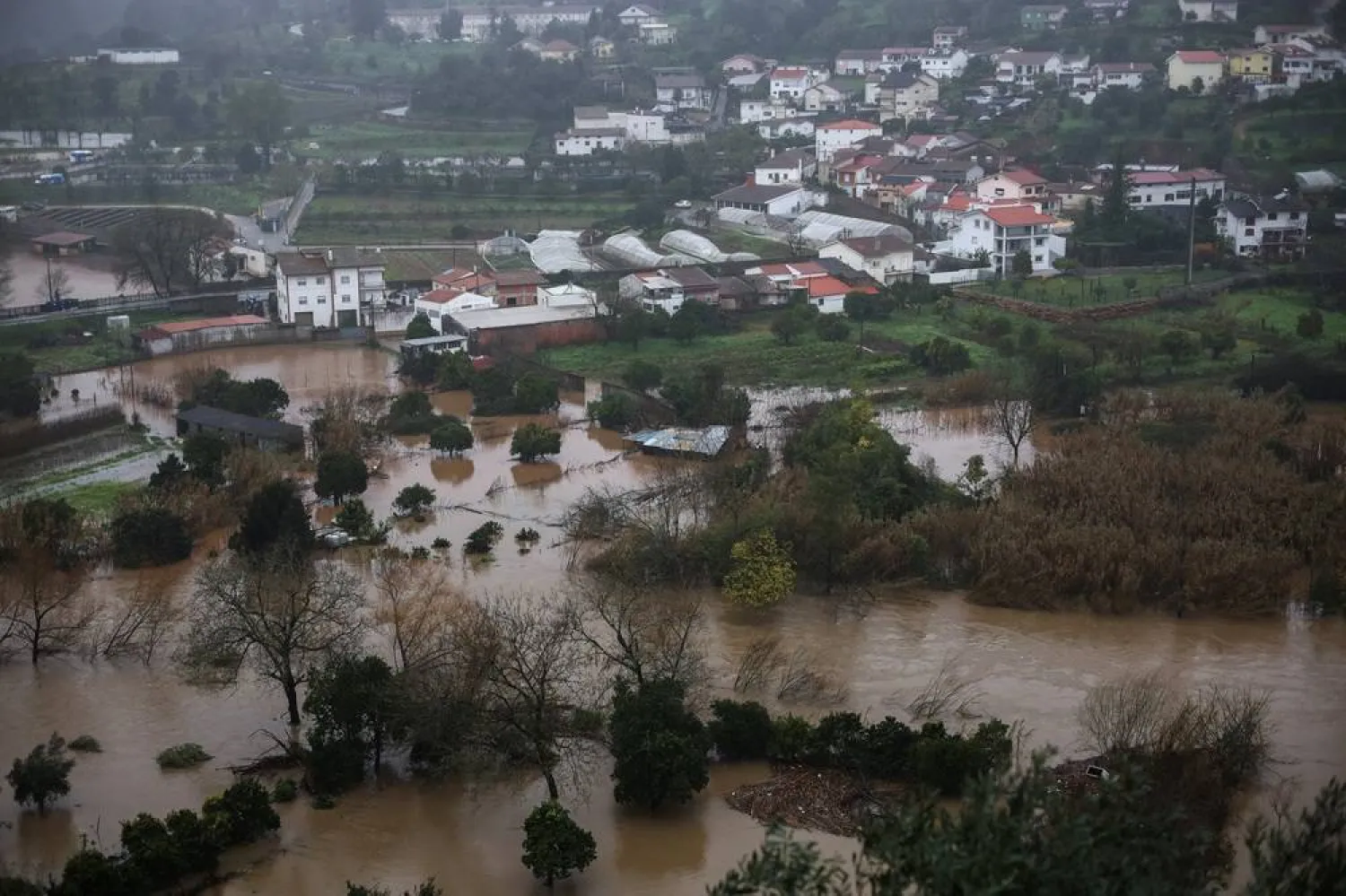
A flooded area in Ceira, Coimbra, Portugal, February 11, 2026. (Reuters)
TT

Rain Further Batters Storm-Hit Portugal, Thousands Evacuated

 A flooded area in Ceira, Coimbra, Portugal, February 11, 2026. (Reuters)
A flooded area in Ceira, Coimbra, Portugal, February 11, 2026. (Reuters)

More ‌heavy rain flooded several rural areas in the north of storm-battered Portugal on Wednesday, leaving levees at risk of bursting around the medieval city of Coimbra and forcing authorities to evacuate about 3,000 residents as a precaution.

A succession of deadly storms has hammered mostly central and southern parts of the country since late January, blowing roofs off houses, flooding several towns and leaving hundreds of thousands without electricity for days. At least 15 people have died as a consequence of the storms, including indirect ‌victims.

As the ‌storms let up this week, a weather ‌phenomenon ⁠known as an "atmospheric river" - ⁠a wide corridor of concentrated water vapor carrying massive amounts of moisture from the tropics - brought new downpours, affecting the north to a greater extent.

RISK OF DAM OVERFLOWING

Municipal authorities in Coimbra ordered the precautionary evacuation late on Tuesday of around 3,000 people most at risk from the River Mondego bursting its banks, ⁠and the operation was still under way on ‌Wednesday, with police making door-to-door checks ‌and bussing residents to shelters.

Regional Civil Protection official Carlos Tavares ‌said on Wednesday the situation could worsen between late Wednesday ‌and midday Thursday, as the rain could cause the Aguieira dam, 35 km northeast of Coimbra, "to overflow, sweep away levees and trigger further flooding".

Part of Coimbra's ancient city wall, on a hillside in one ‌of Europe's oldest university towns and a UNESCO World Heritage site, collapsed, shutting the road below ⁠and forcing ⁠the closure of the municipal market, the city hall said.

Prime Minister Luis Montenegro was due in Coimbra to oversee the emergency response after Interior Minister Maria Lucia Amaral resigned following criticism from opposition parties and local communities over what they described as the authorities' slow and failed response to devastating Storm Kristin two weeks ago.

In central Portugal, just across the River Tagus from Lisbon, authorities evacuated the village of Porto Brandao due to the risk of landslides, and around 30 people were removed from their homes after a landslide in the neighboring beachside area of Caparica.


Record Heat and Raging Fires Ring in 2026 Across the Southern Hemisphere 

A helicopter battles a forest fire in the Biobio region, where multiple wildfires have prompted emergency evacuations, in Florida, Chile, January 21, 2026. (Reuters)
TT

Record Heat and Raging Fires Ring in 2026 Across the Southern Hemisphere 

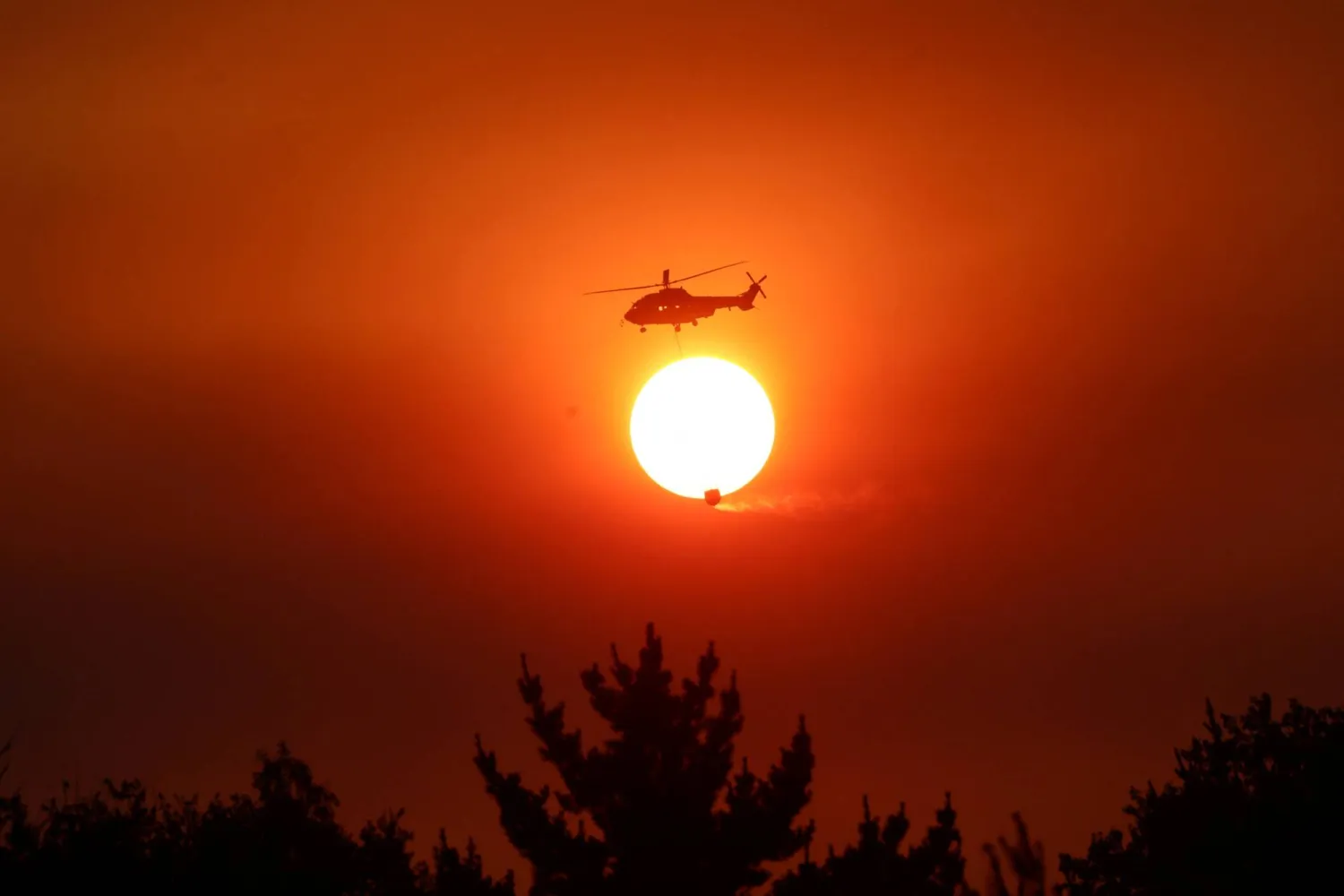
A helicopter battles a forest fire in the Biobio region, where multiple wildfires have prompted emergency evacuations, in Florida, Chile, January 21, 2026. (Reuters)

From Argentina to Australia to South Africa, record heat and raging wildfires are rampaging through the Southern Hemisphere at the start of 2026, with scientists predicting that even more extreme temperatures could lie ahead - and possibly another global annual high - after three of the hottest years on record.

In January, a record-setting heat dome enveloped Australia, sending temperatures near 50 degrees C (122 degrees F) while heat and catastrophic wildfires gripped parts of South America, setting remote parts of Argentina's Patagonia ablaze and killing 21 people in coastal towns in Chile. In addition, South Africa has been experiencing its worst wildfires in years.

The extremes are occurring even as the world remains under the cooling influence of a weak La Nina, a climate cycle marked by cooler waters in the central and eastern Pacific that began in December 2024. Despite this moderating factor, temperatures are reaching record highs in various locales.

"This means the effect of human-caused climate change is overwhelming natural variability," said climate scientist Theodore Keeping of Imperial College London and the international research collaboration World Weather Attribution, who specializes in research on wildfires and extreme heat.

"As we transition into a neutral or even El Nino phase, we'll expect the incidence of extreme heat events around the world to be further amplified," Keeping added.

El Nino typically has the opposite effect of La Nina, warming the central and eastern Pacific and boosting global temperatures.

This year is forecast to be about 1.46 degrees C (2.6 degrees F) above pre-industrial levels, which would make it the fourth consecutive year to be higher than 1.4 degrees C (2.5 degrees F) above pre-industrial levels, according to Adam Scaife, head of the long-range prediction at the United Kingdom's national weather ‌and climate service.

The 2015 ‌international climate treaty, known as the Paris Agreement, aimed to keep warming below 1.5 degrees C (2.7 degrees F) above pre-industrial levels.

"If a big ‌El Nino ⁠were to develop ⁠quickly in 2026 then it's still possible 2026 could be a record," Scaife said. The World Meteorological Organization said last month that the past three years were the warmest on record.

FIRE RAGES FROM WOODS TO WATER

While most wildfires are caused by human activity, they are also a natural part of many ecosystems. Persistent heat, drought and extreme temperatures, however, are turning once-manageable fires into increasingly uncontrollable and destructive events.

Many ecosystems are not adapted to such hot, dry conditions, allowing fires to grow larger and more intense, often causing permanent damage, Keeping said.

The fires that burned through Argentina's Los Alerces National Park illustrate the shift, according to meteorologist Carolina Vera of the Center for Ocean and Atmospheric Research at the University of Buenos Aires.

The park, a UNESCO World Heritage site, is home to trees that have lived more than 3,000 years.

Local officials determined that a lightning strike caused the fire. The blaze initially was under control. But Vera said a heat wave and strong winds caused it to spread about 20 km (12 miles) in a single day, making it the worst wildfire there ⁠in two decades.

The region has been drought-stricken since 2008. Temperatures during the first two weeks of January were about 6 degrees C (11 degrees F) above ‌normal.

"These fires used to burn themselves out and form part of the forest's natural dynamics," Vera said.

"This is an example of ‌how climate change can alter a natural fire, because it appeared to be caused by lightning," Vera said.

There are no towns in that remote area.

Fires erupted in the southern part of neighboring Chile later in January and ‌crossed into the greater Concepcion area, the country's third-largest metropolitan region, destroying hundreds of homes and killing 21 people in coastal communities.

Keeping said the blazes mirrored recent disasters in places such as ‌Los Angeles, Athens and the Hawaiian island of Maui.

"Where there's been the greatest loss of life, it almost always comes down to evacuation being difficult or impossible," Keeping said. "That's particularly true in regions affected by strong downslope winds toward the coast."

WHIRLWINDS OF FIRE

About 80% of Punta de Parra, a small coastal town in southern Chile surrounded by hills and forests, was destroyed.

Punta de Parra residents said they had little time to evacuate. Doralisa Silva, 34, said she heard about a fire in a nearby community the night the blaze reached the town.

"Out of nowhere, the forest started burning and all the houses caught fire," Silva said. "The fire was on us in the blink ‌of an eye. There was nothing we could do."

Silva said her family was among the last to try to flee because they had no vehicle. Silva said flames blocked their exit as embers rained down as she and her partner Hermes Barrientos fled with their ⁠2-year-old daughter.

Barrientos said winds of nearly 70 km ⁠per hour (43.5 mph) whipped through the area, creating whirlwinds of fire that spread to the beach and trapped residents. The family and others eventually found refuge in a large dirt field at the center of town, and spent the night watching their community burn.

A FUTURE FILLED WITH FIRES

Record-breaking heat in southeastern Australia has also fueled the country's worst fires since the deadly 2019-2020 season, when 33 people were killed.

In addition, the 2025-2026 fire season has been the most severe in South Africa in a decade, according to officials, killing wildlife and hitting tourist destinations such as Mossel Bay and Franschhoek.

"The hot, dry and windy conditions that drive the most extreme wildfires are becoming more intense and more likely," Keeping said. "And it's happening all around the world."

The Southern Hemisphere has warmed by about 0.15 to 0.17 degrees C (0.27 to 0.30 degrees F) per decade since the 1970s, compared to 0.25 to 0.30 degrees C (0.45 to 0.54 degrees F) in the Northern Hemisphere - largely because its vast oceans absorb heat more slowly and because of Antarctic meltwater.

Still, southern land masses are now warming at similar rates to northern land masses, and contrasts between warming land and cold meltwater can intensify weather patterns, leading to prolonged heat waves, droughts or flooding.

Keeping said adaptation is critical, including authorities managing vegetation near cities and developing effective evacuation plans, and builders using fire-resistant materials. Wildfires are inflicting mounting economic damage. A 2026 report by insurance broker Aon estimated global insured wildfire losses at $42 billion in 2025, up from an average of $4 billion annually between 2000 and 2024. The Los Angeles fires last year were the costliest on record.

Swiss Re, the world's second-largest reinsurer, found that wildfires accounted for about 1% of global insured losses from natural disasters before 2015, but now represent 7%, with economic losses linked to fires rising by about $170 million a year since 1970.

"You actually cannot stop a lot of these really large intense wildfires. They're simply too big," Keeping said.

The most important way forward, Keeping said, is to "have a serious conversation about limiting future climate change to prevent this issue from worsening."


Study: Noisy Humans Harm Birds and Affect Breeding Success

FILE - Birdhouses line a path outside a resident's room at the Ida Culver House Ravenna, a senior independent and assisted living home in Seattle, on May 21, 2020. (AP Photo/Elaine Thompson, File)
TT

Study: Noisy Humans Harm Birds and Affect Breeding Success

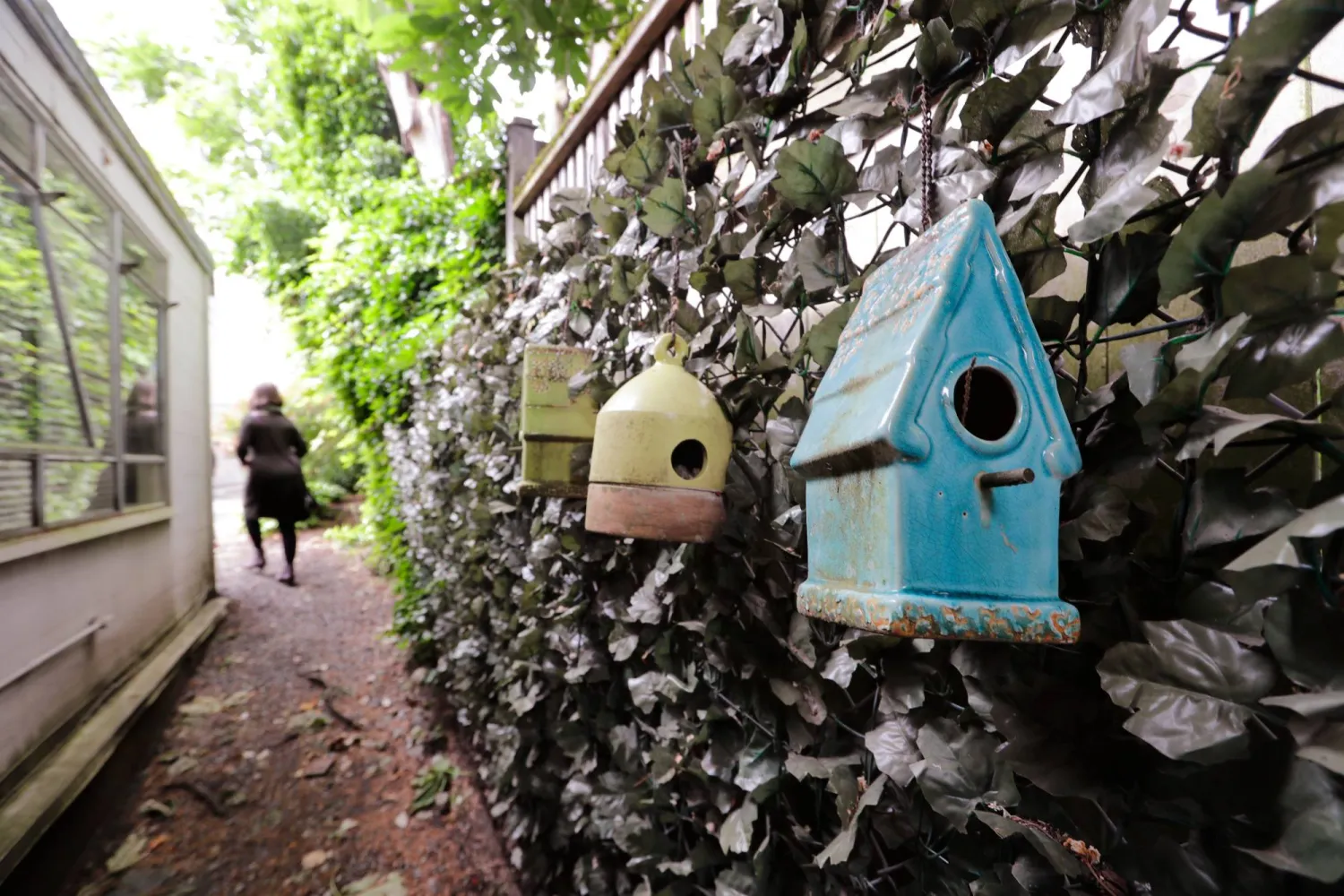
FILE - Birdhouses line a path outside a resident's room at the Ida Culver House Ravenna, a senior independent and assisted living home in Seattle, on May 21, 2020. (AP Photo/Elaine Thompson, File)

Noise pollution is affecting bird behavior across the globe, disrupting everything from courtship songs to the ability to find food and avoid predators, a large-scale new analysis showed on Wednesday.

Researchers reviewed nearly four decades of scientific work and found that noises made by humans were interfering with the lives of birds on six continents and having "strong negative effects" on reproduction success.

Previous research on individual species has shown that single sources of anthropogenic noise -- such as planes, traffic and construction -- can affect birds as it does other wildlife.

But for this study, the team performed a wider analysis by pooling data published since 1990 across 160 bird species to see if any broader trends could be established.

The study, published in the journal Proceedings of the Royal Society B, found clear evidence of a "pervasive" impact of noise pollution on birds worldwide.

"We found that noise significantly impacts communication risk behaviors, foraging, aggression and physiology and had a strong effect on habitat use and a negative impact on reproduction," AFP quoted it as saying.

This is because birds rely on acoustic information to survive, making them particularly vulnerable to the modern din produced by cars, machinery and urban life.

"They use song to find mates, calls to warn of predators, and chicks make begging calls to let their parents know they're hungry," Natalie Madden, who led the research while at the University of Michigan, said in a statement.

"So if there's loud noise in the environment, can they still hear signals from their own species?"

In some cases, noise pollution interrupted mating displays, caused males to change their courtship songs, or masked messages between chicks and parents.

The study included many common species such as European robins and starlings, house sparrows, and great tits.

The response varied between species, with birds that nest close to the ground suffering greater reproductive harm, while those using open nests experienced stronger effects on growth.

Birds living in urban areas, meanwhile, tended to have higher levels of stress hormones than those outside of cities.

Some 61 percent of the world's bird species have declining populations, mostly due to habitat loss driven by expanding agriculture and logging, the International Union for Conservation of Nature said in October.

The study authors said that noise pollution was an "underappreciated consequence" of humanity's impact on nature, especially compared to biodiversity loss and climate change.

But some relatively simple fixes could make a big difference for birds, they said.

Madden told AFP that shifting from noisier cars and landscaping tools such as mowers and leaf blowers to electric-powered alternatives was one idea.

Another could be "running machinery outside peak breeding seasons, avoiding activity when birds are migrating through an area, or shifting construction away from habitats that support vulnerable species", she added.

Buildings could also be adapted to muffle sound in the same way they are constructed to improve visibility and minimize bird collisions, said the study's senior author Neil Carter, from the University of Michigan.

"So many of the things we're facing with biodiversity loss just feel inexorable and massive in scale, but we know how to use different materials and how to put things up in different ways to block sound," he said.