US Sources Expect Washington to Impose Sanctions against Lebanon's Bassil for 'Enabling Hezbollah' https://english.aawsat.com/home/article/2445541/us-sources-expect-washington-impose-sanctions-against-lebanons-bassil-enabling
US Sources Expect Washington to Impose Sanctions against Lebanon's Bassil for 'Enabling Hezbollah'
Some U.S. officials want to sanction Gebran Bassil, a former foreign minister and a key Hezbollah ally.
PHOTO: MOHAMED AZAKIR/REUTERS
The US administration is preparing to impose anticorruption sanctions against prominent Lebanese politicians and businessmen in an effort to weaken Hezbollah’s influence in the aftermath of last week’s explosion in Beirut’s port, US officials said, the Wall Street Journal (WSJ) reported.
The blast, which killed more than 170 people and injured more than 6,000, has accelerated efforts in Washington to blacklist Lebanese leaders aligned with Hezbollah, the country’s dominant political and military force. The US officials see an opportunity to drive a wedge between Hezbollah and its allies as part of a broader effort to contain its force backed by Tehran, according to the report.
Hezbollah has been part of Lebanese coalition governments for more than a decade and is the region’s most potent threat to Israel, which has bombed the group’s forces in Syria and Lebanon to prevent it from amassing advanced missiles.
The officials stressed that by sanctioning carefully selected people, they aim to shape the new government with two prime goals: compelling Lebanon’s political class to target endemic corruption that has eaten away at the country and ensuring that Hezbollah doesn’t retain its hold on government decisions.
According to the report, one key Hezbollah ally some US officials want to sanction is Gebran Bassil, a former foreign minister and a son-in-law of Lebanon’s president, Michel Aoun.
“Gebran Bassil should have been sanctioned years ago,” said Jeffrey Feltman, former US ambassador to Lebanon under President George W. Bush, in an email.
“No one has done more to enable Hezbollah’s political (over)reach in Lebanon that he has, in giving an Iranian-funded Shia militia Christian cover,” he noted.
The WSJ also cited people briefed on the discussions as saying that the US has been considering politicians and businessmen close to Bassil and others suspected of corruption, including some people close to Saad Hariri, who resigned as prime minister last October after weeks of largely peaceful antigovernment protests.
A number of US officials said they want to move quickly so that the penalties can send a message that Lebanon has to change course as it seeks billions of dollars in international aid to rebuild Beirut.
Libya's Dbeibah meets Turkish President Tayyip Erdogan on the sidelines of the Antalya summit on Thursday (Dbeibah's Office)
Turkish President Tayyip Erdogan and Libyan Prime Minister Abdulhamid Dbeibah discussed ways to strengthen cooperation and the latest political and security developments in Libya on Thursday on the sidelines of the COP31 World Leaders Climate Summit in the Turkish city of Antalya.
Dbeibah's media office said the meeting covered bilateral relations and prospects for expanding cooperation in various fields, particularly the economy, investment, security and defense, as well as progress in implementing agreements and memorandums of understanding signed by the two countries.
The talks also addressed efforts to support stability and unify Libya's institutions, alongside continued coordination on regional and international issues.
Erdogan reaffirmed Türkiye's continued support for Libya's stability, stressing that "any initiative not embraced by Libyans will have no impact on the ground."
On the sidelines of the climate summit, Dbeibah also met UN Secretary-General Antonio Guterres to discuss developments in Libya's political process and efforts by the UN mission to support stability.
Dbeibah reaffirmed his government's readiness to continue coordinating with the mission to help it fulfill its mandate, praising UN envoy Hanna Tetteh's efforts to facilitate dialogue and bridge differences among Libyan factions.
He also welcomed the "4+4 agreement" and called for building on its outcomes to end the transitional periods and pave the way for elections.
Representatives of Dbeibah's government and the eastern-based General Command signed the 4+4 agreement on Aug. 30 to break the political deadlock and create conditions for presidential and parliamentary elections within 24 months, through unified institutions and a single executive authority.
Dbeibah's meetings in Antalya on Thursday also included talks with Sudan's Transitional Sovereignty Council Chairman General Abdel Fattah al-Burhan, focusing on developments in Sudan, ways to strengthen economic and trade cooperation, facilitate the movement of citizens and coordinate on security and border issues.
Dbeibah reiterated Libya's support for Sudan's unity, sovereignty and territorial integrity, rejecting any attempts to divide the country or undermine its national institutions.
He stressed the need to intensify regional and international efforts to secure a ceasefire and ensure humanitarian aid reaches those affected by the conflict.
Dbeibah attended the summit's opening on Wednesday. The event, hosted by Antalya on Nov. 11-12 under Erdogan's chairmanship, brought together Guterres and around 102 leaders and senior representatives from 95 countries and seven international organizations.
Discussions focused on climate finance, the energy transition and strengthening international cooperation to achieve sustainable development goals.
The meetings come amid renewed momentum in Libyan-Turkish relations after Libya's House of Representatives ratified a maritime memorandum of understanding signed in 2019 between Ankara and Libya's former Government of National Accord.
Contacts and consultations between Libya's rival factions and Turkish officials have intensified recently.
On Wednesday, Turkish Ambassador Guven Begenc met General Salahuddin al-Namroush, chief of the general staff under Dbeibah's interim Government of National Unity, to discuss developing military relations in ways that serve the two countries' mutual interests.
Meanwhile, General Khaled Haftar, chief of the general staff under the eastern-based General Command, arrived in the Turkish capital Ankara on Thursday for an official visit lasting several days.
Tunisia Says It Is Prepared For 'Various Threats, Scenarios'https://english.aawsat.com/arab-world/5340626-tunisia-says-it-prepared-various-threats-scenarios
Tunisia Says It Is Prepared For 'Various Threats, Scenarios'
Tunisian Defense Minister Khaled Sehili speaks with Justice Minister Leila Jaffel during a parliamentary session (EPA)
Tunisia is preparing for a number of scenarios as conflicts widen and regional and global tensions mount, Defense Minister Khaled Sehili said, outlining plans to bolster military readiness and secure essential supplies, according to local media reports.
Speaking during a joint parliamentary plenary session on Thursday, Sehili said the country's proactive strategy includes stockpiling fuel, medicines and food, diversifying supply sources and tightening surveillance along its land, air and maritime borders.
The military is also reinforcing border security by extending an earthen barrier along the entire eastern frontier and building a parallel 95-km (59-mile) trench to curb infiltration and smuggling, he said.
Sehili announced plans for legislation regulating drone use to address emerging challenges and govern the technology.
Preparing for potential threats and scenarios "requires developing defense capabilities and strengthening readiness" to protect Tunisia and its national interests amid rapidly changing security conditions, he said.
He described the Defense Ministry's budget as "an investment in Tunisia's security and stability" and a safeguard for independent national decision-making as regional and international developments bring mounting military and security risks.
Sehili said Tunisia's security situation remained "relatively stable," but warned that continued vigilance and preparedness were essential.
The military is responding to evolving threats through targeted preemptive operations aimed at putting pressure on suspicious elements and restricting their ability to act and move, he said.
Those efforts include securing borders, combating terrorism and dismantling logistical support networks used by terrorist groups.
"Tunisia's security cannot be separated from that of its regional surroundings," Sehili affirmed, underscoring the need to prepare for different scenarios.
He warned of escalating armed conflicts, growing security threats, intensifying strategic competition over transit routes and a widening arms race.
The developments are closely linked to Tunisia's immediate neighborhood, particularly North Africa, the Sahel and the Sahara, where mounting security challenges risk creating fertile ground for terrorist and criminal groups, he said.
Sehili called for more effective military operations, better use of available resources and greater self-reliance, alongside continued international military cooperation to build a strong national army capable of carrying out its duties effectively.
UK Condemns Houthi Attacks on Airports and Civilians as Unacceptablehttps://english.aawsat.com/arab-world/5340516-uk-condemns-houthi-attacks-airports-and-civilians-unacceptable
UK Condemns Houthi Attacks on Airports and Civilians as Unacceptable
The British Minister of State stressed that Resolution 2216 remains the basis for resolving the conflict in Yemen (Doughty's X account)
British Minister of State for the Middle East Stephen Doughty described the Houthis' escalating attacks in Yemen and against Saudi Arabia as appalling, stressing that launching missiles and drones at airports and places where civilians live and work was unacceptable.
In an interview with Asharq Al-Awsat, Doughty said the Houthis had chosen to escalate and reignite the conflict in Yemen, holding the group and those who arm and enable it responsible for the renewed violence.
The British minister said the United Kingdom, as the penholder on Yemen at the UN Security Council, continued to regard Resolution 2216 as a foundation for a political settlement, with London focused on ensuring the full implementation of existing resolutions.
Doughty also described the situation in Taiz as heartbreaking, urging the Houthis to reopen roads, allow humanitarian aid to pass, facilitate medical evacuations and end attacks on civilians.
He warned that Iranian support for the Houthis and other groups was making the conflict more dangerous, while threats to shipping through the Red Sea and the Bab Al-Mandab Strait had consequences extending well beyond Yemen, including for the United Kingdom.
Visit to Riyadh
Discussing his recent visit to Saudi Arabia, Doughty said he had traveled to Riyadh to personally reaffirm Britain's solidarity with its partners during difficult times, including Saudi Arabia and Yemen's legitimate government.
He said he held extensive talks with Saudi Vice Minister of Foreign Affairs Waleed Elkhereiji on a range of shared interests and met Saudi Ambassador Mohammed Al Jaber and other senior officials to discuss Houthi attacks on the Kingdom and developments on the ground in Yemen.
According to Doughty, the discussions addressed the Houthis' escalation in recent weeks, both within Yemen and across the border into Saudi Arabia, as well as British efforts to support the Kingdom's defense.
They also covered ways to deliver assistance to those most in need in Yemen, ensure humanitarian access, protect civilians, uphold international humanitarian law and mobilize international support for a political settlement.
Doughty said the talks also explored opportunities for long-term cooperation as Britain and Saudi Arabia approach the centenary of their diplomatic relations.
He noted that bilateral ties had expanded beyond defense and energy to encompass trade, investment and education, alongside cooperation on regional security and stability in the Middle East and efforts to combat terrorist organizations.
The minister also met senior Yemeni officials, including the chairman and vice chairman of the Presidential Leadership Council, the prime minister and the foreign minister, to discuss ways to support the Yemeni government and ensure security and prosperity for the Yemeni people.
Houthi Attacks on Saudi Arabia
Doughty condemned the Houthis' escalation as appalling, stressing that firing missiles and drones at airports and places where ordinary people lived and worked was unacceptable.
He said there could be no justification for such attacks and called on the Houthis to end their reckless actions.
The British minister stressed that there should be no doubt about who bore responsibility for the escalation: the Houthis and those supplying them with weapons and enabling their operations.
He said Britain stood alongside Saudi Arabia and had deployed air-to-air refueling aircraft, fighter jets and military advisers to support defensive operations.
Saudi Arabia's Role in Containing the Escalation
Doughty said Saudi Arabia was facing attacks on its own territory and that Britain's position was unequivocal: the Kingdom had the right to defend itself.
At the same time, he emphasized that the United Kingdom had consistently supported efforts to reach a political settlement in Yemen and remained one of the country's major humanitarian and development assistance providers.
He said Britain and Saudi Arabia shared the same objectives: a stable Yemen, a secure Gulf and safe maritime routes for the shipping on which the entire world depended.
Reflecting on discussions at the Manama Dialogue a few days earlier, Doughty said he had been struck by the determination of many governments and regional partners to find a way back to the political process and address wider instability and its humanitarian consequences.
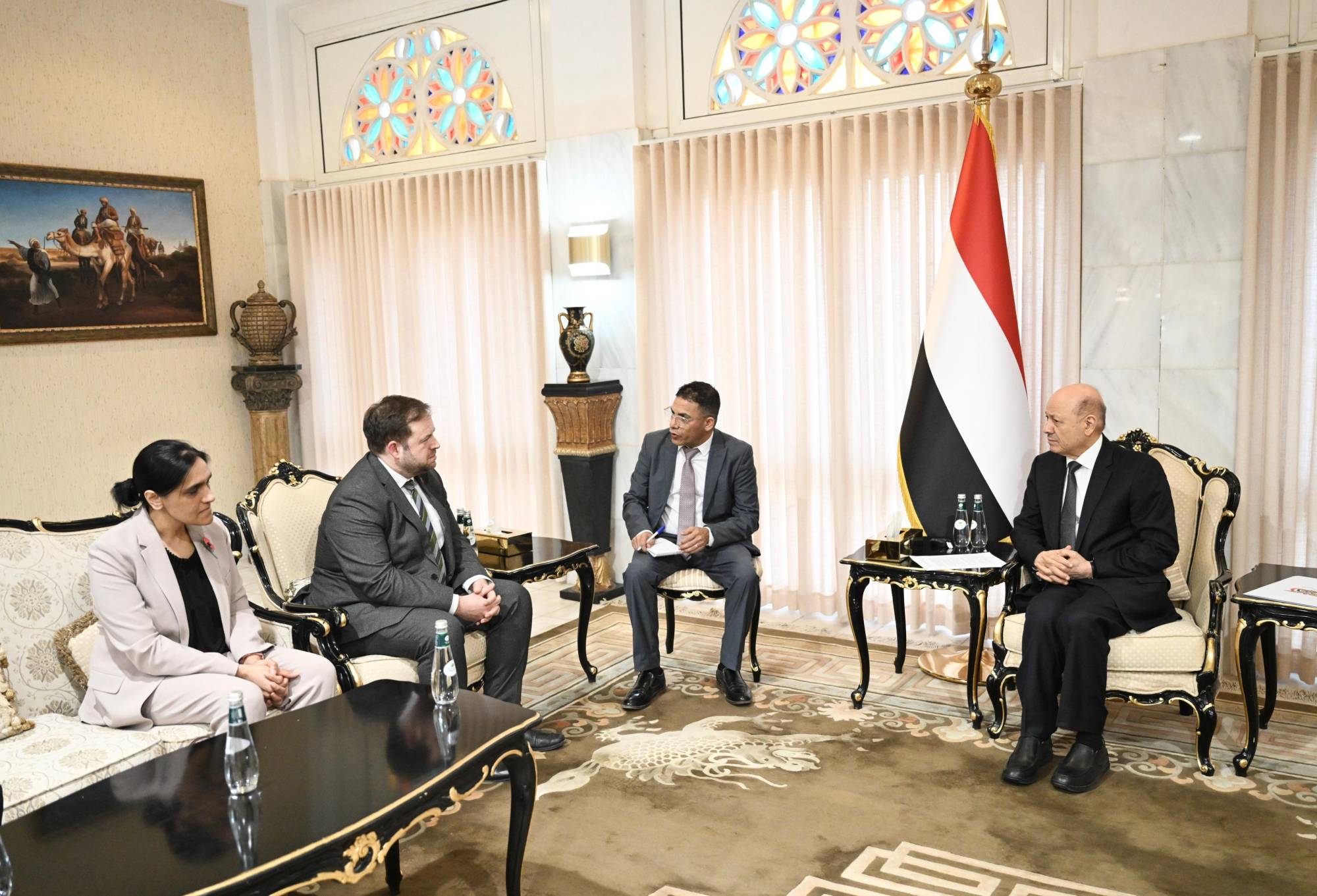
Presidential Leadership Council Chairman Rashad Al-Alimi receives British Minister of State for the Middle East Stephen Doughty (SABA)
Military Developments in Yemen
Asked about developments on Yemen's military fronts, Doughty said the Houthis had chosen to escalate and renew the conflict, while the Yemeni government had the right to protect its people.
He reaffirmed Britain's firm support for Yemen's legitimate government.
The minister warned that continued fighting was costing lives, forcing large numbers of families from their homes and deepening the humanitarian crisis with every passing week.
He said the violence was also undermining regional stability and serving no one's interests.
Doughty stressed that the Houthis must halt their attacks inside Yemen and against Saudi Arabia and return to peaceful dialogue.
Support for the Yemeni Government
Doughty said Britain's partnership with the Yemeni government was longstanding and that London remained committed to working with it to promote regional stability and build a prosperous future for the Yemeni people.
In practical terms, he explained, this involved supporting state institutions so they could serve the population, helping maintain public services and contributing to economic stabilization.
He said the United Kingdom was providing £104 million ($137.9 million) in humanitarian assistance this year and had recently announced that £10 million of that amount would be allocated to the UN emergency fund in response to the renewed conflict.
Doughty added that Britain was using its position at the Security Council and in other international forums to keep Yemen high on the global agenda.
He said London would continue consulting its partners over the coming weeks on what further action could be taken.
The minister noted that Yemen had long been among the world's worst humanitarian crises and stressed the need to break the cycle of destruction through a solution that placed the well-being of the Yemeni people at its center.
Resolution 2216 Remains the Basis for a Settlement
Asked whether London believed new Security Council resolutions were needed in light of developments inside Yemen, Doughty said the United Kingdom held the pen on Yemen at the Council and took that responsibility extremely seriously.
He explained that the existing framework, including Resolution 2216, continued to provide the foundations for a settlement, and that those principles had become even more important amid the renewed fighting.
Britain's priority, he said, was to ensure the full implementation of existing resolutions and provide the UN Special Envoy for Yemen with the support needed to carry out his mission.
Doughty added that London was working closely with Security Council members, including its Gulf partners, to ensure that Yemen remained at the forefront of the international agenda.
Continued Iranian Support for the Houthis
Doughty identified Iran's support for the Houthis and other armed groups as a major factor making the conflict increasingly dangerous.
He said Britain had made clear that such support only deepened regional instability and that de-escalation offered the best path toward peace.
The minister explained that the United Kingdom was working to enforce the UN arms embargo and cooperating closely with partners to prevent weapons from reaching the Houthis.
He added that London continued to hold Iran accountable through sanctions and by raising its concerns in multilateral forums.
Threats to Maritime Navigation
Asked about the risks posed by Houthi control of the Bab Al-Mandab Strait, Doughty said the waterway was one of the world's vital routes for international trade and commercial shipping.
He warned that threats from the Houthis had consequences far beyond Yemen, including for Britain.
The minister emphasized that freedom of navigation was not merely an abstract principle and was just as important in Bab Al-Mandab as in the Strait of Hormuz and other major shipping routes worldwide.
He reaffirmed Britain's commitment to working with allies and partners to keep these waterways open and secure.
As a longstanding maritime nation and the host country of the International Maritime Organization, Britain was working internationally to uphold maritime law and protect vessels and their crews, he added.
A Message to the Yemeni People
Addressing the Yemeni people, Doughty assured them that they had not been forgotten.
He acknowledged the immense suffering Yemenis had endured and described the Houthis' decision to plunge the country back into conflict as tragic.
The minister reaffirmed that Britain had stood alongside the Yemeni government and people for many years and would continue to do so.
He said that commitment would be demonstrated through vital humanitarian assistance, support for public services and government institutions, and continued efforts to keep Yemen high on the international agenda.
Doughty stressed that peace must ultimately be achieved through a political settlement that would provide Yemenis with the security, dignity and opportunities they deserved.
Siege of Taiz Is Heartbreaking
Commenting on the Houthi siege of Taiz, Doughty described the situation in the city as heartbreaking.
He said families had spent years living with closed roads, shelling and sniper fire, even when attempting to reach hospitals, markets or schools.
He placed responsibility for their suffering squarely on the Houthis.
The minister called on the group to reopen roads, allow humanitarian assistance through, facilitate medical evacuations to places where patients could receive safe treatment, and stop attacks targeting civilians.
Doughty also noted that large numbers of families had been uprooted from their homes across Yemen, while humanitarian workers continued to face detention and attacks.
He referred to the death of a UN staff member in a disturbing incident the previous week.
The minister expressed deep distress that Yemeni UN personnel who had dedicated their lives to helping ordinary people remained in Houthi detention.
He conveyed his sympathy to their families and colleagues, noting that the Houthis had yet to acknowledge responsibility for the deaths.
Doughty stressed that the victims' families and the United Nations deserved to know the truth and called for the immediate release of everyone still being held.
لم تشترك بعد
انشئ حساباً خاصاً بك لتحصل على أخبار مخصصة لك ولتتمتع بخاصية حفظ المقالات وتتلقى نشراتنا البريدية المتنوعة