


UN Chief: Pandemic Threatens Peace and Risks New Conflicts

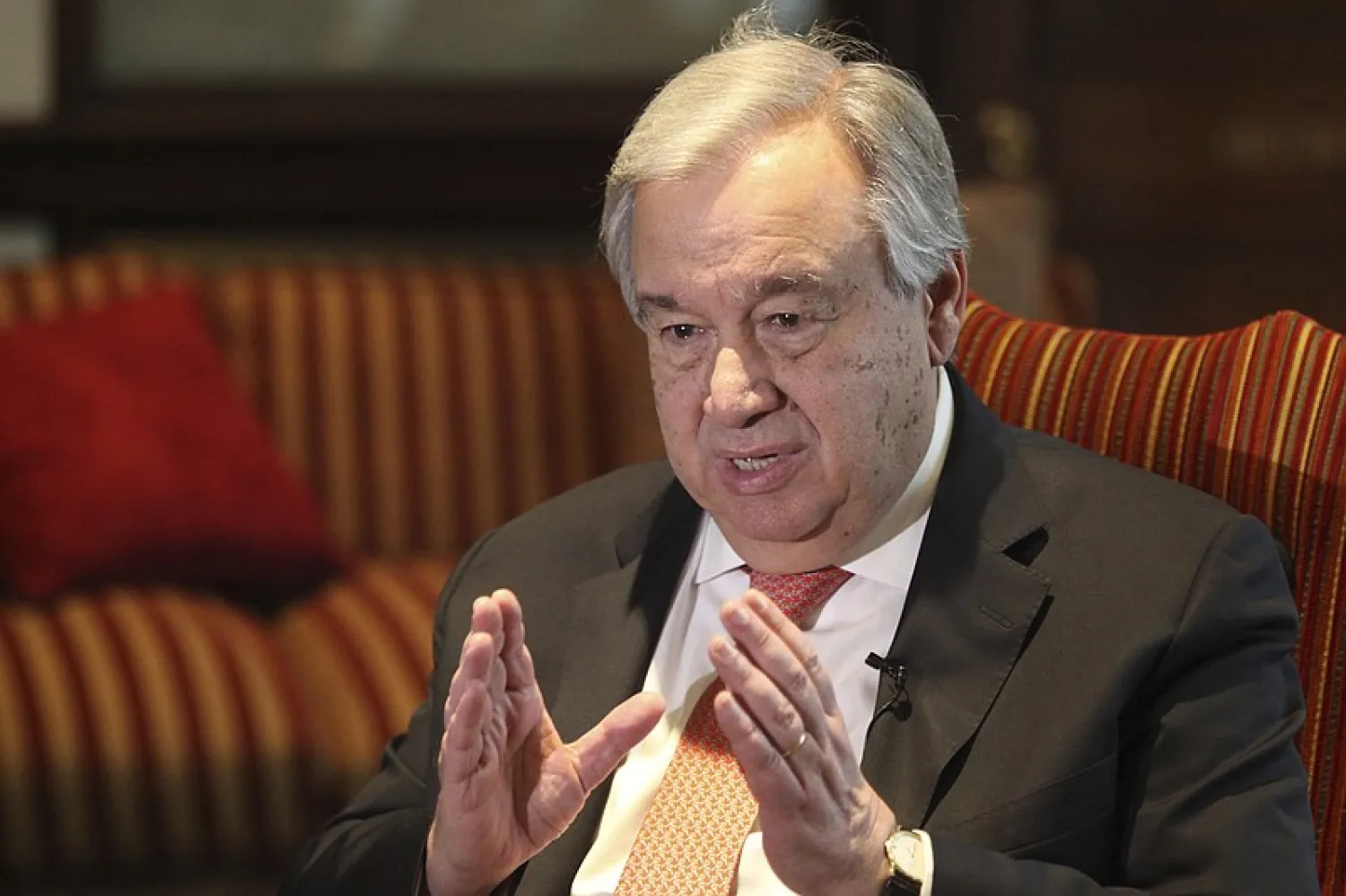
 In this Feb. 18, 2020, file photo, UN Secretary-General Antonio Guterres speaks during an interview with The Associated Press in Lahore, Pakistan. (AP Photo/K.M. Chaudhry, File)
In this Feb. 18, 2020, file photo, UN Secretary-General Antonio Guterres speaks during an interview with The Associated Press in Lahore, Pakistan. (AP Photo/K.M. Chaudhry, File)
TT

UN Chief: Pandemic Threatens Peace and Risks New Conflicts

 In this Feb. 18, 2020, file photo, UN Secretary-General Antonio Guterres speaks during an interview with The Associated Press in Lahore, Pakistan. (AP Photo/K.M. Chaudhry, File)
In this Feb. 18, 2020, file photo, UN Secretary-General Antonio Guterres speaks during an interview with The Associated Press in Lahore, Pakistan. (AP Photo/K.M. Chaudhry, File)

UN Secretary-General Antonio Guterres warned Wednesday that the COVID-19 pandemic not only threatens gains in fighting global poverty and building peace but risks exacerbating existing conflicts and generating new ones.

The UN chief told a Security Council meeting on the challenge of sustaining peace during the pandemic that his March 23 call for an immediate cease-fire in conflicts around the world to tackle the coronavirus led a number of warring parties to take steps to de-escalate and stop fighting.

"Yet, regrettably, in many instances, the pandemic did not move the parties to suspend hostilities or agree to a permanent ceasefire," Guterres said.

His predecessor as secretary-general, Ban Ki-moon, told the council: "It is truly astonishing that in response to this pandemic, the world has placed billions of people under lock-down, closed international borders, suspended trade and migration, and temporarily shut down a whole variety of industries - but has not managed to suspend armed conflicts."

Ban criticized the UN Security Council for wasting valuable months "in arguments over the details of the text" and not adopting a resolution until July 1 demanding an "immediate cessation of hostilities" in key conflicts including Syria, Yemen, Libya, South Sudan, and Congo to tackle COVID-19.

"This has weakened the message that this council needs to send to all warring parties: now is the time to confront our common enemy," Ban said.

And he said delayed council action "further aggravated the current volatile global security situations."

"The impact of COVID-19 on conflict-affected settings has been much worse than initially thought," said Ban, who is a co-chair of the group of prominent world leaders founded by Nelson Mandela known as The Elders.

He pointed to health and humanitarian ramifications, social cohesion, governance, the rule of law and threats to multilateralism which are jeopardizing ongoing efforts to sustain peace, "or may even cause a reversal in hard-won peace and security gains to date."

While governments try to confront the pandemic, some groups have seen an opportunity to ramp up violence, Ban said, citing as examples Boko Haram and other militants in Nigeria, growing mob violence in Congo and murders by drug cartels in Mexico.

He also warned that the economic impacts of the pandemic "will be both long-lasting and severe, with ripple effects for many fragile and conflict-affected states."

As examples, Ban said Lebanon´s political and economic crisis, exacerbated by last week´s deadly explosion at Beirut´s port, is being compounded by COVID-19´s impact on two key money-earners, tourism and trade, while Iraq´s budget is being stretched thin because of the collapse in oil prices.

Secretary-General Guterres said the pandemic has raised growing questions about the effectiveness of health systems, social services, trust in institutions and systems of governance.

"All of this means that our commitment to sustaining peace is more urgent than ever," he said.

Guterres pointed to three key dangers: erosion of public trust, destabilization of the global economic order, and weakening of "the social fabric."

"The perception that authorities are mishandling the crisis, or not being transparent or favoring political allies can lead to public disillusion in government and its institutions," he said.

The UN chief also warned that "without concerted action, inequalities, global poverty, and the potential for instability and violence could grow for years."

While there have been many peaceful protests, Guterres said, "in a number of countries, COVID-19 has been an excuse for harsh crackdowns and a spike in state repression."

Guterres stressed the importance of leadership.

"The world is looking to all leaders - including the council -- to address this epic crisis in ways that make a concrete, meaningful, and positive contribution to the lives of people," he said.

Guterres called for all sectors of society to engage in building peace and preventing and ending conflicts.



Top Trump Iran Negotiator Says Visits US Aircraft Carrier in Middle East

US Special Envoy Steve Witkoff delivers a press conference upon the signing of the declaration on deploying post-ceasefire force in Ukraine, during the so-called "Coalition of the Willing" summit, at the Elysee Palace in Paris, France, January 6, 2026. (Reuters)
TT

Top Trump Iran Negotiator Says Visits US Aircraft Carrier in Middle East

US Special Envoy Steve Witkoff delivers a press conference upon the signing of the declaration on deploying post-ceasefire force in Ukraine, during the so-called "Coalition of the Willing" summit, at the Elysee Palace in Paris, France, January 6, 2026. (Reuters)

US President Donald Trump's lead Iran negotiator Steve Witkoff on Saturday said he visited the USS Abraham Lincoln aircraft carrier currently in the Arabian Sea, with Washington and Tehran due to hold further talks soon.

"Today, Adm. Brad Cooper, Commander of US Naval Forces Central Command, Jared Kushner, and I met with the brave sailors and Marines aboard the USS Abraham Lincoln, her strike group, and Carrier Air Wing 9 who are keeping us safe and upholding President Trump's message of peace through strength," said Witkoff in a social media post.

Iranian Foreign Minister Abbas Araghchi said on Saturday he hoped talks with the United States would resume soon, while reiterating Tehran's red lines and warning against any American attack.


Israel’s Netanyahu Expected to Meet Trump in US on Wednesday and Discuss Iran

Israeli Prime Minister Benjamin Netanyahu delivers a speech during a special session to mark the 77th anniversary of the Knesset's establishment and the 60th anniversary of the dedication of the current building at the Knesset, the Israeli parliament, in Jerusalem, 02 February 2026. (EPA)
TT

Israel’s Netanyahu Expected to Meet Trump in US on Wednesday and Discuss Iran

Israeli Prime Minister Benjamin Netanyahu delivers a speech during a special session to mark the 77th anniversary of the Knesset's establishment and the 60th anniversary of the dedication of the current building at the Knesset, the Israeli parliament, in Jerusalem, 02 February 2026. (EPA)

Israeli Prime Minister Benjamin Netanyahu is expected to meet US President Donald Trump on Wednesday in Washington, where they will discuss negotiations with Iran, Netanyahu's office said on Saturday.

Iranian and US officials held indirect nuclear ‌talks in the ‌Omani capital ‌Muscat ⁠on Friday. ‌Both sides said more talks were expected to be held again soon.

A regional diplomat briefed by Tehran on the talks told Reuters Iran insisted ⁠on its "right to enrich uranium" ‌during the negotiations with ‍the US, ‍and that Tehran's missile capabilities ‍were not raised in the discussions.

Iranian officials have ruled out putting Iran's missiles - one of the largest such arsenals in the region - up ⁠for discussion, and have said Tehran wants recognition of its right to enrich uranium.

"The Prime Minister believes that any negotiations must include limiting ballistic missiles and halting support for the Iranian axis," Netanyahu's office said in a ‌statement.


Italy FM Rules Out Joining Trump’s ‘Board of Peace’

Italy's Minister for Foreign Affairs Antonio Tajani speaks to the press during the EPP Leaders’ meeting, in Zagreb, Croatia, 30 January 2026. (EPA)
TT

Italy FM Rules Out Joining Trump’s ‘Board of Peace’

Italy's Minister for Foreign Affairs Antonio Tajani speaks to the press during the EPP Leaders’ meeting, in Zagreb, Croatia, 30 January 2026. (EPA)

Italy will not take part in US President Donald Trump's "Board of Peace", Italian Foreign Minister Antonio Tajani said Saturday, citing "insurmountable" constitutional issues.

Trump launched his "Board of Peace" at the World Economic Forum in Davos in January and some 19 countries have signed its founding charter.

But Italy's constitution bars the country from joining an organization led by a single foreign leader.

Prime Minister Giorgia Meloni, a Trump ally, last month noted "constitutional problems" with joining, but suggested Trump could perhaps reopen the framework "to meet the needs not only of Italy, but also of other European countries".

Tajani appeared Saturday to rule that out.

"We cannot participate in the Board of Peace because there is a constitutional limit," he told the ANSA news agency.

"This is insurmountable from a legal standpoint," he said, the day after meeting US Secretary of State Marco Rubio and US Vice President JD Vance at the Olympics in Milan.

Although originally meant to oversee Gaza's rebuilding, the board's charter does not limit its role to the Palestinian territory and appears to want to rival the United Nations.