


UN Rejects Iran Arms Embargo Extension

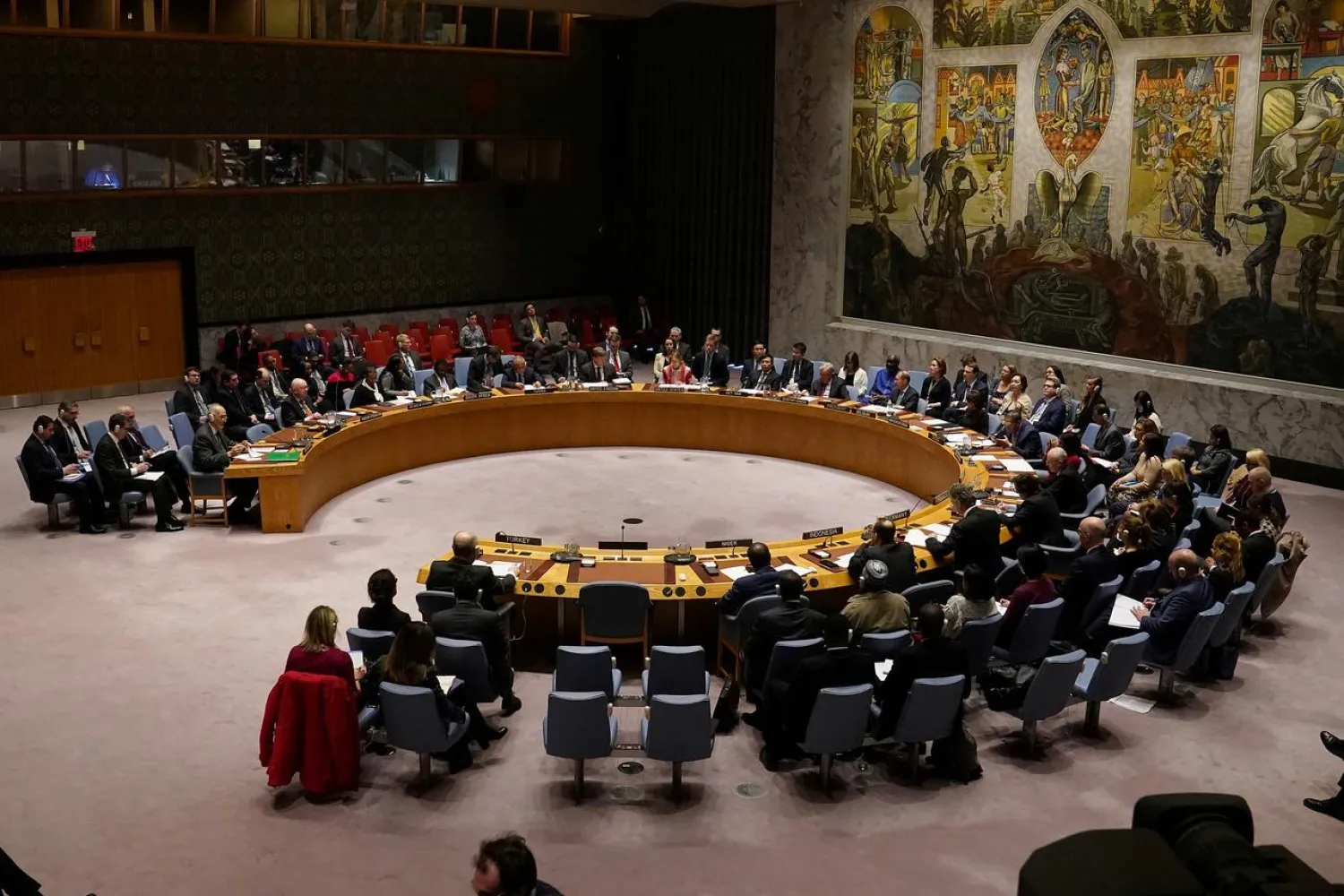
FILE PHOTO: The United Nations Security Council meets about the situation in Syria at United Nations Headquarters in the Manhattan borough of New York City, New York, US, February 28, 2020. REUTERS/Carlo Allegri/File Photo
TT

UN Rejects Iran Arms Embargo Extension

FILE PHOTO: The United Nations Security Council meets about the situation in Syria at United Nations Headquarters in the Manhattan borough of New York City, New York, US, February 28, 2020. REUTERS/Carlo Allegri/File Photo

The United Nations Security Council overwhelmingly rejected a US resolution to extend an Iranian arms embargo on Friday.

Only two of the Council's 15 members voted in favor, highlighting the division between Washington and its European allies since President Donald Trump withdrew from the nuclear accord in May 2018.

The result increases the likelihood that the US will try to unilaterally force a return of UN sanctions, which experts say threatens to plunge the Council into one of its worst-ever diplomatic crises.

"The Security Council's failure to act decisively in defense of international peace and security is inexcusable," US Secretary of State Mike Pompeo said in a statement.

The embargo on conventional arms is due to expire on October 18 under the terms of a resolution that blessed the Iran nuclear deal, signed in July 2015 and officially known as the Joint Comprehensive Plan of Action (JCPOA).

Under the deal, negotiated by then US president Barack Obama, Iran committed to curtailing its nuclear activities for sanctions relief and other benefits.

Since Trump pulled out and slapped unilateral sanctions on Iran under a campaign of "maximum pressure," Tehran has taken small but escalating steps away from compliance with the nuclear accord as it presses for sanctions relief.

European allies of the United States -- who, along with Russia and China, signed the deal with Iran -- have voiced support for extending the 13-year-long conventional arms embargo, saying an expiry threatens stability in the Middle East.

However, their priority is to preserve the JCPOA.

The US text, seen by AFP, effectively called for an indefinite extension of the embargo on Iran, which diplomats said would threaten the nuclear agreement.

Iran says it has the right to self-defense and that a continuation of the ban would mean an end to the nuclear deal.

Pompeo announced that members had failed to back the proposal around 30 minutes before Indonesia, the current president of the Security Council, announced that the official results included two votes against and 11 abstentions.

Russia and China opposed the resolution.

"The result shows again that unilateralism enjoys no support, and bullying will fail," China's UN mission tweeted.

Ambassador Gunter Sautter of Germany, which abstained, said "more consultations are needed" to find a solution that is acceptable to all council members.

During a call between Trump and French President Emmanuel Macron, the leaders "discussed the urgent need for UN action to extend the arms embargo on Iran."

The United States has threatened to try to force a return of UN sanctions if it is not extended by using a controversial technique called "snapback."

Pompeo has offered the contested argument that the United States remains a "participant" in the nuclear accord as it was listed in the 2015 resolution -- and therefore can force a return to sanctions if it sees Iran as being in violation of its terms.



Top Trump Iran Negotiator Says Visits US Aircraft Carrier in Middle East

US Special Envoy Steve Witkoff delivers a press conference upon the signing of the declaration on deploying post-ceasefire force in Ukraine, during the so-called "Coalition of the Willing" summit, at the Elysee Palace in Paris, France, January 6, 2026. (Reuters)
TT

Top Trump Iran Negotiator Says Visits US Aircraft Carrier in Middle East

US Special Envoy Steve Witkoff delivers a press conference upon the signing of the declaration on deploying post-ceasefire force in Ukraine, during the so-called "Coalition of the Willing" summit, at the Elysee Palace in Paris, France, January 6, 2026. (Reuters)

US President Donald Trump's lead Iran negotiator Steve Witkoff on Saturday said he visited the USS Abraham Lincoln aircraft carrier currently in the Arabian Sea, with Washington and Tehran due to hold further talks soon.

"Today, Adm. Brad Cooper, Commander of US Naval Forces Central Command, Jared Kushner, and I met with the brave sailors and Marines aboard the USS Abraham Lincoln, her strike group, and Carrier Air Wing 9 who are keeping us safe and upholding President Trump's message of peace through strength," said Witkoff in a social media post.

Iranian Foreign Minister Abbas Araghchi said on Saturday he hoped talks with the United States would resume soon, while reiterating Tehran's red lines and warning against any American attack.


Israel’s Netanyahu Expected to Meet Trump in US on Wednesday and Discuss Iran

Israeli Prime Minister Benjamin Netanyahu delivers a speech during a special session to mark the 77th anniversary of the Knesset's establishment and the 60th anniversary of the dedication of the current building at the Knesset, the Israeli parliament, in Jerusalem, 02 February 2026. (EPA)
TT

Israel’s Netanyahu Expected to Meet Trump in US on Wednesday and Discuss Iran

Israeli Prime Minister Benjamin Netanyahu delivers a speech during a special session to mark the 77th anniversary of the Knesset's establishment and the 60th anniversary of the dedication of the current building at the Knesset, the Israeli parliament, in Jerusalem, 02 February 2026. (EPA)

Israeli Prime Minister Benjamin Netanyahu is expected to meet US President Donald Trump on Wednesday in Washington, where they will discuss negotiations with Iran, Netanyahu's office said on Saturday.

Iranian and US officials held indirect nuclear ‌talks in the ‌Omani capital ‌Muscat ⁠on Friday. ‌Both sides said more talks were expected to be held again soon.

A regional diplomat briefed by Tehran on the talks told Reuters Iran insisted ⁠on its "right to enrich uranium" ‌during the negotiations with ‍the US, ‍and that Tehran's missile capabilities ‍were not raised in the discussions.

Iranian officials have ruled out putting Iran's missiles - one of the largest such arsenals in the region - up ⁠for discussion, and have said Tehran wants recognition of its right to enrich uranium.

"The Prime Minister believes that any negotiations must include limiting ballistic missiles and halting support for the Iranian axis," Netanyahu's office said in a ‌statement.


Italy FM Rules Out Joining Trump’s ‘Board of Peace’

Italy's Minister for Foreign Affairs Antonio Tajani speaks to the press during the EPP Leaders’ meeting, in Zagreb, Croatia, 30 January 2026. (EPA)
TT

Italy FM Rules Out Joining Trump’s ‘Board of Peace’

Italy's Minister for Foreign Affairs Antonio Tajani speaks to the press during the EPP Leaders’ meeting, in Zagreb, Croatia, 30 January 2026. (EPA)

Italy will not take part in US President Donald Trump's "Board of Peace", Italian Foreign Minister Antonio Tajani said Saturday, citing "insurmountable" constitutional issues.

Trump launched his "Board of Peace" at the World Economic Forum in Davos in January and some 19 countries have signed its founding charter.

But Italy's constitution bars the country from joining an organization led by a single foreign leader.

Prime Minister Giorgia Meloni, a Trump ally, last month noted "constitutional problems" with joining, but suggested Trump could perhaps reopen the framework "to meet the needs not only of Italy, but also of other European countries".

Tajani appeared Saturday to rule that out.

"We cannot participate in the Board of Peace because there is a constitutional limit," he told the ANSA news agency.

"This is insurmountable from a legal standpoint," he said, the day after meeting US Secretary of State Marco Rubio and US Vice President JD Vance at the Olympics in Milan.

Although originally meant to oversee Gaza's rebuilding, the board's charter does not limit its role to the Palestinian territory and appears to want to rival the United Nations.