

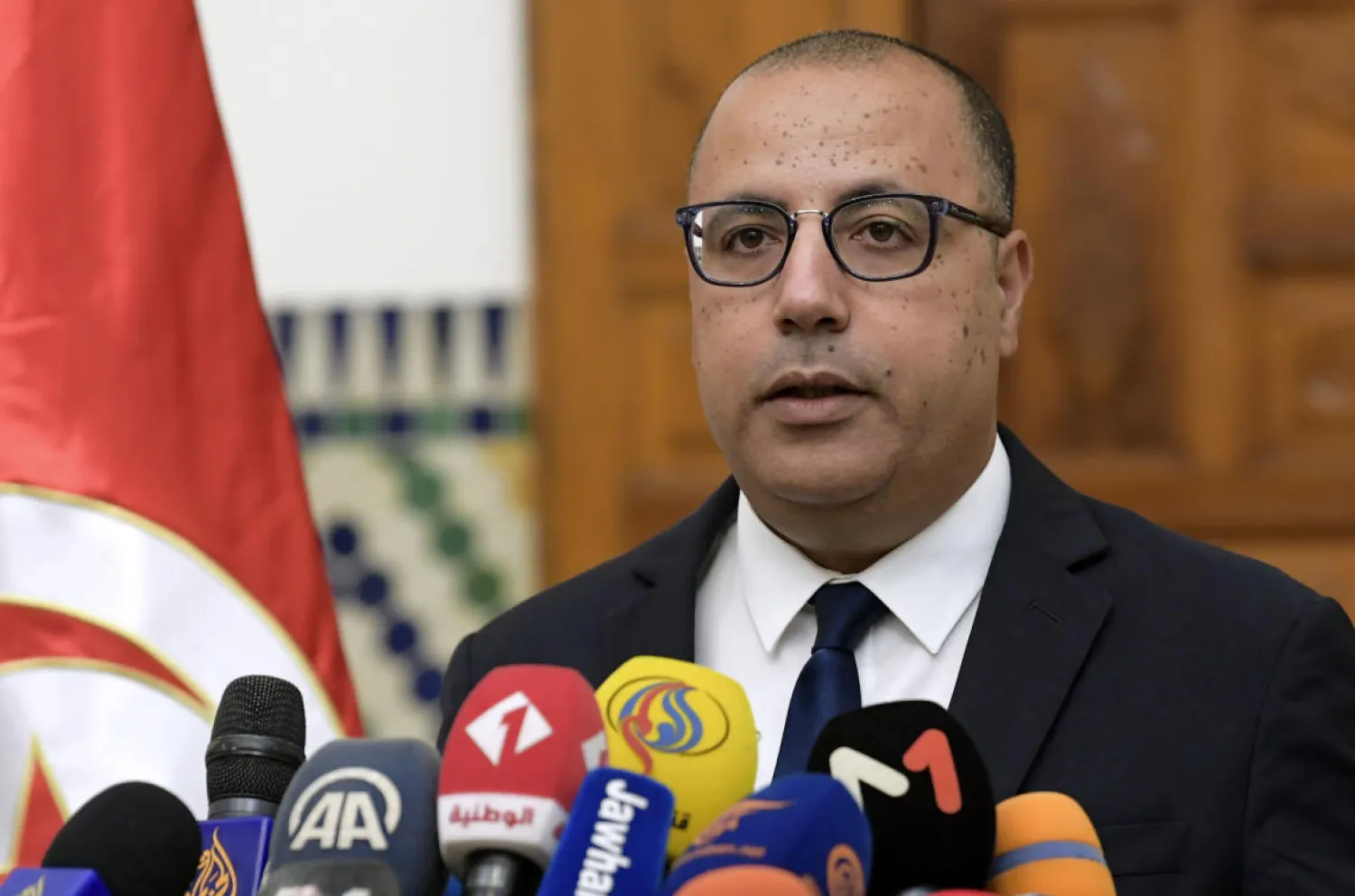

Tunisia Premier Designate Names a Technocratic Government

Tunisia's Prime Minister-designate Hichem Mechichi briefs the media about his proposed government list during a press conference in Carthage, on August 10, 2020. (AFP)
TT

Tunisia Premier Designate Names a Technocratic Government

Tunisia's Prime Minister-designate Hichem Mechichi briefs the media about his proposed government list during a press conference in Carthage, on August 10, 2020. (AFP)

Tunisia’s Prime Minister-designate Hichem Mechichi announced on Monday a cabinet of independent technocrats without parties, seeking to distance the government from political conflicts and focus on reviving the ailing economy.

Mechichi, 46, is an independent, who was interior minister in the government of Elyes Fakhfakh. Tunisian President Kais Saied last month appointed Mechichi the new prime minister after Fakhfakh resigned over allegations of a conflict of interest.

Under plans to revamp the government and revive the economy, Mechichi gathered the ministries of finance, investment and economy into a single department led by liberal economist Ali Kooli, CEO of Arab Banking Corporation (ABC Bank) in Tunisia.

Mechichi needs to win a confidence vote in parliament in the next few days or face the dissolution of parliament by the president and another election, deepening instability.

On Monday, the Democratic Current political party, which is part of the government coalition led by the Ennahda Movement, said it will not support the cabinet proposed by Mechichi.

It vowed to continue to exercise its supervisory role in forming a constructive and responsible opposition.

The party, which is allied to the People's Movement within the Democratic Bloc in parliament, stressed it had dealt “positively” with Mechichi from the first moment he was charged with forming the government.

It also voiced its readiness “to support any government that carries a vision and a political proposal capable of saving the country.”

It expressed shock at Mechichi’s choice of proposing a non-political technocratic government, and his reliance on “mock consultations marred by ambiguity”.

It drew attention to the dangers of forming a technocratic government, saying it undermines the nascent democratic process in Tunisia and the will of voters in the last parliamentary elections.

In contrast to the Democratic Current’s position, head of the People’s Movement, Khaled Krichi, said that his party gave preliminary confidence to Mechichi’s proposed cabinet.

Krichi said that despite the People’s Movement and Democratic Current belonging to the same parliamentary bloc, the latter has no control over the Movement’s opinions and decisions.

He, however, reaffirmed that the two parties remain political partners and that negotiations are ongoing between them.

“The political situation in Tunisia resembles moving sands and there are no constants or final stances—the Democratic Current can possibly review its decision on not supporting the proposed government,” Krichi said.

The Dignity Coalition, led by Seifeddine Makhlouf, confirmed that it will not grant confidence to Mechichi’s government and that it will continue to oppose to protect democracy.

Ennahda Movement and parliament Speaker Rached Ghannouchi also expressed his rejection of the formation of a technocratic government.

Authorities have been struggling to defuse constant protests over widespread unemployment, lack of investment for development and poor health, electricity and water services.

Since their 2011 popular revolution, many Tunisians have grown frustrated over economic stagnation, a decline in living standards and decay in public services while political parties often seem more focused on staying in office instead of tackling problems.

Mechichi said earlier this month his government would focus on rescuing public finances and easing social hardships, saying that while political turmoil had dragged out, “some Tunisians have not found drinking water”.

Tunisia’s tourism-dependent economy shrank 21.6 percent in the second quarter of 2020, compared to the same period last year, due to the coronavirus crisis.


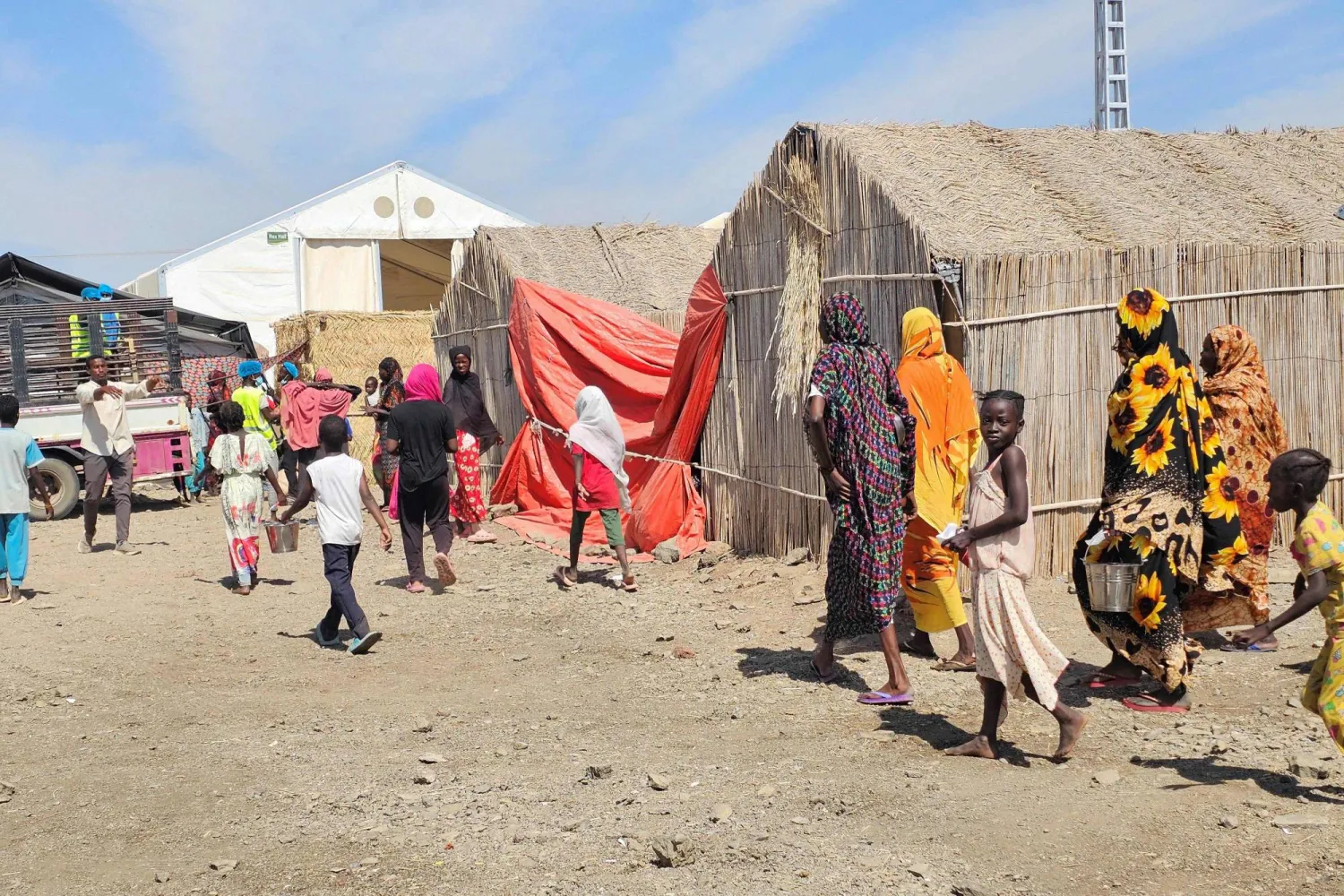

Three Dead After Flooding Hits Northwest Syria

A child watches as civil defense teams open flooded roads in Idlib. (SANA)
TT

Three Dead After Flooding Hits Northwest Syria

A child watches as civil defense teams open flooded roads in Idlib. (SANA)

Two children and a Syrian Red Crescent volunteer have died as a result of flooding in the country's northwest, state media said on Sunday.

The heavy rains in Syria's Idlib region and the coastal province of Latakia have also wreaked havoc in displacement camps, according to authorities, who have launched rescue operations and set up shelters in the areas.

State news agency SANA reported "the death of a Syrian Arab Red Crescent volunteer and the injury of four others as they carried out their humanitarian duties" in Latakia province.

The Syrian Red Crescent said in a statement that the "a mission vehicle veered into a valley", killing a female volunteer and injuring four others, as they went to rescue people stranded by flash floods.

"A fifth volunteer was injured while attempting to rescue a child trapped by the floodwaters," it added.

SANA said two children died on Saturday "due to heavy flooding that swept through the Ain Issa area" in the north of Latakia province.

Authorities said Sunday they were working to clear roads in displacement camps in flooded parts of Idlib province.

The emergencies and disaster management ministry said 14 displacement camps in part of Idlib province were affected, with tents swamped, belongings swept away and around 300 families directly impacted.

Around seven million people remain internally displaced in Syria, according to the United Nations refugee agency, some 1.4 million of them living in camps and sites in the country's northwest and northeast.

The December 2024 ouster of longtime ruler Bashar al-Assad after more than 13 years of civil war revived hopes for many to return home, but the destruction of housing and a lack of basic infrastructure in heavily damaged areas has been a major barrier.


Hamas’s Meshal Rejects Disarmament or 'Foreign Rule'

Boys walk past the rubble of destroyed buildings in the Jabalia camp for Palestinian refugees in the northern Gaza Strip on February 8, 2026. (Photo by Omar AL-QATTAA / AFP)
TT

Hamas’s Meshal Rejects Disarmament or 'Foreign Rule'

Boys walk past the rubble of destroyed buildings in the Jabalia camp for Palestinian refugees in the northern Gaza Strip on February 8, 2026. (Photo by Omar AL-QATTAA / AFP)

A senior Hamas leader said Sunday that the Palestinian movement would not surrender its weapons nor accept foreign intervention in Gaza, pushing back against US and Israeli demands.

"Criminalizing the resistance, its weapons, and those who carried it out is something we should not accept," Khaled Meshal said at a conference in Doha.

"As long as there is occupation, there is resistance. Resistance is a right of peoples under occupation ... something nations take pride in," said Meshal, who previously headed the group.

A US-brokered ceasefire in Gaza is in its second phase, which foresees that demilitarization of the territory -- including the disarmament of Hamas -- along with a gradual withdrawal of Israeli forces.

Hamas has repeatedly said that disarmament is a red line, although it has indicated it could consider handing over its weapons to a future Palestinian governing authority.

Israeli officials say that Hamas still has around 20,000 fighters and about 60,000 Kalashnikovs in Gaza.

A Palestinian technocratic committee has been set up with a goal of taking over the day-to-day governance in the battered Gaza Strip, but it remains unclear whether, or how, it will address the issue of demilitarization.

The committee operates under the so-called "Board of Peace," an initiative launched by US President Donald Trump.

Originally conceived to oversee the Gaza truce and post-war reconstruction, the board's mandate has since expanded, prompting concerns among critics that it could evolve into a rival to the United Nations.

Trump unveiled the board at the World Economic Forum in the Swiss ski resort of Davos last month, where leaders and officials from nearly two dozen countries joined him in signing its founding charter.

Alongside the Board of Peace, Trump also created a Gaza Executive Board - an advisory panel to the Palestinian technocratic committee - comprising international figures including US envoys Steve Witkoff and Jared Kushner, as well as former British prime minister Tony Blair.

On Sunday, Meshal urged the Board of Peace to adopt what he called a "balanced approach" that would allow for Gaza's reconstruction and the flow of aid to its roughly 2.2 million residents, while warning that Hamas would "not accept foreign rule" over Palestinian territory.

"We adhere to our national principles and reject the logic of guardianship, external intervention, or the return of a mandate in any form," Meshal said.
"Palestinians are to govern Palestinians. Gaza belongs to the people of Gaza and to Palestine. We will not accept foreign rule," he added.


Rescue Teams Search for Survivors in Building Collapse that Killed at Least 2 in Northern Lebanon

A Lebanese flag is pictured, in the aftermath of a massive explosion, in Beirut's damaged port area, Lebanon August 17, 2020. REUTERS/Hannah McKay
TT

Rescue Teams Search for Survivors in Building Collapse that Killed at Least 2 in Northern Lebanon

A Lebanese flag is pictured, in the aftermath of a massive explosion, in Beirut's damaged port area, Lebanon August 17, 2020. REUTERS/Hannah McKay

At least two people were killed and four rescued from the rubble of a multistory apartment building that collapsed Sunday in the city of Tripoli in northern Lebanon, state media reported.

Rescue teams were continuing to dig through the rubble. It was not immediately clear how many people were in the building when it fell.

The bodies pulled out were of a child and a woman, the state-run National News Agency reported.

Dozens of people crowded around the site of the crater left by the collapsed building, with some shooting in the air.

The building was in the neighborhood of Bab Tabbaneh, one of the poorest areas in Lebanon’s second largest city, where residents have long complained of government neglect and shoddy infrastructure. Building collapses are not uncommon in Tripoli due to poor building standards, according to The AP news.

Lebanon’s Health Ministry announced that those injured in the collapse would receive treatment at the state’s expense.

The national syndicate for property owners in a statement called the collapse the result of “blatant negligence and shortcomings of the Lebanese state toward the safety of citizens and their housing security,” and said it is “not an isolated incident.”

The syndicate called for the government to launch a comprehensive national survey of buildings at risk of collapse.