


Tokyo's New See-Through Toilets Aim to Enhance Public Spaces

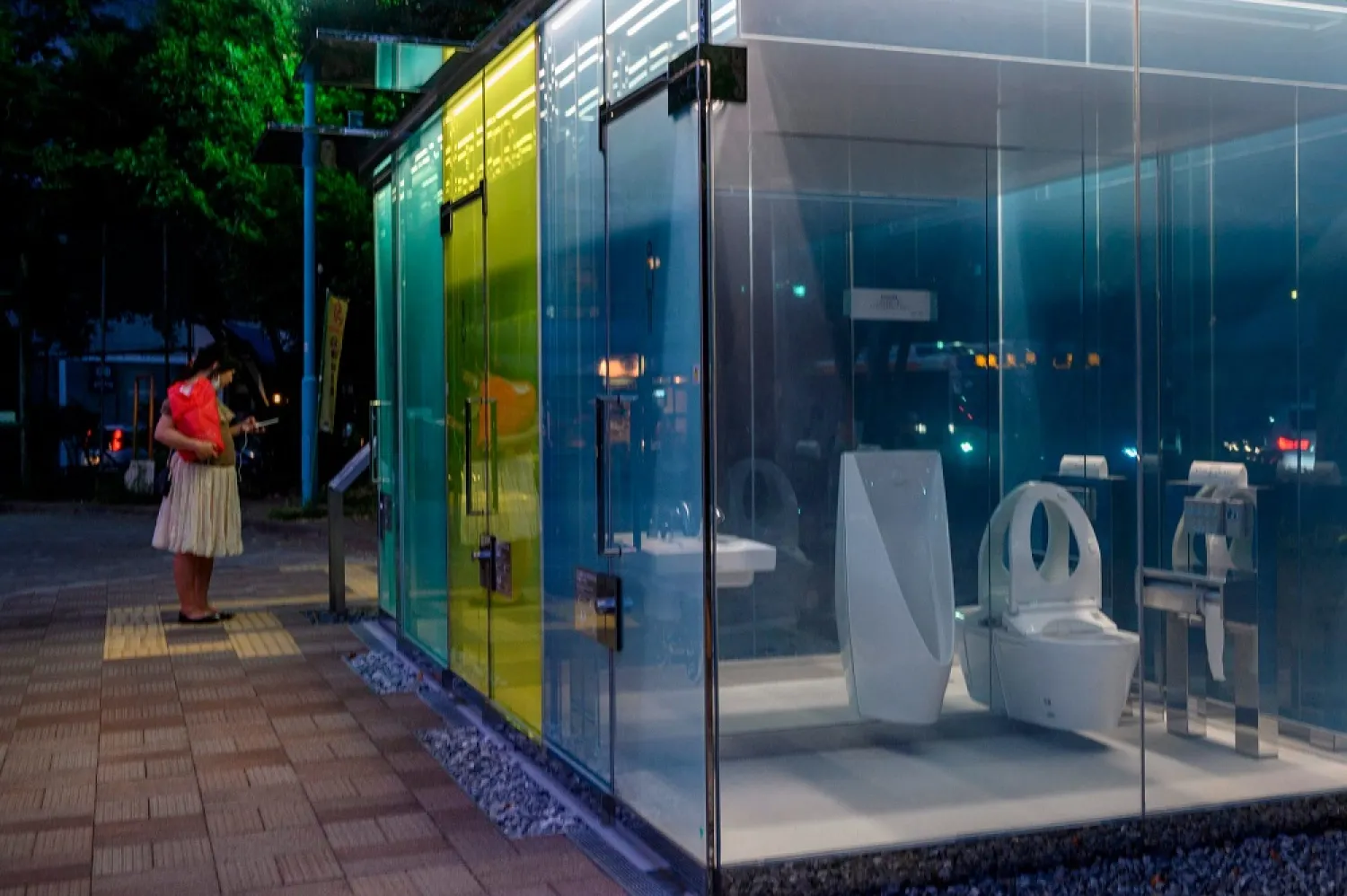
A woman stands in front of a transparent toilet designed by Shigeru Ban, at Haru-no-Ogawa Community Park in Tokyo, Japan on Aug. 19, 2020. (Getty Images)
TT

Tokyo's New See-Through Toilets Aim to Enhance Public Spaces

A woman stands in front of a transparent toilet designed by Shigeru Ban, at Haru-no-Ogawa Community Park in Tokyo, Japan on Aug. 19, 2020. (Getty Images)

Public toilets are usually a welcome sight to anyone who has had too much to drink, but some might do a double take when they come across the ones that have just opened in a Tokyo park.

Made of special glass, the cubicles become opaque when the lock is turned, but are otherwise completely see-through, with sinks, urinals and toilet bowls in full view.

The toilets were designed by architect Shigeru Ban as part of the Tokyo Toilet Project, which is backed by The Nippon Foundation, a non-profit organization.

By installing stylish toilets in public spaces the project hopes to change the common view that such facilities are dark and dirty places.

"It would be great to see the Tokyo Toilets become a model for toilets not just in Japan but across the world," Nippon Foundation Program Director Hayato Hanaoka said.

Passers-by had mixed reactions.

"It's really cool, but it wasn't very relaxing," said 28-year-old Arisa Komori, who was visiting the park with her friend and had used the toilet.

"But it's also pretty," she added with a laugh.

Some said that being able to see inside the toilets first made them feel safer about using them.

"You can see straightaway that there aren't any suspicious people lurking in the toilets, so I appreciate that I feel safer about letting my children use the toilets," said Chieri Kurokawa, 36, who lives nearby and had brought her two young sons to play in the park.

As part of the project, a total of 17 public toilets will be redesigned by renowned architects and designers, including Pritzker Prize winning Tadao Ando and Kengo Kuma.



2011 Japan Quake May Have Moved Whole Country Further East

A sailboat lies among the debris in Ofunato, Iwate Prefecture, Japan (Reuters)
TT

2011 Japan Quake May Have Moved Whole Country Further East

A sailboat lies among the debris in Ofunato, Iwate Prefecture, Japan (Reuters)

Minutes after the massive 2011 Japan earthquake and tsunami that killed nearly 20,000 people, “a previously unrecognized” phenomenon may have caused the whole country to shift further eastwards, a new study reveals, according to The Independent.

Such megaquakes are often followed by events that cause additional ground motion, which are related to aftershocks.

But exactly all the different ways in which aftershocks arise aren’t very clear, scientists say.

In a new study, researchers assessed satellite data to study the magnitude 9-Tohoku-Oki earthquake and its seismic aftereffects.

Researchers found that the devastating quake led to a sudden sliding of blocks of rock past each other along the fault line, the British newspaper reported.

It also led to seismic waves travelling through the Earth, bouncing off the planet’s core, and traveling back to the surface to reactivate the region’s tectonic plate boundaries.

These were “shear waves” that travelled through the Earth's interior and caused rock particles to vibrate in a "shear" or side-to-side motion.

Water inundates homes following the tsunami and earthquake that struck Natori city in northeastern Japan in 2011 (Reuters)

The latest findings reveal a previously unknown hazard that could potentially activate or reactivate the main area of a quake, according to the study published in the journal Science.

“We report an extraordinary observation of ground motion in Japan after the moment magnitude 9 2011 Tohoku-Oki earthquake attributed to a multiplate-interface slip event triggered by a shear wave that travelled to the Earth’s core and back,” researchers wrote in the study.

In the study, scientists re-examined satellite data to look for subtle movements in the minutes surrounding the 2011 quake.

They found that seismic waves travelling through the Earth and bouncing off the core shifted the whole of Japan by as much as 5-6mm.

While this may not be a lot and is a common amount of ground movement following large earthquakes, what surprised scientists was the area of land that had actually shifted.

The triggered slip “has the broadest rupture area of any single event yet documented”, researchers wrote.

“Its overall length is similar to that of mainland Japan (~3,000 km), exceeding the mainshock rupture length by 6‒7 times and more than doubling that of the 2004 great Sumatra Earthquake,” they wrote in the study.

As this ground movement was spread out over several minutes, people may not have felt it happen under their feet, researchers say.

Yet, this new type of seismic hazard needs to be further studied, researchers say.

“I think we should be aware of the fact that there could be this potential triggering of an event many minutes after [an earthquake’s] main shaking has passed,” study author Sunyoung Park told Scientific American.


Australia Detects First Case of Contagious H5 Bird Flu

FILE PHOTO: A test tube labelled "Bird Flu," eggs and a piece of paper in the colors of the Australian national flag are seen in this picture illustration, January 14, 2023. REUTERS/Dado Ruvic/Illustration/File Photo
TT

Australia Detects First Case of Contagious H5 Bird Flu

FILE PHOTO: A test tube labelled "Bird Flu," eggs and a piece of paper in the colors of the Australian national flag are seen in this picture illustration, January 14, 2023. REUTERS/Dado Ruvic/Illustration/File Photo

Scientists have detected the H5 strain of bird flu in Australia for the first time, the country's agriculture minister said on Saturday, meaning the highly contagious variant has now spread to every continent.

Julie Collins told a press conference the disease had been found in a migratory sea bird, a brown skua, in remote Western Australia, and the result confirmed by the national science agency.

Samples from another sick bird, a giant petrel found in the same area, had also shown a suspected positive result, she said.

Australia was previously the only continent where the H5 strain, which can devastate poultry and wild bird populations, had not been detected.

"Whilst disappointing, this is not unexpected, given the global spread of the H5 bird flu," Collins told reporters in Canberra.

"I can confirm there is still no evidence of any mass mortalities at this time, nor is there any evidence of infection in any poultry," AFP quoted her as saying.

An emergency meeting of animal health and agriculture officials has been held to consider a national response.

"We all knew we couldn't be bird flu-free forever," Collins added.

The H5 strain has caused severe disease and high death rates in poultry, wild birds and affected mammals across the globe.

Prime Minister Anthony Albanese said on Saturday the detection of the case was concerning, and that his government would take measures seeking to contain the spread of the disease.

"This is something that has happened through migratory birds, and has happened by definition around the world, and this is why we are preparing for this," he said.

The wild birds most affected by the H5 strain include waterfowl, shorebirds, seabirds and birds of prey.

Marine mammals have also been affected, with some detections in other animals like cats, goats, alpacas and pigs.

There has been concern that the deadly disease could add to the extinction risks faced by Australian fauna, many of which are unique to the vast continent.

Almost half of Australia's wild bird species, and 83 percent of its mammals, are found nowhere else.

Australia's Threatened Species Commissioner Fiona Fraser said on Saturday there was a plan to protect 35 species by boosting captive breeding.

Among them, the Tasmanian devil, black swan, little penguin and Australian sea lion are at particular risk from bird flu, she said.

"There could clearly be population-level impacts for our species," Fraser said.

The confirmed case was detected in a wilderness area 630 kilometers (391 miles) southeast of the city of Perth on the west coast.

Officials said they are investigating if the disease arrived in Australia via birds migrating from the sub-Antarctic.

On Thursday, Australian scientists said the H5 bird flu strain had killed more than 13,000 elephant seal pups after infecting a breeding colony on the remote Heard and McDonald Islands, one of Australia's external territories in the sub-Antarctic.


'Like a Fridge': France Cave Homes Offer Lucky Few Respite from Heat

(FILES) A picture taken on July 27, 2012 shows a cave dwelling in Troo, western France. (Photo by JEAN-FRANCOIS MONIER / AFP)
TT

'Like a Fridge': France Cave Homes Offer Lucky Few Respite from Heat

(FILES) A picture taken on July 27, 2012 shows a cave dwelling in Troo, western France. (Photo by JEAN-FRANCOIS MONIER / AFP)

Millions in France are grappling with scorching heat, but Jean-Luc Eclercy-Deterpigny is not worried as his living room inside a former quarry offers refreshing refuge.

"It feels like stepping inside a fridge," said the 57-year-old former Parisian who moved to the village of Troo in the Loire Valley during the Covid pandemic.

Paris and large swathes of France are battling the latest in a string of heatwaves, whose increased frequency scientists have linked to man-made climate change.

According to AFP, Eclercy-Deterpigny said he and his partner -- the village's new mayor -- were "privileged" as their garden boasts access to a living room buried in the rock.

"We can stay cool all day if necessary," he added.

Troo, a settlement of some 315 residents, includes whole homes and rooms in tunnels left behind by quarrying for tuffeau limestone to build the region's houses and castles.

People in the village live in or rent out some 11 homes entirely buried in the rock, while others have access to a cave room, according to the mayor's office.

Other such dwellings have been abandoned but could be lived in again.

"If you look at the walls of a cave dwelling, there's no insulation. It's simply tuffeau stone," Eclercy-Deterpigny said, adding it was also warm in winter.

"In my view, it's the best natural insulator we have today," added the chairman of the Troo Tourism Association.

Dominique Operon and his husband, Jean-Paul, left their poorly insulated Normandy cottage in 2022 to move in to their new home in Troo.

Under the limestone ceiling of an airy living room dotted with plants, Operon picks up a thermometer indicating a temperature a dozen degrees lower than outdoors.

Even as the heat outside soared above 30C, it remained a delicious 19C indoors.

Here "you feel protected from the outdoor temperatures," the 71-year old retiree said.

"It's a solution for eco-friendly housing," he added.

Troo counts between six and eight kilometers (around 3 to 5 miles) of tunnels, which could eventually allow for an increase in the number of cave dwellings, mayor Patrick Eclercy-Deterpigny said.

The only downside is lack of sunlight, as any cave home not facing southwards can be very gloomy inside.

Moving into a former quarry also comes with significant renovation works, including to lower and regulate humidity.

New residents usually have to spend money on ventilation, water drainage and lime-based plastering of the walls.

But these man-made caves could be "a model for future housing", the mayor said.