


Turkey Bans Gatherings in 14 Provinces to Fight Pandemic

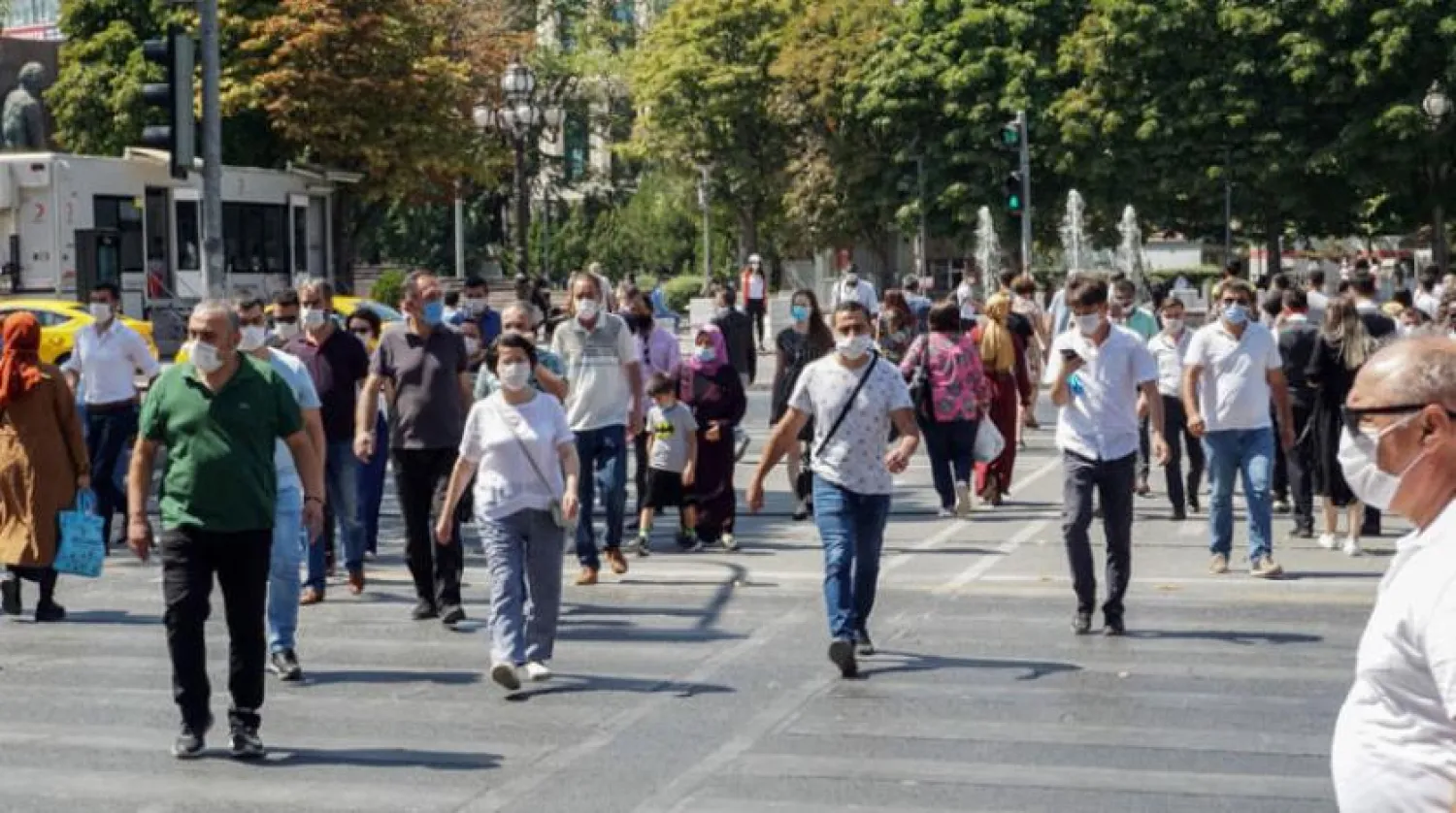
Pedestrians wear face masks as they walk in a street of Ankara on August 26, 2020, as Turkey has reported 1,502 new confirmed cases of the new coronavirus (COVID-19) - the highest daily jump in more than a month. (Photo by Adem ALTAN / AFP)
TT

Turkey Bans Gatherings in 14 Provinces to Fight Pandemic

Pedestrians wear face masks as they walk in a street of Ankara on August 26, 2020, as Turkey has reported 1,502 new confirmed cases of the new coronavirus (COVID-19) - the highest daily jump in more than a month. (Photo by Adem ALTAN / AFP)

Turkey has reimposed preventive measures in light of the rapid spread of the coronavirus, and infections hitting a record level since mid-June.

The Interior Ministry said it was banning certain events and ceremonies in 14 provinces, including the capital, Ankara.

In a nationwide notice, it said weddings in the 14 provinces would be allowed for up to one hour only, saying celebrations or parties were banned.

President Recep Tayyip Erdogan issued a new presidential decree Wednesday that made an informal working model official.

Under the decree, all state institutions may now implement “flexible working methods” to prevent the COVID-19 outbreak.

The decree, which was published in the Official Gazette, allows civil servants to work from home and in rotated shifts, replacing a brief administrative leave with the continued but safe working plan.

It gave managers the right to define flexible work principles, procedures and relevant principles.

Employees who benefit from these flexible work methods will be considered to have already fulfilled their job duties during this period.

According to the decree, employees working from home or in rotation will be equal in terms of responsibility, as their financial, social and other personal rights will be preserved.

It stressed that employees on leave, working from home or in rotation will not be able to leave the scope of their workplaces without their managers’ permission.

Meanwhile, Turkey’s new coronavirus cases jumped on Tuesday to their highest level since mid-June at 1,502, according to Health Ministry data.

Health Minister Fahrettin Koca said on Twitter that 24 more people died from COVID-19, bringing the country’s death toll to 6,163.

Daily cases were last this high on June 15 - two weeks after Turkey lifted a partial lockdown - when the country logged 1,592 cases.

Head of Turkey’s opposition Democracy and Progress Party (DEVA) Ali Babacan said on Tuesday he had tested positive for coronavirus but was in good health, becoming the most high-profile Turkish politician to contract the disease.

“I just learned my COVID-19 test result is positive. Thank God, I am in good condition at the moment. My doctors said I needed to remain in quarantine with my family for some time. I will continue my work from home, God willing,” he said on Twitter.

Babacan, 53, also a former deputy prime minister, resigned from President Recep Tayyip Erdogan’s AK Party last July over “deep differences” about the direction of the party he helped found. In March he formed his rival political party.



France Asks for a NATO Exercise in Greenland, Is Ready to Participate

Snow-covered houses line a hillside in Nuuk, Greenland, as warm evening light hits the neighborhood on January 20, 2026. (AFP)
TT

France Asks for a NATO Exercise in Greenland, Is Ready to Participate

Snow-covered houses line a hillside in Nuuk, Greenland, as warm evening light hits the neighborhood on January 20, 2026. (AFP)

France has asked for a ​NATO exercise in Greenland and is ready to contribute to it, French President Emmanuel Macron's office said on Wednesday.

News of the request comes ‌as US ‌President Donald ‌Trump barrels ⁠into ​Davos, ‌Switzerland, on Wednesday, where he is likely to use the World Economic Forum to escalate his push for acquiring Greenland despite European ⁠protests in the biggest fraying of ‌transatlantic ties in ‍decades.

Speaking in ‍Davos on Tuesday, Macron ‍said Europe would not give in to bullies or be intimidated, in a scathing ​criticism of Trump's threat to impose steep tariffs if ⁠Europe does not let him take over Greenland.

NATO leaders have warned that Trump's Greenland strategy could upend the alliance. Trump has linked Greenland to his anger at not receiving a Nobel Peace Prize.


EU Stands Ready to Defend Itself Against Coercion, Costa Says

European Council President Antonio Costa addresses the EU Parliament in Strasbourg, France, January 21, 2026. (Reuters)
TT

EU Stands Ready to Defend Itself Against Coercion, Costa Says

European Council President Antonio Costa addresses the EU Parliament in Strasbourg, France, January 21, 2026. (Reuters)

The European Union will defend itself ​against any form of coercion and will protect the international rules-based order and international law, EU Council President ‌Antonio Costa ‌said ‌on ⁠Wednesday.

"We ​stand ‌ready to defend ourselves, our member states, our citizens, our companies, against any form of coercion. ⁠And the European Union has ‌the power and ‍the ‍tools to do ‍so," Costa said in a speech in European Parliament.

"We cannot accept ​that the law of the strongest prevails over ⁠the rights of the weakest," Costa said.

"Because international rules are not optional. And alliances cannot just boil down to a sequence of transactions."


Gunman Jailed for Life in Killing of Japan Ex-PM Abe

In this picture taken on July 24, 2019 Japanese Prime Minister Shinzo Abe speaks on the podium during a ceremony marking one year before the start of the Tokyo 2020 Olympic Games in Tokyo. (AFP)
TT

Gunman Jailed for Life in Killing of Japan Ex-PM Abe

In this picture taken on July 24, 2019 Japanese Prime Minister Shinzo Abe speaks on the podium during a ceremony marking one year before the start of the Tokyo 2020 Olympic Games in Tokyo. (AFP)

The gunman charged with killing Japan's former Prime Minister Shinzo Abe was found guilty Wednesday and jailed for life, as the judge declared the broad-daylight assassination "despicable and extremely malicious".

The shooting more than three years ago forced a reckoning in a country with little experience of gun violence, and ignited scrutiny of alleged ties between prominent conservative lawmakers and a secretive sect, the Unification Church.

As he handed down the sentence at a court in the city of Nara, judge Shinichi Tanaka said Tetsuya Yamagami, 45, had been "determined" to shoot Abe.

The fact he "shot him from behind and did so when (Abe) was least expecting it" points to the "despicable and extremely malicious" nature of his act, he said.

A queue of people waited Wednesday morning for tickets to enter the courtroom, highlighting intense public interest in the trial.

Yamagami looked down and expressed little emotion during the sentencing for charges including murder and firearms control law violations, after he used a handmade gun to kill Japan's longest-serving leader during his campaign speech in July 2022.

The defense team of Yamagami -- who had admitted to murder at the trial opening in October -- told a press conference they had not yet decided whether to appeal, which under Japan's legal system must be done within two weeks.

- 'Significant grief' -

Prosecutors had argued that the defendant's motive to kill Abe was rooted in his desire to besmirch the Unification Church.

The months-long trial highlighted how his mother's blind donations to the church plunged his family into bankruptcy and how he came to believe "influential politicians" were helping the sect thrive.

Abe had spoken at events organized by some of the church's groups.

Judge Tanaka said "it is undeniable that the defendant's upbringing influenced the formation of his personality and his mindset... and that it even played a distant role" in his actions.

But "each criminal action he took was based on nothing but his own decision-making, the process of which deserves strong condemnation", he added.

Katsuya Nakatani, a 60-year-old member of the public who was in the courtroom, said the judge had convinced him that "even if there was room for extenuating circumstances... opening fire with so many people around is, after all, something that cannot be forgiven".

"I even began to think it might have been a stroke of luck that only one person died," he said.

Another man outside court held a banner urging the judge to take Yamagami's difficult life circumstances "into the fullest consideration".

- Draw attention -

Yamagami "thought if he killed someone as influential as former prime minister Abe, he could draw public attention to the Church and fuel public criticism of it", a prosecutor told a district court in western Japan's Nara region in October.

The Unification Church was established in South Korea in 1954, with its members nicknamed "Moonies" after founder Sun Myung Moon.

In a plea for leniency, his defense team stressed his upbringing had been mired in "religious abuse" stemming from his mother's extreme faith in the Unification Church.

In despair after the suicide of her husband -- and with her other son gravely ill -- Yamagami's mother poured all her assets into the Church to "salvage" her family, Yamagami's lawyer said, adding that her donations eventually snowballed to around 100 million yen ($1 million at the time).

Yamagami was forced to give up pursuing higher education. In 2005, he attempted to take his own life before his brother died by suicide.

Investigations after Abe's murder led to cascading revelations about close ties between the Church and many conservative lawmakers in the ruling Liberal Democratic Party, prompting four ministers to resign.

In 2020, Yamagami began hand-crafting a firearm, a process that involved meticulous test-firing sessions in a remote mountainous area.

This points to the highly "premeditated" nature of his attack on Abe, prosecutors said.
The assassination was also a wake-up call for a nation which has some of the world's strictest gun controls.

Gun violence is so rare in Japan that security officials at the scene failed to immediately identify the sound made by the first shot, and came to Abe's rescue too late, a police report after the attack said.

Prosecutors sought a life sentence for Yamagami, calling the murder "unprecedented in our post-war history" and citing the "extremely serious consequences" it had on society, according to local media.

The Japanese version of life imprisonment leaves open the possibility of parole, although in reality, experts say many die while incarcerated.