


Human Rights Watch: Venezuela Using COVID-19 to Crack Down

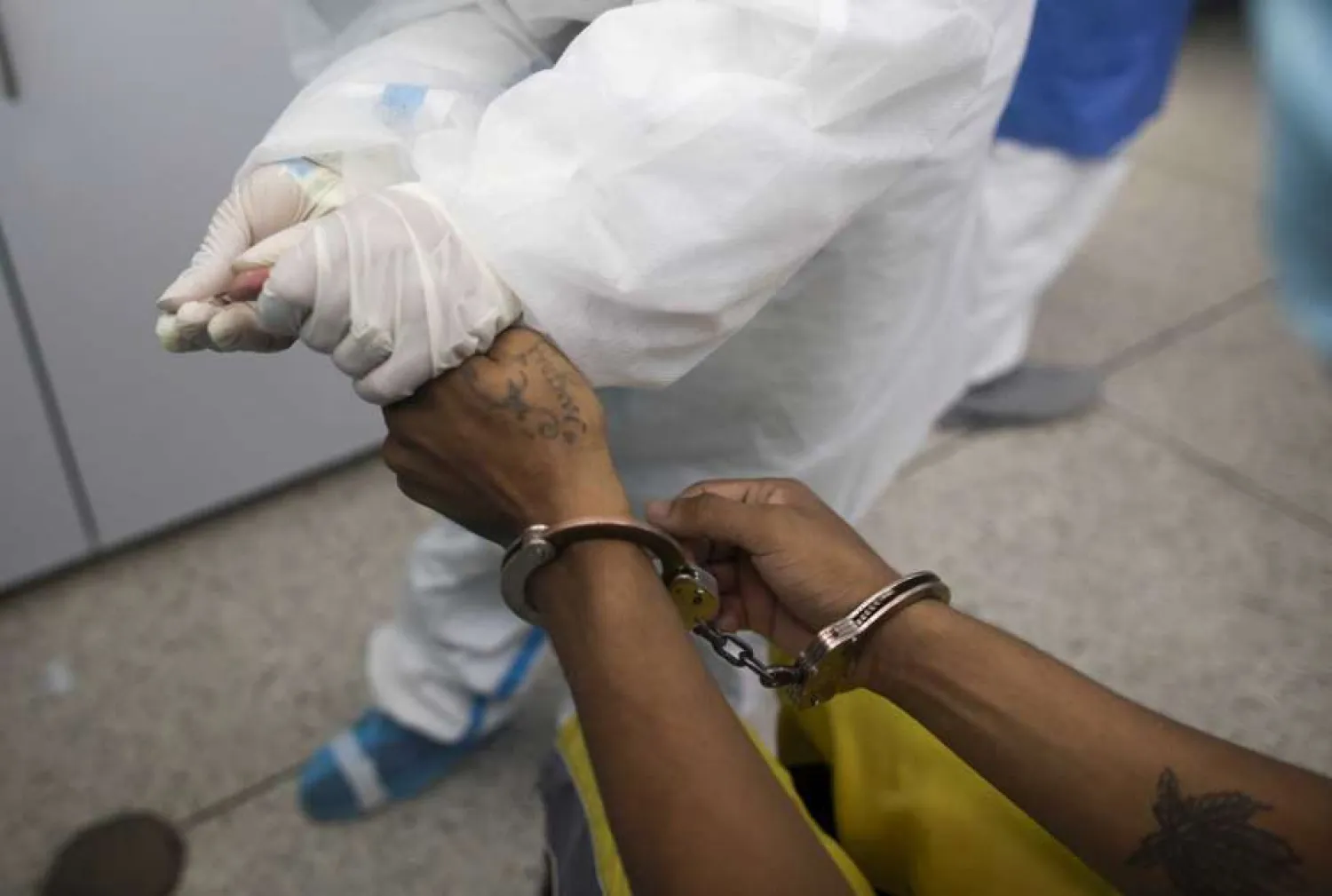
A doctor takes a blood sample for a quick COVID-19 test from a handcuffed inmate at a comprehensive diagnosis center that set up to attend patients with new coronavirus in Caracas, Venezuela, Thursday, Aug 27, 2020. (AP Photo/Ariana Cubillos)
TT

Human Rights Watch: Venezuela Using COVID-19 to Crack Down

A doctor takes a blood sample for a quick COVID-19 test from a handcuffed inmate at a comprehensive diagnosis center that set up to attend patients with new coronavirus in Caracas, Venezuela, Thursday, Aug 27, 2020. (AP Photo/Ariana Cubillos)

Venezuelan security forces and authorities under President Nicolás Maduro have used the coronavirus as an excuse to crack down on dissenting voices on social media and even in private messages, Human Rights Watch reported Friday.

The New York-based rights group said Venezuelan authorities have targeted dozens of journalists, healthcare workers, human rights lawyers and political opponents critical of the government's response to the pandemic.

Some critics have been physically abused to levels bordering on torture, the group said in a report listing 162 such cases from March through June. Human Rights Watch says it verified several complaints through interviews with alleged victims, while also citing reports by Venezuelan media and human rights advocates.

"In Venezuela today, you can´t even share a private message criticizing the Maduro government via WhatsApp without fear of being prosecuted," said José Miguel Vivanco, Americas director at Human Rights Watch.

"The state of emergency has emboldened security forces and armed pro-government groups that already have a record of torture and extrajudicial killings to crack down even more harshly on Venezuelans," Vivanco said.

Venezuela´s Ministry of Communications did not immediately respond to an email from The Associated Press seeking comment. Authorities loyal to Maduro often dismiss critics of its human rights record as outside interests led by the United States interfering in the nation´s internal affairs.

Venezuela was in an economic and political crisis before the pandemic. Maduro has come under heightened international pressure to step down since early 2019, when U.S.-backed opposition leader Juan Guaidó mounted a challenge, claiming the socialist leader illegitimately clings to power following a fraudulent election.

Maduro´s government instituted emergency measures in mid-March shortly after Venezuela´s first coronavirus cases were diagnosed, closing many businesses, limiting travel inside the country, and grounding commercial air travel.

Officials so far have reported roughly 350 coronavirus deaths and 42,000 illnesses, but medical workers and government critics say that is an undercount due to the lack of testing.

Human Rights Watch said Maduro´s government often evokes an "overly broad" anti-hate law approved in 2017 as an instrument for its crackdown, which is enforced by a judicial system lacking independence from Maduro.

The group cited the case of Iván Virgüez, a 65-year-old human rights lawyer arrested in mid-April after a Facebook post critical of how migrants returning to Venezuela were held in quarantine centers.

Over the two days he was in custody, police handcuffed him for two hours under the sun to a metal tube 2 feet off the ground, Human Rights Watch said, adding that he was denied a bathroom for 26 hours.

Virgüez was charged with public disturbance, contempt, defamation of authorities, and instigation of rebellion. He remains under house arrest, allowed to leave his home only for medical visits, Human Rights Watch says.

Hospital worker Andrea Sayago in April sent colleagues a warning on the WhatsApp messaging service of their first coronavirus cases. Photos of test results she sent ended up on social media and hospital administrators forced her to resign, saying her message constituted "terrorism," the human rights group reported.

Venezuela's intelligence police later questioned her for several hours, and she's been charged with misuse of privileged information and put under house arrest pending trial, Human Rights Watch said.

Security forces in March entered the home of Darvinson Rojas, a 25-year-old freelance journalist, and activist, without a search warrant, claiming an anonymous tip reporting a coronavirus case. Human Rights Watch said Rojas tweeted a tally of coronavirus cases collected from various official sources, which gave a total number of cases higher than the ones authorities reported.

The organization said authorities roughed up Rojas' family members, seized his cellphone and computer, and detained him for nearly two weeks. He's charged with inciting hatred for publishing false information aimed at destabilizing the government.



France Accuses Iran of ‘Repression’ in Sentence for Nobel Laureate

People cross an intersection in downtown Tehran, Iran, Monday, Feb. 9, 2026. (AP)
TT

France Accuses Iran of ‘Repression’ in Sentence for Nobel Laureate

People cross an intersection in downtown Tehran, Iran, Monday, Feb. 9, 2026. (AP)

France accused Iran on Monday of "repression and intimidation" after a court handed Nobel Peace Prize laureate Narges Mohammadi a new six-year prison sentence on charges of harming national security.

Mohammadi, sentenced Saturday, was also handed a one-and-a-half-year prison sentence for "propaganda" against Iran's system, according to her foundation.

"With this sentence, the Iranian regime has, once again, chosen repression and intimidation," the French foreign ministry said in a statement, describing the 53-year-old as a "tireless defender" of human rights.

Paris is calling for the release of the activist, who was arrested before protests erupted nationwide in December after speaking out against the government at a funeral ceremony.

The movement peaked in January as authorities launched a crackdown that activists say has left thousands dead.

Over the past quarter-century, Mohammadi has been repeatedly tried and jailed for her vocal campaigning against Iran's use of capital punishment and the mandatory dress code for women.

Mohammadi has spent much of the past decade behind bars and has not seen her twin children, who live in Paris, since 2015.

Iranian authorities have arrested more than 50,000 people as part of their crackdown on protests, according to US-based Human Rights Activists News Agency (HRANA).


Iran's Supreme Leader Urges Iranians to Show 'Resolve' against Foreign Pressure

Iran's supreme leader Ali Khamenei on (File Photo/Supreme Leader's website).
TT

Iran's Supreme Leader Urges Iranians to Show 'Resolve' against Foreign Pressure

Iran's supreme leader Ali Khamenei on (File Photo/Supreme Leader's website).

Iran's supreme leader Ali Khamenei on Monday called on his compatriots to show "resolve" ahead of the anniversary of the 1979 Islamic revolution this week.

Since the revolution, "foreign powers have always sought to restore the previous situation", Ali Khamenei said, referring to the period when Iran was under the rule of shah Reza Pahlavi and dependent on the United States, AFP reported.

"National power is less about missiles and aircraft and more about the will and steadfastness of the people," the leader said, adding: "Show it again and frustrate the enemy."


UK PM's Communications Director Quits

British Prime Minister Keir Starmer delivers a speech at Horntye Park Sports Complex in St Leonards, Britain, February 05, 2026. Peter Nicholls/Pool via REUTERS
TT

UK PM's Communications Director Quits

British Prime Minister Keir Starmer delivers a speech at Horntye Park Sports Complex in St Leonards, Britain, February 05, 2026. Peter Nicholls/Pool via REUTERS

British Prime Minister Keir Starmer's director of communications Tim Allan resigned on Monday, a day after Starmer's top aide Morgan McSweeney quit over his role in backing Peter Mandelson over his known links to Jeffrey Epstein.

The loss of two senior aides ⁠in quick succession comes as Starmer tries to draw a line under the crisis in his government resulting from his appointment of Mandelson as ambassador to the ⁠US.

"I have decided to stand down to allow a new No10 team to be built. I wish the PM and his team every success," Allan said in a statement on Monday.

Allan served as an adviser to Tony Blair from ⁠1992 to 1998 and went on to found and lead one of the country’s foremost public affairs consultancies in 2001. In September 2025, he was appointed executive director of communications at Downing Street.