


'Fresh Paint on Crumbling Building': Lebanon Bank Clean-up Raises Doubts

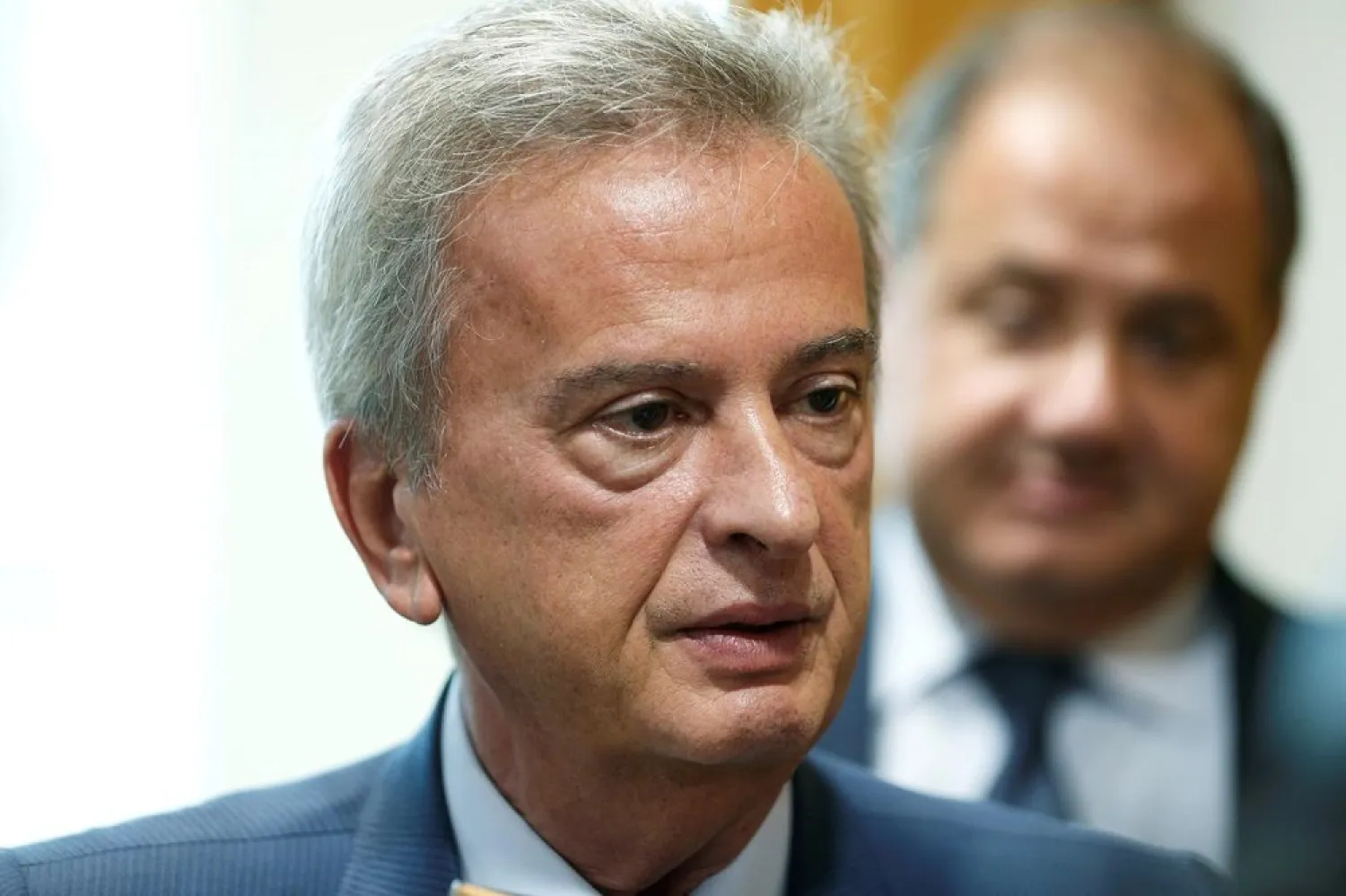
Lebanon's Central Bank Governor Riad Salameh meets with the government's social and economic council in Beirut, Lebanon September 27, 2018. (Reuters)
TT

'Fresh Paint on Crumbling Building': Lebanon Bank Clean-up Raises Doubts

Lebanon's Central Bank Governor Riad Salameh meets with the government's social and economic council in Beirut, Lebanon September 27, 2018. (Reuters)

Bankers and analysts have voiced skepticism about attempts by Lebanon’s central bank to clean up the country’s banks, warning they must form part of a wider rescue plan to fix its broken financial and economic system.

In a series of circulars on Thursday, the central bank told domestic banks to raise fresh capital, urge their big depositors to move funds back to the country and provision for a 45% loss on their Eurobond holdings.

The move follows a further downward spiral in Lebanon’s fortunes since an explosion this month at Beirut’s port. Even before the blast, which led to the government’s resignation, Beirut was grappling with its worst financial crisis in the wake of protests and a default on its foreign currency debt in March.

“These ad-hoc policy decisions will add to Lebanon’s credit and banking woes and risk undermining the little progress made in talks with the IMF,” said Alia Moubayed, managing director at Jefferies, referring to already stalled negotiations with the International Monetary Fund over a bailout.

“Nor are they anchored in a revised macro-fiscal and debt restructuring plan that factors in the deteriorating socio-economic context and worsening debt dynamics after the blast.”

The bank’s initiative comes ahead of a visit next week by French President Emmanuel Macron, who is pressing Lebanese leaders to make political and financial reforms to unlock foreign aid and ease the economic crisis, including by making a full audit of state finances and the central bank.

Lebanon’s banks, at the center of the crisis because of their large holdings of the government’s debt, were told by the central bank to raise their capital by 20% by the end of February 2021 or leave the market.

Reforms
“The necessity to have a cleaning in the banks after the default is there because we want banks to resume their role and activity,” Central Bank Governor Riad Salameh told Reuters when asked about the purpose of the circulars.

But lenders wouldn’t be able to resume activity without sufficient funds with their correspondent banks, he said.

Several analysts reacted cautiously.

“It is difficult to see why the private sector would pump fresh equity capital into the banking system unless a full asset clean-up has first taken place,” said Rahul Shah, head of financials equity research at Tellimer.

Analysts also questioned how the requirement for banks to take a 45% loss on Eurobond holdings tallies with a rescue plan released earlier this year by the now-caretaker government that proposed 75% haircuts on external debt and 40% on domestic debt.

The 45% loss also does not reflect the current market value of the bonds, which plummeted deeper below 20 cents in the dollar on Thursday, in the wake of the circulars and comments from French government officials that aid will not be forthcoming without reforms.

“We do not know how the negotiation between Lebanon and the creditors will end up but we have taken the normal provision that follows such a default,” Salameh said, adding the 45% level could be readjusted “in both ways”, depending on negotiations.

The provision level could signal a desire to pursue smaller haircuts or treat bank holdings differently from foreign holdings of Eurobonds, said Patrick Curran, senior economist at Tellimer.

Banks were told that the provisions, which also included a 1.89% loss on their hard currency deposits with the central bank, should be in place within five years, but were extendable to 10 years with the approval of the central bank.

The timetable was likely an effort to ensure that banks, already struggling to remain solvent, did not flout international regulatory capital floors, said analysts.

“It’s camouflage,” said a former senior central bank official. “They’re trying to dress things up, to put a fresh coat of paint on a crumbling building.”

There was also wariness about attempts by the central bank to require large depositors to return some of their funds from overseas, with analysts viewing it a precursor to some depositors having to share financial losses.

Incentives
Banks were told to urge depositors who transferred more than $500,000 abroad as of July 1, 2017 to deposit funds in a special account in Lebanon that will be frozen for five years and would be equivalent to 15% of the transferred amount. The equivalent deposit amount is raised to 30% for “politically exposed persons”.

The directive was causing panic among some bank customers with large overseas holdings, said one financial services source, while other industry sources questioned what incentives would be offered to convince people to return funds.

“This is not the right way to do things,” said the financial services source. “The government, not the central bank, has to take decisions on this as this is a legal issue.

“Asking normal citizens to transfer some of their money back doesn’t seem fair, and if there is concern about politically exposed persons then an audit should first be carried out on their accounts to determine if they’ve benefited from financial engineering.”

The source was referring to a practice of Lebanon’s central bank that involved siphoning dollars from local banks at high interest rates to keep the government’s finances afloat.



Abu Dhabi Ports Signs MoU to Develop, Operate Shuaiba Container Terminal in Kuwait

Containers are seen at Abu Dhabi's Khalifa Port, UAE, December 11, 2019. REUTERS/Satish Kumar
TT

Abu Dhabi Ports Signs MoU to Develop, Operate Shuaiba Container Terminal in Kuwait

Containers are seen at Abu Dhabi's Khalifa Port, UAE, December 11, 2019. REUTERS/Satish Kumar

Kuwait Ports Authority (KPA) said on Monday it had signed a memorandum of understanding with Abu Dhabi Ports Group to develop and operate the container terminal at Kuwait’s Shuaiba port under a concession agreement.

Shuaiba port, established in the 1960s, is Kuwait’s oldest port. It covers a total area of 2.2 million square metres (543.63 acres) and has 20 berths, while the container terminal has a storage area of 318,000 sqare metres, according to KPA’s website.

The port, located about 60 km (37.3 miles) south of the capital, handles commercial cargo, heavy equipment, raw materials and chemicals essential to various industries.

The MoU represents “the first preliminary step” toward concluding a concession contract, subject to the completion of required studies, KPA said in a statement without disclosing the value of the deal, Reuters reported.

Under the agreement, Abu Dhabi Ports Group will prepare the technical, environmental and financial studies needed for the project, including infrastructure requirements.


Iran’s Rial Currency Plummets to New Low, Sparking Fears of Higher Food Prices

An Iranian trader counts money in Tehran's Grand Bazaar. (Reuters)
TT

Iran’s Rial Currency Plummets to New Low, Sparking Fears of Higher Food Prices

An Iranian trader counts money in Tehran's Grand Bazaar. (Reuters)

Iran’s rial slid further Monday to a new record low of more than 1.3 million to the US dollar, deepening the currency’s collapse less than two weeks after it first breached the 1.2-million mark amid sanctions pressure and regional tensions.

Currency traders in Tehran quoted the dollar above 1.3 million rials, underscoring the speed of the decline since Dec. 3, when the rial hit what was then a historic low.

The rapid depreciation is compounding inflationary pressures, pushing up prices for food and other daily necessities and further straining household budgets, a trend that could be intensified by a gasoline price change introduced in recent days.

Iran on Saturday added a third gasoline price tier, raising the cost of full bought beyond monthly quotes at 50,000 rials (4 US cents). It is the first major adjustment to fuel pricing since a price hike in 2019 that sparked nationwide protests and a crackdown that reportedly killed over 300 people.

Under the revised system, motorists continue to receive 60 liters a month at the subsidized rate of 15,000 rials per liter and another 100 liters at 30,000 rials, but any additional purchases now cost more than three times the original subsidized price. While gasoline in Iran remains among the cheapest in the world, economists warn the change could feed inflation at a time when the rapidly weakening rial is already pushing up the cost of food and other basic goods.

The fall comes as efforts to revive negotiations between Washington and Tehran over Iran’s nuclear program appear stalled, while uncertainty persists over the risk of renewed conflict following June’s 12-day war involving Iran and Israel. Many Iranians also fear the possibility of a broader confrontation that could draw in the United States, adding to market anxiety.

Iran’s economy has been battered for years by international sanctions, particularly after Donald Trump unilaterally withdrew the United States from Tehran’s nuclear deal with world powers in 2018. At the time the 2015 accord was implemented — which sharply curtailed Iran’s uranium enrichment and stockpiles in exchange for sanctions relief — the rial traded at about 32,000 to the dollar.

After Trump returned to the White House for a second term in January, his administration revived a “maximum pressure” campaign, expanding sanctions that target Iran’s financial sector and energy exports. Washington has again pursued firms involved in trading Iranian crude oil, including discounted sales to buyers in China, according to US statements.

Further pressure followed in late September, when the United Nations reimposed nuclear-related sanctions on Iran through what diplomats described as the “snapback” mechanism. Those measures once again froze Iranian assets abroad, halted arms transactions with Tehran and imposed penalties tied to Iran’s ballistic missile program.

Economists warn that the rial’s accelerating decline risks feeding a vicious cycle of higher prices and reduced purchasing power, particularly for staples such as meat and rice that are central to Iranian diets. For many Iranians, the latest record low reinforces concerns that relief remains distant as diplomacy falters and sanctions tighten.


Industry Minister Inaugurates Made in Saudi Expo 2025

Industry Minister Inaugurates Made in Saudi Expo 2025
TT

Industry Minister Inaugurates Made in Saudi Expo 2025

Industry Minister Inaugurates Made in Saudi Expo 2025

Saudi Minister of Industry and Mineral Resources Bandar Alkhorayef inaugurated the third Made in Saudi Expo 2025 at the Riyadh International Convention and Exhibition Center in Malham, organized by the Saudi Export Development Authority through the Made in Saudi Program, with Syria’s Minister of Economy and Industry Dr. Mohammad Nidal al-Shaar in attendance.

The Syrian Arab Republic has been invited as the Guest of Honor at the exhibition, which has attracted strong participation from public and private sector organizations, as well as leading national manufacturers and industry leaders, SPA reported.

In his opening remarks, Alkhorayef emphasized that the exhibition serves as a key platform for showcasing advancements in Saudi industry, the quality of its products, and their competitiveness in local and international markets. He added that it is also an important venue for establishing strategic partnerships that support the growth of national industries.

He pointed out that the Made in Saudi Program, launched in 2021 under the esteemed patronage of HRH the Crown Prince, reflects the Kingdom's ambition to become a leading industrial power. Achieving this goal involves building consumer trust in its products and services in both domestic and global markets by nurturing local talent and innovation, promoting national products, and strengthening companies’ capabilities to expand internationally.

He also highlighted that Saudi non-oil exports have achieved remarkable success, reaching SAR515 billion in 2024, with historic results in the first half of 2025, demonstrating the highest half-year value of SAR307 billion. These figures underscore the industry’s vital role in diversifying the national economy in line with the objectives of Saudi Vision 2030.

The opening ceremony also welcomed the Syrian Arab Republic as this year’s Guest of Honor, highlighting the participation of more than 25 Syrian companies to present opportunities for industrial cooperation and integration, reflecting the strong fraternal ties between the two nations.

Alongside the exhibition, over 25 workshops are being conducted, while more than 50 memoranda of understanding are set to be signed.