


Kuwait’s Interior Minister Faces Second Vote of Confidence

Kuwait’s Interior Minister Faces Second Vote of Confidence
TT

Kuwait’s Interior Minister Faces Second Vote of Confidence

Kuwait’s Interior Minister Faces Second Vote of Confidence

Kuwaiti Speaker Marzouq Ali al-Ghanim announced that 10 lawmakers submitted a request for a vote of confidence against Interior Minister Anas Saleh. The session also included another grilling motion against Minister of Education and Higher Education Saud al-Harbi.

This is the second grilling request in less than two weeks against Saleh, after the National Assembly discussed in its regular session another one submitted by MP Mohammed Hayef.

The Speaker clarified that the voting session on the two ministers' confidence motion will be held in a special session on September 10.

The National Assembly approved the request of the Prime Minister Sheikh Sabah Khaled al-Sabah to postpone his grilling by MPs Abdulkarim al-Kanderi and al-Humaidi al-Subaie.

The parliament approved 15 September as the date for the grilling.

The assembly began to discuss the questioning submitted by MP Muhammad Hayef against Saleh, who is also the Deputy Prime Minister and Minister of State for Cabinet Affairs.

MP Khalid al-Otaibi called upon the Interior Minister to resign, noting that over a thousand files are missing from the State Security, which may be related to the Malaysian Fund case.

Lawmaker Ali al-Deqbasi opposed the questioning, asserting that the Minister is paying the price for the bold measures he took.

In August, the parliament rejected a no-confidence vote against Saleh, after the motion was opposed by 35 MPs and supported by 13, of the total 48 lawmakers present during the session.

The vote came regarding the 2018 “leaked recordings” issue, which created a massive public uproar in the country after discovering that personal accounts of prominent public figures, among them lawmakers and journalists, were being monitored.

In addition, three lawmakers began a grilling against the Minister of Education and Minister of Higher Education.

Two grilling motions, one from MP al-Humaidi al-Subai and the other from MPs Khalil Abul and Ouda al-Ruwaiee were combined into one and the minister was answering them.

Subai accused Harbi of failing to abide by regulations of Council of Ministers and Civil Services Commission (CSC) regarding the priority of employment for Kuwaiti citizens. He also accused the Minister of failing to adopt proper decisions during the coronavirus pandemic crisis.

Abul and Ruwaiee claimed that Harbi stalled the implementation of online education, mismanagement, and undermining the private education system.

They also accused the minister of adopting decisions without considering quality criteria, delay in announcing scholarships, as well as failing to issue university degrees for stateless students despite completing their studies.



Shibani Meets Barrack in Riyadh

Syrian Foreign Minister Asaad Hassan al-Shibani during his meeting with US Special Envoy to Syria Thomas Barrack in Riyadh (SANA)
TT

Shibani Meets Barrack in Riyadh

Syrian Foreign Minister Asaad Hassan al-Shibani during his meeting with US Special Envoy to Syria Thomas Barrack in Riyadh (SANA)

Syrian Foreign Minister, Asaad al-Shibani, met on Monday in Riyadh with US Special Envoy for Syria, Tom Barrack, the Syrian Foreign Ministry reported via its Telegram channel.

According to the Syrian Arab News Agency (SANA), the meeting took place on the sidelines of the meeting of political leaders of the International Coalition to Defeat ISIS.

Al-Mikdad, accompanied by General Intelligence Chief Hussein al-Salama, arrived in Riyadh on Sunday to participate in the Coalition’s discussions.

On February 4, the UN Security Council warned during a session on threats to international peace and security that the terrorist group remains adaptable and capable of expansion.

The council emphasized that confronting this evolving threat requires comprehensive international cooperation grounded in respect of international law and human rights.


Israel Announces Arrest of Prominent Jamaa Islamiya Member in Southern Lebanon

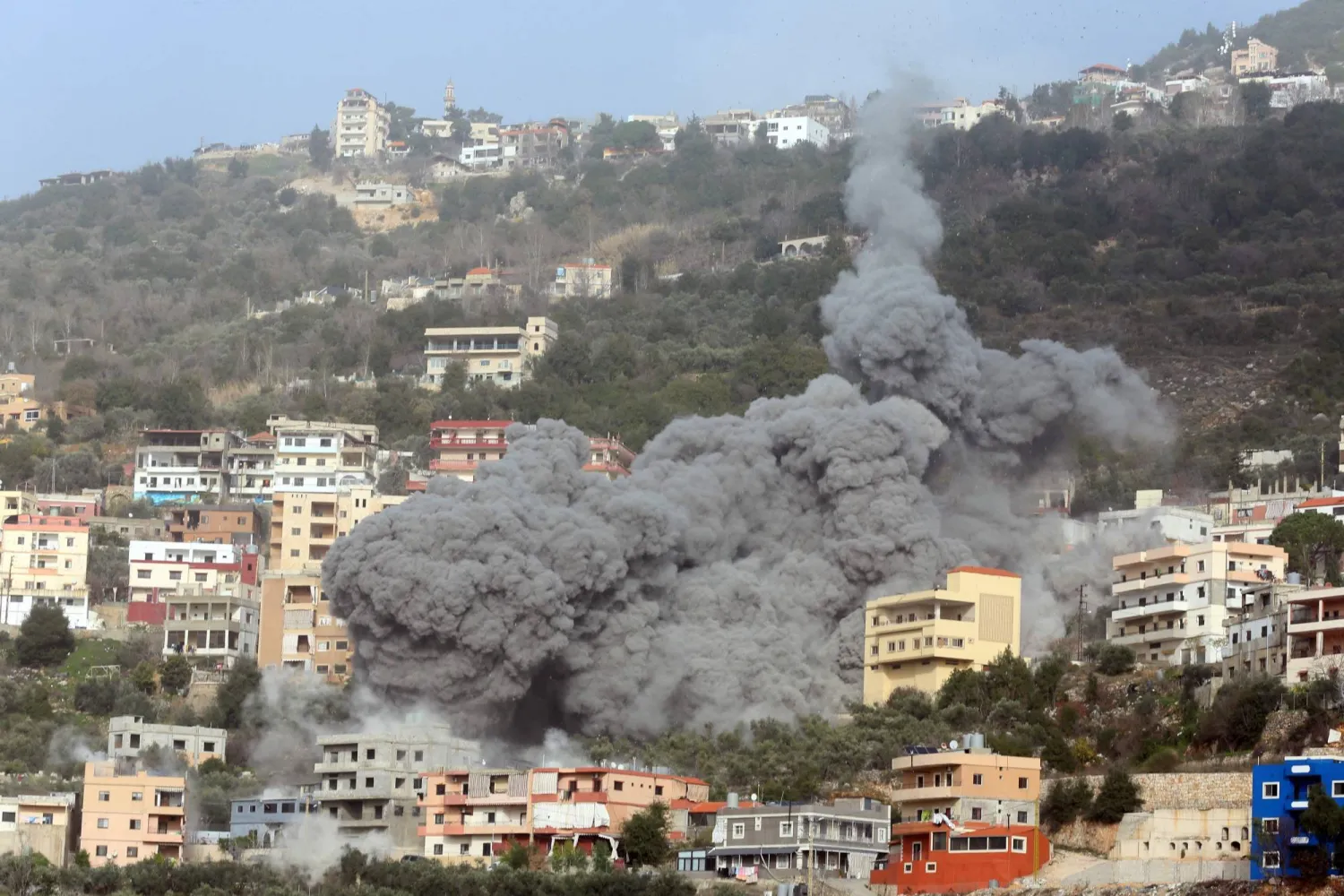
Smoke rises from the site of an Israeli airstrike that targeted a building in the southern Lebanese village of Ain Qana on February 2, 2026. (AFP)
TT

Israel Announces Arrest of Prominent Jamaa Islamiya Member in Southern Lebanon

Smoke rises from the site of an Israeli airstrike that targeted a building in the southern Lebanese village of Ain Qana on February 2, 2026. (AFP)

The Israeli army announced on Monday the arrest of a member of the Jamaa al-Islamiya group in Lebanon.

The military said a unit carried out a night operation in Jabal al-Rouss in southern Lebanon, arresting a “prominent” member of the group and taking him to Israel for investigation.

Israeli army spokesman Avichai Adree revealed that the operation took place based on intelligence gathered in recent weeks.

The military raided a building in the area where it discovered combat equipment, he added, while accusing the group of “encouraging terrorist attacks in Israel”.

He vowed that the Israeli army will “continue to work on removing any threat” against it.

Also on Monday, an Israeli drone struck a car in the southern Lebanese village of Yanouh, killing three people, including a child, Lebanon’s state-run National News Agency. 

Adree confirmed the strike, saying the army had targeted a Hezbollah member.

The Jamaa al-Islamiya slammed the Israeli operation, acknowledging on Monday the kidnapping of its official in the Hasbaya and Marjeyoun regions Atweh Atweh.

In a statement, the group said Israel abducted Atweh in an overnight operation where it “terrorized and beat up his family members.”

It held the Israeli army responsible for any harm that may happen to him, stressing that this was yet another daily violation committed by Israel against Lebanon.

“Was this act of piracy a response to Prime Minister Nawaf Salam’s tour of the South?” it asked, saying the operation was “aimed at terrorizing the people and encouraging them to leave their villages and land.”

The group called on the Lebanese state to pressure the sponsors of the ceasefire to work on releasing Atweh and all other Lebanese detainees held by Israel. It also called on it to protect the residents of the South.

Salam had toured the South over the weekend, pledging that the state will reimpose its authority in the South and kick off reconstruction efforts within weeks.

After the outbreak of the Israel-Hamas war in October 2023, the Jamaa al-Islamiya's Fajr Forces joined forces with Hezbollah, launching rockets across the border into Israel that it said were in support of Hamas in Gaza.

Hezbollah started attacking Israel on Oct. 8, 2023, a day after Hamas attacked southern Israel, triggering the latest Israel-Hamas war. Israel later launched a widespread bombardment of Lebanon that severely weakened Hezbollah, followed by a ground invasion.

The conflict ended with a US-brokered ceasefire in 2024, and since then, Israel has carried out almost daily airstrikes and ground incursions into Lebanon. Israel says it is carrying out the operations to remove Hezbollah strongholds and threats against Israel.

The Israel-Hezbollah war killed more than 4,000 people in Lebanon, including hundreds of civilians, and caused an estimated $11 billion in damage and destruction, according to the World Bank. In Israel, 127 people died, including 80 soldiers. 


Israel Says Killed Four Militants Exiting Tunnel in Gaza’s Rafah

Boys walk past the rubble of destroyed buildings in the Jabalia camp for Palestinian refugees in the northern Gaza Strip on February 8, 2026. (AFP)
TT

Israel Says Killed Four Militants Exiting Tunnel in Gaza’s Rafah

Boys walk past the rubble of destroyed buildings in the Jabalia camp for Palestinian refugees in the northern Gaza Strip on February 8, 2026. (AFP)

Israel's military said it killed four suspected militants who attacked its troops as the armed men emerged from a tunnel in southern Gaza on Monday, calling the group's actions a "blatant violation" of the ceasefire.

Despite a US-brokered truce entering its second phase last month, violence has continued in the Gaza Strip, with Israel and Hamas accusing each other of breaching the agreement.

"A short while ago, four armed terrorists exited an underground tunnel shaft and fired towards soldiers in the Rafah area in the southern Gaza Strip.... Following identification, the troops eliminated the terrorists," the military said in a statement.

It said none of its troops had been injured in the attack, which it called a "blatant violation of the ceasefire agreement" between Israel and Hamas.

Israeli troops "are continuing to operate in the area to locate and eliminate all the terrorists within the underground tunnel route", the military added.

Gaza health officials have said Israeli air strikes last Wednesday killed 24 people, with Israel's military saying the attacks were in response to one of its officers being wounded by enemy gunfire.

That wave of strikes came after Israel partly reopened the Rafah border crossing between Gaza and Egypt on February 2, the only gateway to the Palestinian territory that does not pass through Israel.

Israeli forces seized control of the crossing in May 2024 during the war with Hamas, and it had remained largely closed since.

Around 180 Palestinians have left the Gaza Strip since Rafah's limited reopening, according to officials in the territory.

Israel has so far restricted passage to patients and their accompanying relatives.

The second phase of the Gaza ceasefire foresees a demilitarization of the territory -- including the disarmament of Hamas -- along with a gradual withdrawal of Israeli forces.

Hamas has repeatedly said that disarmament is a red line, although it has indicated it could consider handing over its weapons to a future Palestinian governing authority.

Israeli officials say Hamas still has around 20,000 fighters and about 60,000 Kalashnikovs in Gaza.

A Palestinian technocratic committee has been set up with a goal of taking over day-to-day governance in the strip, but it remains unclear whether, or how, it will address the issue of demilitarization.