


Mexico Tortilla Shop Gives Free TV, Internet for School Kids

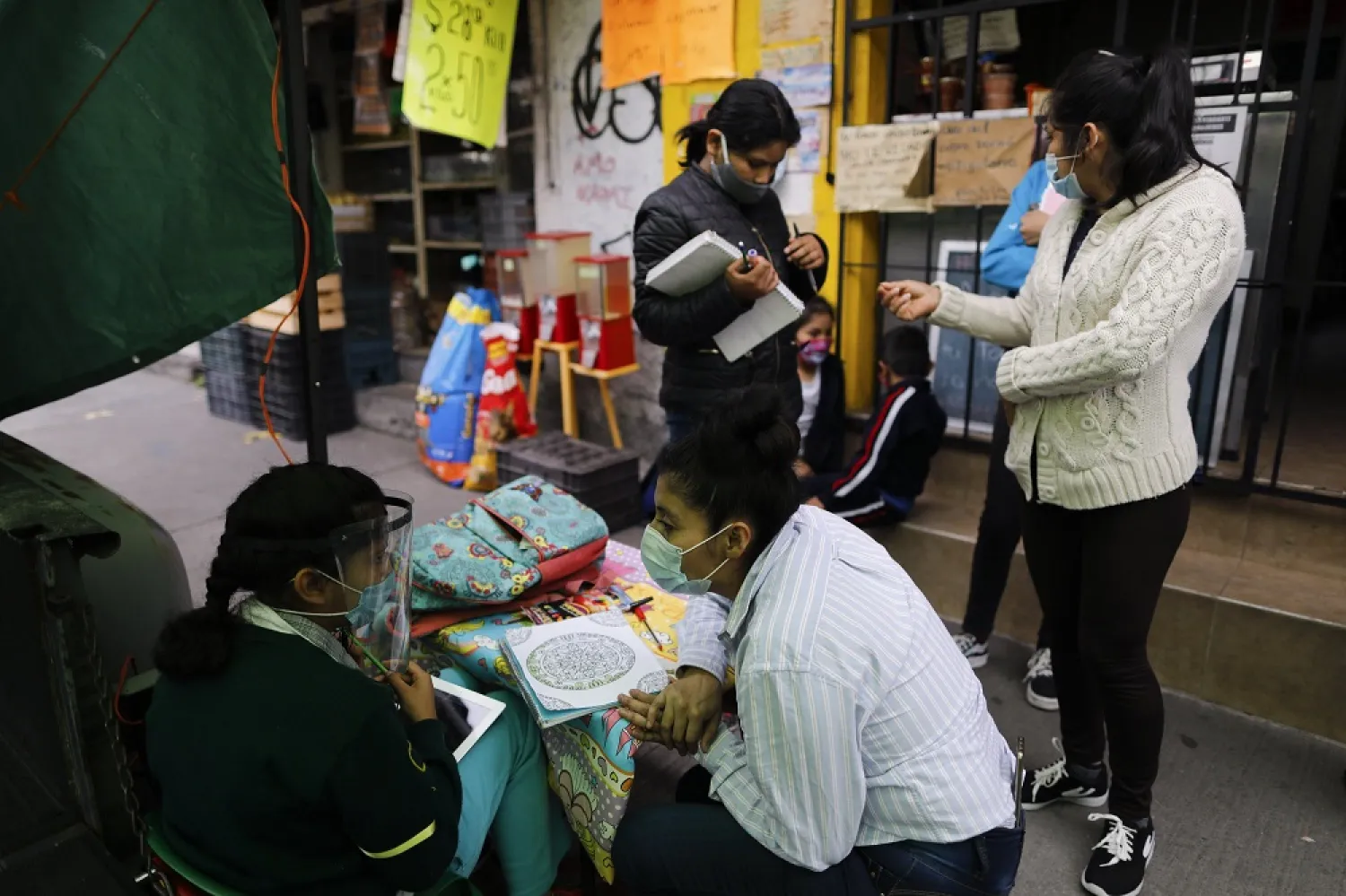
Dalia Davila Neri, who runs ‘Tortillerias La Abuela’ with her husband, assists a student while she learns outside Davila's shop on the southern edge of Mexico City, Friday, Sept. 4, 2020. (AP)
TT

Mexico Tortilla Shop Gives Free TV, Internet for School Kids

Dalia Davila Neri, who runs ‘Tortillerias La Abuela’ with her husband, assists a student while she learns outside Davila's shop on the southern edge of Mexico City, Friday, Sept. 4, 2020. (AP)

A tortilla shop has started giving free wifi and television access for kids in its Mexico City neighborhood whose homes don’t have them, or whose brothers and sisters are already using the services for remote learning during the pandemic.

Mexico’s government schools started at-distance classes Aug. 24 using televised lessons due to the coronavirus, because 94% of Mexican homes have TVs. But there are often many youngsters in a Mexican family and they all need to look up something online or watch classes at the same time.

That is where the “Rinconcito de Esperanza” — the Corner of Hope — comes in. The owners of Grandma's Tortilla Shop in the southern borough of Tlalpan set up learning areas to offer free tutoring, TV and computer access.

The assemblage of space spills out of the store into a tent set up on the sidewalk outside, and continues into the bed of an old pickup truck parked at the curb. A true community effort, classes that need more room or quiet are held in neighboring shops.

Dalia Dãvila and her companion, Fernando Lozano, set up the informal non-profit project at their tortilla shop after she heard neighbors and friends worrying about how their children were going to keep up with classes. Initially it started with a single balky TV and the store's wifi, but when the TV burned out in a rainstorm, neighbors came to her aid by providing a new television set and other items.

“We saw how worried they (mothers) were, thinking: ‘Either I work, or I educate my children, and if I help my child with their classes, how are we going to eat?’” said Dávila, who continues to bake and sell tortillas while overseeing the project. “So we neighbors started organizing to help out.”

There is a box of textbooks, one smartphone, one tablet and a laptop, all donated. “People have brought pencils, donated notebooks and even brought donated grain for food packages,” Lozano said.

The spaces serve about 50 children each day, and classes are staggered to avoid crowding together children from different families. Volunteer tutors come to teach classes in English, math and the sciences.

“We saw there was inequality right now, because of the pandemic. A lot of parents don't have money to buy a telephone, a television or a computer,” Lozano said. “The truth is that if you miss out on a year you never make it up. And the truth is we are not talking about one or two children, we are talking about millions of kids all over the world, and this is going to have real repercussions.”

The government has distributed some 140 million free textbooks, and homes that have no television can listen to radio classes. Students will not return to classrooms until the government’s version of a stoplight to evaluate the pandemic’s risk is safely at green.

Only 44% of Mexican households have a computer. A slightly higher percentage, 56%, have some sort of internet service, though many of those connections are used just for smartphones. According to polling, 95% of people in Mexico say they use the internet for phones, 33% with a laptop and 29% for a desktop computer.

Most households have more than one child, often taking classes simultaneously and putting a strain on TV and computer access.

María Luisa Moreno Barajas, a mother of four whose husband is unemployed, brought her young son José Mario to study at one part of the improvised learning area that spills over into a neighboring ironworker’s shop.

José Maria isn’t disturbed at all by the unusual surroundings. “I feel as if I was in school,” he said.

“This project has helped us a lot,” his mother said. “We do have internet that my father lent us, but because there are a lot of us, we're all using the internet at the same time.”

“So there are times when we can't do all research we need to do,” she said. “That's why I come to the Corner of Hope. If we need to do homework on the internet or print off something, there is someone who can help us.”

Manuel López Pereyra, a researcher in the education department of Mexico City’s Iberoamerican University, said such community efforts are great, but they illustrate what the government hasn't done.

“One of the education policies that we would expect is for the government to help these families that don't have access to technology,” he said. “But now, when we are in a moment of crisis and the government is not giving us what we need, the community is who is coming to save the day.”




Thieves Drill into a German Bank Vault and Steal Tens of Millions of Euros Worth of Property

 Police officers stand in front of the savings bank branch in the Buer district in Gelsenkirchen, Germany, Tuesday, Dec. 30, 2025 following a break-in into the bank's vault. (Christoph Reichwein/dpa via AP)
Police officers stand in front of the savings bank branch in the Buer district in Gelsenkirchen, Germany, Tuesday, Dec. 30, 2025 following a break-in into the bank's vault. (Christoph Reichwein/dpa via AP)
TT

Thieves Drill into a German Bank Vault and Steal Tens of Millions of Euros Worth of Property

 Police officers stand in front of the savings bank branch in the Buer district in Gelsenkirchen, Germany, Tuesday, Dec. 30, 2025 following a break-in into the bank's vault. (Christoph Reichwein/dpa via AP)
Police officers stand in front of the savings bank branch in the Buer district in Gelsenkirchen, Germany, Tuesday, Dec. 30, 2025 following a break-in into the bank's vault. (Christoph Reichwein/dpa via AP)

Thieves stole tens of millions of euros worth of property from safety deposit boxes inside a German bank vault that they drilled into Monday during the holiday lull, police said.

Some 2,700 bank customers were affected by the theft in Gelsenkirchen, police and the Sparkasse bank said.

Thomas Nowaczyk, a police spokesperson, said investigators believe the theft was worth between 10 and 90 million euros ($11.7 to 105.7 million).

German news agency dpa reported that the theft could be one of Germany's largest heists.

The bank remained closed Tuesday, when some 200 people showed up demanding to get inside, dpa reported.

A fire alarm summoned police officers and firefighters to the bank branch shortly before 4 a.m. Monday. They found a hole in the wall and the vault ransacked. Police believe a large drill was used to break through the vault's basement wall.

Witnesses told investigators they saw several men carrying large bags in a nearby parking garage over the weekend. Video footage from the garage shows masked people inside a stolen vehicle early Monday, police said.

Gelsenkirchen is about 192 kilometers (119 miles) northwest of Frankfurt.


The Year's First Meteor Shower and Supermoon Clash in January Skies

People look up to the sky from an observatory near the village of Avren, Bulgaria, Aug. 12, 2009. (AP Photo/Petar Petrov, File)
TT

The Year's First Meteor Shower and Supermoon Clash in January Skies

People look up to the sky from an observatory near the village of Avren, Bulgaria, Aug. 12, 2009. (AP Photo/Petar Petrov, File)

The year's first supermoon and meteor shower will sync up in January skies, but the light from one may dim the other.

The Quadrantid meteor shower peaks Friday night into Saturday morning, according to the American Meteor Society. In dark skies during the peak, skygazers typically see around 25 meteors per hour, but this time they'll likely glimpse less than 10 per hour due to light from Saturday's supermoon, The AP news reported.

“The biggest enemy of enjoying a meteor shower is the full moon,” said Mike Shanahan, planetarium director at Liberty Science Center in New Jersey.

Meteor showers happen when speedy space rocks collide with Earth’s atmosphere, burning up and leaving fiery tails in their wake — the end of a “shooting star.” A handful of meteors are visible on any given night, but predictable showers appear annually when Earth passes through dense streams of cosmic debris.

Supermoons occur when a full moon is closer to Earth in its orbit. That makes it appear up to 14% bigger and 30% brighter than the faintest moon of the year, according to NASA. That difference can be tough to notice with the naked eye.

Supermoons, like all full moons, are visible in clear skies everywhere that it's night. The Quadrantids, on the other hand, can be seen mainly from the Northern Hemisphere. Both can be glimpsed without any special equipment.

To spot the Quadrantids, venture out in the early evening away from city lights and watch for fireballs before the moon crashes the party, said Jacque Benitez with the Morrison Planetarium at the California Academy of Sciences. Skygazers can also try looking during early dawn hours on Sunday.

Wait for your eyes to get used to the darkness, and don’t look at your phone. The space rocks will look like fast-moving white dots and appear over the whole sky.

Meteor showers are named for the constellation where the fireballs appear to come from. The Quadrantids — space debris from the asteroid 2003 EH1 — are named for a constellation that's no longer recognized.

The next major meteor shower, called the Lyrids, is slotted for April.

Supermoons happen a few times a year and come in groups, taking advantage of the sweet spot in the moon’s elliptical orbit. Saturday night’s event ends a four-month streak that started in October. There won't be another supermoon until the end of 2026.


New Maritime Theater in Jazan to Host the City's Festival Opening

The site also includes various amenities, such as shopping zones, kiosks for dining, an art gallery - SPA
TT

New Maritime Theater in Jazan to Host the City's Festival Opening

The site also includes various amenities, such as shopping zones, kiosks for dining, an art gallery - SPA

The Jazan city theater on the southern corniche will host the opening ceremony of the Jazan Festival 2026 on Friday. This event will take place at a 35-square-kilometer site that features the Kingdom's largest maritime theater, SPA reported.

The theater accommodates more than 10,000 spectators and features five VIP areas. To ensure a smooth experience, the venue offers parking for over 9,000 vehicles, providing easy access during peak times.

Built specifically for the festival, the stage meets stringent safety and technical standards, providing a high-quality audiovisual experience against the stunning backdrop of the Red Sea.

The site also includes various amenities, such as shopping zones, kiosks for dining, an art gallery, a play area for children, a bird garden, and a regional museum, showcasing the region's history and culture.

This temporary maritime theater aims to provide a cohesive experience, integrating entertainment, culture, shopping, and services in one location, further establishing Jazan as a year-round destination for tourism and entertainment.