


World Wildlife Plummets More Than Two-Thirds in 50 Years: Index

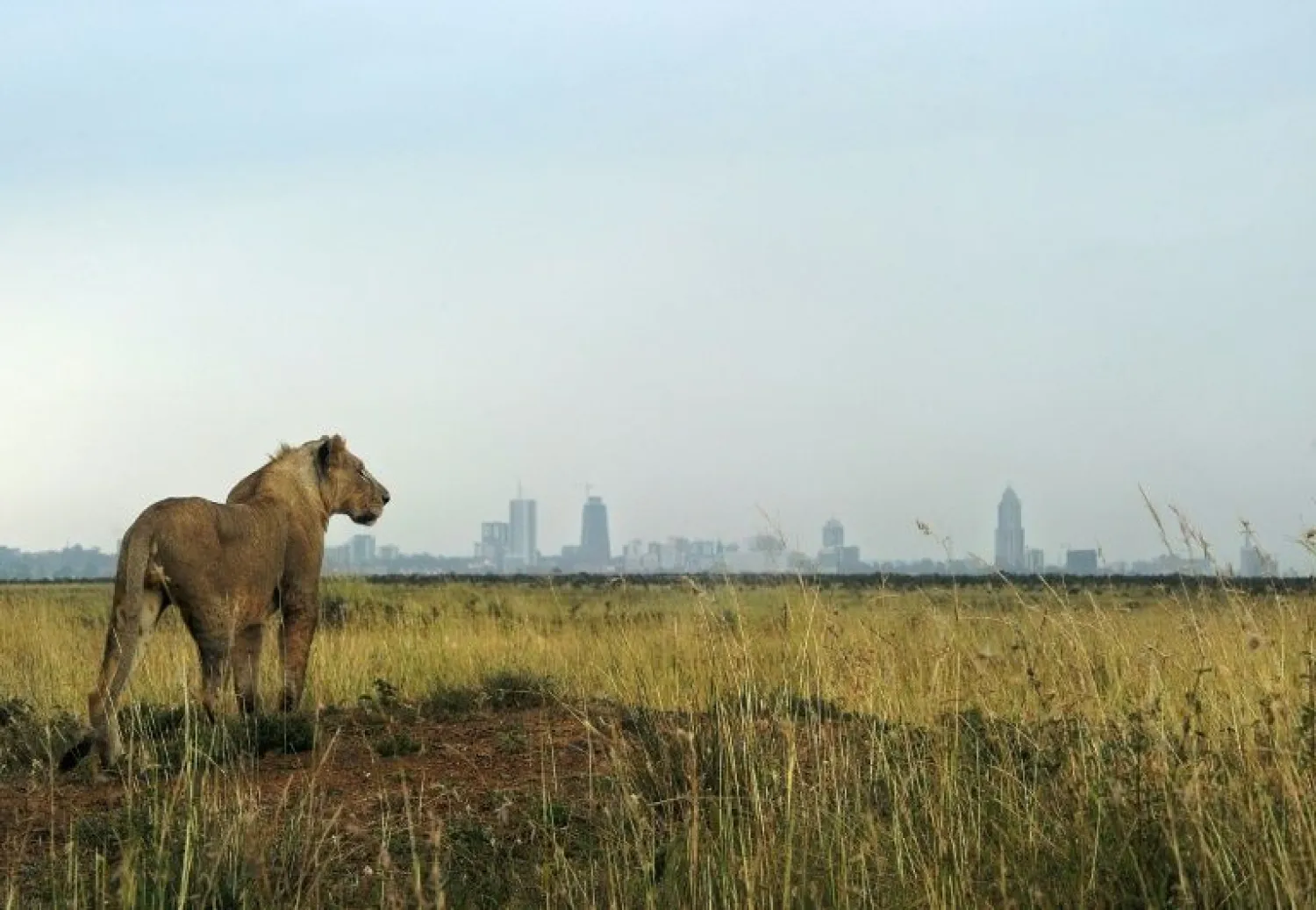
A lion looks towards the Nairobi skyline - the Living Planet Index warns that continued natural habitat loss increased the risk of future pandemics as humans expand their presence into ever closer contact with wild animals | AFP
TT

World Wildlife Plummets More Than Two-Thirds in 50 Years: Index

A lion looks towards the Nairobi skyline - the Living Planet Index warns that continued natural habitat loss increased the risk of future pandemics as humans expand their presence into ever closer contact with wild animals | AFP

Global animal, bird, and fish populations have plummeted more than two-thirds in less than 50 years due to rampant over-consumption, experts said Thursday in a stark warning to save nature in order to save ourselves.

Human activity has severely degraded three quarters of all land and 40 percent of Earth's oceans, and our quickening destruction of nature is likely to have untold consequences on our health and livelihoods.

The Living Planet Index, which tracks more than 4,000 species of vertebrates, warned that increasing deforestation and agricultural expansion were the key drivers behind a 68 percent average decline in populations between 1970 and 2016.

It warned that continued natural habitat loss increased the risk of future pandemics as humans expand their presence into ever closer contact with wild animals.

2020's Living Planet Report, a collaboration between WWF International and the Zoological Society of London, is the 13th edition of the biennial publication tracking wildlife populations around the world.

WWF International director general Marco Lambertini told AFP of the staggering loss of Earth's biodiversity since 1970.

"It's an accelerating decrease that we've been monitoring for 30 years and it continues to go in the wrong direction," he said.

"In 2016 we documented a 60 percent decline, now we have a 70 percent decline.

"All this is in a blink of an eye compared to the millions of years that many species have been living on the planet," Lambertini added.

- 'Staggering' fall -

The last half-decade has seen unprecedented economic growth underpinned by an explosion in global consumption of natural resources.

Whereas until 1970, humanity's ecological footprint was smaller than the Earth's capacity to regenerate resources, the WWF now calculates we are overusing the planet's capacity by more than half.

While aided by factors such as invasive species and pollution, the biggest single driver of species lost is land-use changes: normally, industry converting forests or grasslands into farms.

This takes an immense toll on wild species, who lose their homes.

But it also requires unsustainable levels of resources to uphold: one third of all land mass and three quarters of all freshwater are now dedicated to producing food.

The picture is equally dire in the ocean, where 75 percent of fish stocks are over exploited.

And while wildlife is declining rapidly, species are disappearing faster in some places than others.

The index showed that the tropical regions of Central and South America had seen a 94 percent fall in species since 1970.

"It is staggering. It is ultimately an indicator of our impact on the natural world," said Lambertini.

- 'From sad to worried' -

The Living Planet update comes alongside a study co-authored by more than 40 NGOs and academic institutions, which lays out ways of arresting and reversing the losses human consumption has inflicted.

The research, published in the journal Nature, suggests that reducing food waste and favoring healthier and more environmentally friendly diets could help to "bend the curve" of degradation.

Coupled with radical conservation efforts, these measures could avert more than two-thirds of future biodiversity loss, the authors suggested.

"We need to act now. Rates of biodiversity recovery are typically much slower than those of recent biodiversity loss," said lead study author David Leclere, research scholar at the International Institute of Applied System Analysis.

"This implies that any delay in action will allow further biodiversity losses that might take decades to restore."

Leclere also warned of "irreversible" losses to biodiversity, such as when a species goes extinct.

Lambertini said that, like public discourse on climate change, societies are increasingly concerned about the links between the health of the planet and human well-being.

"From being sad about losing nature, people are beginning to actually get worried," he said.

"We still have a moral duty to co-exist with life on the planet, but there's now this new element of impact on our society, our economy and, of course, our health.



Hundreds of Charlie Chaplin Lookalikes Gather in Switzerland

Some of the 429 people dressed as "The Tramp" pose for a photo during the 10th anniversary of Chaplin's World, the museum dedicated to the life of Charlie Chaplin, in Corsier-sur-Vevey, Switzerland, 07 June 2026. (EPA)
TT

Hundreds of Charlie Chaplin Lookalikes Gather in Switzerland

Some of the 429 people dressed as "The Tramp" pose for a photo during the 10th anniversary of Chaplin's World, the museum dedicated to the life of Charlie Chaplin, in Corsier-sur-Vevey, Switzerland, 07 June 2026. (EPA)

More than 400 people donning black bowler hats, toothbrush moustaches and canes gathered in Switzerland Sunday seeking to break the record for the biggest ever assembly of Charlie Chaplin lookalikes.

The unusual rally, drawing Chaplin fans of all ages, took place at a museum dedicated to the legendary filmmaker at his former home in Corsier-sur-Vevey in western Switzerland.

Timed to mark the 10th anniversary of the museum's opening, the gathering in the end drew 429 Chaplin lookalikes, falling short of the world record set there in 2017, when 662 people took part.

But that did not dampen the mood.

Under a blazing sun, the Chaplins crowded together to form a giant number 10 on the lawn stretching before the large manor where the English movie icon spent the last 25 years of his life.

"I am sincerely the happiest man alive," said Anthony Champeil, a dapper 36-year-old Frenchman who looked the spitting image of Chaplin, explaining that he was an actor who often played the film legend on stage.

"We are at Chaplin's place with people who are passionate about Chaplin," he told AFP.

Suggesting that Chaplin had wanted to encourage people to maintain a childlike capacity for wonder and play for as long as possible, he mused that the actor would have enjoyed having hundreds "of big kids gathered here today".

"I find it marvelous."

The museum is set on the vast estate of Manoir de Ban, about 26 kilometers (16 miles) from Lausanne, where Chaplin lived with his wife Oona and their eight children until his death in 1977, at age 88.

He had moved to Switzerland after being barred from the United States in the 1950s over suspicions that he had communist sympathies, at the height of Cold War paranoia about Soviet infiltration.

Alice Kauffmann, who had brought her young children to participate as miniature Chaplins, said Sunday's gathering was "moving" to behold.

She and other participants said the event brought to mind the humanistic ideas Chaplin promoted with iconic films such as "The Great Dictator", "The Kid" and "Modern Times".

"He defended love, respect and beautiful values," she said.

Sophie Teteule, 52, agreed.

"I love Charlie Chaplin, and I love this place," she told AFP.

"I think it is magnificent that we can gather today, so long after he left us. It is a marvelous moment in his honor."

Organizers of Sunday's event also did not seem too bothered that it had failed to break the world record, which the museum already holds.

"Nothing is lost," spokeswoman Olivia Baliguet told AFP.

"Who knows, we may try again next year, or for the 20th anniversary."


Bernadette Chirac, France’s Dedicated and Determined Ex-First Lady

French First Lady Bernadette Chirac listens to a speech by Queen Elizabeth II at the Senate in Paris 06 April 2004, on the second day of a three-day state visit to mark the centenary of the Entente Cordiale, the colonial-era promise of cross-channel friendship between Britain and France. (AFP)
TT

Bernadette Chirac, France’s Dedicated and Determined Ex-First Lady

French First Lady Bernadette Chirac listens to a speech by Queen Elizabeth II at the Senate in Paris 06 April 2004, on the second day of a three-day state visit to mark the centenary of the Entente Cordiale, the colonial-era promise of cross-channel friendship between Britain and France. (AFP)

Bernadette Chirac, who has died aged 93, stood by her late husband, former French president Jacques Chirac, during 12 years as first lady, but also forged her own, more discreet, political career.

Quiet, traditionally Roman Catholic and always immaculately turned out in classic suits and styled hair, she dedicated herself to the career of the man she married when she was 22 years old.

Jacques Chirac died on September 26, 2019, aged 86, after serving as president from 1995 to 2007.

"She is the woman of my life, we have accomplished so much together," Jacques Chirac -- who also served as prime minister and mayor of Paris -- wrote in his memoirs in 2012.

Current President Emmanuel Macron said Bernadette Chirac "changed so many lives with discretion and determination" and "left her mark on our history".

"An era comes to an end with her passing. I feel, like so many French people, a deep nostalgia," added Jacques Chirac's successor and protege, Nicolas Sarkozy.

- 'Not always easy' -

The couple met at Paris's political science university Sciences Po in 1954 and married two years later -- a match considered below the rank of Bernadette, who was born on May 18, 1933 into the aristocratic Chodron de Courcel family.

The marriage, during which she had two daughters, was not always easy, with Chirac admitting publicly to having a weakness for women and rumors abounding of affairs.

In her book "Conversation" (2001), she spoke about her Catholic faith and her opposition to abortion -- but also with unusual frankness about the tests through which a family can be put by a husband's infidelity.

Describing Jacques Chirac as a "handsome man" who had "enormous success with women", she wrote: "Nowadays at the first difficulty people just give up. But as far as I was concerned, I hesitated because I had children, and also because I was the prisoner of certain family traditions.

"Convention had it that in this sort of situation you put up a front and just kept going. In any case I warned him often enough: the day Napoleon left Josephine, he lost everything."

Jacques Chirac was elected head of state in 1995 and 2002, his 12 years in the job making him France's second longest-serving president after his Socialist predecessor Francois Mitterrand.

- 'Turtle' -

Bernadette described herself as a mere "wagon" hooked onto her powerhouse "engine" spouse, while he referred to his determined and sometimes authoritarian wife as "a turtle".

But she was also seen as an electoral asset in his campaigning, with her cheerful personality and charity work for sick children boosting her image, while her conservatism reassured right-wing voters.

Her discretion and immaculate appearance also made Bernadette into something of an icon herself. In 2023 French screen legend Catherine Deneuve starred in a film about her years as first lady, titled simply "Bernadette".

Besides being patron of several charities, she carved out her own modest political career as long-time elected councilor for the couple's rural home department of Correze and a member of the municipal council of the department's small village of Sarran.

In darker times in later life, a protective Bernadette closely guarded information about Chirac's deteriorating health as a degenerative neurological disorder took hold and he was confined to a wheelchair.

She lived to see her husband become the first president to be convicted for graft when he was given a two-year suspended sentence in 2011 for syphoning off public money to pay people working for his political party while Paris mayor.

After his death Bernadette, by then said to be in frail health, attended a private funeral service but was not present at the main ceremony attended by dozens of world leaders.

In 2016 their eldest daughter, Laurence, died aged 58, after a heart attack, having suffered with anorexia since 1974.


Millions of Chinese Students Sit for Grueling 'Gaokao'

A student enters a school on the first day of China's National College Entrance Examination, known as "gaokao". WANG Zhao / AFP
TT

Millions of Chinese Students Sit for Grueling 'Gaokao'

A student enters a school on the first day of China's National College Entrance Examination, known as "gaokao". WANG Zhao / AFP

Hundreds of young Chinese students clutching pens and their IDs shuffled into a testing center in blue-skied Beijing on Sunday, swarmed by parents, joining millions sitting for the national high-stakes university entrance exam.

Around 12.9 million students nationwide registered for this year's "gaokao", according to the Ministry of Education, which for most is the sole determining factor in admission to a Chinese university.

The multi-day exam, which began Sunday, drills test-takers on subjects including Chinese, mathematics, English, science and the humanities -- with the tallied scores to be released later this month, said AFP.

"It's my first time, so I'm a bit anxious," said student Zhang Xinnan moments before entering the exam hall.

The spectacled Beijinger admitted he was nervous for the essay portion of the Chinese test, as he said he thought the prompts had become harder to respond to.

But, wearing his school uniform, the 18-year-old told AFP that despite the jitters he thought he would do well, having spent the last year drilling practice questions.

"The things we needed to master have been mastered," said Zhang, who hopes to work with new energy vehicles.

"Just go in with self-confidence; you'll be solid."

Some mothers and fathers clustered outside the exam halls dressed in red, a symbol of good fortune in Chinese culture.

Dozens of police and security guards milled about as parents stood beside the line of students waiting to enter the exam hall, hoping to film their children walking inside.

- Shifting attitudes -

High-level education has expanded rapidly in China in recent decades as an economic boom pushed up living standards -- as well as parental expectations for their children's careers.

Yet the job market that fresh graduates enter is no longer as rosy as it once was, with high youth unemployment a significant concern.

Roughly one in six Chinese between the ages of 16 and 24, excluding students, are jobless, according to official data.

Attitudes toward the test are changing, with students and parents more and more unwilling to trade physical and mental health for high test scores.

"I'm pretty free range," said mother Deng Ju, standing across from the exam hall holding a stack of practice books for her daughter, revising last minute with her friend nearby.

"Just perform normally; that's enough," said Deng, 53. "I care more about physical health; the test is just a formality."

For Deng, whose daughter isn't aiming for a "name school" such as the elite Tsinghua or Peking University in the capital, doing away with the gaokao would be ideal.

"No more gaokao. Let's not gaokao anymore," she told AFP. "But that's impossible," she said, smiling.

For many Beijing students, the gaokao was still a step toward achieving their dream.

"I hope I can go to my ideal university," said student Zhang.

His friends also cared about the exam, he said.

"But if we can calm down, we should be able to get to a stable mentality," said Zhang.

"Mentality is the most important when it comes to the gaokao."