
Lebanon: Families of Port Blast Victims to File Lawsuits Against the State

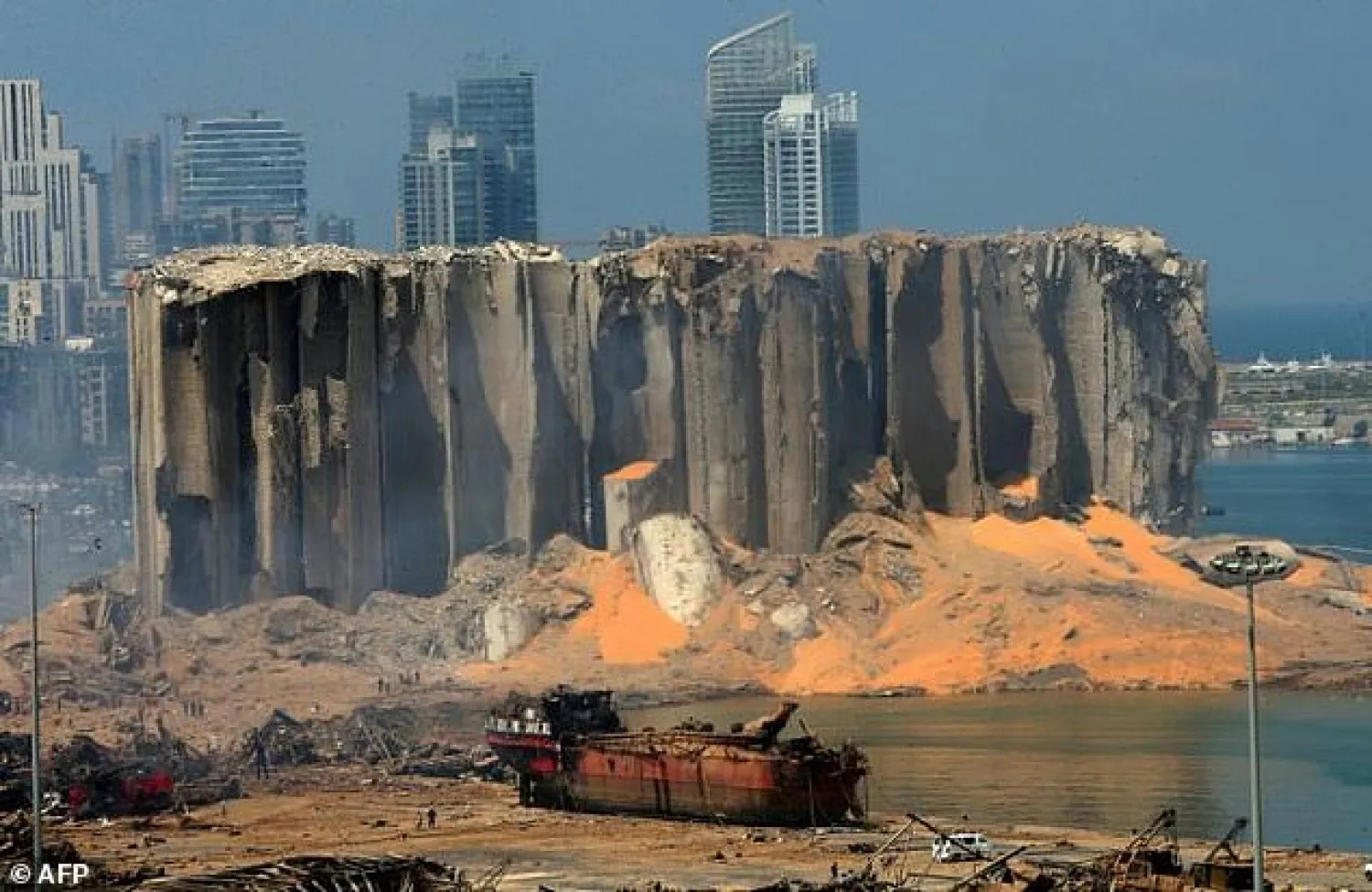
The explosion destroyed the massive grain silos at Beirut's port, killed more than 190 people and wounded at least 6,500 more. AFP
TT

Lebanon: Families of Port Blast Victims to File Lawsuits Against the State

The explosion destroyed the massive grain silos at Beirut's port, killed more than 190 people and wounded at least 6,500 more. AFP

Elie Hasrouty, who lost his father to the August 4 Beirut port blast, is one of at least 1,228 grieving Lebanese preparing to file a lawsuit against the state.

The young computer engineer said going to court won't bring his father back, but it could go some way towards preventing similar disasters from happening again.

"We are pursuing legal action (for) us, the people who remain in this country and who want to live in it with dignity," he told AFP.

Hasrouty's father, Ghassan, was among the more than 190 people killed in the mega-blast, caused -- the authorities said-- by a large stockpile of ammonium nitrate blowing up.

The explosion, one of the largest non-nuclear blasts in history, also wounded at least 6,500 people, and ravaged swathes of Beirut.

Ghassan worked for most of his life in a control room in the shadow of the port's giant silos, right next to the epicenter of the explosion.

He was buried so deep under rubble, wheat and corn that the foreign rescue teams who rushed to the scene never stood a chance of pulling him out alive.

His body was found two weeks after the blast.

His son said the point of legal action was not "retaliation" against the authorities, whose negligence and corruption are widely blamed for the blast, but rather to address the underlying conditions that led to the disaster.

"We need to determine who is responsible as well as all behavior that led to this situation, so that the issue is addressed and proper measures are taken to deter similar conduct in the future," he said.

"What's the use of... prosecuting those who will be found guilty if (official) conduct does not change?" he asked.

- 'Only want justice' -

The Hasrouty family is one of at least 1,228 families who have turned to the Beirut Bar Association to file complaints they hope will become lawsuits against the state, as Lebanese law does not allow for class action procedures.

The Beirut Bar Association is offering its services pro bono as part of an accountability drive it launched after the blast, assigning a lawyer to each of the cases it is currently handling.

"We can't stand by idly in the face of a tragic crime of this kind," Melhem Khalaf, the head of the association, told AFP.

"We are not seeking revenge in any way. We only want justice."

With an army of 400 volunteer lawyers and 200 legal aides, the Beirut Bar Association has set up seven makeshift centres in blast-hit districts in the aftermath of the explosion, Khalaf said.

They have been backed by more than 450 real-estate appraisers who helped assess the cost of damages suffered by the claimants.

Staring at a computer at the association's Beirut headquarters, lawyer Ali Jaber gave a break-down of the cases.

So far, more than 82 percent of all cases brought to the Beirut Bar Association involve people whose complaint focuses on material losses as a result of the blast, according to Jaber.

Those who sustained injuries as well as material losses make up around seven percent of future claimants, while those whose complaint centred solely on injuries accounted for three and a half percent, he said.

A little over one percent have lost a relative to the blast.

Jaber said claimants would seek first to establish responsibility through a verdict before any second lawsuit for compensation from the cash-strapped state, as Lebanon grapples with its worst economic crisis since the 1975-1990 civil war.

- Doubts over local probe -

A long history of high-level impunity in Lebanon has pushed many of the country's citizens at home and abroad to call for an international probe into the blast -- a demand now backed by Western powers and rights groups.

But Lebanese authorities have rejected such a proposal, favoring instead a local investigation that has so far yielded the arrest of some 25 people.

They include the head of the Beirut port and its customs director, but not a single official in government or parliament.

The US Federal Bureau of Investigation (FBI) and French experts have been assisting Lebanese authorities in a probe that has yet to establish a cause for the blast almost seven weeks later.

Amnesty International this month said an "international fact-finding mechanism" is the only way to "guarantee victims' rights to truth, justice and remedy".

But the government has instead referred the investigation to "the Judicial Council, a court... whose proceedings inherently lack independence and impartiality", Amnesty said.

With political forces routinely exercising influence over judges to bypass accountability, a frustrated Khalaf called on the ruling elite to "leave the judiciary alone".

"A crime of this scale cannot be caught up in political disputes," he added.

"Knowing the truth and achieving justice would comfort people and let them live in peace."


Rescue Teams Search for Survivors in Building Collapse that Killed at Least 2 in Northern Lebanon

A Lebanese flag is pictured, in the aftermath of a massive explosion, in Beirut's damaged port area, Lebanon August 17, 2020. REUTERS/Hannah McKay
TT

Rescue Teams Search for Survivors in Building Collapse that Killed at Least 2 in Northern Lebanon

A Lebanese flag is pictured, in the aftermath of a massive explosion, in Beirut's damaged port area, Lebanon August 17, 2020. REUTERS/Hannah McKay

At least two people were killed and four rescued from the rubble of a multistory apartment building that collapsed Sunday in the city of Tripoli in northern Lebanon, state media reported.

Rescue teams were continuing to dig through the rubble. It was not immediately clear how many people were in the building when it fell.

The bodies pulled out were of a child and a woman, the state-run National News Agency reported.

Dozens of people crowded around the site of the crater left by the collapsed building, with some shooting in the air.

The building was in the neighborhood of Bab Tabbaneh, one of the poorest areas in Lebanon’s second largest city, where residents have long complained of government neglect and shoddy infrastructure. Building collapses are not uncommon in Tripoli due to poor building standards, according to The AP news.

Lebanon’s Health Ministry announced that those injured in the collapse would receive treatment at the state’s expense.

The national syndicate for property owners in a statement called the collapse the result of “blatant negligence and shortcomings of the Lebanese state toward the safety of citizens and their housing security,” and said it is “not an isolated incident.”

The syndicate called for the government to launch a comprehensive national survey of buildings at risk of collapse.


Israel to Take More West Bank Powers and Relax Settler Land Buys

A view of Israeli settlement of Maale Adumim, in the West Bank, Sunday, June 18, 2023. (AP)
TT

Israel to Take More West Bank Powers and Relax Settler Land Buys

A view of Israeli settlement of Maale Adumim, in the West Bank, Sunday, June 18, 2023. (AP)

Israel's security cabinet approved a series of steps on Sunday that would make it easier for settlers in the occupied West Bank to buy land while granting Israeli authorities more enforcement powers over Palestinians, Israeli media reported.

The West Bank is among the territories that the Palestinians seek for a future independent state. Much of it is under Israeli military control, with limited Palestinian self-rule in some areas run by the Western-backed Palestinian Authority (PA).

Citing statements by Finance Minister Bezalel Smotrich and Defense Minister Israel Katz, Israeli news sites Ynet and Haaretz said the measures included scrapping decades-old regulations that prevent Jewish private citizens buying land in the West Bank, The AP news reported.

They were also reported to include allowing Israeli authorities to administer some religious sites, and expand supervision and enforcement in areas under PA administration in matters of environmental hazards, water offences and damage to archaeological sites.

Palestinian President Mahmoud Abbas said the new measures were dangerous, illegal and tantamount to de-facto annexation.

The Israeli ministers did not immediately respond to requests for comment.

The new measures come three days before Prime Minister Benjamin Netanyahu is scheduled to meet in Washington with US President Donald Trump.

Trump has ruled out Israeli annexation of the West Bank but his administration has not sought to curb Israel's accelerated settlement building, which the Palestinians say denies them a potential state by eating away at its territory.

Netanyahu, who is facing an election later this year, deems the establishment of any Palestinian state a security threat.

His ruling coalition includes many pro-settler members who want Israel to annex the West Bank, land captured in the 1967 Middle East war to which Israel cites biblical and historical ties.

The United Nations' highest court said in a non-binding advisory opinion in 2024 that Israel's occupation of Palestinian territories and settlements there is illegal and should be ended as soon as possible. Israel disputes this view.


Arab League Condemns Attack on Aid Convoys in Sudan

A general view shows the opening session of the meeting of Arab foreign ministers at the Arab League Headquarters (Reuters)
TT

Arab League Condemns Attack on Aid Convoys in Sudan

A general view shows the opening session of the meeting of Arab foreign ministers at the Arab League Headquarters (Reuters)

Arab League Secretary-General Ahmed Aboul Gheit strongly condemned the attack by the Rapid Support Forces on humanitarian aid convoys and relief workers in North Kordofan State, Sudan.

In a statement reported by SPA, secretary-general's spokesperson Jamal Rushdi quoted Aboul Gheit as saying the attack constitutes a war crime under international humanitarian law, which prohibits the deliberate targeting of civilians and depriving them of their means of survival.

Aboul Gheit stressed the need to hold those responsible accountable, end impunity, and ensure the full protection of civilians, humanitarian workers, and relief facilities in Sudan.