


Pandemic Dampens Kashmir Weddings, Lavish Feasts

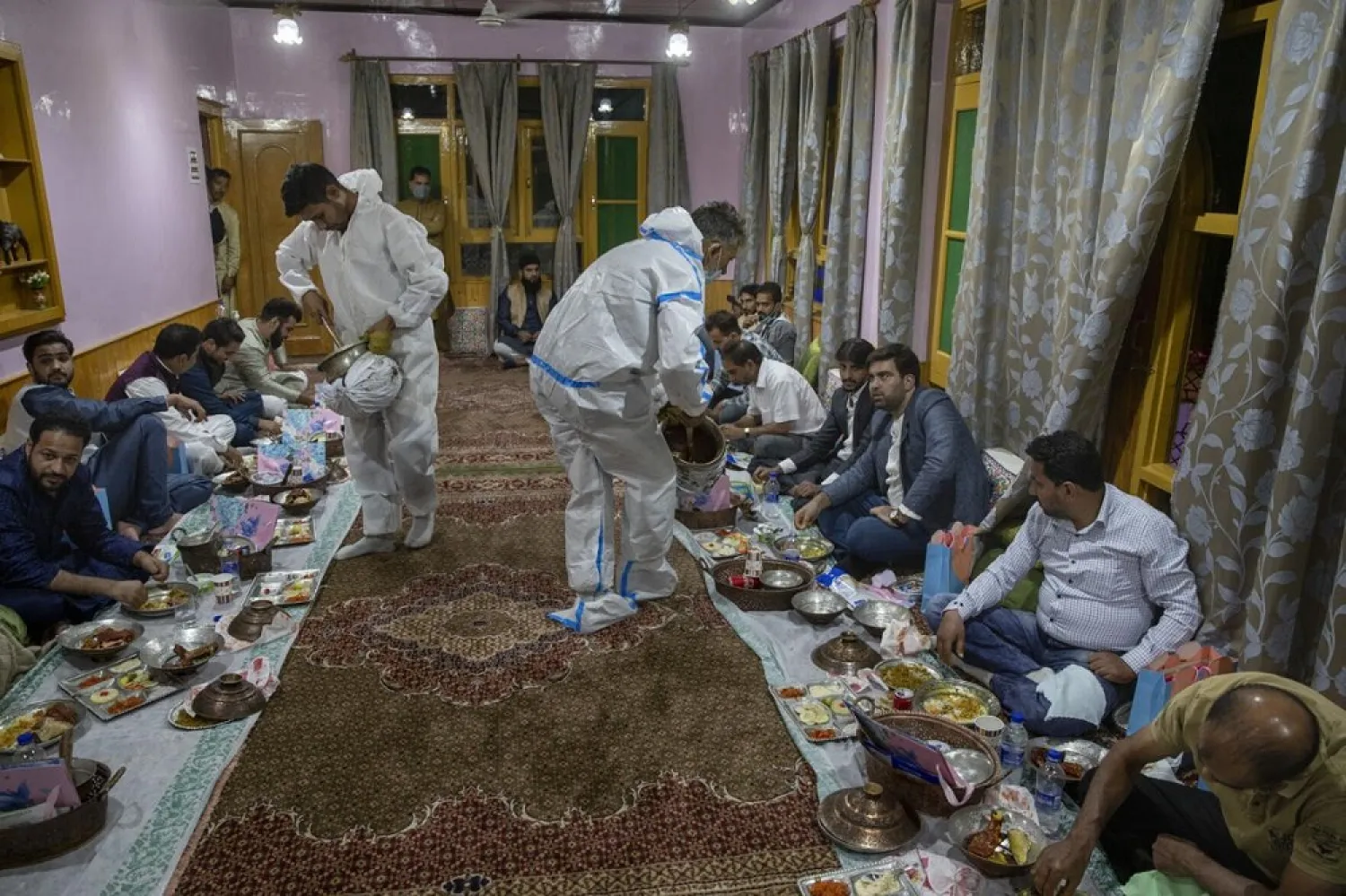
Kashmiri Wazas, or chefs, in personal protective equipment serve Wazwan during a wedding ceremony on outskirts of Srinagar, Indian controlled Kashmir, Tuesday, Sept. 15, 2020. (AP)
TT

Pandemic Dampens Kashmir Weddings, Lavish Feasts

Kashmiri Wazas, or chefs, in personal protective equipment serve Wazwan during a wedding ceremony on outskirts of Srinagar, Indian controlled Kashmir, Tuesday, Sept. 15, 2020. (AP)

In Indian-controlled Kashmir, the coronavirus pandemic within months has changed an elaborate and lavish marriage tradition that had remained virtually unaltered for centuries.

Three days of feasting, elaborate rituals and huge gatherings have been replaced by muted ceremonies attended by a limited number of close relatives and neighbors. With restrictions in place and many weddings canceled, the traditional master chefs have little or no work.

Months before the pandemic, Haseeb Mushtaq drew up a guest list of hundreds and grand plans for celebrating his wedding in May.

But then the pandemic blocked him from traveling home for his wedding from Dubai, where he has an engineering job. When he finally arrived home for his postponed wedding in September, he could only invite about a hundred people, mostly from his extended family and close friends.

“Marriage is a once-in-a-lifetime affair and I feel really bad that we couldn’t invite most of our relatives, friends and neighbors,” Haseeb said at the ceremony. “The hardest part was deciding whom to invite and whom not.”

As Kashmir's wedding season sets in, normally lavish celebrations have been drastically downsized.

Kashmiris normally hold elaborate marriage feasts, with meals cooked over firewood through the night by chiefs called “wazas.” Hundreds of guests are invited for lunch and dinner and served up to 30-course meals. The feast is called “wazwan.”

The peculiarity of a wazwan is that every part of a lamb, except the hide, head and hooves, is used for making different dishes.

Groups of four diners squat around large copper platters heaped with rice and various mutton and chicken dishes. More dishes are served by the chefs, dressed in crisp white baggy trousers and tunics.

The wazwan tradition is so entrenched across all classes in Kashmir that awareness of the wastage of high-quality food has not produced any restraint. Numerous attempts by social groups and the government have failed to instill any significant austerity in the food.

However, the pandemic has largely achieved that in a matter of months.

Wedding ceremonies require prior permission from the authorities, and guest limits and social distancing are mandatory. Most feasts are restricted to 10 dishes and the chefs are advised to wear protective suits and gloves.

Health officials say 63,990 coronavirus cases have been reported in the region through Sept. 20, including 1,001 deaths.

For master chef Ghulam Qadir and his team of over three dozen cooks, the pandemic has caused his earnings to be badly hit for the second straight year. Last year, India suddenly scrapped disputed Kashmir’s statehood in August and imposed an unprecedented security clampdown, creating economic disaster and the cancellation of most wedding celebrations.

Qadir said the pandemic has posed another challenge to the cooks — keeping themselves and guests safe while cooking and serving the marriage feasts.

“It is sad to see our hundreds of years of tradition changing in few months due to the pandemic. We used to eat from one big platter and now we have a small plate for each guest,” Bashir Ahmed said at a relative’s marriage party. “It looks like a small change, but this kind of change saddens me.”



iRead Marathon Records over 6.5 Million Pages Read

Participants agreed that the number of pages read was not merely a numerical milestone - SPA
TT

iRead Marathon Records over 6.5 Million Pages Read

Participants agreed that the number of pages read was not merely a numerical milestone - SPA

The fifth edition of the iRead Marathon achieved a remarkable milestone, surpassing 6.5 million pages read over three consecutive days, in a cultural setting that reaffirmed reading as a collective practice with impact beyond the moment.

Hosted at the Library of the King Abdulaziz Center for World Culture (Ithra) and held in parallel with 52 libraries across 13 Arab countries, including digital libraries participating for the first time, the marathon reflected the transformation of libraries into open, inclusive spaces that transcend physical boundaries and accommodate diverse readers and formats.

Participants agreed that the number of pages read was not merely a numerical milestone, but a reflection of growing engagement and a deepening belief in reading as a daily, shared activity accessible to all, free from elitism or narrow specialization.

Pages were read in multiple languages and formats, united by a common conviction that reading remains a powerful way to build genuine connections and foster knowledge-based bonds across geographically distant yet intellectually aligned communities, SPA reported.

The marathon also underscored its humanitarian and environmental dimension, as every 100 pages read is linked to the planting of one tree, translating this edition’s outcome into a pledge of more than 65,000 trees. This simple equation connects knowledge with sustainability, turning reading into a tangible, real-world contribution.

The involvement of digital libraries marked a notable development, expanding access, strengthening engagement, and reinforcing the library’s ability to adapt to technological change without compromising its cultural role. Integrating print and digital reading added a contemporary dimension to the marathon while preserving its core spirit of gathering around the book.

With the conclusion of the iRead Marathon, the experience proved to be more than a temporary event, becoming a cultural moment that raised fundamental questions about reading’s role in shaping awareness and the capacity of cultural initiatives to create lasting impact. Three days confirmed that reading, when practiced collectively, can serve as a meeting point and the start of a longer cultural journey.


Imam Turki bin Abdullah Royal Reserve Launches Fifth Beekeeping Season

Jazan’s Annual Honey Festival - File Photo/SPA
TT

Imam Turki bin Abdullah Royal Reserve Launches Fifth Beekeeping Season

Jazan’s Annual Honey Festival - File Photo/SPA

The Imam Turki bin Abdullah Royal Nature Reserve Development Authority launched the fifth annual beekeeping season for 2026 as part of its programs to empower the local community and regulate beekeeping activities within the reserve.

The launch aligns with the authority's objectives of biodiversity conservation, the promotion of sustainable environmental practices, and the generation of economic returns for beekeepers, SPA reported.

The authority explained that this year’s beekeeping season comprises three main periods associated with spring flowers, acacia, and Sidr, with the start date of each period serving as the official deadline for submitting participation applications.

The authority encouraged all interested beekeepers to review the season details and attend the scheduled virtual meetings to ensure organized participation in accordance with the approved regulations and the specified dates for each season.


Hail Municipality Named Arab Green City For 2024-2025

The achievement establishes Hail as a leading Arab model for sustainable urban development - SPA
TT

Hail Municipality Named Arab Green City For 2024-2025

The achievement establishes Hail as a leading Arab model for sustainable urban development - SPA

The Hail Region Municipality has secured first place in the Arab Green City award for 2024-2025 at the 15th session of the Arab Towns Organization.

This recognition honors the municipality’s commitment to environmental sustainability, the expansion of green spaces, and the implementation of urban practices that elevate the quality of life, SPA reported.

The award follows a series of strategic environmental initiatives, including large-scale afforestation, the modernization of public parks, and the adoption of eco-friendly solutions to enhance the urban landscape and resource efficiency.

By aligning its projects with the sustainability goals of Saudi Vision 2030, the municipality continues to foster a healthy and safe environment for residents and visitors.

This achievement establishes Hail as a leading Arab model for sustainable urban development.