


Algerian Music Icon Dies from Coronavirus

Algerian singer Hamdi Benani (APZ)
TT

Algerian Music Icon Dies from Coronavirus

Algerian singer Hamdi Benani (APZ)

Prominent Algerian singer Hamdi Benani passed away on Monday in Ibn Sina hospital in Annaba, where he had spent 10 days for treatment from the coronavirus.

Doctors at the hospital told journalists that the artist suffered from coronavirus and his health deteriorated in recent days, which necessitated his admission to the recovery room.

Benani is most known for the Malouf de Annabi song and always carrying a white violin.

Throughout his career, he was famous for his contribution to spreading Algerian culture in general, and Malouf in particular, through his participation in international events.

His successful career included over 30 songs, such as Adalah ya Adalah, Ya Lili, and Jani ma Jani.

President Abdelmadjid Tebboune expressed “great sadness for the loss of a master that was hugely considered a figure in Algerian culture,” adding that he was respected by his local and international audience throughout his whole career.

The number of coronavirus cases in Algeria climbed to over 50,000 cases with 1,672 deaths and about 35,000 recoveries.

At least seven deaths and 197 new infections were reported in the country over the past 24 hours, according to a statement by the Health Ministry.

Following the rise in infections, it has become certain that the school year will not resume on October 4 as previously determined by the government. This is due to its inability to prepare a plan to prevent a surge in infections, especially with regard to maintaining social distancing in overcrowded schools.

Authorities are considering delaying the school year till after the referendum on the constitution, scheduled for November 01.

Meanwhile, the syndicate of Imams mosques called for lifting the ban on Friday prayers, which the government excluded from its decision to reopen mosques issued in August.

Observers believe that the ban on Friday prayers is a political decision linked to the popular movement, as hundreds of thousands of protests used to occupy the streets after leaving the mosques on Fridays.

The authority wants to put an end to the Hirak movement, which was halted by its activists last March due to the outbreak of the pandemic.

On Saturday, Algerian Health Minister Abderrahmane Benbouzid expressed his satisfaction with the results of the fight against COVID-19, APS news agency reported.

Benbouzid said there is a drop in new cases in recent weeks, which is due to “the effective participation of all sectors and all sections of society, despite the fact that some still do not respect the compulsory wearing of masks.”

He warned against another wave of high infections if the precautionary measures issued by authorities were not respected.



Israel Plans Major Settlement Push Across Occupied West Bank

A photograph taken from a land corridor that Israel plans to use for its controversial E1 settlement project, near the Arab town of al-Tur in Israel-annexed east Jerusalem, shows camels belonging to Bedouins gathered on a hill overlooking the Israeli settlement of Maale Adumim (background) on May 31, 2026. (Photo by AHMAD GHARABLI / AFP)
TT

Israel Plans Major Settlement Push Across Occupied West Bank

A photograph taken from a land corridor that Israel plans to use for its controversial E1 settlement project, near the Arab town of al-Tur in Israel-annexed east Jerusalem, shows camels belonging to Bedouins gathered on a hill overlooking the Israeli settlement of Maale Adumim (background) on May 31, 2026. (Photo by AHMAD GHARABLI / AFP)

Israel's hardline finance minister announced on Wednesday a major expansion by more than 2,000 homes of three Jewish settlements in the occupied West Bank that Palestinians hope will be part of a future independent state.

Most nations consider Israeli settlements there to be illegal under international law and a major obstacle to a two-state solution for long-term peace.

Bezalel Smotrich, who holds authority over parts of Israel's civilian administration in the West Bank, said a planning committee approved the construction of 2,162 new Jewish homes.

They include 1,006 units in a new settlement near Jerusalem, 922 near the Palestinian city of Nablus and 234 near ⁠Hebron.

"We are continuing ⁠to build the Land of Israel in practice," said Smotrich, an ultranationalist sanctioned by Britain, France and others who accuse him of inciting violence against Palestinians.

Smotrich has denounced the sanctions against him, saying the measures would not change Israeli policy.

The new homes would "strengthen our hold on the land, reinforce Israel's security, and establish clear facts on the ground that prevent the creation of an Arab terror state ⁠in the heart of the country," Smotrich said in a statement, without specifying when construction would begin.

Since becoming a minister three years ago, Smotrich has sought to tighten Israel's control and presence in the West Bank while advocating against the idea of a Palestinian state.

Prime Minister Benjamin Netanyahu's right-wing government has overseen the significant expansion of Jewish settlements in the West Bank and the establishment of new settlements.

Palestinians want the West Bank as part of a future independent state that includes East Jerusalem and Gaza. Around half a million Israelis live in the West Bank among about 3 million Palestinians.

US President Donald Trump's administration has been ⁠far less critical of ⁠the fast-expanding Israeli settlements.

However, Trump did say last September that he would not allow Israel to annex the West Bank, angering some right-wing Israeli lawmakers.

Condemning Wednesday's announcement, Palestinian President Mahmoud Abbas' office warned that Israel's "provocative" policies were pushing the region towards more rounds of violence and called on the US to stop the Israeli "madness.”

Smotrich on May 19 said he would wage "war" on the Palestinian Authority, which exercises limited civic rule in the West Bank, after he said he was told the International Criminal Court (ICC) prosecutor had sought a confidential arrest warrant against him. The ICC has not confirmed that.


UNIFIL Peacekeeper Killed in South Lebanon

A United Nations Interim Force in Lebanon (UNIFIL) convoy maneuvers within southern Lebanon, as seen from the Israeli side of the border in the Upper Galilee, northern Israel, 02 June 2026, amid a ceasefire between Israel and Hezbollah. EPA/ATEF SAFADI
TT

UNIFIL Peacekeeper Killed in South Lebanon

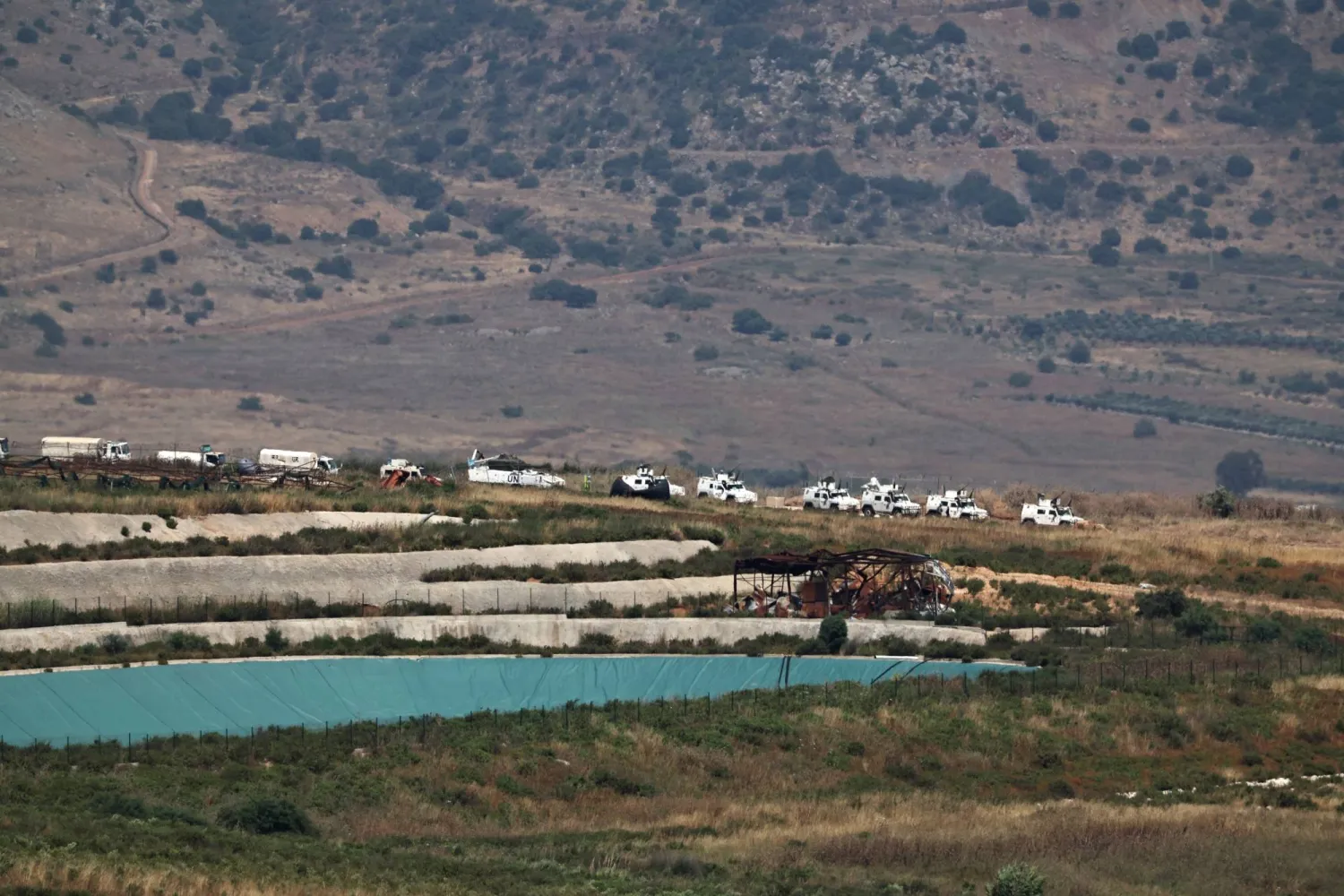
A United Nations Interim Force in Lebanon (UNIFIL) convoy maneuvers within southern Lebanon, as seen from the Israeli side of the border in the Upper Galilee, northern Israel, 02 June 2026, amid a ceasefire between Israel and Hezbollah. EPA/ATEF SAFADI

The United Nations Interim Force in Lebanon said Thursday that a peacekeeper was killed and two others wounded when shelling hit their base in the country's south the previous night.

"A UNIFIL peacekeeper died early this morning from critical injuries sustained when mortar shells struck his position," a statement from the force said, adding that an investigation had been launched.

The peacekeeper was Serbian, the country's defense ministry confirmed on Thursday, specifying that he died from injuries caused by a missile strike on the UN base.

"Senior Sergeant Milovan Jovanovic was given emergency medical care at a hospital inside the base after being wounded and then transported by helicopter to the University Medical Center in Beirut, where he died," the statement said.


Lebanon-Israel Ceasefire Deal: Complete Cessation of Hezbollah Attacks, Creation of Pilot Zones

(L/R) Israel's Ambassador to the US Yechiel Leiter, State Department Chief of Staff Daniel Holler, US Ambassador to Lebanon Michel Issa and Lebanese Ambassador to the US Nada Hamadeh attend a meeting between Israeli and Lebanese delegations hosted by the United States at the State Department in Washington, DC, on June 3, 2026. (Photo by Oliver Contreras / AFP)
TT

Lebanon-Israel Ceasefire Deal: Complete Cessation of Hezbollah Attacks, Creation of Pilot Zones

(L/R) Israel's Ambassador to the US Yechiel Leiter, State Department Chief of Staff Daniel Holler, US Ambassador to Lebanon Michel Issa and Lebanese Ambassador to the US Nada Hamadeh attend a meeting between Israeli and Lebanese delegations hosted by the United States at the State Department in Washington, DC, on June 3, 2026. (Photo by Oliver Contreras / AFP)

Israel and Lebanon on Wednesday agreed to a new ceasefire following talks mediated by the United States. Under the agreement, Hezbollah is to stop all attacks on Israel and withdraw its fighters from the area south of the Litani River in southern Lebanon.

In a joint statement, the US, Israel and Lebanon said “the ceasefire is contingent on a complete cessation of Hezbollah fire and the evacuation of all Hezbollah operatives from the South Litani Sector.”

Israel and Lebanon agreed with US guidance “to swiftly advance the creation of pilot zones” in which the Lebanese army “will take exclusive control of the territory to the exclusion of all non-state actors.”

“These steps will enable progress towards a comprehensive peace and security agreement,” the statement said, adding that both sides “rejected any attempt, by any state or non-state actor, to hold Lebanon’s future hostage.”

Hezbollah has yet to comment on the ceasefire. Before it was announced, the group said it had conducted two drone and rocket attacks on Israeli troops inside Lebanon that it said took place just after midnight local time on Wednesday.

In their statement, “Israel and Lebanon reaffirmed that they have no hostile intent toward one another and committed to continuing direct negotiations to build confidence, resolve all outstanding issues, and work toward a comprehensive agreement between the two countries.”

The US reaffirmed that any agreement to cease hostilities must be reached directly between the two governments, brokered by Washington, and not through any separate track.

As for Israel, it said that its security and respect for its territorial integrity can only be achieved through Hezbollah’s disarmament and the dismantlement of its infrastructure across Lebanon.

In the statement, “Lebanon reaffirmed the necessity for mutual respect of internationally recognized borders, the urgent need for full implementation of the cessation of hostilities, underscoring the principles of territorial integrity and full state sovereignty.”

It stressed commitment to enhancing the capacity of the Lebanese army, with US support, to assert effective control across the country.