
What's the Matter with the Universe?

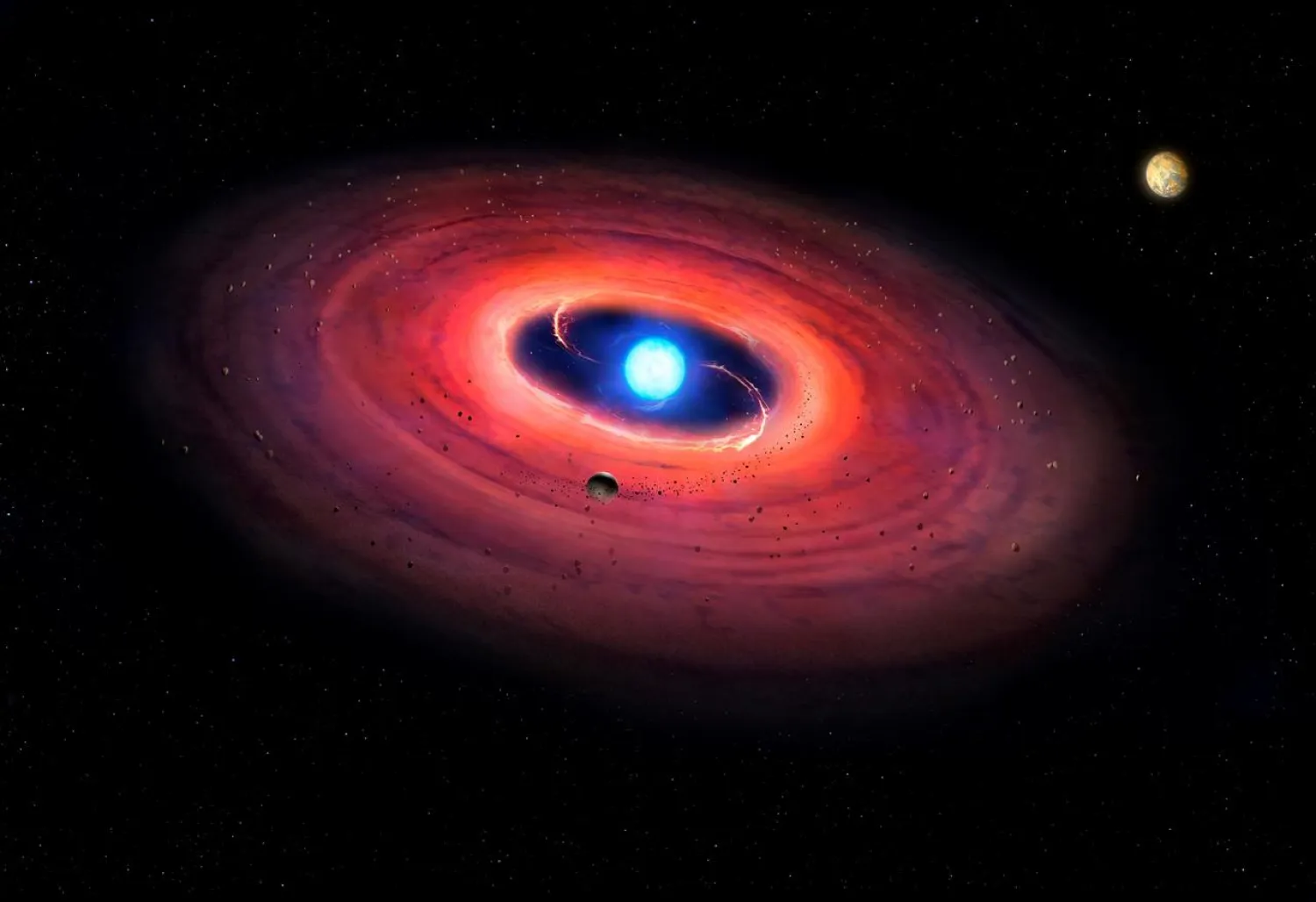
An artist's rendering shows a star called a white dwarf with a planet (upper right) and material in orbit around the star. Courtesy of Mark Garlick/UCLA/Handout via REUTERS.
TT

What's the Matter with the Universe?

An artist's rendering shows a star called a white dwarf with a planet (upper right) and material in orbit around the star. Courtesy of Mark Garlick/UCLA/Handout via REUTERS.

A team of US astrophysicists has produced one of the most precise measurements ever made of the total amount of matter in the Universe, a longtime mystery of the cosmos.

The answer, published in The Astrophysical Journal on Monday, is that matter accounts for 31.5 percent -- give or take 1.3 percent -- of the total amount of matter and energy that make up the Universe.

The remaining 68.5 percent is dark energy, a mysterious force that is causing the expansion of the Universe to accelerate over time, and was first inferred by observations of distant supernovae in the late 1990s.

Put another way, this means the total amount of matter in the observable Universe is equivalent to 66 billion trillion times the mass of our Sun, Mohamed Abdullah, a University of California, Riverside astrophysicist and the paper's lead author, told AFP.

Most of this matter -- 80 percent -- is called dark matter. Its nature is not yet known, but it may consist of some as-yet-undiscovered subatomic particle.

The latest measurements correspond well with values previously found by other teams using different cosmological techniques, such as measuring temperature fluctuations in the low-energy radiation left over from the Big Bang.

"This has been a long process over the course of 100 years where we're gradually getting more and more precise," Gillian Wilson, the study's co-author and a professor at UCR told AFP.

"It's just kind of cool to be able to make such a fundamental measurement about the Universe without leaving planet Earth," she added.

So how exactly do you weigh the Universe?

The team honed a 90-year-old technique that involves observing how galaxies orbit inside galaxy clusters -- massive systems that contain thousands of galaxies.

These observations told them how strong each galaxy cluster's gravitational pull was, from which its total mass could then be calculated.

In fact, explained Wilson, their technique was originally developed by the pioneering astronomer Fritz Zwicky, who was the first person to suspect the existence of dark matter in galaxy clusters, in the 1930s.

He noticed that the combined gravitational mass of the galaxies he observed in the nearby Coma galaxy cluster was insufficient to prevent those galaxies from flying away from one another, and realized there must be some other invisible matter at play.

The UCR team, whose research received money from the US National Science Foundation and NASA, refined Zwicky's technique, developing a tool they called GalWeight that determines more accurately which galaxies belong to a given cluster and which do not.

They applied their tool to the Sloan Digital Sky Survey, the most detailed three-dimensional maps of the Universe currently available, measuring the mass of 1,800 galaxy clusters and creating a catalog.

Finally, they compared the number of clusters observed per unit volume in their catalog against a series of computer simulations, each of which was fed a different value for the total matter of the Universe.

Simulations with too little matter had too few clusters, while those with too much matter had too many clusters.

The "Goldilocks" value they found fit just right.

Wilson explained that having a more precise measure of the total amount of matter in the Universe may take us a step closer to learning the nature of dark matter, because "we know just how much matter we should be looking for" when scientists carry out particle experiments, for example at the Large Hadron Collider.

What's more, "the total amount of dark matter and dark energy tells us the fate of the Universe," she added, with the current scientific consensus being that we are headed for a "Big Freeze" where galaxies move further and further apart, and the stars in those galaxies eventually run out of fuel.




The Year's First Meteor Shower and Supermoon Clash in January Skies

People look up to the sky from an observatory near the village of Avren, Bulgaria, Aug. 12, 2009. (AP Photo/Petar Petrov, File)
TT

The Year's First Meteor Shower and Supermoon Clash in January Skies

People look up to the sky from an observatory near the village of Avren, Bulgaria, Aug. 12, 2009. (AP Photo/Petar Petrov, File)

The year's first supermoon and meteor shower will sync up in January skies, but the light from one may dim the other.

The Quadrantid meteor shower peaks Friday night into Saturday morning, according to the American Meteor Society. In dark skies during the peak, skygazers typically see around 25 meteors per hour, but this time they'll likely glimpse less than 10 per hour due to light from Saturday's supermoon, The AP news reported.

“The biggest enemy of enjoying a meteor shower is the full moon,” said Mike Shanahan, planetarium director at Liberty Science Center in New Jersey.

Meteor showers happen when speedy space rocks collide with Earth’s atmosphere, burning up and leaving fiery tails in their wake — the end of a “shooting star.” A handful of meteors are visible on any given night, but predictable showers appear annually when Earth passes through dense streams of cosmic debris.

Supermoons occur when a full moon is closer to Earth in its orbit. That makes it appear up to 14% bigger and 30% brighter than the faintest moon of the year, according to NASA. That difference can be tough to notice with the naked eye.

Supermoons, like all full moons, are visible in clear skies everywhere that it's night. The Quadrantids, on the other hand, can be seen mainly from the Northern Hemisphere. Both can be glimpsed without any special equipment.

To spot the Quadrantids, venture out in the early evening away from city lights and watch for fireballs before the moon crashes the party, said Jacque Benitez with the Morrison Planetarium at the California Academy of Sciences. Skygazers can also try looking during early dawn hours on Sunday.

Wait for your eyes to get used to the darkness, and don’t look at your phone. The space rocks will look like fast-moving white dots and appear over the whole sky.

Meteor showers are named for the constellation where the fireballs appear to come from. The Quadrantids — space debris from the asteroid 2003 EH1 — are named for a constellation that's no longer recognized.

The next major meteor shower, called the Lyrids, is slotted for April.

Supermoons happen a few times a year and come in groups, taking advantage of the sweet spot in the moon’s elliptical orbit. Saturday night’s event ends a four-month streak that started in October. There won't be another supermoon until the end of 2026.


New Maritime Theater in Jazan to Host the City's Festival Opening

The site also includes various amenities, such as shopping zones, kiosks for dining, an art gallery - SPA
TT

New Maritime Theater in Jazan to Host the City's Festival Opening

The site also includes various amenities, such as shopping zones, kiosks for dining, an art gallery - SPA

The Jazan city theater on the southern corniche will host the opening ceremony of the Jazan Festival 2026 on Friday. This event will take place at a 35-square-kilometer site that features the Kingdom's largest maritime theater, SPA reported.

The theater accommodates more than 10,000 spectators and features five VIP areas. To ensure a smooth experience, the venue offers parking for over 9,000 vehicles, providing easy access during peak times.

Built specifically for the festival, the stage meets stringent safety and technical standards, providing a high-quality audiovisual experience against the stunning backdrop of the Red Sea.

The site also includes various amenities, such as shopping zones, kiosks for dining, an art gallery, a play area for children, a bird garden, and a regional museum, showcasing the region's history and culture.

This temporary maritime theater aims to provide a cohesive experience, integrating entertainment, culture, shopping, and services in one location, further establishing Jazan as a year-round destination for tourism and entertainment.


Saudi Post Issues Commemorative Stamp for Riyadh Air

Saudi Post Issues Commemorative Stamp for Riyadh Air
TT

Saudi Post Issues Commemorative Stamp for Riyadh Air

Saudi Post Issues Commemorative Stamp for Riyadh Air

Saudi Post, in collaboration with Riyadh Air, has launched a commemorative stamp set priced at SAR3 to celebrate the airline’s inaugural flights on October 26, 2025, coinciding with the start of its operational phase.

This issuance marks the beginning of operational activities for Riyadh Air as a new national carrier, aiming to serve over 100 destinations worldwide, SPA reported.

Saudi Post's stamps commemorate major national and international events, preserving important moments in Saudi history and appealing to collectors and historians alike.