

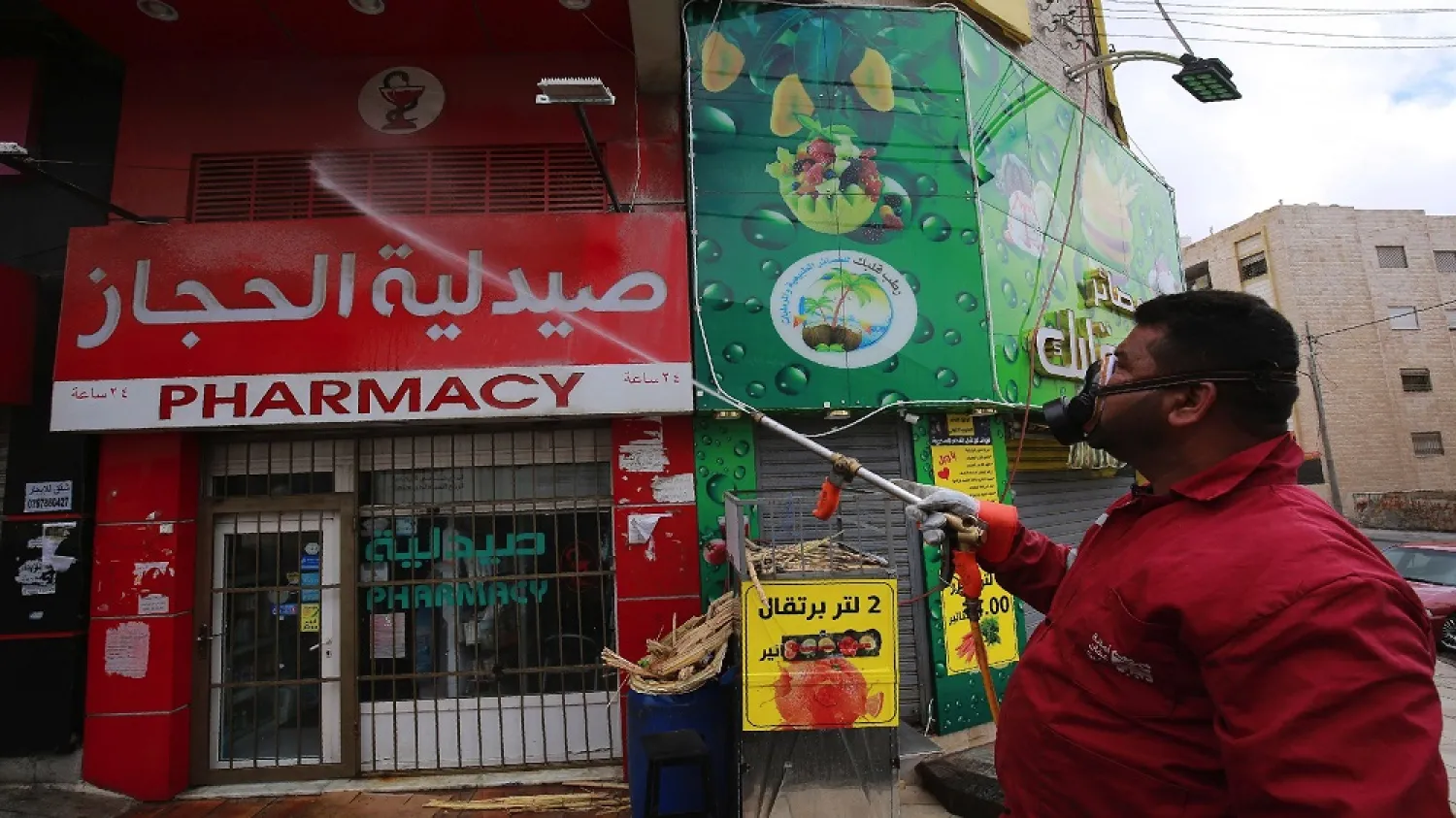

Jordan Reports 1,767 COVID-19 Cases in its Highest Daily Tally

A municipality worker disinfects a pharmacy in the Jordanian capital Amman as part of preventive measures against the spread of the coronavirus, on March 21, 2020. (Getty Images)
TT

Jordan Reports 1,767 COVID-19 Cases in its Highest Daily Tally

A municipality worker disinfects a pharmacy in the Jordanian capital Amman as part of preventive measures against the spread of the coronavirus, on March 21, 2020. (Getty Images)

Jordan registered 1,767 new cases of COVID-19 on Wednesday, its highest daily tally since the start of the outbreak, with officials warning that a wider spread could force a return to a complete lockdown.

The country's total number of confirmed infections now stands at 11,816, with 61 deaths since the first case surfaced in early March, Health Minister Saad Jaber said in a statement.

Jordan, which had some of the lowest numbers of infections in the region in the first few months of the pandemics' spread, has seen daily numbers rise alarmingly this month, with health officials saying the country now faced a community spread.

The government could be forced to impose a full lockdown that would paralyze daily activity and suspend businesses if a "dangerous" spiral of cases made it difficult for health authorities to cope, government spokesman Amjad Adailah said.

"This is matter that no one wants," he said.

The government also stiffened jail sentences to up to a year for anyone organizing weddings, parties, funerals or social gatherings where more than 20 people attend, in the latest measures to impose health safeguards.



UN: More Than 8 Million Sudanese Need Food in 2026

Famine spreads in North Darfur and South Kordofan in Sudan (AP) 
TT

UN: More Than 8 Million Sudanese Need Food in 2026

Famine spreads in North Darfur and South Kordofan in Sudan (AP) 

Sudan continues to face critical gaps in humanitarian nutrition services, exacerbated by ongoing conflict, displacement, and limited access to health and nutrition services, the UN and its partners said on Monday.

According to the Office for the Coordination of Humanitarian Affairs (OCHA), an estimated 8.4 million people in Sudan will require nutrition assistance in 2026.

This includes approximately 5 million children under the age of five and 3.4 million pregnant and breastfeeding women.

Of the 8.4 million in need, OCHA estimated that 4.2 million children and pregnant and breastfeeding women are projected to be acutely malnourished across Sudan, including over 824,000 cases of children under five suffering from Severe Acute Malnutrition (SAM).

Recent SMART surveys show further deterioration in the nutrition situation, with 31 out of the 61 validated SMART surveys reporting global acute malnutrition (GAM) prevalence of 15% and above the WHO emergency threshold, out of which one survey recorded GAM of 34.2 %, which is the famine threshold.

Kordofan and Darfur Battles

At the field level, military pressure is significantly escalating in the Kordofan and Darfur regions.

Earlier this month, the UN said road blockades and siege-like conditions have exasperated the delivery of food and health care to several areas, including the city of Kadugli and the city of Dilling in south Kordofan.

For months, the RSF and its ally, the Sudan People's Liberation Movement, have imposed a harsh siege on the two cities, with recurring artillery and drone strikes that led to 800,000 internally displaced people.

Military operations have targeted markets and troop concentrations, including an attack that killed 12 people and left tens of injuries, according to local reports.

Also, fierce battles took place in Habila and Kertala.

Meanwhile, the use of drones in combat zones in Sudan constitutes to play a leading role in the fighting between the two warrying parties.

This month, drones have been heavily documented in El-Obeid, the capital of North Kordofan, and surrounding areas in Sudan, as part of the ongoing conflict between the Sudanese Army and the RSF.

More than 13 people, including children and women, were reportedly killed by drone attacks in and around El-Obeid, amid widespread targeting of vital facilities in the city.

Local reports said violent clashes happened in axes linking North Kordofan to strategic areas, increasing the risk of limiting access to supplies and the movement of civilians.

The UN said gaps in humanitarian nutrition is projected to further deteriorate in 2026 due to expanding conflict, food security decline, compromised health and water services, and prolonged and recent displacements.

It warned that the actual number of malnourished individuals, particularly among IDPs, returnees, and non-displaced communities, are expected to exceed the current projected People in Need (PIN) figures as the situation worsens.

Turk’s Warnings

UN Human Rights commissioner Volker Turk said on Sunday he is alarmed by the increasing militarization of society by all parties to the conflict in Sudan, also expressing his worries that the atrocity crimes committed during and after the takeover of El Fasher would be repeated in the Kordofan region.

Speaking at a press conference in Port Sudan, where the government had been operating as a temporary capital since the conflict began, the UN envoy said the proliferation of advanced military equipment, in particular drones, across Sudan has enhanced the military capabilities of both the Sudanese army and the RSF, prolonging hostilities and deepening the crisis for civilians.

Turk said the international community must ensure that the perpetrators of the horrific violations in Sudan face justice, regardless of their affiliation.


Lebanese Army Chief to Make Pivotal Visit to Washington Next Month

Lebanese army chief General Rodolphe Haykal. Photo: Army command
TT

Lebanese Army Chief to Make Pivotal Visit to Washington Next Month

Lebanese army chief General Rodolphe Haykal. Photo: Army command

Lebanese army chief General Rodolphe Haykal is gearing up for an official visit to Washington in early February, after the US cancelled meetings with him in November.

The visit comes at a sensitive time, preceding the Paris conference to supporting the Lebanese army in March.

Ministerial sources told Asharq Al-Awsat that Haykal’s visit to Washington has been set for between February 3 and 5, saying the army’s needs, cooperation between the US and Lebanese militaries, and continued American support for the Lebanese army will be high on the agenda of the talks.

Military sources said that the visit’s postponement in November has not frozen contacts between the two sides. On the contrary, intense contacts have since been made to reschedule the visit, resulting in setting a new date next month.

The army’s plan to confiscate all unauthorized arms and extend state authority over all Lebanese territory will most likely top the agenda of the visit. This plan has drawn broad international attention.

A statement issued by the army command on January 8 regarding the achievement of the objectives of the first phase of the weapons-control plan will constitute a key component of Haykal’s briefing to US officials.

The army said in that statement that it had achieved the initial goal to clear non-state weaponry from the southern area near the Israeli border by the end of 2025.

It said it secured areas south of the Litani River, excluding positions still held by Israeli forces, though there was more work to be done clearing unexploded ordnance and tunnels.

Haykal’s briefing will most likely refer to the challenges hindering the full implementation of the plan, foremost among them ongoing Israeli attacks and the occupation of a number of sites inside Lebanese territory, in addition to the establishment of buffer zones that restrict freedom of movement, as well as the daily violations of the ceasefire agreement of November 27, 2024.

The army chief will also stress continued close cooperation with the United Nations Interim Force in Lebanon (UNIFIL) and with the ceasefire monitoring committee known as the mechanism, which held its last meeting on January 7 at the military level in the absence of civilians.

Ministerial sources told Asharq Al-Awsat that the mechanism will not hold meetings this month. “We are awaiting the return of the US general who is abroad, as well as the appointment of a civilian representative to replace US envoy Morgan Ortagus, who has been relieved of her duties,” they said.

Meanwhile, Lebanon continues its preparations for the Paris conference to support the army, scheduled for March 5.

Lebanese President Joseph Aoun told a recent security meeting that the army and security forces should prepare accurate reports on their needs and brief the conferees to secure the required assistance for their institutions.


Al-Khanbashi: Hadramout Has Been Liberated from Al-Zubaidi, UAE's Hegemony

Hadramout Governor and a member of the Yemeni Presidential Leadership Council, Salem al-Khanbashi gives a media briefing in the port city of Mukalla in Hadramout, Yemen, January 19, 2026. (Reuters)
TT

Al-Khanbashi: Hadramout Has Been Liberated from Al-Zubaidi, UAE's Hegemony

Hadramout Governor and a member of the Yemeni Presidential Leadership Council, Salem al-Khanbashi gives a media briefing in the port city of Mukalla in Hadramout, Yemen, January 19, 2026. (Reuters)

Presidential Leadership Council (PLC) member and Governor of Yemen's eastern Hadramout province Salem al-Khanbashi accused on Monday the United Arab Emirates of exploiting its participation in the coalition to support legitimacy in Yemen to pursue its own agenda.

Speaking at a press conference in Mukalla city, he said the UAE's actions in Hadramout were a shock to the people and local authorities.

The authorities had hoped that the UAE would act as a supporter to the Yemeni people as part of the coalition, but its actions on the ground went against those expectations, he remarked.

Hadramout has suffered from the hegemony of armed factions affiliated with Aidarous al-Zubaidi, leader of the Southern Transitional Council, with direct support from the UAE, added all-Khanbashi.

Hadramout has been liberated from al-Zubaidi and the UAE's hegemony, he stressed.

He accused groups loyal to al-Zubaidi of looting public institutions, terrorizing the people and committing wide violations against them, leading to instability in Hadramout.

He vowed that the authorities will take "all legal measures" against the UAE and al-Zubaidi's armed groups.

Justice will prevail, he declared, pledging to support the victims of the violations and hold to account the perpetrators.

Moreover, al-Khanbashi revealed that the UAE was running "several large secret prisons" in Hadramout. Explosives were also stored in the al-Riyan airbase that were going to be used to in assassinations and attacks in the province.

He said that Hadramout has closed a "dangerous and bitter chapter" in its history through direct support from Saudi Arabia.

This backing has helped restore stability, boost the state's authority and end a period of chaos and violations, he continued.