

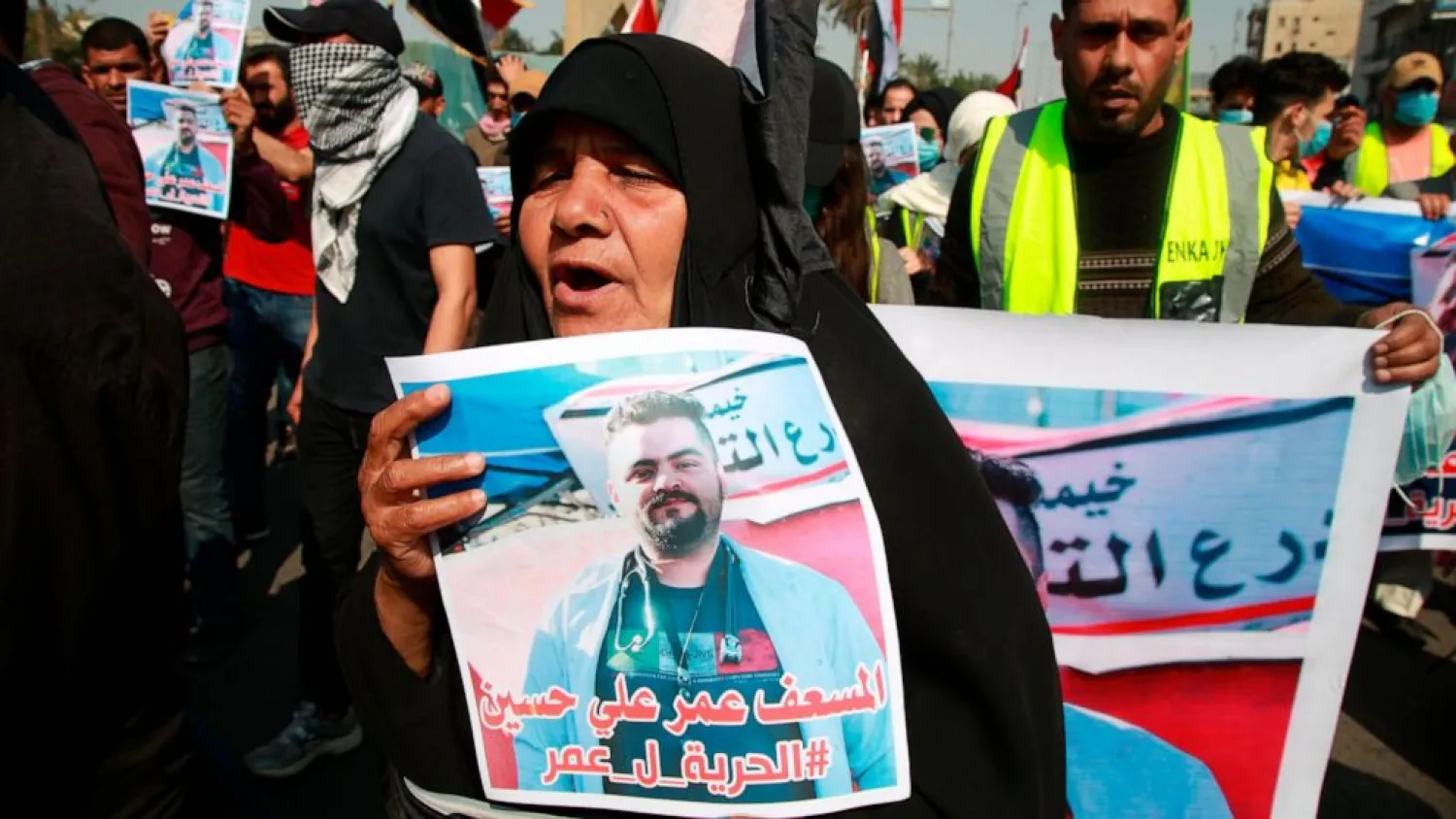

An Iraqi Father Confronts Militia in Search for Missing Son

A woman holds a picture of her a missing son during anti-government protest in Baghdad, Iraq, Sunday, Feb. 23, 2020. There are 25 activists still missing since the protests erupted on Oct. 1, 2019, according to the semi-official Iraqi High Commission for Human Rights. No group has claimed responsibility but activists have blamed the militias. Arabic reads, "Freedom for paramedic Omr Ali." (AP Photo/Khalid Mohammed)
TT

An Iraqi Father Confronts Militia in Search for Missing Son

A woman holds a picture of her a missing son during anti-government protest in Baghdad, Iraq, Sunday, Feb. 23, 2020. There are 25 activists still missing since the protests erupted on Oct. 1, 2019, according to the semi-official Iraqi High Commission for Human Rights. No group has claimed responsibility but activists have blamed the militias. Arabic reads, "Freedom for paramedic Omr Ali." (AP Photo/Khalid Mohammed)

In the span of 30 seconds, Ali Jasb, a young rights lawyer, vanished into the night in southern Iraq.

On an evening a year ago, a woman emerged from a dimly lit street in the city of Amara and greeted Jasb. Almost immediately a black SUV pulled up, two men forced him in, and the vehicle sped away. The woman climbed into a waiting pickup truck and left.

The fateful moment, captured by a surveillance camera at 6:22 p.m. on Oct. 8, 2019, was the last sighting of the 21-year-old Jasb.

Since that day, Jasb´s father has been on a search for justice that has run repeatedly against one major obstacle: the increasing helplessness of Iraq´s government in the face of powerful, Iranian-backed Shiite militias. According to The Associated Press, judicial investigations show a clear connection between Jasb´s abduction and the most powerful militia group in his home city.

Still, his father, Jasb Aboud is determined to bring the head of that militia to court.

"I am afraid," he told the AP. "But I lost what was most valuable to me, so I´ve got nothing else to lose."

Jasb was abducted a week into historic protests that had erupted on Oct. 1 and saw tens of thousands of youth rallying against corruption and the ruling class. Hope for change inspired many, including Jasb, to speak out against the influence of militias.

He is among 53 protesters still missing since the movement began on Oct. 1, according to the semi-official Iraqi High Commission for Human Rights.

When the nationwide protests erupted, Jasb participated and used his legal expertise to form a committee to help those detained. He also openly criticized militias.

In his home city of Amara, capital of Missan province, that meant Ansar Allah Al-Awfia, one of the more extreme pro-Iranian militias, led by a local commander, Haidar al-Gharawi. It was incorporated under the state-sponsored umbrella group, the Popular Mobilization Forces, created to fight the ISIS group in 2014.

Over the years, it came to control important offices in the provincial government and many businesses in Missan, while being notorious for illicit dealings along the border with Iran.

There was no response to repeated emails by the AP to the PMF seeking comment for this story, and calls and messages to Awfia were not answered.

Curtailing the power of militias was a key promise of Prime Minister Mustafa al-Kadhimi when he took office in May, following months of political deadlock when former premier Adel Abdul-Mahdi resigned under pressure from protests.

But he was soon faced with the limits of his administration. Abdul-Mahdi had allowed militias´ power to grow so much that "now, we almost don´t have a state," said a high-level official, speaking on condition of anonymity because of the sensitivity of the issue.

Frequent rocket attacks targeted Kadhimi´s seat of power in Baghdad, straining relations with the US. A raid on the Iranian-backed Kataeb Hezbollah, suspected of firing the rockets, backfired when most of those detained were set free - lack of evidence, the court said.

Activists continue to be targeted. The July shooting death of a high-profile commentator and critic of Iran, Hisham al-Hashimi, stunned Baghdad. Two leading activists in Basra were assassinated.

In the case of Jasb´s disappearance, investigators in Missan quickly came across evidence of a link to Gharawi, the Awfia militia commander, according to court documents seen by the AP.

Hours before his abduction, Jasb received a phone call from a woman seeking legal help who asked to meet him later that evening, his father said. It was when he went to meet her that he was snatched.

Key to the case was the mobile number that had called Jasb.

Investigators found it belonged to an illegally acquired SIM not registered with the authorities. There is a thriving black market for such unregistered SIMs, which cannot be traced to a user.

Police identified other numbers that had called the unknown SIM. Among them was a man named Sadam Hamed. He told investigators that he knew nothing about the unknown number, but said his wife, Fatima Saeed, sometimes used his phone to call a relative. That relative is married to Awfia´s commander, Gharawi, according to his testimony.

The judge summoned Saeed for questioning but she never showed up. Both she and Hamed had fled.

There the investigation ground to a halt. For nine long months, Jasb´s father waited for developments. Nothing happened. So Aboud went to Baghdad and met a new lawyer, Wala al-Ameri.

They decided to attempt a bold gambit: To seek an arrest warrant against Gharawi from a court in the capital, which would hopefully be far from the militia´s sway in Missan.

"The accused is a militia that has power in Missan, so it could be that it has influence over witnesses, even the law," Ameri said.

But again they hit a dead end.

The Baghdad judge deemed there was insufficient evidence for a warrant against Gharawi. He dismissed Hamed´s testimony and said only a statement from someone who had seen the kidnapping could advance the case.

"Now it´s a case against the unknown," Aboud said.

In September, Kadhimi visited Missan and gave Jasb´s father an audience. During their 15-minute meeting, Aboud laid out the court documents, explained the details of the case, and named the militia he believes took his son.

Kadhimi "put his hand to his chest and promised he would deliver him to me," Aboud said.

The premier might be Aboud´s last hope. There are witnesses to his son´s abduction, but none dare speak out.

One man told the AP he was near a shop that night and saw everything. He belongs to a powerful local tribe but spoke on condition of anonymity out of fear.

He recounted seeing the woman emerge and the men push Jasb into the vehicle. He also saw police arrive afterward and search Jasb´s car. The AP confirmed that the shop he named had a view of the site.

But would he testify?

"It would be my funeral the next day."


Appeal Trial of Tunisia Jailed Prominent Lawyer Starts

People stand outside a closed court during a nationwide strike in Tunis, Tunisia November 22, 2018. REUTERS/Zoubeir Souissi
TT

Appeal Trial of Tunisia Jailed Prominent Lawyer Starts

People stand outside a closed court during a nationwide strike in Tunis, Tunisia November 22, 2018. REUTERS/Zoubeir Souissi

The appeal trial of a prominent Tunisian lawyer jailed on anti-terror charges started on Thursday, after the judge rejected the defense's demand of his provisional release on health grounds.

Ahmed Souab's lawyers and relatives said his health condition had become critical since his jailing in April last year as part of what many said was a crackdown on political dissent.

The court rejected his provisional release and postponed the hearing to February 23, his lawyer, Fedi Snene, told AFP.

Souab -- also a rights advocate and a former judge -- was detained after claiming that judges were under political pressure to hand down hefty sentences last year in a mass trial of critics of President Kais Saied.

He had been a member of the defense team during the high-profile mass trial, and last October he was sentenced to five years in prison in a speedy trial that lasted less than two minutes.

UN Special Rapporteur on human rights defenders Mary Lawlor said on Wednesday Souab had been convicted on "baseless charges" and called for his "immediate release".

Snene rejected accusations against Souab, saying "he should not be in prison".

"He is a well-known man of law, who served for nearly 30 years as a judge before becoming a lawyer," Snene added.

Souab's son, Saeb, told AFP the family had submitted a "substantial medical file" asking the judge for his release pending a verdict.

Saeb said his father suffered a heart attack in 2022 and that his cardiologist had certified that prison conditions could worsen his health.

Souab had accused authorities of putting "a knife to the throat of the judge who was to deliver the verdict" during the mass trial that saw around 40 public figures sentenced to long terms on charges including plotting against the state.


At Least 21 Drown in Nile Boat Sinking in Sudan

At least 21 people drowned when a boat sank in the Nile River in northern Sudan, according to the local state government and eyewitnesses interviewed by AFP. (REUTERS)
TT

At Least 21 Drown in Nile Boat Sinking in Sudan

At least 21 people drowned when a boat sank in the Nile River in northern Sudan, according to the local state government and eyewitnesses interviewed by AFP. (REUTERS)

At least 21 people drowned when a boat sank in the Nile River in northern Sudan, according to the local state government and eyewitnesses interviewed by AFP.

River Nile State said Thursday that 21 bodies had been recovered after the accident, listed their names and warned that some passengers were still missing.

The boat was crossing the river between the villages of Tayba al-Khawad and Deim al-Qarai, according to the local government's statement.

The statement did not explain the cause of the accident.

Eyewitnesses told AFP the boat was carrying 30 people.

The Sudanese Doctors Network said in a statement that six of the boat's passengers survived.

The group said the incident exposes "the fragility of river transport and the absence of basic safety requirements, as well as the complete absence of local authorities and civil defense rescue teams in the early hours of the incident".

Many Sudanese rely on river transport via single-engine boats captained by solo operators.

The country's infrastructure has been collapsing due to a war that has been ongoing for nearly three years.

The war has divided the country between the army and their enemy, the paramilitary Rapid Support Forces, with road closures and a severe deterioration in public services and medical and educational infrastructure.


Syria Affirms Deep Ties with Saudi Arabia

Saudi Ambassador to Damascus Dr. Faisal Al-Mujfel visits the Kingdom’s pavilion, guest of honor at the Damascus International Book Fair (Saudi Embassy account). 
TT

Syria Affirms Deep Ties with Saudi Arabia

Saudi Ambassador to Damascus Dr. Faisal Al-Mujfel visits the Kingdom’s pavilion, guest of honor at the Damascus International Book Fair (Saudi Embassy account). 

Syria has reaffirmed the strength of its relations with Saudi Arabia during a visit by the Saudi ambassador to Damascus, Dr. Faisal Al-Mujfel, to the Saudi pavilion, guest of honor at the 2026 Damascus International Book Fair.

Saudi Arabia’s participation in the fair, held from Feb. 6-16, is led by the Literature, Publishing and Translation Commission.

At the start of the visit, Al-Mujfel met Syria’s Minister of Culture, Mohammad Yassin Saleh, who welcomed the Kingdom’s designation as guest of honor as a clear affirmation of the depth of Saudi-Syrian cultural relations, based on partnership and mutual respect.

Saleh praised Saudi Arabia’s cultural efforts and commended the pavilion for showcasing activities that reflect the richness and diversity of Saudi cultural heritage.

He noted that the Saudi program highlights the Kingdom’s commitment to supporting culture and literature at both the Arab and international levels. The pavilion features a wide range of events, including seminars and poetry evenings, with the participation of leading Saudi writers and intellectuals.

During a guided tour, the Saudi ambassador was briefed on the creative diversity presented at the pavilion. Exhibits include a collection of manuscripts, a section dedicated to traditional Saudi attire, displays of archaeological replicas, and a selection of publications issued by the Literature, Publishing and Translation Commission.

Among the featured works are titles from the “Translate” initiative, the “Saudi Literature Comics” series, and short story collections from Saudi authors, offering visitors insight into the Kingdom’s contemporary literary scene.

The commission is overseeing Saudi Arabia’s participation as guest of honor at the 2026 book fair, presenting what it described as a vibrant cultural experience that celebrates Saudi creativity and promotes dialogue through books.

The program aligns with the Kingdom’s National Culture Strategy under Vision 2030, which emphasizes cultural exchange, knowledge sharing, and constructive dialogue among nations, while reinforcing Saudi Arabia’s role in the Arab and global cultural landscape.

The visit was attended by several Arab diplomats accompanying the Saudi ambassador, including the ambassadors of Bahrain, Oman and Lebanon, as well as the chargé d’affaires of the United Arab Emirates embassy in Damascus.
