Yemeni Govt Condemns Houthi Targeting of Banks

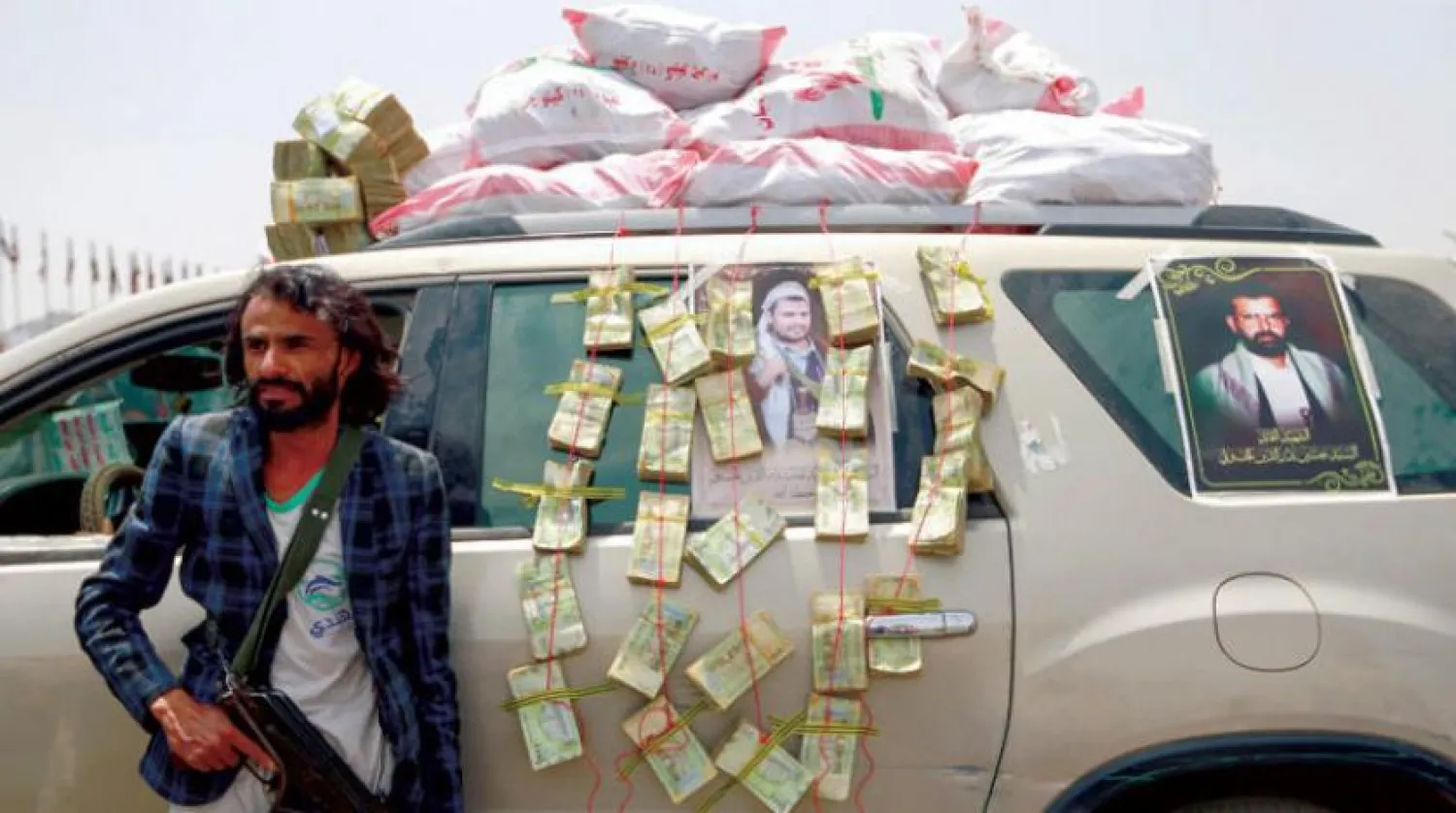
A Houthi gunman guards a car decorated with money  (AFP)
A Houthi gunman guards a car decorated with money (AFP)
TT

Yemeni Govt Condemns Houthi Targeting of Banks

A Houthi gunman guards a car decorated with money  (AFP)
A Houthi gunman guards a car decorated with money (AFP)

The Yemeni government condemned the Iran-backed militia’s recent targeting of banks and money transfer shops in areas falling under their control, describing Houthis as a “criminal gang,”

This week, the pro-Iran group stormed the headquarters of the most branched out bank in Yemen, Al-Kuraimi Bank. Houthis closed its offices in Sanaa, and temporarily shut down its branches in Hodeidah, Ibb,and Ad Dali' governorates.

The group’s attack on the Al-Kuraimi Bank shocked Yemeni circles. Economists described it as “a barbaric action taken without any awareness of the risks it imposes on the private sector and the national economy.”

Information minister, Muammar Al-Eryani wrote on Twitter on Thursday that the group is taking 30% of each money transfer from outside Yemen or from regions under the control of the government.

"Deductions from remittances of expatriates or citizens inside the country is a criminal act and collective punishment amidst deteriorating living conditions and deepening humanitarian crisis," he said.

The government has accused the Houthis of stealing the national foreign currency reserves, public revenues and salaries of public servants for five years and imposing illegal taxes and customs duties.

Harassing banks and exchange firms means cutting the remaining artery of the national economy which is helping save the lives of millions of people, Al-Eryani said.

Late last year, the group ordered to stop the circulation of new banknotes issued by the government under the justification of protecting the national currency from total collapse.

The move confused exchange firms across the country, forcing them to increase the transfer fees to 30% of the value of a remittance to secure the difference of exchange rates.

Al-Eryani confirmed that the Houthi “criminal” policies undoubtedly proof the group’s indifference towards the dire humanitarian conditions Yemenis are suffering from, and an insistence on advancing an agenda anchored in the impoverishment of citizens.

Houthis, through starving out Yemenis, aim to drive the poor to fight their battles in exchange for money.


Calm Prevails in Yemen’s Liberated Areas after Dissolution of Southern Transitional Council

Minister of State and Governor of Aden Abdulrahman Sheikh al-Yafei takes the constitutional oath on Saturday before the Chairman of the Presidential Leadership Council, Rashad al-Alimi. Saba
TT

Calm Prevails in Yemen’s Liberated Areas after Dissolution of Southern Transitional Council

Minister of State and Governor of Aden Abdulrahman Sheikh al-Yafei takes the constitutional oath on Saturday before the Chairman of the Presidential Leadership Council, Rashad al-Alimi. Saba

Security calm prevailed across Yemen’s liberated areas on Saturday, a day after the leadership of the Southern Transitional Council announced the dissolution of the council and all its bodies at home and abroad.

This paves the way for participation in the anticipated Riyadh conference dedicated to the southern issue, a step widely seen as pivotal in reshaping political and security arrangements in southern Yemen.

While the Hadhramaut governorate continued to strengthen its security presence and consolidate stability through a series of measures and official assurances, local authorities in the interim capital, Aden, tightened precautionary steps, rejecting what they described as suspicious calls that could lead to chaos.

The measures coincided with a heavy deployment of Giants Brigades and National Shield forces, which took control of the security situation.

In this context, the newly appointed Minister of State and Governor of Aden, Abdulrahman Sheikh al-Yafei, took the constitutional oath on Saturday before the Chairman of the Presidential Leadership Council, Rashad al-Alimi, according to official media.

The state news agency Saba reported that Al-Alimi met with the new governor and emphasized the priority of unifying decision-making and strengthening the role of the security committee in Aden.

He underscored the need for the state to exclusively control weapons, enable its institutions to exercise their legal authorities, and entrench the rule of law as a cornerstone of stability.

Al-Alimi also called for upholding the values of tolerance, coexistence, and social peace, preventing any acts of revenge or retaliation, and facilitating the work of humanitarian organizations to ensure the smooth flow of aid, contributing to improved living conditions for citizens.

He urged Aden’s local leadership to work jointly with the government to improve basic services, particularly electricity, create a safe and attractive environment for investment, remove administrative obstacles, boost local and sovereign revenues, restore investor confidence, and reinforce Aden’s status and its historic port as a regional commercial hub.

In a televised address on Saturday, Al-Alimi announced the formation of a Supreme Military Committee under the leadership of the Coalition forces.

The committee will prepare, equip, and command all military forces and formations, aiming to unify military decision-making and enhance state readiness to restore its institutions peacefully or by force if the Houthis refuse peace.

He confirmed the completion of the handover of military camps in Hadhramaut, Al-Mahra, the interim capital Aden, and other liberated areas, reaffirming the state’s commitment to the southern issue and support for convening a comprehensive southern dialogue conference under Saudi sponsorship, with its outcomes to be implemented under regional and international guarantees.

Observers say Al-Alimi’s positions signal the beginning of a new phase of unity aimed at achieving security and stability in Yemen’s liberated governorates and protecting them from the Houthis, terrorist operations, and any threats to Yemen’s security and stability.

They note that the presidential council chairman continues to emphasize the Yemeni government’s belief in the just southern cause, pointing out that Saudi Arabia will lead this phase with the participation of the legitimate government and Yemeni parties, as Riyadh is set to host a conference on the southern issue with the participation of southern figures and leaders.

Rejection of Chaos

Earlier, Aden’s local authorities issued a key security directive based on instructions from the Vice Chairman of the Presidential Leadership Council, Abdulrahman al-Muharrami, and a decision by al-Yafei, banning any gatherings or mass rallies during the current period.

The directive stated that the local authority is not opposed to demonstrations in principle, but rejected the timing, describing the current phase as sensitive and challenging.

It warned of attempts to exploit any peaceful activity by infiltrators to drag it toward violence and target institutions, military camps, and public and private property.

The statement said the circulating calls promoted by elements of the dissolved Southern Transitional Council had not obtained any official permit and were not backed by any responsible or coordinated entity, making them vulnerable to infiltration by terrorist organizations seeking to undermine stability.

It stressed that maintaining security does not mean suppressing opinions, and that peaceful expression will remain open once conditions stabilize.

The local authority urged citizens to comply with the directive and not be drawn into suspicious calls, affirming that security agencies will deal firmly and in accordance with the law with any violations, to safeguard the capital and its residents.


US Military Launches ‘Large-Scale’ Strikes Against ISIS in Syria

A US navy F-18 Super Hornet lands on the flight deck on the USS Nimitz, off the coast of Busan, South Korea, 27 March, 2023. Jeon Heon-Kyun/Pool via REUTERS/File Photo
TT

US Military Launches ‘Large-Scale’ Strikes Against ISIS in Syria

A US navy F-18 Super Hornet lands on the flight deck on the USS Nimitz, off the coast of Busan, South Korea, 27 March, 2023. Jeon Heon-Kyun/Pool via REUTERS/File Photo

The US military carried out “large-scale strikes” against multiple ISIS targets in Syria, the Central Command (CENTCOM) forces affirmed on Saturday.

The attacks were part of Operation Hawkeye Strike, which was launched and announced on Dec. 19, at the direction of President Donald Trump, in direct response to the ISIS attack on US and Syrian forces in Palmyra on Dec. 13, the military said in a statement. That attack killed two US soldiers and a US civilian interpreter, according to US officials.

“Today’s strikes targeted ISIS throughout Syria as part of our ongoing commitment to root out terrorism against our warfighters, prevent future attacks, and protect American and partner forces in the region,” the military statement said.

Earlier on Saturday, Fox News quoted US officials as saying that the US military has launched airstrikes against ISIS in Syria.

There was no information about whether anyone was killed in the strikes. The Pentagon did not deliver more details.

The UK Ministry of Defense said on Saturday that Royal Air Force Typhoon jets have joined French aircraft in a joint strike on an underground arms cache in Syria used by ISIS.

Western aircraft have been conducting patrols to stop a resurgence of the extremist group that ruled parts of Syria until 2019.

“Careful intelligence analysis led officials to believe the facility was storing arms and explosives,” the statement said, and was in mountains just north of Palmyra, an ancient site in central Syria.

“This action shows our UK leadership, and determination to stand shoulder to shoulder with our allies, to stamp out any resurgence of ISIS and their dangerous and violent ideologies in the Middle East,” UK Defense Secretary John Healey said.


Mohammad Mahdi Shamseddine to Shiites: Integrate Into Your States

Sheikh Mohammad Mahdi Shamseddine during an event with Amal Movement military commander Akel Hamiyeh (Getty). 
TT

Mohammad Mahdi Shamseddine to Shiites: Integrate Into Your States

Sheikh Mohammad Mahdi Shamseddine during an event with Amal Movement military commander Akel Hamiyeh (Getty). 

Asharq Al-Awsat begins publishing an extended text in the form of a dialogue held in 1997 between the late Sheikh Mohammad Mahdi Shamseddine, then head of Lebanon’s Higher Islamic Shiite Council, and figures close to Hezbollah’s milieu.

The text is of exceptional importance, as it addresses the situation of Shiites in their countries and the need for them to integrate into their states rather than become part of a project subordinate to Iran.

As is well known, Shamseddine was marginalized for many years by supporters of Hezbollah and the Amal Movement. He was displaced from Haret Hreik in Beirut’s southern suburbs and lived outside it because of positions that conflicted with those of Iran-aligned forces in Lebanon.

The dialogue is scheduled to be published by Ibrahim Mohammad Mahdi Shamseddine, the cleric’s son, in a book titled Lebanese Shiites and Arab Shiites: The Relationship with Others and the Relationship with the Self. Asharq Al-Awsat is publishing lengthy excerpts from the text on the occasion of the 25th anniversary of the Lebanese Shiite cleric’s death, which falls today, Saturday, January 10.

Ibrahim Shamseddine: Why now?

Ibrahim Shamseddine introduces the publication with a preface explaining why he chose to reveal the contents of the dialogue after all these years. He writes that he decided to publish the text marking 25 years since his father’s passing in order to honor him, revive his thought, and recall his deep insight, courage and firmness in expressing what he believed to be the truth — truth that safeguards people and preserves the nation and the state for all.

Central to this vision, he notes, was placing the unity of the national political community above any particularism, without exception, including that of Lebanese Shiites and Arab Shiites, who are part of the broader national, Arab and Islamic collectives.

The text is the outcome of a dialogue session, preserved on audio recordings, lasting more than four hours on the night of Tuesday, March 18, 1997. It brought together Sheikh Shamseddine and a large group of cadres from the “Islamic movement” in Lebanon, closely linked to the party-based Shiite political current that emerged in the mid-1980s under direct and sustained Iranian sponsorship.

Ibrahim Shamseddine explains that he was especially motivated to publish this previously unpublished text because it addresses highly sensitive and contentious issues — particularly relations between Lebanese Shiites and their fellow citizens, their national framework, their Arab and Islamic surroundings, and, most notably, their relationship with Iran.

He adds that these same issues remain at the heart of today’s debates, charged with urgency and tension, and continue to interact with shifting regional and global geopolitical dynamics. For this reason, he argues that the document is not a relic of the past but a living text that speaks directly to a volatile and uncertain present. The full text, with an expanded summary, will later be published in the aforementioned book.

Lebanese Shiites and Arab Shiites

The dialogue opens with a question from one of the young participants, who tells Shamseddine that he had long been regarded as a leading figure of the Islamist movement, but that over time a distance had emerged between him and part of its base. The questioner suggests this may be due to Shamseddine’s position and proximity to official authority, and asks whether he now speaks in the name of state necessities or the choices of the people.

Shamseddine replies that he remains in his original position, unchanged “by even a hair’s breadth,” but rather deeper, broader and more mature. What some perceive as distance, he insists, did not originate from him but from certain clerics and those influenced by them, driven by a purely partisan spirit he describes as almost idolatrous. Barriers were erected, through suspicion or inducement, leaving him personally surprised by developments he had not planned.

He speaks of hidden maneuvering rooted in the pursuit of status and influence, noting that such dynamics have existed within Shiism since the era of the infallible imams. He recounts how the Lebanese Union of Muslim Students, which he helped establish and nurture, was later taken out of his hands, eventually aligning with partisan currents that later fed into Hezbollah. He stresses that many were innocent or misled, while responsibility for others he leaves to divine judgment.

Shamseddine affirms that assuming the presidency of the Higher Islamic Shiite Council did not alter his religious understanding or commitments formed since the 1950s. He reiterates his well-known formulation distinguishing between “the necessities of regimes and the choices of Al-Umma (the community),” stressing that the council has always expressed the latter. Disagreement over whether a given stance falls under necessity or choice, he says, is legitimate.

He laments deliberate distortions portraying him and the council as aligned with the state, exploiting Shiite sensitivities toward authority. While a few acted knowingly, he says the majority were misled. He declares that he harbors no personal grievance, leaving judgment to God.

The relationship with regimes

Responding to a question about the cordiality shown during his visits to Arab states and whether it served the interest of avoiding escalation, Shamseddine dismisses the premise. Affection, he says, is natural and mutual among Muslims, whether in Egypt, Saudi Arabia, the Gulf, India or Pakistan. He notes that during his visits he met governments and oppositions alike, including Islamist groups critical of their own states.

He rejects the suggestion that cordiality implies submission, stressing that shared causes, above all the broader Islamic cause and opposition to the Zionist project, create common ground and understanding.

Shamseddine then addresses what he calls a deep-seated Shiite psychological complex: the belief of being universally rejected. While acknowledging that Shiites do face hostility at times, he argues that the deeper problem is self-isolation rooted in a siege mentality cultivated through poor social and political upbringing. This mindset, he says, has been cynically exploited by some Shiite leaders, particularly after the rise of Islamist movements, to mobilize followers without ethical restraint.

He adds that conflict is not unique to Shiites. Sunnis fight Sunnis in Algeria, Sudan and Afghanistan, just as Shiites have fought Shiites in Iraq and Lebanon. Social struggle, he says, is a universal reality.

“Integrate into your states”

Shamseddine then lays out his central message. His overriding concern, he says, is for the blood, dignity, freedom and honor of Shiites. To protect these, Shiites must be accepted within their homelands and not perceived as a threat or contagion.

“I say this openly,” he declares. “Integrate into your states. Integrate into your societies. Integrate into your systems of shared interests. Do not create a separate system of interests. Do not arouse suspicion. Respect your laws.”

He insists this position is grounded in firm religious conviction, stressing that stealing public funds is forbidden regardless of whether a state is Sunni or Shiite. He argues that acceptance should come from being a constructive citizen, not from acting as a proxy or protected extension of another state.

Shamseddine warns against behavior that seeks to intimidate others through transnational partisan threats, recounting instances where individuals exploited partisan affiliations to evade accountability abroad. Such conduct, he says, ultimately harms the broader Shiite community.

He concludes that his mission is to make Shiites accepted within their societies and the wider Islamic world, accepted as they are, in their religious practices and traditions. Portraying Shiites as a distinct, abnormal case within Islam, he argues, is both false and dangerous. He says that his religious and intellectual duty is to pull Shiites out of this predicament, a task he believes he had already achieved to a significant extent.

Below are some of the key issues addressed by Shamseddine in the dialogue, revealed for the first time:

• When you do not threaten others’ system of interests with your own, few people will stand in your way.

• I say: integrate into your states, integrate into your societies, integrate into your systems of interests. Do not create a separate system of interests. Do not arouse the suspicions of others. Respect your laws.

• My message is to make Shiites acceptable within their societies and within the wider Muslim community. I want them to be accepted in their own right, not because they represent a “protectorate” of another state, meaning to be accepted because Iran protects me.

• The secret group that was formed in Egypt as the nucleus of a party or grouping, including that wretched creature “Shehata” and others like him, does not concern us, whether they are sincere or charlatans.

• The psychological complex among Shiites, that they are ostracized, stems from the fact that they themselves ostracize others. The world is not against us. We are against the world. One of the tasks of my mission is to remove Shiites from a posture of being against the world.

• If Iran is building a party for itself in Egypt and wants to build work upon it, that is not my business. Iran manages its own affairs.

• Shiites make up one-fifth of Muslims compared with four-fifths. My role is to create a state of friendship between them and their societies, far from any political sectarianism.

• I am not speaking only about Arab Shiites. Shiites in Türkiye or Azerbaijan belong to Türkiye and Azerbaijan, not to Iran. Shiites in the Indian subcontinent belong to their homelands, ethnicities and peoples. Iran represents neither a political nor a religious authority for them.

• It is impermissible for there to be a separate project for Shiites within their homelands.

• What interest do Shiites have in killing the emir of Kuwait? Why do we conspire against this or that regime or official? Managing Shiite affairs begins with integration.

• I moved into besieged Beirut in 1982 and said: Shiites will not leave Beirut. Their glory and dignity lie in being besieged alongside Sunnis and Palestinians inside it.

• Shiites are not in danger. If there is any danger to them, it comes from themselves, not from others.

• Had I wanted to flatter the Iranians, I would have mentioned them, praised and lauded them, and you would then have heard applause from Iran and Hezbollah.

• The state cannot deal with secret systems of interests, as some are trying to create here or elsewhere.

• Shiites have no interest, regionally or nationally, in establishing a separate system of interests and linking it to Iran.

• Shiite strength lies in integrating into the body of Islam, not in becoming a special community affiliated with Iranians.

• I call for citizenship without deceit. If one of the turbaned pretenders issues a fatwa saying that stealing the property of a Sunni or a Christian is permissible, absolutely not. This is forbidden.

• The concept of an unjust system or an unjust ruler no longer exists. The modern state has legitimate ownership. We issue religious rulings forbidding the embezzlement of public funds, the betrayal of laws and the undermining of public order.