

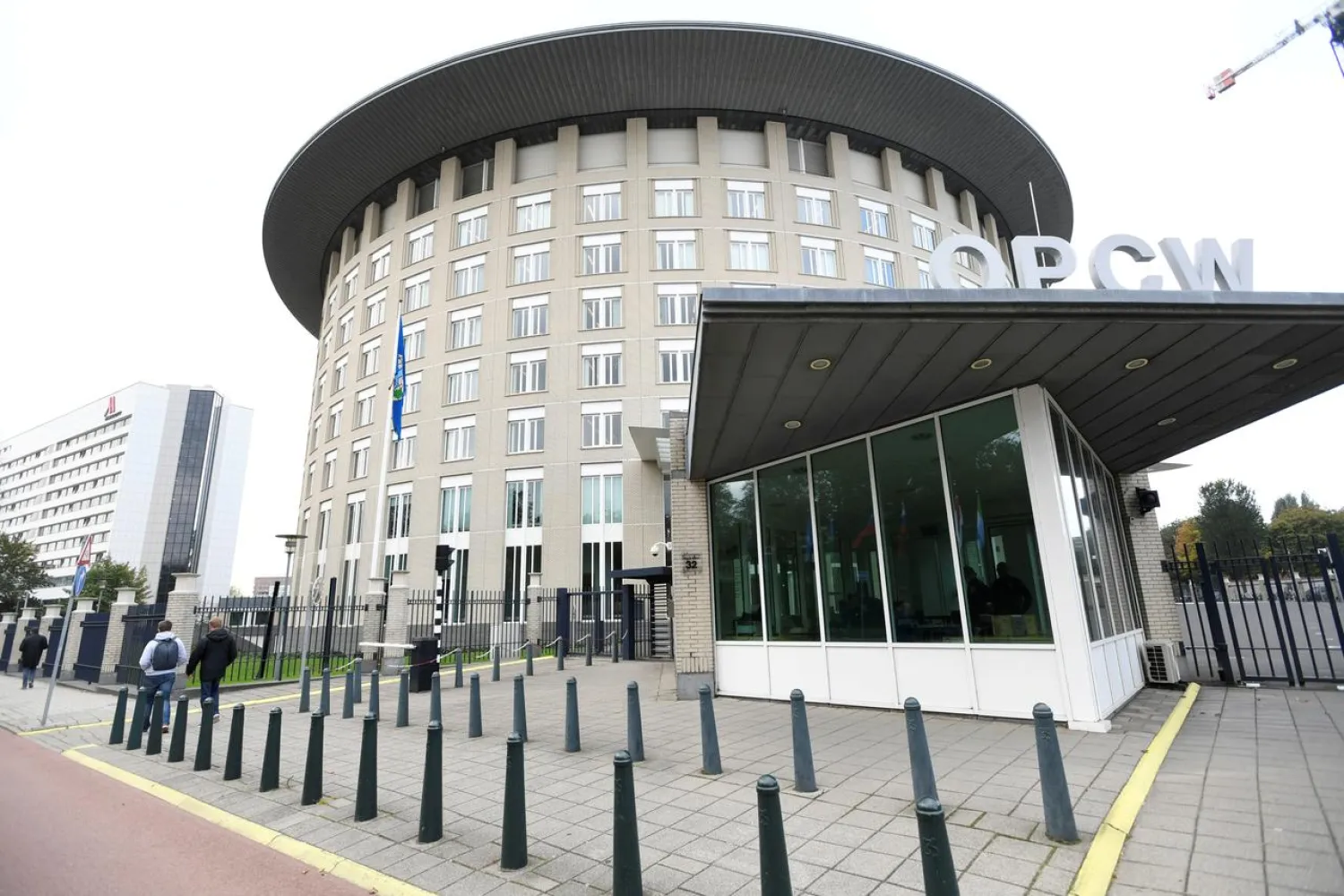

OPCW Confirms Nerve Agent Used in Navalny Poisoning

The headquarters of the Organization for the Prohibition of Chemical Weapons (OPCW) is pictured in The Hague, Netherlands, October 4, 2018. (Reuters)
TT

OPCW Confirms Nerve Agent Used in Navalny Poisoning

The headquarters of the Organization for the Prohibition of Chemical Weapons (OPCW) is pictured in The Hague, Netherlands, October 4, 2018. (Reuters)

The global chemical watchdog group has confirmed Germany and other countries' findings that Russian opposition leader Alexei Navalny was the victim of an attack with a Soviet-era nerve agent, German Chancellor Angela Merkel’s spokesman said Tuesday.

Steffen Seibert said in a statement that the Organization for the Prohibition of Chemical Weapons, or OPCW, had carried out its own analysis of samples taken from Navalny, and they "agree with the results already from special laboratories in Germany, Sweden and France.”

Navalny, a corruption investigator who is Russian President Vladimir Putin’s fiercest critic, was flown to Germany two days after falling ill on Aug. 20 during a domestic flight in Russia. German officials said last month that labs found traces of a chemical agent from the Novichok family in the Russian politician’s system.

“This once again confirms unequivocally that Alexei Navalny was the victim of an attack with a chemical nerve agent from the Novichok group,” Seibert said.

He renewed Germany’s call on Russia to fully investigate and explain what happened to Navalny, who fell ill on a flight in Russia and was later taken to Berlin for treatment.

In a statement, OPCW Director-General Fernando Arias called the test results “a matter of grave concern.”

Asked about the watchdog's report in a conference call with reporters, Kremlin spokesman Dmitry Peskov refrained from comment, saying that the Kremlin needs to see the report to react.

Seibert said Germany received the OPCW’s report on Monday and was still examining it. Officials were still trying to determine how much of the information could be released to the public without causing a security risk by allowing knowledge of the substance to “fall into the wrong hands.”

He added that Germany would be consulting closely in the coming days with the OPCW and a group of European Union partners to talk about the next steps.

“Any use of chemical weapons is serious and cannot be without consequences,” Seibert said.

OPCW experts gathered their own samples from Navalny and sent them to two designated labs for tests.

Earlier Tuesday, Germany and its allies at a meeting of the OPCW's Executive Council called on Moscow to fully investigate and explain how Navalny was poisoned with a military-grade nerve agent.

“It is up to Russia — where the chemical attack occurred — to shed light on the incident, and to provide an explanation on how a chemical nerve agent came to be used in a reckless act against a Russian citizen on Russian soil,” Germany's representative to the organization, Gudrun Lingner, said in a statement. “Up to now, the Russian Federation has not provided any credible explanation.”

Lingner said that Russian responses so far to calls for clarification about Navalny’s poisoning “seek to obfuscate, to deflect responsibility and to distract from the main point — the use of a military-grade nerve agent.”

The United Kingdom, which accused Russia of using a Novichok nerve agent in a 2018 attack on former double agent Sergei Skripal and his daughter in the English city of Salisbury, supported Germany’s demand for answers.

“It is less than three years since we saw first-hand the deadly consequences of Novichok used as a chemical weapon in the United Kingdom,” said Nicola Stewart, the UK’s deputy permanent representative to the OPCW. “We are appalled that there should have been a repeat anywhere in the world.”

Russia’s statement to the meeting wasn't immediately published online. Moscow has bristled at demands for an investigation, saying that Germany needs to share medical data in the case or compare notes with Russian doctors. Germany has noted that Russian doctors have their own samples from Navalny since he was in their care for 48 hours.



Two Airports in Poland Closed Due to Russian Strikes on Ukraine

Lublin Airport is unavailable due to military activity involving NATO aircraft (Reuters)
TT

Two Airports in Poland Closed Due to Russian Strikes on Ukraine

Lublin Airport is unavailable due to military activity involving NATO aircraft (Reuters)

Two airports in southeastern Poland were suspended from operations as a precaution due to Russian strikes on nearby Ukraine territory, Polish authorities said on Saturday.

"In connection with the need to ensure the possibility of the free operation of military aviation, the airports in Rzeszow and Lublin ‌have temporarily ‌suspended flight operations," ‌Polish Air ⁠Navigation Services Agency ‌posted on X.

Both cities are close to the country's border with Ukraine, with Rzeszow being NATO's main hub for arms supplies to Ukraine, Reuters said.

Military aviation had begun operating in Polish airspace due to Russian ⁠strikes on Ukraine, the Operational Command of ‌the Polish Armed Forces said on ‍X.

"These actions are ‍of a preventive nature and ‍are aimed at securing and protecting the airspace, particularly in areas adjacent to the threatened regions," the army said.

Flight tracking service FlightRadar24 posted on X that the closure involved NATO aircraft operating in the area.

The ⁠US Federal Aviation Administration said in a notice to airmen that both airports were inaccessible due to the military activity related to ensuring state security.

Last month, Rzeszow and Lublin suspended operations for a time, but the authorities said then that the military aviation operations were routine and there had been no threat to ‌Polish airspace.


Police Warn Sydney Protesters ahead of Israeli President’s Visit

 01 February 2026, Australia, Sydney: A protester holds a poster during a Free Palestine rally protesting the invitation of Isaac Herzog to Australia at the State Library of Victoria in Melbourne. (Jay Kogler/AAP/dpa)
01 February 2026, Australia, Sydney: A protester holds a poster during a Free Palestine rally protesting the invitation of Isaac Herzog to Australia at the State Library of Victoria in Melbourne. (Jay Kogler/AAP/dpa)
TT

Police Warn Sydney Protesters ahead of Israeli President’s Visit

 01 February 2026, Australia, Sydney: A protester holds a poster during a Free Palestine rally protesting the invitation of Isaac Herzog to Australia at the State Library of Victoria in Melbourne. (Jay Kogler/AAP/dpa)
01 February 2026, Australia, Sydney: A protester holds a poster during a Free Palestine rally protesting the invitation of Isaac Herzog to Australia at the State Library of Victoria in Melbourne. (Jay Kogler/AAP/dpa)

Australian authorities warned protesters to avoid violence in Sydney's streets when Israeli President Isaac Herzog visits on Monday to honor victims of the Bondi Beach mass shooting.

Police say they will deploy in large numbers for the Israeli head of state's visit following the December 14 attack on a Jewish Hanukkah celebration that killed 15 people.

"It's really important that there's no clashes or violence on the streets in Sydney," New South Wales Premier Chris Minns told reporters on Saturday.

"Our clear message is in an unambiguous way that we're hoping that people can remain calm and respectful during that presidential visit."

The state premier promised a "massive policing presence" in Sydney on Monday afternoon.

State police declared the Sydney visit to be a "major event", a designation that allows them to separate different groups to reduce the risk of confrontation.

Herzog has said he will "express solidarity and offer strength" to the Jewish community in Australia during his four-day visit, which starts Monday.

The trip has been welcomed by many Jewish Australians.

"His visit will lift the spirits of a pained community," said Alex Ryvchin, co-chief executive of the Executive Council of Australian Jewry, the community's peak body.

Pro-Palestinian activists have called for protests nationwide, however, including in parts of central Sydney where police have refused to authorize demonstrations under new powers granted after the Bondi Beach attack.

- 'Full immunity' -

Amnesty International Australia has also urged supporters to rally for an end to "genocide" against Palestinians, and urged Herzog be investigated for alleged war crimes.

High-profile Australian human rights lawyer Chris Sidoti -- a member of a UN-established inquiry into rights abuses in Israel and the Palestinian territories -- called this week for Herzog's invitation to be withdrawn, or for his arrest on arrival.

The UN's Independent International Commission of Inquiry found in 2025 that Herzog "incited the commission of genocide" by saying all Palestinians -- "an entire nation" -- were responsible for the Hamas attack on October 7, 2023.

Australia's federal police have ruled out an arrest, with senior officials telling lawmakers this week that they received legal advice Herzog had "full immunity" covering civil and criminal matters, including genocide.

Critics have accused Prime Minister Anthony Albanese's center-left government of moving too slowly to protect Jewish Australians ahead of the Bondi Beach shooting despite a rise in antisemitic attacks since 2023.

Alleged Bondi Beach gunman Sajid Akram, 50, was shot and killed by police during the attack.

An Indian national, he entered Australia on a visa in 1998.

His 24-year-old son Naveed, an Australian-born citizen who remains in prison, has been charged with terrorism and 15 murders.


Cuba to Protect Essential Services as US Moves to Cut Off Oil Supply

 People wait for transportation as Cubans brace for fuel scarcity measures after US tightens oil supply blockade, in Havana, Cuba, February 6, 2026. (Reuters)
People wait for transportation as Cubans brace for fuel scarcity measures after US tightens oil supply blockade, in Havana, Cuba, February 6, 2026. (Reuters)
TT

Cuba to Protect Essential Services as US Moves to Cut Off Oil Supply

 People wait for transportation as Cubans brace for fuel scarcity measures after US tightens oil supply blockade, in Havana, Cuba, February 6, 2026. (Reuters)
People wait for transportation as Cubans brace for fuel scarcity measures after US tightens oil supply blockade, in Havana, Cuba, February 6, 2026. (Reuters)

Cuba detailed a wide-ranging plan on Friday to protect essential services and ration fuel as the communist-run government dug in its heels in defiance of a US effort to cut off oil supply to the Caribbean island.

The rationing measures are the first to be announced since President Donald Trump threatened to slap tariffs on the US-bound products of any country exporting fuel to Cuba and suggested hard times ahead for Cubans already suffering severe shortages of food, fuel ‌and medicine.

Government ‌ministers said the measures would guarantee ‌fuel supply ⁠for key sectors, ‌including agricultural production, education, water supply, healthcare and defense.

Commerce Minister Oscar Perez-Oliva struck a defiant tone as he laid out details of the government plan.

"This is an opportunity and a challenge that we have no doubt we will overcome," Perez-Oliva told a television news program. "We are not going to collapse."

The government will supply fuel to the ⁠tourism and export sectors, including for the production of Cuba's world-famous cigars, to ensure ‌the foreign exchange necessary to fund other basic ‍programs, Perez-Oliva said, adding, "If we ‍don't have income, then we will not overcome this situation."

Domestic ‍and international air travel will not be immediately affected by the fuel rationing, although drivers will see cutbacks at the pump until supply normalizes, he said.

The government said it would protect ports and ensure fuel for domestic transportation in a bid to protect the island nation's import and export sectors.

Perez-Oliva also announced an ambitious ⁠plan to plant 200,000 hectares (500,000 acres) of rice to guarantee "an important part of our demand," but acknowledged fuel shortfalls would push the country to depend more on renewable energy for irrigation needs and animal-power for tilling fields.

Education Minister Naima Ariatne, appearing on the same program, said infant-care centers and primary schools would remain open and in person, but secondary schools and higher education would implement a hybrid system that would require more "flexibility" and vary by institution and region.

"As a priority, we want to leave (open) our primary schools," Ariatne said.

Top officials said ‌health care would also be prioritized, with special emphasis on emergency services, maternity wards and cancer programs.