


Belarus' Authoritarian Leader Visits his Foes in Prison

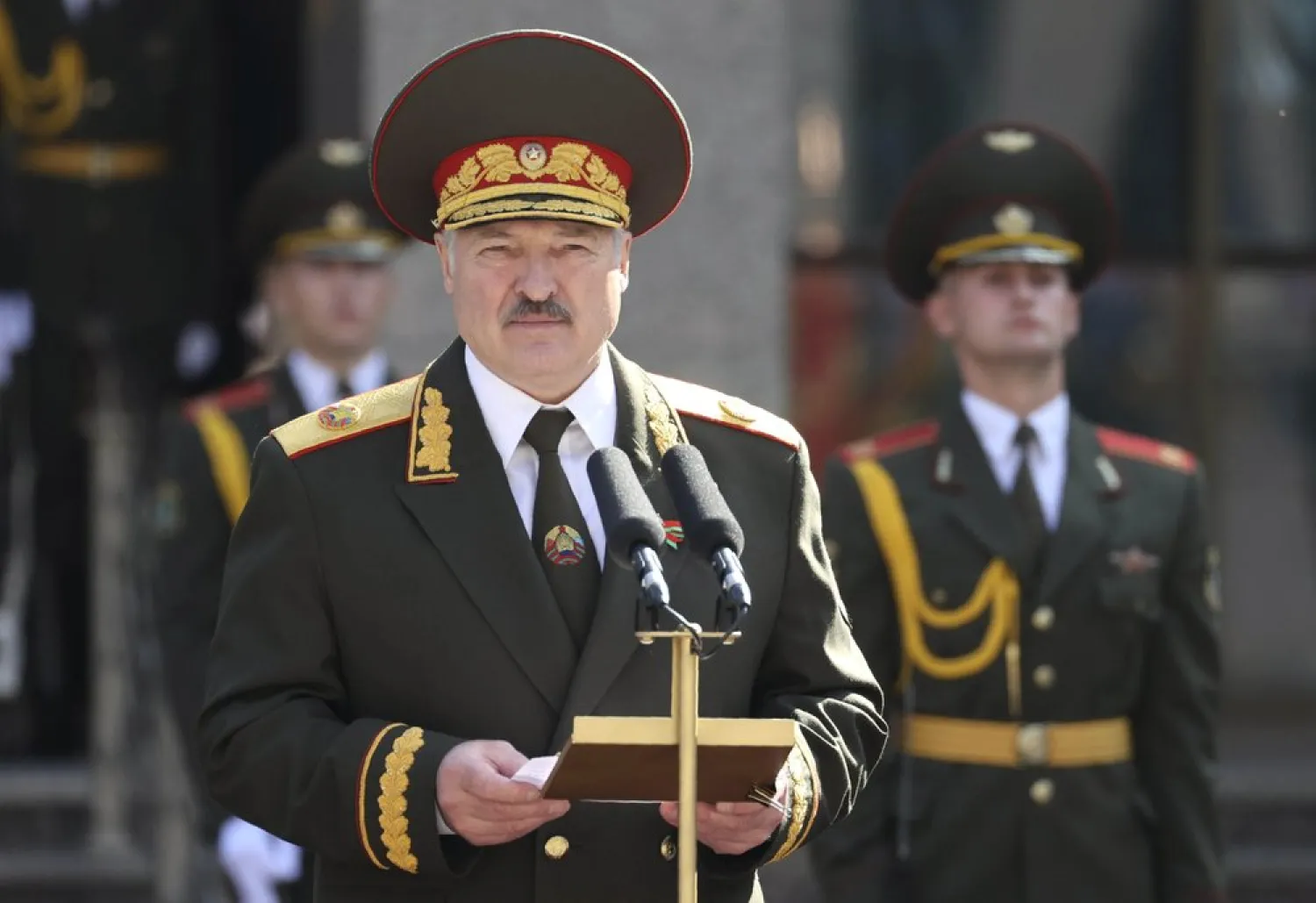
Belarusian President Alexander Lukashenko delivers a speech during his inauguration ceremony at the Palace of the Independence in Minsk, Belarus, Sept. 23, 2020. (AP)
TT

Belarus' Authoritarian Leader Visits his Foes in Prison

Belarusian President Alexander Lukashenko delivers a speech during his inauguration ceremony at the Palace of the Independence in Minsk, Belarus, Sept. 23, 2020. (AP)

Belarus' authoritarian president on Saturday visited a prison to talk to opposition activists, who have been jailed for challenging his re-election that was widely seen as manipulated and triggered two months of protests.

President Alexander Lukashenko spent more than four hours talking to his jailed political foes at the Minsk prison that belongs to Belarus' State Security Committee, which still goes under its Soviet-era name, KGB.

Lukashenko's office said that “the goal of the president was to hear everyone's opinion."

Among 11 jailed activists who attended the meeting were several members of the opposition's Coordination Council and Viktor Babariko, the former head of a major Russia-owned bank. Babariko aspired to challenge Lukashenko but was barred from the race and remained in jail since his arrest in May on charges he dismissed as political.

Lukashenko's landslide re-election in the Aug. 9 vote was widely seen as manipulated amid widespread public frustration with the Belarusian leader's 26-year authoritarian rule, his cavalier response to the coronavirus pandemic and the deteriorating economy.

A violent crackdown on peaceful demonstrators in the first days after the vote, in which thousands were arrested and hundreds were beaten by police, provoked international outrage and helped swell protesters’ ranks.

The European Union and the United States said the election was neither free nor fair. They have slapped scores of Belarusian officials with sanctions for their role in the alleged vote-rigging and the crackdown on protests, but didn’t target Lukashenko himself.

EU members Poland and Lithuania have been especially outspoken in their support for Belarusian opposition politicians, leading to diplomatic tensions that have included Belarus' government expelling Polish and Lithuanian diplomats. Those two countries responded by withdrawing their ambassadors to Minsk.

Late Friday, Britain temporarily recalled its ambassador to Belarus, Jacqueline Perkins, in response to the Belarusian government’s decision to expel the Polish and Lithuanian diplomats.

In a tweet, Foreign Secretary Dominic Raab condemned the decision, labeling it as “completely unjustified.” He said the temporary recall of the ambassador “for consultations on the situation in Belarus” was intended to show “solidarity” with the people in the country.

The government has sought to stifle protests by detaining hundreds of demonstrators, prosecuting some top activists and forcing others to leave the country. However, massive demonstrations have continued, reaching their peak numbers on Sundays when up to 100,000 flood the streets of the Belarusian capital, Minsk. Another big protest is planned for this Sunday.

Hundreds of women marched through the Belarusian capital on Saturday to protest against political repressions and demand a new election. Several participants in the rally were detained.

Pavel Latushko, a former culture minister and ambassador to France, who joined the opposition's Coordination Council and was pressured by authorities to leave the country, said that the meeting reflected the Belarusian leader's weakness.

“Lukashenko was forced to sit down at the negotiation table with the people whom he jailed,” Latushko said in a statement, demanding the release of all political prisoners.

Observers saw Lukashenko's visit to prison as part of his efforts to steal the protesters' thunder by offering vaguely-described reforms, such as his proposal to draft a new constitution. During the meeting in prison, Lukashenko emphasized that “the constitution can't be written in the streets,” his office said without offering other details of the meeting.

“After two months of protests and harsh repressions, Lukashenko is moving to de-escalate the situation,” said Valery Karbalevich, an independent Minsk-based political expert.

“The discussion of a new constitution is an attempt by the government to imitate a dialogue. It would allow Lukashenko to drown the protests in talks, reduce tensions and enforce his agenda both inside the country and to foreign players,” Karbalevich said.



Top Trump Iran Negotiator Says Visits US Aircraft Carrier in Middle East

US Special Envoy Steve Witkoff delivers a press conference upon the signing of the declaration on deploying post-ceasefire force in Ukraine, during the so-called "Coalition of the Willing" summit, at the Elysee Palace in Paris, France, January 6, 2026. (Reuters)
TT

Top Trump Iran Negotiator Says Visits US Aircraft Carrier in Middle East

US Special Envoy Steve Witkoff delivers a press conference upon the signing of the declaration on deploying post-ceasefire force in Ukraine, during the so-called "Coalition of the Willing" summit, at the Elysee Palace in Paris, France, January 6, 2026. (Reuters)

US President Donald Trump's lead Iran negotiator Steve Witkoff on Saturday said he visited the USS Abraham Lincoln aircraft carrier currently in the Arabian Sea, with Washington and Tehran due to hold further talks soon.

"Today, Adm. Brad Cooper, Commander of US Naval Forces Central Command, Jared Kushner, and I met with the brave sailors and Marines aboard the USS Abraham Lincoln, her strike group, and Carrier Air Wing 9 who are keeping us safe and upholding President Trump's message of peace through strength," said Witkoff in a social media post.

Iranian Foreign Minister Abbas Araghchi said on Saturday he hoped talks with the United States would resume soon, while reiterating Tehran's red lines and warning against any American attack.


Israel’s Netanyahu Expected to Meet Trump in US on Wednesday and Discuss Iran

Israeli Prime Minister Benjamin Netanyahu delivers a speech during a special session to mark the 77th anniversary of the Knesset's establishment and the 60th anniversary of the dedication of the current building at the Knesset, the Israeli parliament, in Jerusalem, 02 February 2026. (EPA)
TT

Israel’s Netanyahu Expected to Meet Trump in US on Wednesday and Discuss Iran

Israeli Prime Minister Benjamin Netanyahu delivers a speech during a special session to mark the 77th anniversary of the Knesset's establishment and the 60th anniversary of the dedication of the current building at the Knesset, the Israeli parliament, in Jerusalem, 02 February 2026. (EPA)

Israeli Prime Minister Benjamin Netanyahu is expected to meet US President Donald Trump on Wednesday in Washington, where they will discuss negotiations with Iran, Netanyahu's office said on Saturday.

Iranian and US officials held indirect nuclear ‌talks in the ‌Omani capital ‌Muscat ⁠on Friday. ‌Both sides said more talks were expected to be held again soon.

A regional diplomat briefed by Tehran on the talks told Reuters Iran insisted ⁠on its "right to enrich uranium" ‌during the negotiations with ‍the US, ‍and that Tehran's missile capabilities ‍were not raised in the discussions.

Iranian officials have ruled out putting Iran's missiles - one of the largest such arsenals in the region - up ⁠for discussion, and have said Tehran wants recognition of its right to enrich uranium.

"The Prime Minister believes that any negotiations must include limiting ballistic missiles and halting support for the Iranian axis," Netanyahu's office said in a ‌statement.


Italy FM Rules Out Joining Trump’s ‘Board of Peace’

Italy's Minister for Foreign Affairs Antonio Tajani speaks to the press during the EPP Leaders’ meeting, in Zagreb, Croatia, 30 January 2026. (EPA)
TT

Italy FM Rules Out Joining Trump’s ‘Board of Peace’

Italy's Minister for Foreign Affairs Antonio Tajani speaks to the press during the EPP Leaders’ meeting, in Zagreb, Croatia, 30 January 2026. (EPA)

Italy will not take part in US President Donald Trump's "Board of Peace", Italian Foreign Minister Antonio Tajani said Saturday, citing "insurmountable" constitutional issues.

Trump launched his "Board of Peace" at the World Economic Forum in Davos in January and some 19 countries have signed its founding charter.

But Italy's constitution bars the country from joining an organization led by a single foreign leader.

Prime Minister Giorgia Meloni, a Trump ally, last month noted "constitutional problems" with joining, but suggested Trump could perhaps reopen the framework "to meet the needs not only of Italy, but also of other European countries".

Tajani appeared Saturday to rule that out.

"We cannot participate in the Board of Peace because there is a constitutional limit," he told the ANSA news agency.

"This is insurmountable from a legal standpoint," he said, the day after meeting US Secretary of State Marco Rubio and US Vice President JD Vance at the Olympics in Milan.

Although originally meant to oversee Gaza's rebuilding, the board's charter does not limit its role to the Palestinian territory and appears to want to rival the United Nations.