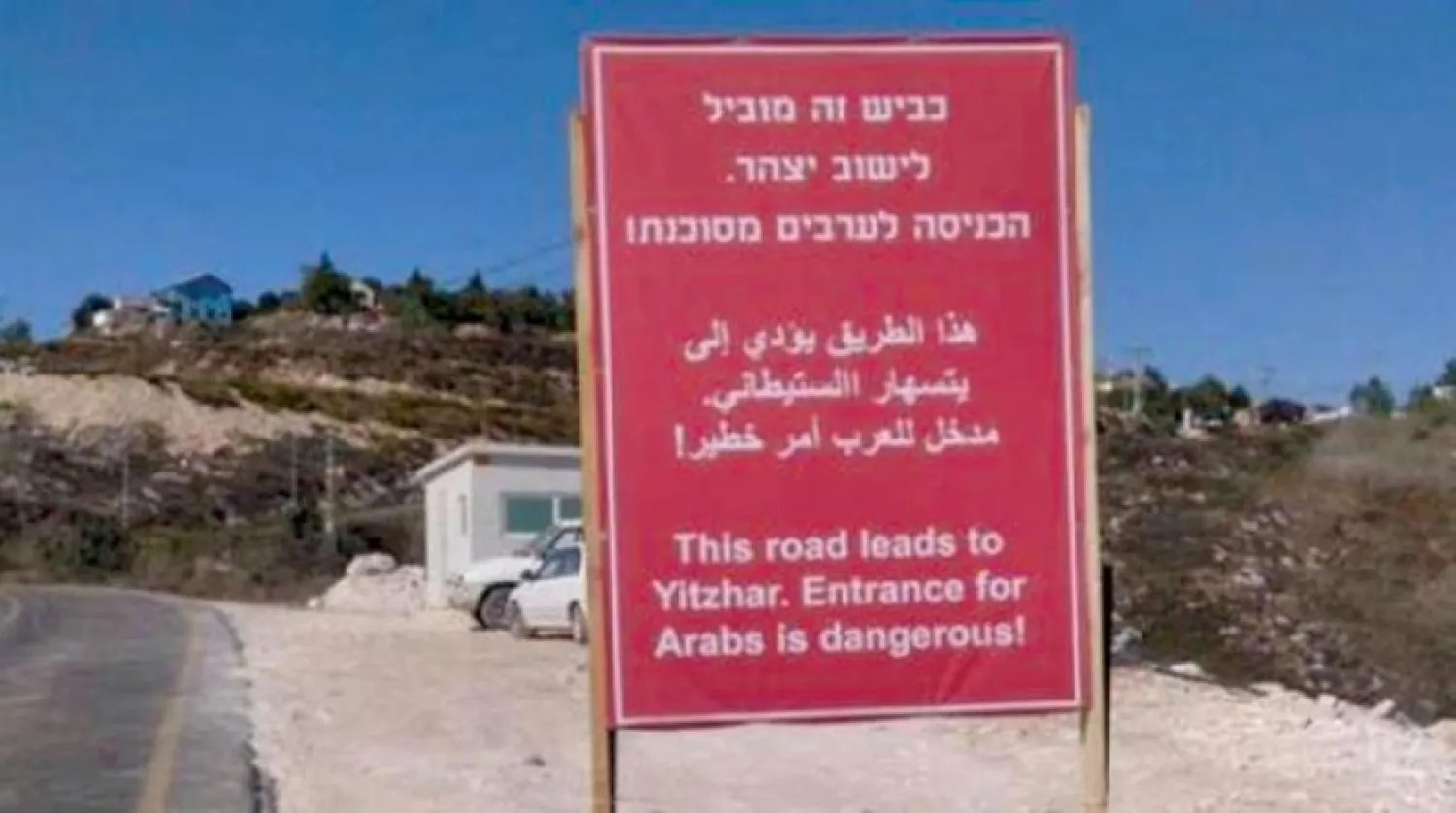
Anti-Arab Sign Sparks Dispute among Israeli Settlers

The anti-Arab racist sign at the entrance to Yitzhar settlement that was removed by Israeli police
TT

Anti-Arab Sign Sparks Dispute among Israeli Settlers

The anti-Arab racist sign at the entrance to Yitzhar settlement that was removed by Israeli police

An anti-Arab sign placed on the road outside the Israeli army-run Yitzhar settlement, near Nablus, has prompted accusations of racism among settlers.

Some settlement leaders launched a campaign against their allies, with a former general urging them to stop taking foolish decisions that would cause great harm to settlers and to the image of the Jewish State in the world.

The sign appeared after a dispute between the settlement and the army when the Ministry of Health sent a medical team for PCR tests. But settlers stopped the team for being headed by an Arab doctor.

An Israeli police official dubbed the racist decision “foolish.”

Human rights groups raised the issue with the area’s military commander, who said the action was illegal.

The sign included a phrase written in three languages, Hebrew, Arabic and English. “This road leads to Yitzhar. Entrance for Arabs in dangerous!” it read.

Police removed it, but the incident was highly criticized even by settlers and right-wing Israelis.

In 1983, the Gush Emunim settlement of Yitzhar was built by newcomers from the United States on top of a mountain located south of Nablus city.

Emerging from this settlement, a group of Israeli settlers affiliated with the “Price Tag” movement launched attacks against neighboring Palestinian villages and towns.

Every time Israeli authorities take action against their illegal practices, they take their revenge from Palestinians, by burning mosques, storming their towns, vandalizing cars and smashing windows.

In 2015, they carried out a deadly arson attack on the Palestinian Dawabsheh family in the village of Duma in the West Bank.

They also incite for killing Arabs by writing racist mottos on walls of Palestinian houses.

Every now and then, settlers throw stones on Palestinian vehicles, injuring passengers. In October 12, 2019, Aisha Rabi, 45, died after settlers threw stones at the car she was traveling in with her family in the West Bank.

In olive harvest seasons, these settlers enjoy burning olive trees or stealing olives from Palestinian lands.

Over the past few years, many Yitzhar settlers had carried out attacks against Israeli police forces, set their vehicles on fire and assaulted Israeli journalists.

On Tuesday, settlers attacked journalist Ohad Hemo by throwing stones at him at an olive grove in the West Bank while he was covering clashes between settler youth and Palestinian farmers in the area.


Yemeni Gov’t Accuses Houthis of Assassinating Senior Development Official

Yemeni Interior Minister Maj. Gen. Ibrahim Haidan (Government media)
TT

Yemeni Gov’t Accuses Houthis of Assassinating Senior Development Official

Yemeni Interior Minister Maj. Gen. Ibrahim Haidan (Government media)

The Yemeni government has accused the Houthi group of assassinating one of the country’s most prominent development officials, in a case that has drawn wide attention because of the victim’s stature and his role in leading an important development program.

The accusation was made during talks between Yemeni Interior Minister Maj. Gen. Ibrahim Haidan and European Union Ambassador to Yemen Patrick Simonnet.

Haidan briefed the ambassador on the latest findings in the investigation into the killing of Wesam Qaid, Acting Executive Director of the Social Fund for Development (SFD), and on the measures taken by security agencies since the incident, according to official media.

The program has worked for decades to support local communities and ease the impact of humanitarian crises.

Haidan said the investigation had led to the arrest of several suspects. He also pointed to evidence that authorities said proved Houthi involvement in planning and carrying out the killing.

The case adds a new dimension to accusations exchanged between the government and the group over the targeting of civilian cadres and workers in humanitarian and development fields.

According to Yemen’s Interior Ministry, the investigation produced what it described as decisive results, prompting authorities to hold the Houthis responsible for the assassination.

Qaid had led an institution that played a central role in carrying out development and service projects across Yemen’s governorates.

Haidan told the EU ambassador that security agencies were continuing to complete the investigation, collect evidence, and pursue those involved. He said the crime could not be separated from the complex security climate Yemen has faced for years.

He also linked the case to the Houthis’ continued detention of a number of United Nations employees and staff from international organizations, saying such practices reflected an escalating pattern of restrictions on humanitarian and development work.

Government circles see the killing as a painful blow to development efforts in Yemen.

The SFD is considered one of the country’s most important institutions, having maintained its work during the years of war and helped provide jobs and improve basic services in the most vulnerable areas.

The assassination case was discussed as part of broader talks on security cooperation between Yemen and the EU. Haidan praised the EU’s support for the Yemeni government and its programs to build the capacity of security agencies.

He said his ministry hoped to expand its partnership with the European Union, particularly in combating illegal migration and cross-border security challenges. He stressed the importance of joint coordination to protect mutual interests and promote stability.

Simonnet, for his part, reiterated EU’s support for Yemen’s Presidential Leadership Council and government. He also confirmed continued cooperation with the Interior Ministry in various security fields to help consolidate security and stability, according to official media.

The support comes as the government seeks to mobilize more international backing to confront worsening security, economic, and humanitarian challenges, amid the continuing conflict and declining international funding for relief and development programs.


Sudanese Groups Agree on Basis for Transition to Democratic Rule

A photo shows political and civil groups who participated in the Addis Ababa meeting and agreed on a new path to end the war
TT

Sudanese Groups Agree on Basis for Transition to Democratic Rule

A photo shows political and civil groups who participated in the Addis Ababa meeting and agreed on a new path to end the war

Sudanese political and civil forces from rival camps have reached a significant breakthrough, agreeing on a common vision to launch a process aimed at ending the war and laying the groundwork for a peaceful transition to democratic civilian rule, following days of talks.

The forces, once grouped under one umbrella before the war split them apart and hardened their positions, issued a joint statement that included the Civil Democratic Alliance for the Forces of the Revolution, known as Somoud, led by former prime minister Abdalla Hamdok, the Democratic Bloc, an ally of the Sudanese army, and the Arab Socialist Baath Party, along with other parties, political forces, public figures, and civil, women’s and youth organizations.

The statement said the parties had agreed on a new political path to achieve comprehensive peace, end the war, and establish the basis for a peaceful solution that preserves Sudan’s unity and sovereignty.

It marks the first such consensus since Sudan’s war erupted in April 2023, bringing together anti-war forces represented by Somoud and the Democratic Bloc, the largest political alliance supporting the Sudanese army.

Early on Friday, the Sudanese forces handed the draft consensus vision to the international quintet mechanism, which includes the African Union, the Arab League, the European Union, the United Nations, and the Intergovernmental Authority on Development, IGAD.

The agreement followed the failure to hold a formal meeting called by the Quintet mechanism, pushing the political and civil forces into intensive side consultations to agree on the foundations of a new political process. The signatories said the consensus reflected a shared political and civil will to end the fighting and pave the way for a comprehensive, peaceful settlement.

The meetings brought together the Democratic Bloc, Somoud, and the Tasis alliance, which is aligned with the Rapid Support Forces (RSF). But the talks themselves were held between the Democratic Bloc and Somoud after members of the Democratic Bloc refused to sit with the Tasis delegation.

The joint statement said any political process must be comprehensive, with priority given to addressing the humanitarian disaster caused by the war, expanding civic space, and creating the conditions needed for a successful national dialogue.

It also stressed accountability for war crimes, criminal justice, and transitional justice to address the social and psychological scars left by the conflict.

Committee to draft the agenda

The parties agreed to form a preparatory committee of no more than 40 members, men and women, representing the different sides of the political process.

The committee would reflect political diversity, geographic balance and social, professional, women’s and youth representation, as well as those affected by the war, including displaced people and refugees.

The committee will identify the participants in the political process according to agreed criteria, draft the dialogue agenda and the principles and foundations of a political solution, oversee measures to prepare the atmosphere, set the dialogue methodology, determine the time and venue, and coordinate with regional and international mediators and guarantors.

The vision sets out three simultaneous tracks for the political process.

On the humanitarian track, the forces called for lifting sieges on cities and camps in Darfur, Kordofan and other affected areas, opening safe corridors for aid delivery and civilian protection, and requiring the warring parties to allow humanitarian organizations to operate without restrictions.

On the security track, the vision called for a humanitarian ceasefire based on the terms of the Jeddah Declaration and monitored by regional, international and UN bodies, in parallel with the launch of the political process, paving the way for a permanent and comprehensive ceasefire.

On the political track, it called for a comprehensive Sudanese dialogue among political and civil forces to address the roots of the national crisis and reach a new social contract that would underpin a democratic civilian transition.

The document also called for confidence-building measures before the process begins, including the release of detainees, prisoners and abductees, mechanisms to search for the missing, the cancellation of arbitrary measures against civil and political forces, guarantees for freedom of political and civil activity, and an end to politically driven war-related trials.

Participants in the Addis Ababa meetings on Wednesday and Thursday stressed that the ousted National Congress Party and its organizational fronts must be excluded from any role in the next political process, a position described as one of the principles that won broad consensus among the participating parties.

They also stressed the exclusion from the political process of the National Congress Party, which was ousted by the 2018 revolution, and its organizational fronts.

It is widely believed that the Democratic Bloc’s participation in the Addis Ababa meeting and the consensus that followed may have been directed by Sudanese army leaders.

The vision’s principles include affirming Sudan’s unity and sovereignty, linking the humanitarian, security, and political tracks as part of an integrated package to end the war, and restoring the path toward a democratic civilian transition.

The quintet mechanism had invited Sudanese forces, including the RSF-linked Tasis, to an exploratory meeting aimed at narrowing differences and opening a new political track to end the country’s continuing conflict.

The meeting also examined the possibility of forming a unified mechanism to support efforts to stop the war and negotiate transitional arrangements, ahead of a comprehensive political dialogue among the Sudanese.

Mubarak Ardol, head of the Democratic Alliance for Social Justice and a prominent Democratic Bloc leader, said the Addis Ababa consultations marked a major step since the war began.

He said participants had reached a common position on the preparatory committee for the political process and on the final statement, while maintaining their rejection of Tasis’ participation in the political process.

The Democratic Bloc includes several armed movements and political forces, most notably the Justice and Equality Movement led by Jibril Ibrahim, the Sudan Liberation Movement led by Minni Arko Minnawi, the Beja Congress, and the Democratic Unionist Party, among others.

Al-Wathiq al-Bireir, Secretary-General of the National Umma Party, said the Addis Ababa meeting aimed to agree on the foundations and mechanisms for preparing a comprehensive Sudanese political process.

He said his party remained committed to rejecting the return of the National Congress Party and the Islamic Movement to the political scene after the war.


UN Mission Condemns Calls for Violence Against its Staff in Libya

Protesters gather outside the headquarters of the United Nations High Commissioner for Refugees (UNHCR), in Tripoli, Libya, June 4, 2026. Picture taken with a mobile phone. REUTERS/Ayman al-Sahili
TT

UN Mission Condemns Calls for Violence Against its Staff in Libya

Protesters gather outside the headquarters of the United Nations High Commissioner for Refugees (UNHCR), in Tripoli, Libya, June 4, 2026. Picture taken with a mobile phone. REUTERS/Ayman al-Sahili

The United Nations Support Mission in Libya denied on Friday that its refugee agency is seeking to resettle irregular migrants in the country, affirming that “allegations to the contrary are categorically false.”

UNSMIL said in a statement it took note of the demonstrations held in front of its premises and those of the Office of the United Nations High Commissioner for Refugees.

“The United Nations affirms the right of all Libyans to obtain accurate information, and their right to express their opinions peacefully in accordance with what is guaranteed by Libyan and international laws,” the mission said.

“UNSMIL is concerned about the spread of misinformation, disinformation and hate speech regarding the work of the UN in Libya, which has contributed to heightened tensions and incitement against UN national and international staff,” it added.

The UN in Libya reiterated that none of its agencies, including UNHCR, implement any resettlement programs to Libya. “Allegations to the contrary are categorically false,” the mission affirmed.

It said the Office works in cooperation with Libyan authorities and the international community, within the framework of full respect for Libya's sovereignty, to find solutions outside Libya for persons fleeing wars, conflicts, and persecution, including evacuations to third countries and voluntary returns to their home countries when circumstances permit.

The Mission condemned “any incitement to violence, threats against UN personnel, and acts of vandalism and/or attacks against United Nations staff, premises, and property.”

It called on all parties to respect the inviolability of UN premises, staff, property, and assets in accordance with international law.

The UN in Libya also expressed its appreciation to the relevant authorities in Tripoli for their efforts in maintaining public order and ensuring the safety and security of the demonstrators, as well as UN staff and facilities.

UNSMIL’s statement came amid heightened debate within Libya over the issue of irregular migration, and growing popular and official demands for tougher measures to address the trend.

On Thursday, angry Libyan demonstrators blocked off the office of the UN refugee agency in the capital Tripoli during a protest against migrants who have travelled to the country in search of work or passage to Europe.

They demanded the UN to shut down its offices in Libya, acting on reports that resettlement cards were being distributed by the UNHCR to refugees and illegal immigrants in Libya.

Later, other Libyan protesters who oppose the resettlement of migrants, stormed the mission’s headquarters in the Janzour area, west of Tripoli before Libyan security forces intervened, dispersed the crowds, and secured UN and local staff inside the compound.

On Friday night, the UN mission in Libya issued a statement affirming that a fruitful dialogue requires all parties to engage in good faith to achieve constructive and sustainable outcomes.

The mission again condemned any incitement to violence, saying, “There is no justification for violence or intimidation, which we know does not align with Libyan culture, traditions, and values.”