


As Virus Flares Globally, New Strategies Target Hot Spots

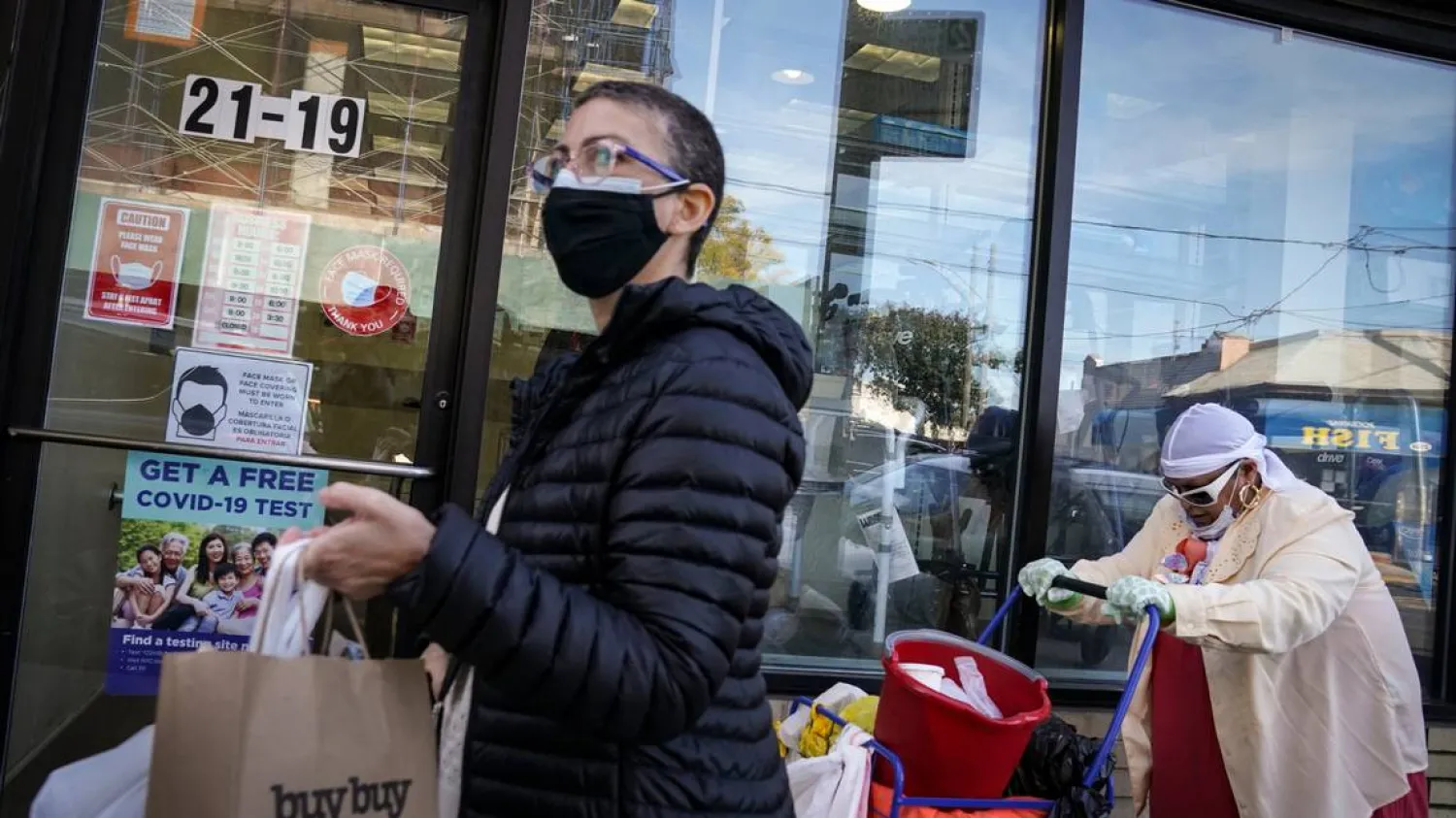
Pedestrians in protective masks pass a storefront on Thursday, Oct. 15, 2020, as restrictions on operations are imposed due to an increase in COVID-19 infections in the Far Rockaway neighborhood of the borough of Queens in New York. (AP Photo/John Minchillo)
TT

As Virus Flares Globally, New Strategies Target Hot Spots

Pedestrians in protective masks pass a storefront on Thursday, Oct. 15, 2020, as restrictions on operations are imposed due to an increase in COVID-19 infections in the Far Rockaway neighborhood of the borough of Queens in New York. (AP Photo/John Minchillo)

After entire nations were shut down during the first surge of the coronavirus earlier this year, some countries and US states are trying more targeted measures as cases rise again around the world, especially in Europe and the Americas.

New York´s new round of virus shutdowns zeroes in on individual neighborhoods, closing schools and businesses in hot spots measuring just a couple of square miles.

Spanish officials limited travel to and from some parts of Madrid before restrictions were widened throughout the capital and some suburbs.

Italian authorities have sometimes quarantined spots as small as a single building.

While countries including Israel and the Czech Republic have reinstated nationwide closures, other governments hope smaller-scale shutdowns can work this time, in conjunction with testing, contact tracing, and other initiatives they've now built up.

The concept of containing hot spots isn't new, but it's being tested under new pressures as authorities try to avoid a dreaded resurgence of illness and deaths, this time with economies weakened from earlier lockdowns, populations chafing at the idea of renewed restrictions, and some communities complaining of unequal treatment.

Some scientists say a localized approach, if well-tailored and explained to the public, can be a nimble response at a complex point in the pandemic.

"It is pragmatic in appreciation of `restriction fatigue´ ... but it is strategic, allowing for mobilization of substantial resources to where they are needed most," says Dr. Wafaa El-Sadr, who is following New York City's efforts closely and is on some city advisory boards.

Other scientists are warier.

"If we´re serious about wiping out COVID in an area, we need coordinated responses across" as wide a swath as possible, says Benjamin Althouse, a research scientist with the Institute for Disease Modeling in Washington state.

In a study that has been posted online but not published in a journal or reviewed by independent experts, Althouse and other scientists found that amid patchwork coronavirus-control measures in the U.S. this spring, some people traveled farther than usual for such activities as worship, suggesting they might have responded to closures by hopscotching to less-restricted areas.

Still, choosing between limited closures and widespread restrictions is "a very, very difficult decision," Althouse notes. "I´m glad I´m not the one making it."

Early in the outbreak, countries tried to quell hot spots from Wuhan, China - where a stringent lockdown was seen as key in squelching transmission in the world's most populous nation - to Italy, where a decision to seal off 10 towns in the northern region of Lombardy evolved within weeks into a nationwide lockdown.

After the virus's first surge, officials fought flare-ups with city-sized closures in recent months in places from Barcelona, Spain, to Melbourne, Australia.

In the English city of Leicester, nonessential shops were shut down and households banned from mixing in late June.

The infection rate fell, dropping from 135 cases per 100,000 to around 25 cases per 100,000 in about two months.

Proponents took that as evidence localized lockdowns work. Skeptics argued that summertime transmission rates were generally low anyway in the United Kingdom, where the official coronavirus death toll of over 43,000 stands as Europe´s highest, according to figures compiled by Johns Hopkins University.

With infection levels and deaths rising anew in Britain, scientists have advised officials to implement a national, two-week lockdown. Instead, the government on Monday carved England into three tiers of coronavirus risk, with restrictions ranging accordingly.

"As a general principle, the targeting of measures to specific groups or geographical areas is preferable to one-size-fits-all measures, because they allow us to minimize the damage that social distancing inevitably imposes on society and the economy," said Flavio Toxvaerd, who specializes in economic epidemiology at the University of Cambridge.

The damage doesn't feel so minimal to Steven Goldstein, who had to close his New York City men's hat shop last week.

The 72-year-old business, Bencraft Hatters, is in one of a handful of small areas around the state with new restrictions. Authorities hope they'll avert a wider crisis in a state that beat back the deadliest spike in the U.S. this spring, losing over 33,000 people to date.

Goldstein takes the virus seriously - he said he and his mother both had it early on - and he sees the economic rationale behind trying local restrictions instead of another citywide or statewide shutdown.

But he questions whether the zones are capturing all the trouble spots, and he's rankled that the restrictions are falling on his shop after, he says, he faithfully enforced mask-wearing and other rules.

"I did my part, and a lot of other people did our part, and yet we´re being forced to close," said Goldstein, 53, who tapped into savings to sustain the third-generation business through the earlier shutdown.

In New York's most restricted "red zones," houses of worship can't admit more than 10 people at a time and schools and nonessential businesses have been closed. Those zones are ensconced in small orange and yellow zones with lighter restrictions.

Some researchers, however, say officials need to consider not just where people live, but where else they go. In New York City, people can escape restrictions entirely by taking the subway one or two stops.

"There´s room for improvement by taking into account some spillovers across neighborhoods," says John Birge, a University of Chicago Booth School of Business operations research professor. He, colleague Ozan Candogan and Northwestern University graduate student Yiding Feng have been modeling how localized restrictions in New York City could best minimize both infections and economic harm; the research hasn't yet been reviewed by other experts.

If hot spot measures can be strategic, they also have been criticized as unfairly selective.

In Brooklyn, Orthodox Jews have complained their communities are being singled out for criticism. In Madrid, residents of working-class areas under mobility restrictions said authorities were stigmatizing the poor. Restaurant and bar owners in Marseille, France, said the city was unfairly targeted last month for the nation's toughest virus rules at the time. As of Saturday, several French cities, including Paris and Marseille, were subject to restrictions including a 9 p.m. curfew.

When an apartment complex housing mostly Bulgarian migrant farm workers was locked down in late June in the Italian city of Mondragone, the workers protested, and about a dozen broke the quarantine.

Other denizens of Mondragone feared infection would spread and, at one point, surrounded the buildings and jeered at the residents, one of whom tossed down a chair. Eventually, authorities called in the army to maintain the quarantine and keep the peace.

For hot spot shutdowns to work, public health experts say, the message behind the measures is key.

"Lead with: `Here´s a community in need. ... We should be empathetic,´" said Rutgers University epidemiology and biostatistics professor Henry F. Raymond. "It´s not a criticism of those people´s behaviors. It´s just saying, ´These communities might need more attention.'"



US Judge Blocks Deportation of Columbia University Palestinian Activist

Mohsen Mahdawi at a press conference in Vermont last year - Photo by Alex Driehaus/AP
TT

US Judge Blocks Deportation of Columbia University Palestinian Activist

Mohsen Mahdawi at a press conference in Vermont last year - Photo by Alex Driehaus/AP

A US immigration judge has blocked the deportation of a Palestinian graduate student who helped organize protests at Columbia University against Israel's war in Gaza, according to US media reports.

Mohsen Mahdawi was arrested by immigration agents last year as he was attending an interview to become a US citizen.

Mahdawi had been involved in a wave of demonstrations that gripped several major US university campuses since Israel began a massive military campaign in the Gaza Strip.

A Palestinian born in the occupied West Bank, Mahdawi has been a legal US permanent resident since 2015 and graduated from the prestigious New York university in May. He has been free from federal custody since April.

In an order made public on Tuesday, Judge Nina Froes said that President Donald Trump's administration did not provide sufficient evidence that Mahdawi could be legally removed from the United States, multiple media outlets reported.

Froes reportedly questioned the authenticity of a copy of a document purportedly signed by Secretary of State Marco Rubio that said Mahdawi's activism "could undermine the Middle East peace process by reinforcing antisemitic sentiment," according to the New York Times.

Rubio has argued that federal law grants him the authority to summarily revoke visas and deport migrants who pose threats to US foreign policy.

The Trump administration can still appeal the decision, which marked a setback in the Republican president's efforts to crack down on pro-Palestinian campus activists.

The administration has also attempted to deport Mahmoud Khalil, another student activist who co-founded a Palestinian student group at Columbia, alongside Mahdawi.

"I am grateful to the court for honoring the rule of law and holding the line against the government's attempts to trample on due process," Mahdawi said in a statement released by his attorneys and published Tuesday by several media outlets.

"This decision is an important step towards upholding what fear tried to destroy: the right to speak for peace and justice."


Fire Breaks out Near Iran's Capital Tehran, State Media Says

Smoke rises from a fire caused by an explosion in Tehran (File photo - Reuters)
TT

Fire Breaks out Near Iran's Capital Tehran, State Media Says

Smoke rises from a fire caused by an explosion in Tehran (File photo - Reuters)

A fire broke out in Iran's Parand near the capital city Tehran, state media reported on Wednesday, publishing videos of smoke rising over the area which is close to several military and strategic sites in the country's Tehran province, Reuters reported.

"The black smoke seen near the city of Parand is the result of a fire in the reeds around the Parand river bank... fire fighters are on site and the fire extinguishing operation is underway", state media cited the Parand fire department as saying.


Pakistan PM Sharif to Seek Clarity on Troops for Gaza in US Visit

US President Donald Trump looks at Pakistan's Prime Minister Shehbaz Sharif speaking following the official signing of the first phase of the Gaza ceasefire agreement between Israel and Hamas, during a world leaders' summit on ending the Gaza war, in Sharm El-Sheikh, Egypt, October 13, 2025. REUTERS/Evelyn Hockstein/File Photo
TT

Pakistan PM Sharif to Seek Clarity on Troops for Gaza in US Visit

US President Donald Trump looks at Pakistan's Prime Minister Shehbaz Sharif speaking following the official signing of the first phase of the Gaza ceasefire agreement between Israel and Hamas, during a world leaders' summit on ending the Gaza war, in Sharm El-Sheikh, Egypt, October 13, 2025. REUTERS/Evelyn Hockstein/File Photo

Before Pakistan commits to sending troops to Gaza as part of the International Stabilization Force it wants assurances from the United States that it will be a peacekeeping mission rather than tasked with disarming Hamas, three sources told Reuters.

Pakistan's Prime Minister Shehbaz Sharif is set to attend the first formal meeting of President Donald Trump's Board of Peace in Washington on Thursday, alongside delegations from at least 20 countries.

Trump, who will chair the meeting, is expected to announce a multi-billion dollar reconstruction plan for Gaza and detail plans for a UN-authorized stabilization force for the Palestinian enclave.

Three government sources said during the Washington visit Sharif wanted to better understand the goal of the ISF, what authority they were operating under and what the chain of command was before making a decision on deploying troops.

"We are ready to send troops. Let me make it clear that our troops could only be part of a peace mission in Gaza," said one of the sources, a close aide of Sharif.

"We will not be part of any other role, such as disarming Hamas. It is out of the question," he said.

Analysts say Pakistan would be an asset to the multinational force, with its experienced military that has gone to war with arch-rival India and tackled insurgencies.

"We can send initially a couple of thousand troops anytime, but we need to know what role they are going to play," the source added.

Two of the sources said it was likely Sharif, who has met Trump earlier this year in Davos and late last year at the White House, would either have an audience with him on the sidelines of the meeting or the following day at the White House.

Initially designed to cement Gaza's ceasefire, Trump sees the Board of Peace, launched in late January, taking a wider role in resolving global conflicts. Some countries have reacted cautiously, fearing it could become a rival to the United Nations.

While Pakistan has supported the establishment of the board, it has voiced concerns against the mission to demilitarize Gaza's militant group Hamas.