


UAE, US, Israel Announce Establishment of Abraham Fund

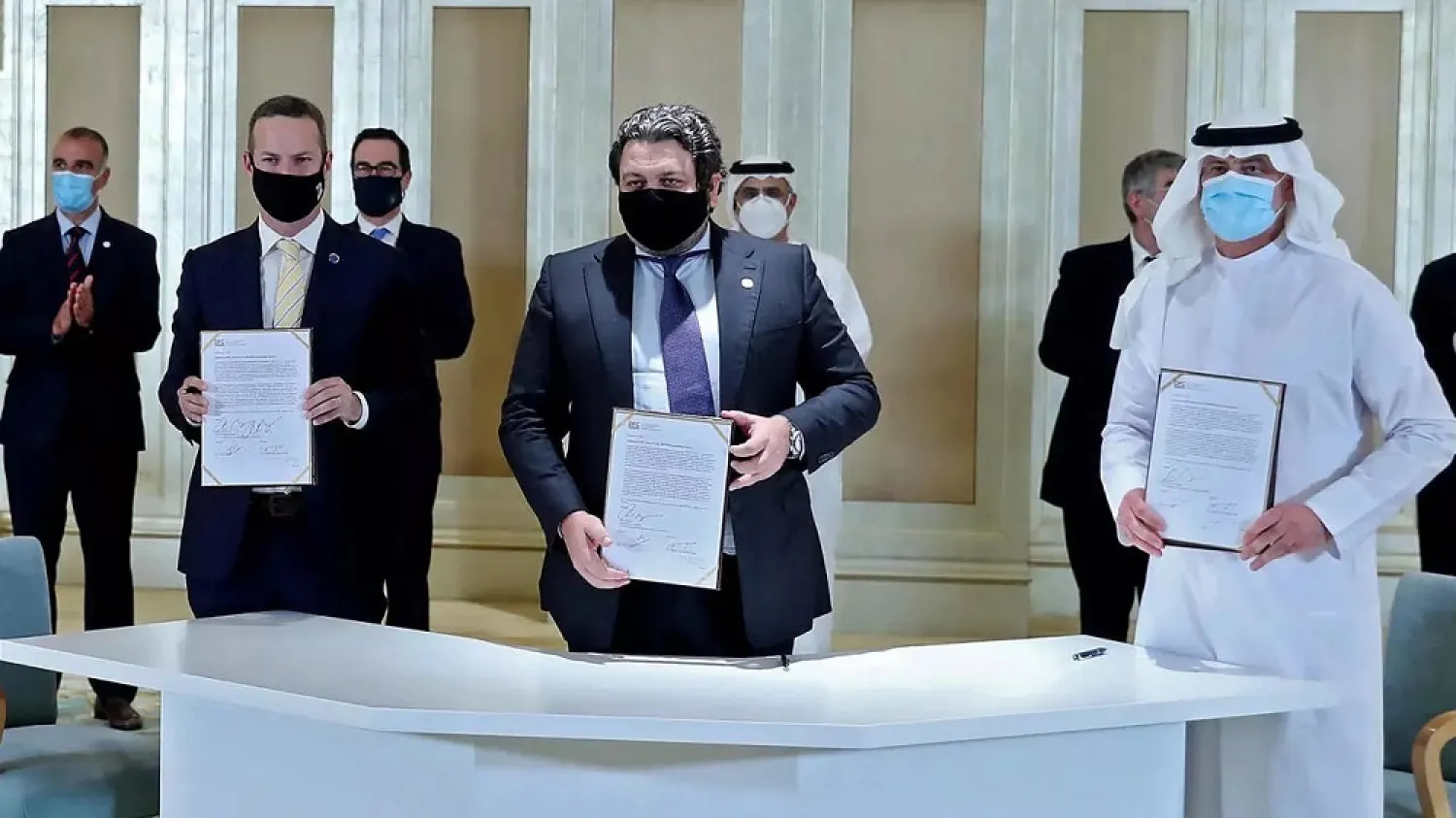
Emirati and Israeli delegates sign an agreement at the first Abraham Accords Business Summit in Abu Dhabi in the presence of US Treasury Secretary Steven Mnuchin on October 19. (WAM)
TT

UAE, US, Israel Announce Establishment of Abraham Fund

Emirati and Israeli delegates sign an agreement at the first Abraham Accords Business Summit in Abu Dhabi in the presence of US Treasury Secretary Steven Mnuchin on October 19. (WAM)

The United Arab Emirates, United States and Israel announced on Tuesday the establishment of the Abraham Fund, which fulfils a commitment made in the Abraham Accords.

Through this fund, the UAE, the US International Development Finance Corporation and Israel will mobilize more than $3 billion in private sector-led investment and development initiatives to promote regional economic cooperation and prosperity in the Middle East and beyond. The partners welcome participation from other countries to advance these objectives, read a statement carried by the UAE state agency (WAM).

This initiative is an integral part of the historic peace accord signed by the UAE and Israel with the United States’ support, and demonstrates the benefits of peace by improving the lives of the region’s peoples. It is a manifestation of the new spirit of friendship and cooperation between the three countries, as well their common will to advance the region.

The countries will trilaterally open a development office based in Israel to identify and initiate strategic projects with a high developmental impact, including those that catalyze economic growth, improve standards of living, and create high-value, quality jobs.

The fund will enable its members to launch people-focused investments, providing opportunity and hope for the region and its youth by enabling them to build a future that serves them and their communities. The UAE, US and Israel believe that this initiative will create the foundation for stronger regional cooperation based on diversity, exchange and shared humanity.

The Abraham Fund will bolster regional trade, enable strategic infrastructure projects, and increase energy security through the provision of reliable and affordable access to electricity. The fund also aims to improve agricultural productivity and facilitate reliable and efficient access to clean water in the region.

Ahmed Ali Al Sayegh, UAE Minister of State, stated that the fund "reflects the desire of the three countries to put the wellbeing of people first, regardless of their creed or identity." He added that the UAE "is confident the initiative can be a source of economic and technological strength for the region, while simultaneously improving the lives of those who need the most support."

"The Abraham Fund will tackle challenges facing the region and increase economic opportunity for everyone," said Adam Boehler, CEO of the US International Development Finance Corporation. "We are excited to take this historic partnership to the next level to promote shared prosperity."

"The Abraham Fund we are launching today will be an essential tool in the realization of the vision of our leaders to enhance regional cooperation," said Ronen Peretz, Director-General of the Israeli Prime Minister's Office. "It will support the ingenuity of our entrepreneurs, it will produce the necessary menu of financial tools and it will provide the facilitation of our governments. The combination of business, finance, and government is essential in the creation of projects on the ground."



Saudi Inflation Slows to Nine-Month Low in November

 People enjoy sitting outdoors as the summer heat eases in Riyadh (AFP). 
 People enjoy sitting outdoors as the summer heat eases in Riyadh (AFP). 
TT

Saudi Inflation Slows to Nine-Month Low in November

 People enjoy sitting outdoors as the summer heat eases in Riyadh (AFP). 
 People enjoy sitting outdoors as the summer heat eases in Riyadh (AFP). 

Saudi Arabia’s annual inflation rate slowed to 1.9 percent in November 2025, its lowest level in nine months, down from 2.2 percent in October, driven by easing housing costs and lower prices for food and beverages.

On a monthly basis, inflation remained broadly stable, edging up 0.1 percent compared with October.

According to data released on Monday by the Saudi General Authority for Statistics (GASTAT), the housing, water, electricity, gas and other fuels category rose 4.3 percent year on year in November, down from 4.5 percent in October. Within that category, actual housing rents increased 5.4 percent, slowing from 5.7 percent a month earlier.

Prices in the food and beverages category rose 1.3 percent, reflecting a 1.6 percent increase in the prices of fresh, chilled and frozen meat. The transport category climbed 1.5 percent, driven by a 6.4 percent rise in passenger transport services.

The personal care, social protection and miscellaneous goods and services category recorded the largest annual increase, up 6.6 percent, supported by a 19.9 percent surge in prices of other personal products, influenced by a 21.6 percent rise in jewelry and watch prices.

Prices for insurance and financial services increased 5.1 percent, led by an 8.4 percent rise in insurance costs. The recreation, sports and culture category rose 1.3 percent, reflecting a 2.1 percent increase in holiday package prices.

In contrast, prices for furniture, household equipment and routine household maintenance declined 0.3 percent. The restaurants and accommodation services category also fell 0.5 percent, as accommodation service prices decreased 2.3 percent.

GASTAT noted that the Consumer Price Index (CPI) measures changes in prices paid by consumers for a fixed basket of 582 items, while the Wholesale Price Index (WPI) tracks price movements of goods at the pre-retail stage for a fixed basket of 343 items.


Northern Saudi Arabia Offers 240 Investment Opportunities Worth $10.6 Billion

Prince Faisal bin Khalid bin Sultan bin Abdulaziz during the inauguration of the Northern Borders Investment Forum, alongside the Minister of Investment (Asharq Al-Awsat). 
TT

Northern Saudi Arabia Offers 240 Investment Opportunities Worth $10.6 Billion

Prince Faisal bin Khalid bin Sultan bin Abdulaziz during the inauguration of the Northern Borders Investment Forum, alongside the Minister of Investment (Asharq Al-Awsat). 

The Northern Borders Investment Forum 2025 has unveiled more than 240 investment opportunities in northern Saudi Arabia, with a total value estimated at SAR 40 billion ($10.6 billion), spanning key sectors including livestock and food production, mining and energy, tourism and environment, and logistics.

Prince Faisal bin Khalid bin Sultan bin Abdulaziz, Governor of the Northern Borders Region, inaugurated the forum on Monday, at the Ministry of Interior Employees Club in the city of Arar. The event was attended by ministers, senior officials, experts and advisers, as well as company chairmen, chief executives and business leaders.

Prince Faisal said the forum reflects the government’s commitment to development and investment promotion, noting that the region possesses strong fundamentals, including natural resources, a strategic logistics location and advanced infrastructure. These advantages, he noted, position the Northern Borders as an attractive destination for high-quality investments aligned with Vision 2030.

He added that the forum provides an institutional platform to discuss sector-specific opportunities, showcase investment enablers, including incentives, financing and regulatory frameworks, and translate outcomes into practical programs and executive initiatives in coordination with national ministries and agencies.

For his part, Saudi Minister of Investment Khalid Al-Falih said the forum serves as a strategic platform to strengthen investment in the Northern Borders Region, support business growth and advance sustainable development goals under Vision 2030.

Also speaking at the event, Qutaiba Badawi, head of Syria’s General Authority for Border Crossings and Customs, highlighted the forum’s role in fostering professional dialogue and development cooperation, noting Saudi Arabia’s continued progress in improving its business environment and investment competitiveness.

The forum’s main panel discussion, titled “Northern Borders: A Global Investment Destination — Energy as a Driver of Growth and Sustainable Development,” brought together senior officials from the environment, energy, commerce, education and investment sectors, who underscored the region’s promising economic potential and partnership opportunities.


Saudi Logistics and Supply Chain Investments Reach $74.6 Billion  

Saudi Minister of Transport and Logistics Services Saleh Al-Jasser speaks at Monday's conference. (Asharq Al-Awsat)
TT

Saudi Logistics and Supply Chain Investments Reach $74.6 Billion  

Saudi Minister of Transport and Logistics Services Saleh Al-Jasser speaks at Monday's conference. (Asharq Al-Awsat)

Investments in Saudi Arabia’s supply chain and logistics sector have reached approximately SAR 280 billion ($74.6 billion) since the launch of the National Transport and Logistics Strategy, Saudi Minister of Transport and Logistics Services Saleh Al-Jasser said on Monday.

Speaking at the opening of the seventh Supply Chain and Logistics Conference in Riyadh, Al-Jasser said the strategy, launched by Prince Mohammed bin Salman, Crown Prince and Prime Minister, has raised the contribution of transport and storage activities to 6.2 percent of gross domestic product. He added that air cargo volumes rose 34 percent year on year to 1.2 million tons.

The conference attracted strong participation from policymakers, sector leaders and international stakeholders.

Al-Jasser said Saudi Arabia has entered a new phase in its ambition to rank among the world’s top 10 countries on the World Bank’s Logistics Performance Index, after jumping 17 places to 38th out of 160 countries.

The minister noted that the number of logistics hubs across the Kingdom has increased by about 30 centers, supporting economic diversification and strengthening Saudi Arabia’s role in global supply chains. He attributed the sector’s progress to leadership support and the goals of Vision 2030.

Saudi Arabia also ranked among the top four emerging markets out of 50 countries in the Agility Logistics Index 2025. Employment in the logistics ecosystem has grown to 651,000 workers, he underlined.

Al-Jasser described the Kingdom as a key pillar in safeguarding global supply chains and a central hub for Arab logistics integration amid ongoing global challenges.

The conference brings together 150 exhibitors and 14,000 participants, highlighting the sector’s importance to trade, tourism, industry and quality of life.

Al-Jasser revealed that Saudi Arabia’s aviation sector is undergoing unprecedented expansion, including airport development, fleet growth and supply chain integration, positioning the Kingdom as a reliable global logistics partner.

The Kingdom has also become a host for major international logistics events. Last year, it staged the inaugural Global Logistics Forum, and next year it will host the second UNCTAD Global Supply Chain Forum, in cooperation with the United Nations and the Saudi Ports Authority.

At the conference, Sulaiman bin Mohammed Al Rubaian, senior vice president of Aramco Procurement and Supply Chain Management at Saudi Aramco, said the company’s Iktva (In-Kingdom Total Value Add) program has contributed about SAR 900 billion ($240 billion) to Saudi GDP over the past decade.

He said the program created more than 200,000 direct and indirect jobs, established 350 local manufacturing facilities, and enabled the local production of 47 products manufactured in the Kingdom for the first time.

Al-Jasser also inaugurated the exhibition accompanying the conference, where leading local and international companies showcased logistics technologies and services.

Over two days, the event will witness the signing of 93 agreements and memoranda of understanding worth SAR 19.05 billion ($5.2 billion), supporting the development of new logistics projects across the Kingdom.