


Japan PM Suga Sets 2050 Deadline for Carbon Neutrality

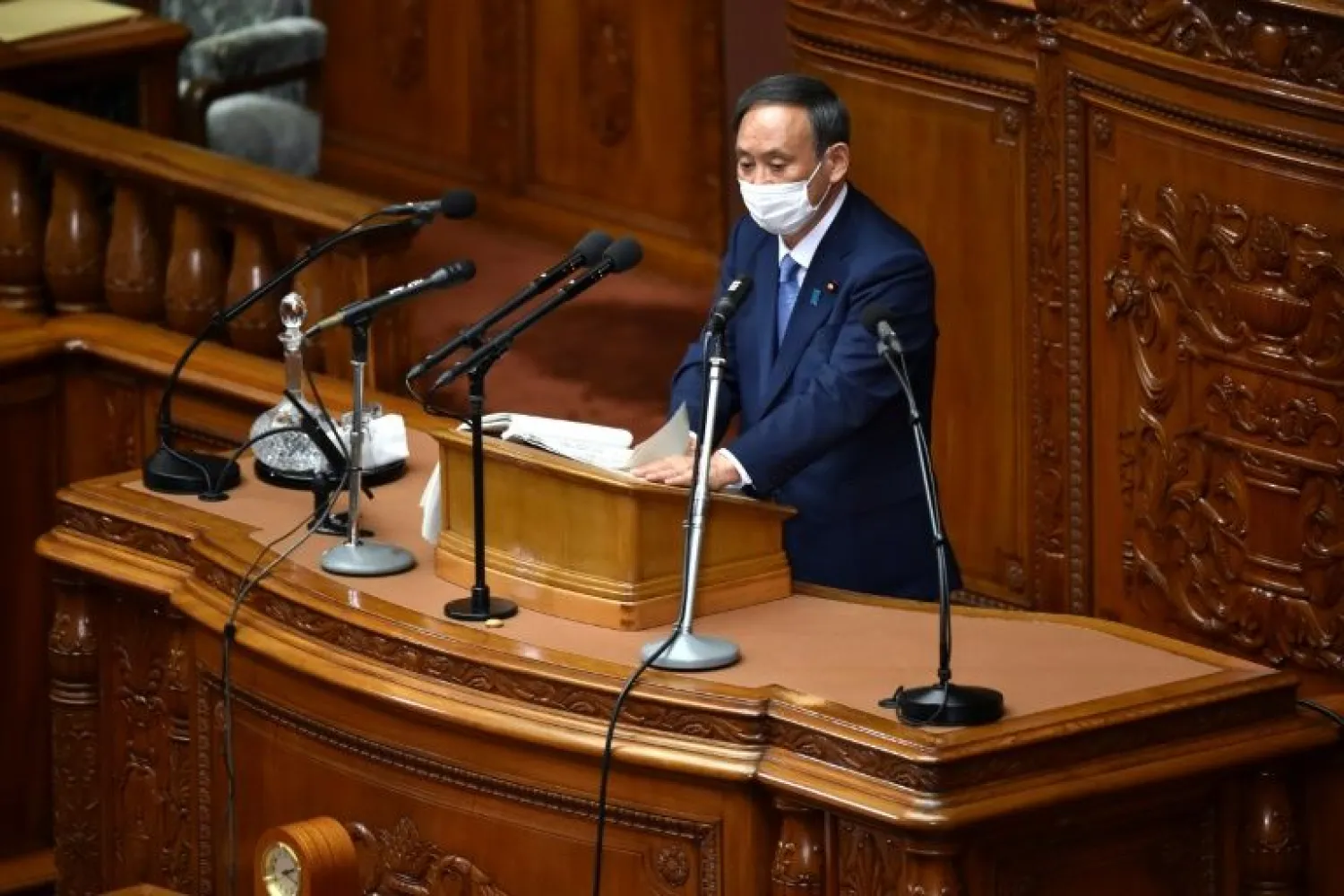
Japan's Prime Minister Yoshihide Suga has set a 2050 deadline for the world's third-largest economy to become carbon neutral | Photo: AFP
TT

Japan PM Suga Sets 2050 Deadline for Carbon Neutrality

Japan's Prime Minister Yoshihide Suga has set a 2050 deadline for the world's third-largest economy to become carbon neutral | Photo: AFP

Japan's Prime Minister Yoshihide Suga on Monday set a 2050 deadline for the world's third-largest economy to become carbon neutral, significantly firming up the country's climate change commitments.

"We will bring the total amount of greenhouse gas (emitted by Japan) to net zero by 2050, meaning carbon neutral," Suga said in his first policy address to parliament since taking office.

"I declare we will aim to realize a decarbonized society," he added, to applause from Diet members.

Tokyo had previously only aimed to achieve carbon neutrality some time in the latter half of the century, a goal criticized by climate activists as vague and unambitious.

The new goal puts Japan on the same timeline as Europe, Britain, and a host of smaller nations, and a decade ahead of China, which last month set a 2060 goal.

Suga did not give precise details on how Japan, a country still heavily reliant on coal, will achieve the goal but said technology would be essential.

"The key is innovation," Suga said, citing examples including next-generation solar batteries.

He said Japan would also push the use of renewable energy and nuclear power, stressing that safety would be a priority -- a key point in a country that suffered the Fukushima nuclear disaster.

Japan, which is a signatory to the Paris agreement, was the sixth-biggest contributor to global greenhouse emissions in 2017, according to the International Energy Agency.

It has struggled to cut carbon emissions after shutting down nuclear reactors following the 2011 meltdown in Fukushima sparked by a devastating earthquake and tsunami.

Reliance on fossil fuels like coal increased after the Fukushima disaster, as public anger over the accident pushed all of the country's nuclear reactors offline temporarily.

- 'The time is right' -

Japan has regularly come under fire for continuing to build coal-fired plants at home, as well as financing projects to build them abroad, notably in Southeast Asia.

The country's 140 coal-fired power plants provide nearly a third of its total electricity generation.

The fuel is the second-biggest power-generation method behind LNG-fired plants, which provide 38 percent of the nation's needs.

The new deadline is expected to shape the country's basic energy plan, which is currently being revised.

The most recent plan, issued in 2018, aimed to have 22-24 percent of the country's energy needs met by renewable sources including wind and solar by 2030, a figure critics called unambitious based on current levels of around 17 percent.

That plan also called for nuclear to provide more than 20 percent of the country's energy needs by 2030.

In September, the world's largest greenhouse gas polluter China announced it would be carbon neutral by 2060, a goal hailed by climate activists as a major step forward.




Top Trump Iran Negotiator Says Visits US Aircraft Carrier in Middle East

US Special Envoy Steve Witkoff delivers a press conference upon the signing of the declaration on deploying post-ceasefire force in Ukraine, during the so-called "Coalition of the Willing" summit, at the Elysee Palace in Paris, France, January 6, 2026. (Reuters)
TT

Top Trump Iran Negotiator Says Visits US Aircraft Carrier in Middle East

US Special Envoy Steve Witkoff delivers a press conference upon the signing of the declaration on deploying post-ceasefire force in Ukraine, during the so-called "Coalition of the Willing" summit, at the Elysee Palace in Paris, France, January 6, 2026. (Reuters)

US President Donald Trump's lead Iran negotiator Steve Witkoff on Saturday said he visited the USS Abraham Lincoln aircraft carrier currently in the Arabian Sea, with Washington and Tehran due to hold further talks soon.

"Today, Adm. Brad Cooper, Commander of US Naval Forces Central Command, Jared Kushner, and I met with the brave sailors and Marines aboard the USS Abraham Lincoln, her strike group, and Carrier Air Wing 9 who are keeping us safe and upholding President Trump's message of peace through strength," said Witkoff in a social media post.

Iranian Foreign Minister Abbas Araghchi said on Saturday he hoped talks with the United States would resume soon, while reiterating Tehran's red lines and warning against any American attack.


Israel’s Netanyahu Expected to Meet Trump in US on Wednesday and Discuss Iran

Israeli Prime Minister Benjamin Netanyahu delivers a speech during a special session to mark the 77th anniversary of the Knesset's establishment and the 60th anniversary of the dedication of the current building at the Knesset, the Israeli parliament, in Jerusalem, 02 February 2026. (EPA)
TT

Israel’s Netanyahu Expected to Meet Trump in US on Wednesday and Discuss Iran

Israeli Prime Minister Benjamin Netanyahu delivers a speech during a special session to mark the 77th anniversary of the Knesset's establishment and the 60th anniversary of the dedication of the current building at the Knesset, the Israeli parliament, in Jerusalem, 02 February 2026. (EPA)

Israeli Prime Minister Benjamin Netanyahu is expected to meet US President Donald Trump on Wednesday in Washington, where they will discuss negotiations with Iran, Netanyahu's office said on Saturday.

Iranian and US officials held indirect nuclear ‌talks in the ‌Omani capital ‌Muscat ⁠on Friday. ‌Both sides said more talks were expected to be held again soon.

A regional diplomat briefed by Tehran on the talks told Reuters Iran insisted ⁠on its "right to enrich uranium" ‌during the negotiations with ‍the US, ‍and that Tehran's missile capabilities ‍were not raised in the discussions.

Iranian officials have ruled out putting Iran's missiles - one of the largest such arsenals in the region - up ⁠for discussion, and have said Tehran wants recognition of its right to enrich uranium.

"The Prime Minister believes that any negotiations must include limiting ballistic missiles and halting support for the Iranian axis," Netanyahu's office said in a ‌statement.


Italy FM Rules Out Joining Trump’s ‘Board of Peace’

Italy's Minister for Foreign Affairs Antonio Tajani speaks to the press during the EPP Leaders’ meeting, in Zagreb, Croatia, 30 January 2026. (EPA)
TT

Italy FM Rules Out Joining Trump’s ‘Board of Peace’

Italy's Minister for Foreign Affairs Antonio Tajani speaks to the press during the EPP Leaders’ meeting, in Zagreb, Croatia, 30 January 2026. (EPA)

Italy will not take part in US President Donald Trump's "Board of Peace", Italian Foreign Minister Antonio Tajani said Saturday, citing "insurmountable" constitutional issues.

Trump launched his "Board of Peace" at the World Economic Forum in Davos in January and some 19 countries have signed its founding charter.

But Italy's constitution bars the country from joining an organization led by a single foreign leader.

Prime Minister Giorgia Meloni, a Trump ally, last month noted "constitutional problems" with joining, but suggested Trump could perhaps reopen the framework "to meet the needs not only of Italy, but also of other European countries".

Tajani appeared Saturday to rule that out.

"We cannot participate in the Board of Peace because there is a constitutional limit," he told the ANSA news agency.

"This is insurmountable from a legal standpoint," he said, the day after meeting US Secretary of State Marco Rubio and US Vice President JD Vance at the Olympics in Milan.

Although originally meant to oversee Gaza's rebuilding, the board's charter does not limit its role to the Palestinian territory and appears to want to rival the United Nations.