

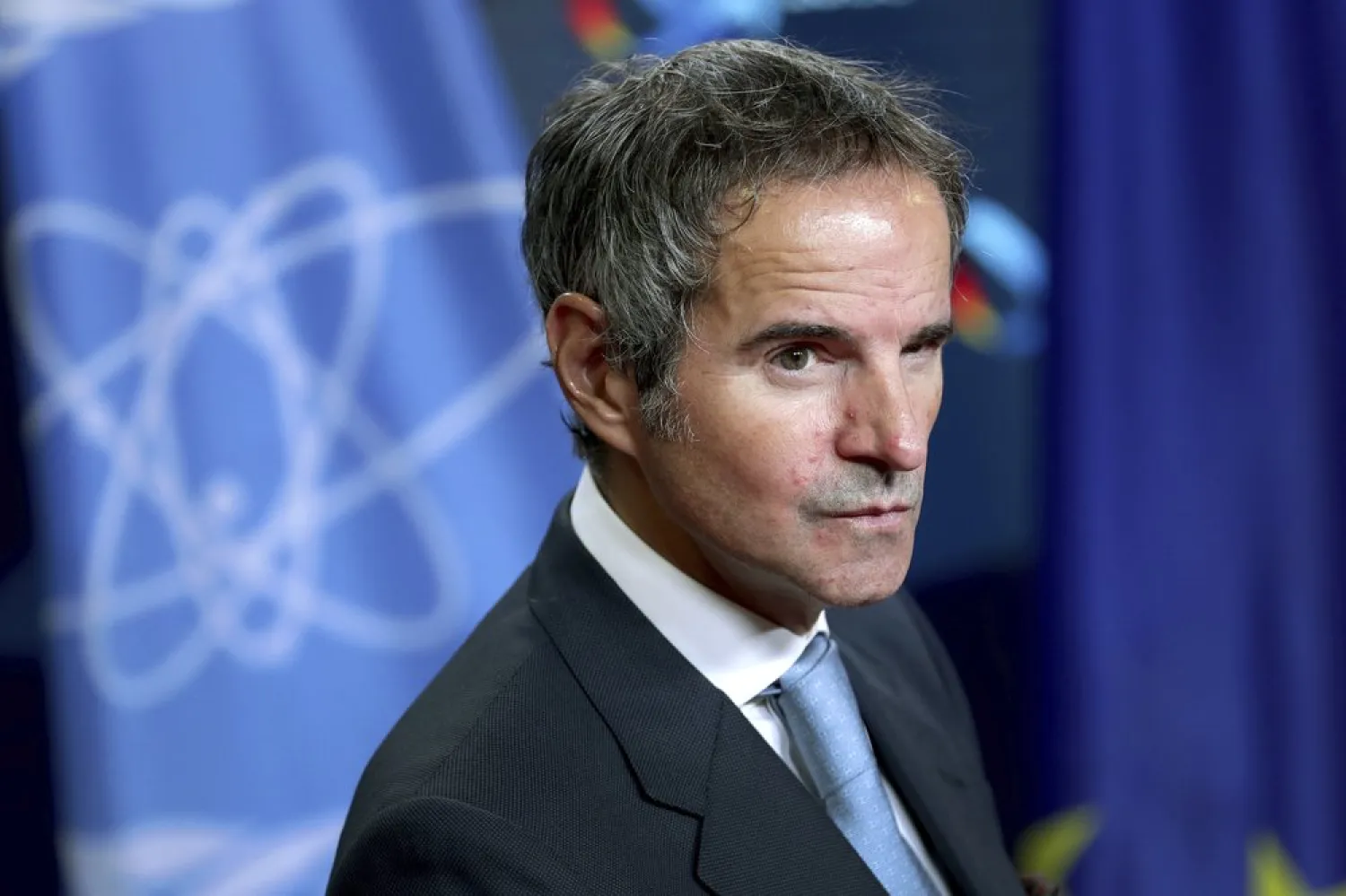

UN Watchdog: Iran Building at Underground Nuclear Facility

IAEA Director General Rafael Mariano Grossi attends a joint press conference as part of a meeting with German Foreign Minister Heiko Maas in Berlin, Germany, Oct. 26, 2020. (AP)
TT

UN Watchdog: Iran Building at Underground Nuclear Facility

IAEA Director General Rafael Mariano Grossi attends a joint press conference as part of a meeting with German Foreign Minister Heiko Maas in Berlin, Germany, Oct. 26, 2020. (AP)

Inspectors from the UN's atomic watchdog have confirmed Iran has started building an underground centrifuge assembly plant after its previous one exploded in what Tehran called a sabotage attack over the summer, the agency's head told The Associated Press on Tuesday.

Iran also continues to stockpile greater amounts of low-enriched uranium, but does not appear to possess enough to produce a weapon, Rafael Grossi, director-general of the International Atomic Energy Agency, told the AP in an interview in Berlin.

Following the July explosion at the Natanz nuclear site, Tehran said it would build a new, more secure, structure in the mountains around the area. Satellite pictures of Natanz analyzed by experts have yet to show any obvious signs of construction at the site in Iran's central Isfahan province.

“They have started, but it’s not completed,” Grossi said. “It’s a long process.”

He would not give further details, saying it’s “confidential information.” Iran's mission to the United Nations did not immediately respond to a request for comment.

Ali Akbar Salehi, the head of Iran's nuclear department, last month told state television the destroyed above-ground facility was being replaced with one “in the heart of the mountains around Natanz.”

Natanz hosts the country’s main uranium enrichment facility. In its long underground halls, centrifuges rapidly spin uranium hexafluoride gas to enrich uranium.

Natanz became a flashpoint for Western fears about Iran’s nuclear program in 2002, when satellite photos showed Iran building an underground facility at the site, some 200 kilometers (125 miles) south of the capital, Tehran.

In 2003, the IAEA visited Natanz, which Iran said would house centrifuges for its nuclear program, buried under some 7.6 meters (25 feet) of concrete. That offers protection from potential airstrikes on the site, which also is guarded by anti-aircraft positions.

Natanz had been targeted by the Stuxnet computer virus previously, which was believed to be a creation of the US and Israel. Iran has yet to say who it suspects of carrying out the sabotage in the July incident. Suspicion has fallen on Israel as well, despite a claim of responsibility by a previously unheard-of group at the time.

Under the provisions of the landmark 2015 nuclear deal with world powers known as the Joint Comprehensive Plan of Action, Iran is allowed to produce a certain amount of enriched uranium for non-military purposes.

In return, Iran was offered economic incentives by the countries involved.

Since President Donald Trump pulled the US unilaterally out of the deal in 2018 and re-imposed sanctions, however, the other signatories — Germany, France, Britain, Russia and China — have been struggling to keep the deal alive.

Meanwhile, Iran has been steadily exceeding the deal's limits on how much uranium it can stockpile, the purity to which it can enrich uranium and other restrictions to pressure those countries to come up with a plan to offset US sanctions.

Still though, Iran has continued to allow IAEA inspectors full access to its nuclear facilities, including Natanz, Grossi said.

In the latest IAEA quarterly report, the agency reported Iran as of Aug. 25 had stockpiled 2,105.4 kilograms (4,641.6 pounds) of low-enriched uranium, well above the 202.8 kilograms (447.1 pounds) allowed under the JCPOA. It was also enriching uranium to a purity of 4.5%, higher than the 3.67% allowed under the deal.

In the next report, due in coming weeks, Grossi said: “We continue to see the same trend that we have seen so far.”

According to a widely cited analysis by the Washington-based Arms Control Association, Iran would need roughly 1,050 kilograms (1.16 tons) of low-enriched uranium — under 5% purity — in gas form and would then need to enrich it further to weapons-grade, or more than 90% purity, to make a nuclear weapon.

The IAEA's current assessment is, however, that Iran does not at the moment possess a “significant quantity” of uranium — defined by the agency as enough to produce a bomb — according to Grossi.

“At the moment, I'm not in contact with my inspectors, but by memory, I wouldn't say so,” he said.

“All of these are projections and the IAEA is not into speculation" he added. “What may happen? What could happen? We are inspectors, we say the amounts that we see.”

Iran insists it has no interest in producing a bomb, and Grossi noted that before the JCPOA, Iran had enriched its uranium up to 20% purity, which is just a short technical step away from the weapons-grade level of 90%. And in 2013, Iran’s stockpile of enriched uranium was already more than 7,000 kilograms (7.72 tons) with higher enrichment, but it didn’t pursue a bomb.

“The idea of a ‘significant quantity’ is a technical parameter ... that applies in the context of the safeguards agreement to indicate amounts which could be theoretically used for the development of a nuclear weapon," he said.

“The fact that there could be such an amount would not indicate automatically that a nuclear weapon is being fabricated, so I think we have to be very careful when we use these terms.”

Grossi personally visited Tehran in late August for meetings with top officials, and managed to break a months-long impasse over two locations thought to be from the early 2000s where Iran was suspected of having stored or used undeclared nuclear material and possibly conducted nuclear-related activities.

Inspectors have now taken samples from both of those sites, and Grossi said they are still undergoing lab analysis.

“It was a constructive solution to a problem what we were having,” he said. “And I would say since then we have kept the good level of cooperation in the sense that our inspectors are regularly present and visiting the sites.”



Turkish FM to Attend Trump’s Board of Peace Meeting in Washington, Italy as ‘Observer’ 

28 November 2025, Berlin: Turkish Foreign Minister Hakan Fidan during a joint press conference with German Foreign Minister Wadephul. (dpa)
TT

Turkish FM to Attend Trump’s Board of Peace Meeting in Washington, Italy as ‘Observer’ 

28 November 2025, Berlin: Turkish Foreign Minister Hakan Fidan during a joint press conference with German Foreign Minister Wadephul. (dpa)

‌Turkish Foreign Minister Hakan Fidan will travel to Washington in lieu of President Recep Tayyip Erdogan for the inaugural meeting of US President Donald Trump's "Board of Peace" on Thursday, the foreign ministry said on Wednesday.

A Turkish diplomatic source told Reuters ‌that Fidan, during the ‌talks, would call ‌for ⁠determined steps to ⁠resolve the Palestinian issue and emphasize that Israel must end actions to hinder the flow of aid into Gaza and stop its ceasefire violations.

Fidan ⁠will also reiterate Türkiye's ‌readiness ‌to contribute to Gaza's reconstruction and its ‌desire to help protect Palestinians ‌and ensure their security, the source said.

He will also call for urgent action against Israel's "illegal ‌settlement activities and settler violence in the West Bank", ⁠the ⁠source added.

According to a readout from Erdogan's office, the president separately told reporters on Wednesday that he hoped the Board of Peace would help achieve "the lasting stability, ceasefire, and eventually peace that Gaza has longed for", and would focus on bringing about a two-state solution.

The board, of which Trump is the chairman, was initially designed to oversee the Gaza truce and the territory's reconstruction after the war between Hamas and Israel.

Meanwhile, Italy will be present at the meeting as an "observer", Italian Foreign Minister Antonio Tajani said Wednesday.

"I will go to Washington to represent Italy as an observer to this first meeting of the Board of Peace, to be present when talks occur and decisions are made for the reconstruction of Gaza and the future of Palestine," Tajani said according to ANSA news agency.

Italy cannot be present as anything more than an observer as the country's constitutional rules do not allow it to join an organization led by a single foreign leader.

But Tajani said it was key for Rome to be "at the forefront, listening to what is being done".

Since Trump launched the Board of Peace at the World Economic Forum in Davos in January, at least 19 countries have signed its founding charter.


Energy Secretary: US to Stop Iran's Nuclear Ambitions 'One Way or the Other'

US Secretary of Energy Chris Wright speaks during a press conference after a meeting with Venezuela's acting president Delcy Rodriguez at the Miraflores Presidential Palace in Caracas on February 11, 2026. (Photo by Juan BARRETO / AFP)
TT

Energy Secretary: US to Stop Iran's Nuclear Ambitions 'One Way or the Other'

US Secretary of Energy Chris Wright speaks during a press conference after a meeting with Venezuela's acting president Delcy Rodriguez at the Miraflores Presidential Palace in Caracas on February 11, 2026. (Photo by Juan BARRETO / AFP)

The United States will deter Iran from acquiring nuclear weapons "one way or the other", US Energy Secretary Chris Wright warned on Wednesday.

"They've been very clear about what they would do with nuclear weapons. It's entirely unacceptable," Wright told reporters in Paris on the sidelines of meetings of the International Energy Agency.

"So one way or the other, we are going to end, deter Iran's march towards a nuclear weapon," Wright said.

US and Iranian officials held talks in Geneva on Tuesday aimed at averting the possibility of US military intervention to curb Tehran's nuclear program.

Iran said following the talks that they had agreed on "guiding principles" for a deal to avoid conflict.

US Vice President JD Vance, however, said Tehran had not yet acknowledged all of Washington's red lines.


Iran, Russia to Conduct Joint Drills in the Sea of Oman 

This handout photo released by Iran's Revolutionary Guards Corps (IRGC)'s official website Sepanews on February 17, 2026, shows boats maneuvering around a tanker vessel during a military exercise by members of the IRGC and navy in the Strait of Hormuz. (Sepahnews / AFP)
TT

Iran, Russia to Conduct Joint Drills in the Sea of Oman 

This handout photo released by Iran's Revolutionary Guards Corps (IRGC)'s official website Sepanews on February 17, 2026, shows boats maneuvering around a tanker vessel during a military exercise by members of the IRGC and navy in the Strait of Hormuz. (Sepahnews / AFP)

Iran and Russia will conduct naval maneuvers in the Sea of Oman on Thursday, following the latest round of talks between Tehran and Washington in Geneva, Iranian media reported.

On Monday, the Revolutionary Guards, the ideological arm of Iran's military, also launched exercises in the strategic Strait of Hormuz, a challenge to US naval forces deployed in the region.

"The joint naval exercise of Iran and Russia will take place tomorrow (Thursday) in the Sea of Oman and in the northern Indian Ocean," the ISNA agency reported, citing drill spokesman, Rear Admiral Hassan Maghsoudloo.

"The aim is to strengthen maritime security and to deepen relations between the navies of the two countries," he said, without specifying the duration of the drill.

The war games come as Iran struck an upbeat tone following the second round of Oman-mediated negotiations in Geneva on Tuesday.

Previous talks between the two foes collapsed following the unprecedented Israeli strike on Iran in June 2025, which sparked a 12-day war that the United States briefly joined.

US President Donald Trump has deployed a significant naval force in the region, which he has described as an "armada."

Iranian officials have repeatedly threatened to block the Strait of Hormuz, particularly during periods of tension with the United States, but it has never been closed.

A key passageway for global shipments of oil and liquefied natural gas, the Strait of Hormuz has been the scene of several incidents in the past and has returned to the spotlight as pressure has ratcheted amid the US-Iran talks.

Iran announced on Tuesday that it would partially close it for a few hours for "security" reasons during its own drills in the strait.