


Satellite Photos Show Construction at Iran Nuclear Site

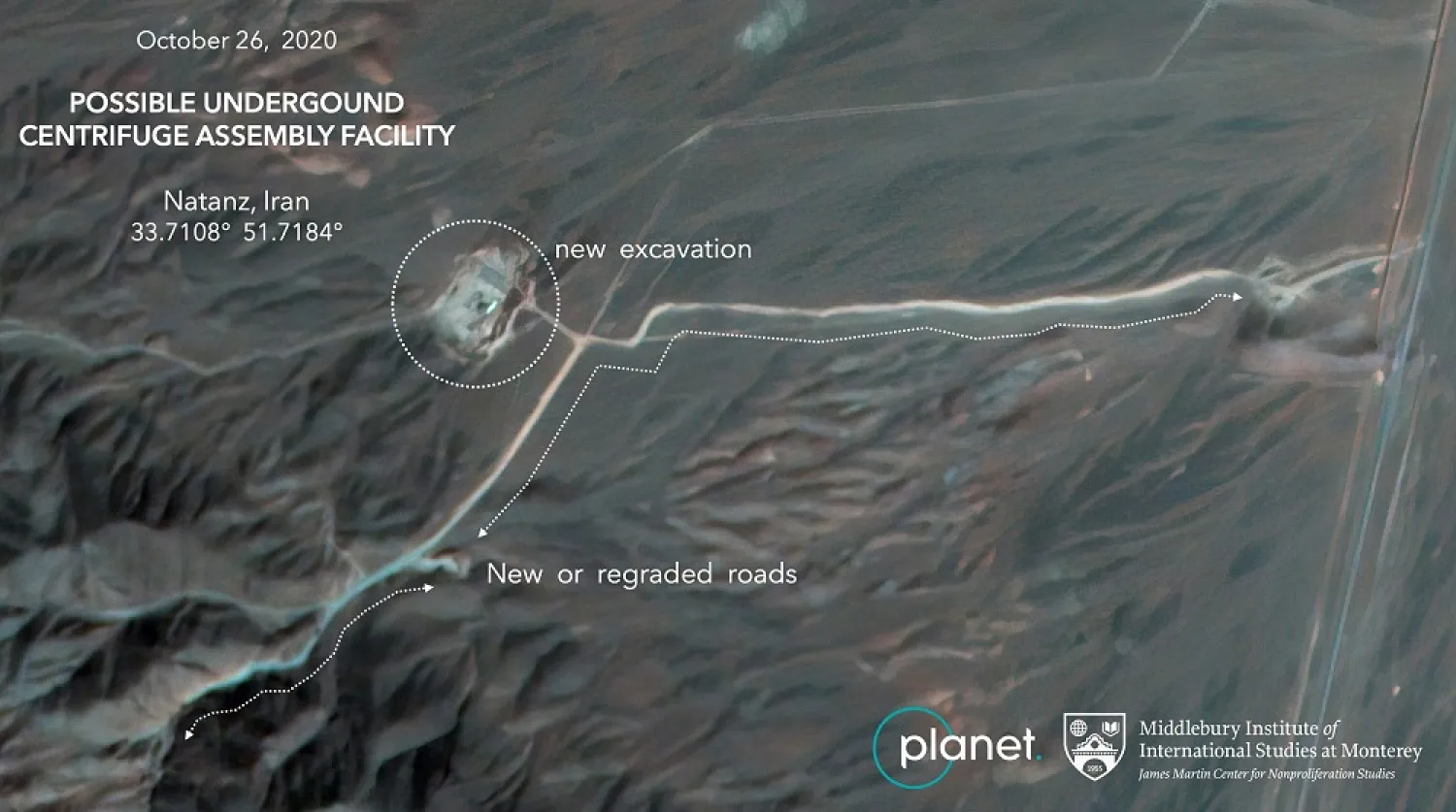
This Oct. 26, 2020, satellite image that has been annotated by experts at the James Martin Center for Nonproliferation Studies at Middlebury Institute of International Studies shows construction at the Natanz nuclear facility. (Planet Labs Inc. via AP)
TT

Satellite Photos Show Construction at Iran Nuclear Site

This Oct. 26, 2020, satellite image that has been annotated by experts at the James Martin Center for Nonproliferation Studies at Middlebury Institute of International Studies shows construction at the Natanz nuclear facility. (Planet Labs Inc. via AP)

Iran has begun construction at its Natanz nuclear facility, satellite images released Wednesday show, just as the UN nuclear agency acknowledged Tehran is building an underground advanced centrifuge assembly plant after its last one exploded in a reported sabotage attack last summer.

The construction comes as the US nears Election Day in a campaign pitting President Donald Trump, whose maximum pressure campaign against Iran has led Tehran to abandon all limits on its atomic program, and Joe Biden, who has expressed a willingness to return to the accord. The outcome of the vote likely will decide which approach America takes. Heightened tensions between Iran and the US nearly ignited a war at the start of the year.

Since August, Iran has built a new or regraded road to the south of Natanz toward what analysts believe is a former firing range for security forces at the enrichment facility, images from San Francisco-based Planet Labs show. A satellite image Monday shows the site cleared away with what appears to be construction equipment there.

Analysts from the James Martin Center for Nonproliferation Studies at the Middlebury Institute of International Studies say they believe the site is undergoing excavation.

“That road also goes into the mountains so it may be the fact that they’re digging some kind of structure that’s going to be out in front and that there’s going to be a tunnel in the mountains," said Jeffrey Lewis, an expert at the institute who studies Iran's nuclear program. "Or maybe that they’re just going to bury it there.”

Iran's mission to the United Nations did not immediately respond to an Associated Press request for comment. Ali Akbar Salehi, the head of the Atomic Energy Organization of Iran, last month told state television the destroyed above-ground facility was being replaced with one “in the heart of the mountains around Natanz.”

Rafael Grossi, the director-general of the International Atomic Energy Agency, told the AP on Tuesday that his inspectors were aware of the construction. He said Iran had previously informed IAEA inspectors, who continue to have access to Iran's sites despite the collapse of the nuclear deal.

“It means that they have started, but it’s not completed. It’s a long process," Grossi said.

Trump in 2018 unilaterally withdrew the US from Iran's nuclear deal with world powers, in which Tehran agreed to limit its uranium enrichment in exchange for the lifting of economic sanctions. When the US ramped up sanctions, Iran gradually and publicly abandoned those limits as a series of escalating incidents pushed the two countries to the brink of war at the beginning of the year.

Iran now enriches uranium to up to 4.5% purity, and according to the last IAEA report, had a stockpile of 2,105 kilograms (2.32 tons). Experts typically say 1,050 kilograms (1.15 tons) of low-enriched uranium is enough material to be re-enriched up to weapons-grade levels of 90% purity for one nuclear weapon.

Iran’s so-called “breakout time” — the time needed for it to build one nuclear weapon if it chose to do so — is estimated now to have dropped from one year under the deal to as little as three months. Iran maintains its nuclear program is for peaceful purposes, though Western countries fear Tehran could use it to pursue atomic weapons.

Natanz, built underground to harden it against airstrikes, long has been at the center of those fears since its discovery in 2002. Centrifuges there still spin in vast halls under 7.6 meters (25 feet) of concrete. Air defense positions surround the facility in Iran's central Isfahan province.

Despite being one of the most-secure sites in Iran, Natanz was targeted by the Stuxnet computer virus — believed to be the creation of the US and Israel — before the nuclear deal.

In July, a fire and explosion struck its advanced centrifuge assembly facility in an incident Iran later described as sabotage. Suspicion has fallen on Israel, despite a claim of responsibility by a previously unheard-of group.

There have been tensions with the IAEA and Iran even at Natanz, with Tehran accusing one inspector of testing positive for explosives last year. However, so far inspectors have been able to maintain their surveillance. something Lewis described as very important.

“As long as they declared to the IAEA in the proper time frame, there’s no prohibition on putting things underground,” he said. “For me, the real red line would be if the Iranians started to stonewall the IAEA."

For now, it remains unclear how deep Iran will put this new facility. And while the sabotage will delay Iran in assembling new centrifuges, Lewis warned the program ultimately would regroup as it had before and continue accumulating ever-more material beyond the scope of the abandoned nuclear deal.

“We buy ourselves a few months," he said. "But what good is a few months if we don’t know what we’re going to use it for?”



France Accuses Iran of ‘Repression’ in Sentence for Nobel Laureate

People cross an intersection in downtown Tehran, Iran, Monday, Feb. 9, 2026. (AP)
TT

France Accuses Iran of ‘Repression’ in Sentence for Nobel Laureate

People cross an intersection in downtown Tehran, Iran, Monday, Feb. 9, 2026. (AP)

France accused Iran on Monday of "repression and intimidation" after a court handed Nobel Peace Prize laureate Narges Mohammadi a new six-year prison sentence on charges of harming national security.

Mohammadi, sentenced Saturday, was also handed a one-and-a-half-year prison sentence for "propaganda" against Iran's system, according to her foundation.

"With this sentence, the Iranian regime has, once again, chosen repression and intimidation," the French foreign ministry said in a statement, describing the 53-year-old as a "tireless defender" of human rights.

Paris is calling for the release of the activist, who was arrested before protests erupted nationwide in December after speaking out against the government at a funeral ceremony.

The movement peaked in January as authorities launched a crackdown that activists say has left thousands dead.

Over the past quarter-century, Mohammadi has been repeatedly tried and jailed for her vocal campaigning against Iran's use of capital punishment and the mandatory dress code for women.

Mohammadi has spent much of the past decade behind bars and has not seen her twin children, who live in Paris, since 2015.

Iranian authorities have arrested more than 50,000 people as part of their crackdown on protests, according to US-based Human Rights Activists News Agency (HRANA).


Iran's Supreme Leader Urges Iranians to Show 'Resolve' against Foreign Pressure

Iran's supreme leader Ali Khamenei on (File Photo/Supreme Leader's website).
TT

Iran's Supreme Leader Urges Iranians to Show 'Resolve' against Foreign Pressure

Iran's supreme leader Ali Khamenei on (File Photo/Supreme Leader's website).

Iran's supreme leader Ali Khamenei on Monday called on his compatriots to show "resolve" ahead of the anniversary of the 1979 Islamic revolution this week.

Since the revolution, "foreign powers have always sought to restore the previous situation", Ali Khamenei said, referring to the period when Iran was under the rule of shah Reza Pahlavi and dependent on the United States, AFP reported.

"National power is less about missiles and aircraft and more about the will and steadfastness of the people," the leader said, adding: "Show it again and frustrate the enemy."


UK PM's Communications Director Quits

British Prime Minister Keir Starmer delivers a speech at Horntye Park Sports Complex in St Leonards, Britain, February 05, 2026. Peter Nicholls/Pool via REUTERS
TT

UK PM's Communications Director Quits

British Prime Minister Keir Starmer delivers a speech at Horntye Park Sports Complex in St Leonards, Britain, February 05, 2026. Peter Nicholls/Pool via REUTERS

British Prime Minister Keir Starmer's director of communications Tim Allan resigned on Monday, a day after Starmer's top aide Morgan McSweeney quit over his role in backing Peter Mandelson over his known links to Jeffrey Epstein.

The loss of two senior aides ⁠in quick succession comes as Starmer tries to draw a line under the crisis in his government resulting from his appointment of Mandelson as ambassador to the ⁠US.

"I have decided to stand down to allow a new No10 team to be built. I wish the PM and his team every success," Allan said in a statement on Monday.

Allan served as an adviser to Tony Blair from ⁠1992 to 1998 and went on to found and lead one of the country’s foremost public affairs consultancies in 2001. In September 2025, he was appointed executive director of communications at Downing Street.