


Armenia, Azerbaijan Meet in Geneva for Nagorno-Karabakh Peace Talks

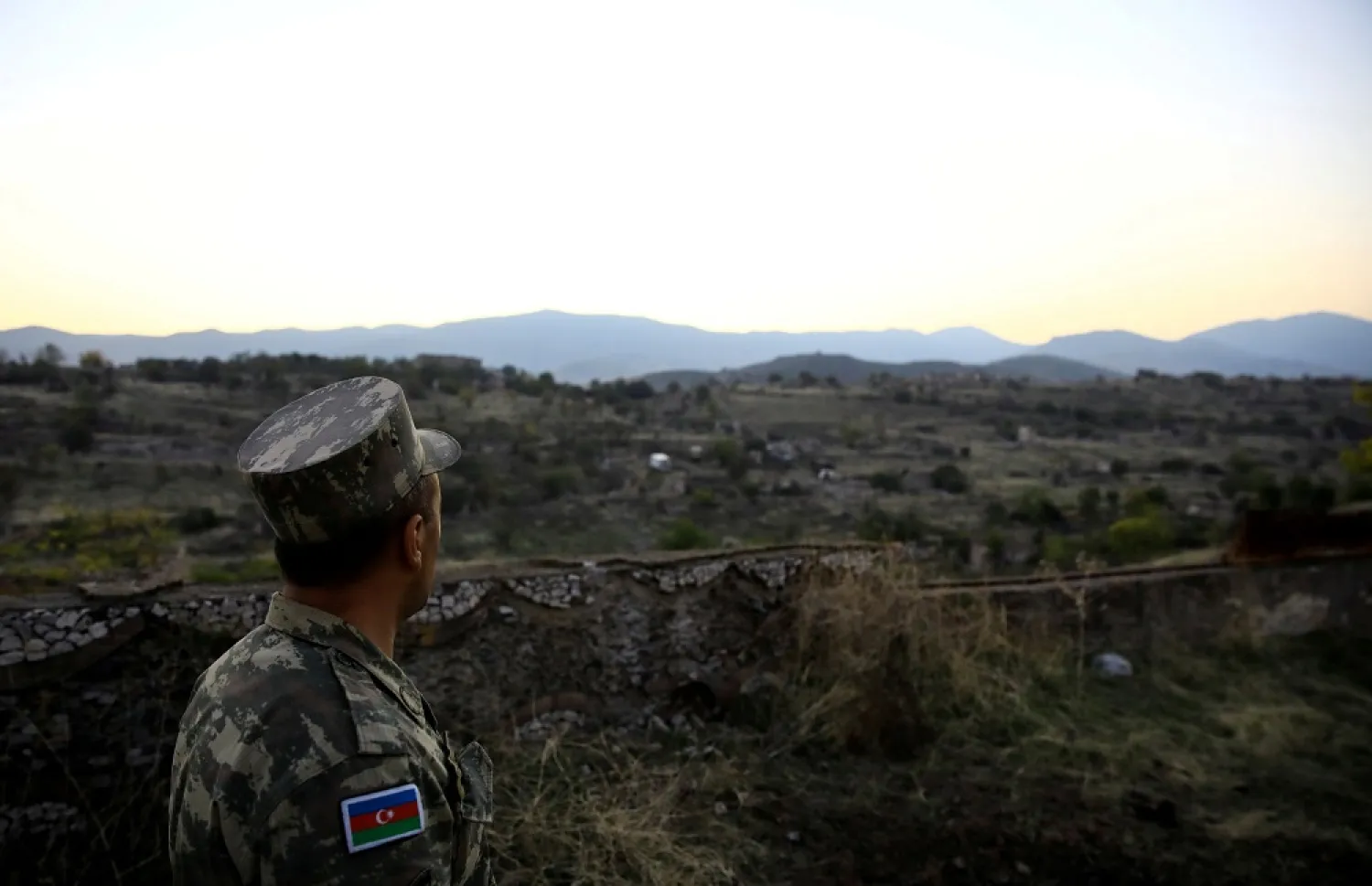
An Azerbaijani soldier inspects the city of Cebrayil, where Azerbaijani forces regained control during the fighting over Nagorno-Karabakh, October 16, 2020. (Reuters)
TT

Armenia, Azerbaijan Meet in Geneva for Nagorno-Karabakh Peace Talks

An Azerbaijani soldier inspects the city of Cebrayil, where Azerbaijani forces regained control during the fighting over Nagorno-Karabakh, October 16, 2020. (Reuters)

The foreign ministers of Armenia and Azerbaijan met international mediators in Geneva on Friday in the latest round of talks to resolve conflict in Nagorno-Karabakh, where hundreds have been killed in more than a month of fighting.

The ministers are meeting envoys from France, Russia and the United States, co-chairs of the OSCE Minsk Group created to mediate a conflict that has escalated in recent days, a diplomat in the Swiss city told Reuters.

The foreign ministries of Armenia and Azerbaijan both confirmed that their respective ministers had flown to Geneva.

Human rights groups also called for an immediate halt to the use of banned weapons by both sides after confirming the use of cluster munitions either fired or supplied by Armenian forces in an attack this week on the Azeri city of Barda.

The worst fighting in the South Caucasus for more than 25 years has brought into sharp focus the increased influence of Turkey, an ally of Azerbaijan, in a former Soviet region considered by Russia to be within its sphere of influence.

Nagorno-Karabakh is internationally recognized as part of Azerbaijan, but is populated and controlled by ethnic Armenians. About 30,000 people were killed in a 1991-94 war in the region.

Azeri President Ilham Aliyev said on Twitter the country's troops had taken under their control nine more settlements. The regions to which he referred are in the southern part of the conflict zone, close to the border with Iran.

Azerbaijan's military gains since fighting began on Sept. 27 make a negotiated settlement more difficult. Aliyev has rejected any solution that would leave Armenians in control of territory claimed by both countries as part of their historic homeland.

In comments published on the prime ministerial web site, Armenian Prime Minister Nikol Pashinyan, responding to questions from foreign media, said he believed "the principle of 'remedial secession' should be applied to Nagorno-Karabakh".

Remedial secession refers to the secession of a subgroup from its parent state as a remedy of last resort.

Three ceasefires have failed to halt the latest fighting, the most recent brokered in Washington last Sunday by US Secretary of State Mike Pompeo.

Sporadic fighting continued on Friday. Azerbaijan's defense ministry said military positions and settlements in the Aghdere, Khojavend and Gubadli regions had come under fire.

The ethnic Armenian-controlled Nagorno-Karabakh defense ministry said it had thwarted Azeri offensives and that shelling of residential areas of towns in the enclave had resumed. It also said it had captured a fighter from Syria.

Rights group Amnesty International and New York-based Human Rights Watch said they had independently confirmed the use of cluster munitions in an attack on Barda on Wednesday. Azerbaijan has said 21 people were killed.

Both groups called for an immediate halt to the use of banned weapons. A separate report by Human Rights Watch on Oct. 23 found that Azerbaijan had used cluster munitions in at least four separate incidents.



France Accuses Iran of ‘Repression’ in Sentence for Nobel Laureate

People cross an intersection in downtown Tehran, Iran, Monday, Feb. 9, 2026. (AP)
TT

France Accuses Iran of ‘Repression’ in Sentence for Nobel Laureate

People cross an intersection in downtown Tehran, Iran, Monday, Feb. 9, 2026. (AP)

France accused Iran on Monday of "repression and intimidation" after a court handed Nobel Peace Prize laureate Narges Mohammadi a new six-year prison sentence on charges of harming national security.

Mohammadi, sentenced Saturday, was also handed a one-and-a-half-year prison sentence for "propaganda" against Iran's system, according to her foundation.

"With this sentence, the Iranian regime has, once again, chosen repression and intimidation," the French foreign ministry said in a statement, describing the 53-year-old as a "tireless defender" of human rights.

Paris is calling for the release of the activist, who was arrested before protests erupted nationwide in December after speaking out against the government at a funeral ceremony.

The movement peaked in January as authorities launched a crackdown that activists say has left thousands dead.

Over the past quarter-century, Mohammadi has been repeatedly tried and jailed for her vocal campaigning against Iran's use of capital punishment and the mandatory dress code for women.

Mohammadi has spent much of the past decade behind bars and has not seen her twin children, who live in Paris, since 2015.

Iranian authorities have arrested more than 50,000 people as part of their crackdown on protests, according to US-based Human Rights Activists News Agency (HRANA).


Iran's Supreme Leader Urges Iranians to Show 'Resolve' against Foreign Pressure

Iran's supreme leader Ali Khamenei on (File Photo/Supreme Leader's website).
TT

Iran's Supreme Leader Urges Iranians to Show 'Resolve' against Foreign Pressure

Iran's supreme leader Ali Khamenei on (File Photo/Supreme Leader's website).

Iran's supreme leader Ali Khamenei on Monday called on his compatriots to show "resolve" ahead of the anniversary of the 1979 Islamic revolution this week.

Since the revolution, "foreign powers have always sought to restore the previous situation", Ali Khamenei said, referring to the period when Iran was under the rule of shah Reza Pahlavi and dependent on the United States, AFP reported.

"National power is less about missiles and aircraft and more about the will and steadfastness of the people," the leader said, adding: "Show it again and frustrate the enemy."


UK PM's Communications Director Quits

British Prime Minister Keir Starmer delivers a speech at Horntye Park Sports Complex in St Leonards, Britain, February 05, 2026. Peter Nicholls/Pool via REUTERS
TT

UK PM's Communications Director Quits

British Prime Minister Keir Starmer delivers a speech at Horntye Park Sports Complex in St Leonards, Britain, February 05, 2026. Peter Nicholls/Pool via REUTERS

British Prime Minister Keir Starmer's director of communications Tim Allan resigned on Monday, a day after Starmer's top aide Morgan McSweeney quit over his role in backing Peter Mandelson over his known links to Jeffrey Epstein.

The loss of two senior aides ⁠in quick succession comes as Starmer tries to draw a line under the crisis in his government resulting from his appointment of Mandelson as ambassador to the ⁠US.

"I have decided to stand down to allow a new No10 team to be built. I wish the PM and his team every success," Allan said in a statement on Monday.

Allan served as an adviser to Tony Blair from ⁠1992 to 1998 and went on to found and lead one of the country’s foremost public affairs consultancies in 2001. In September 2025, he was appointed executive director of communications at Downing Street.