


EU Cuts 2021 Economic Outlook as Virus Spreads

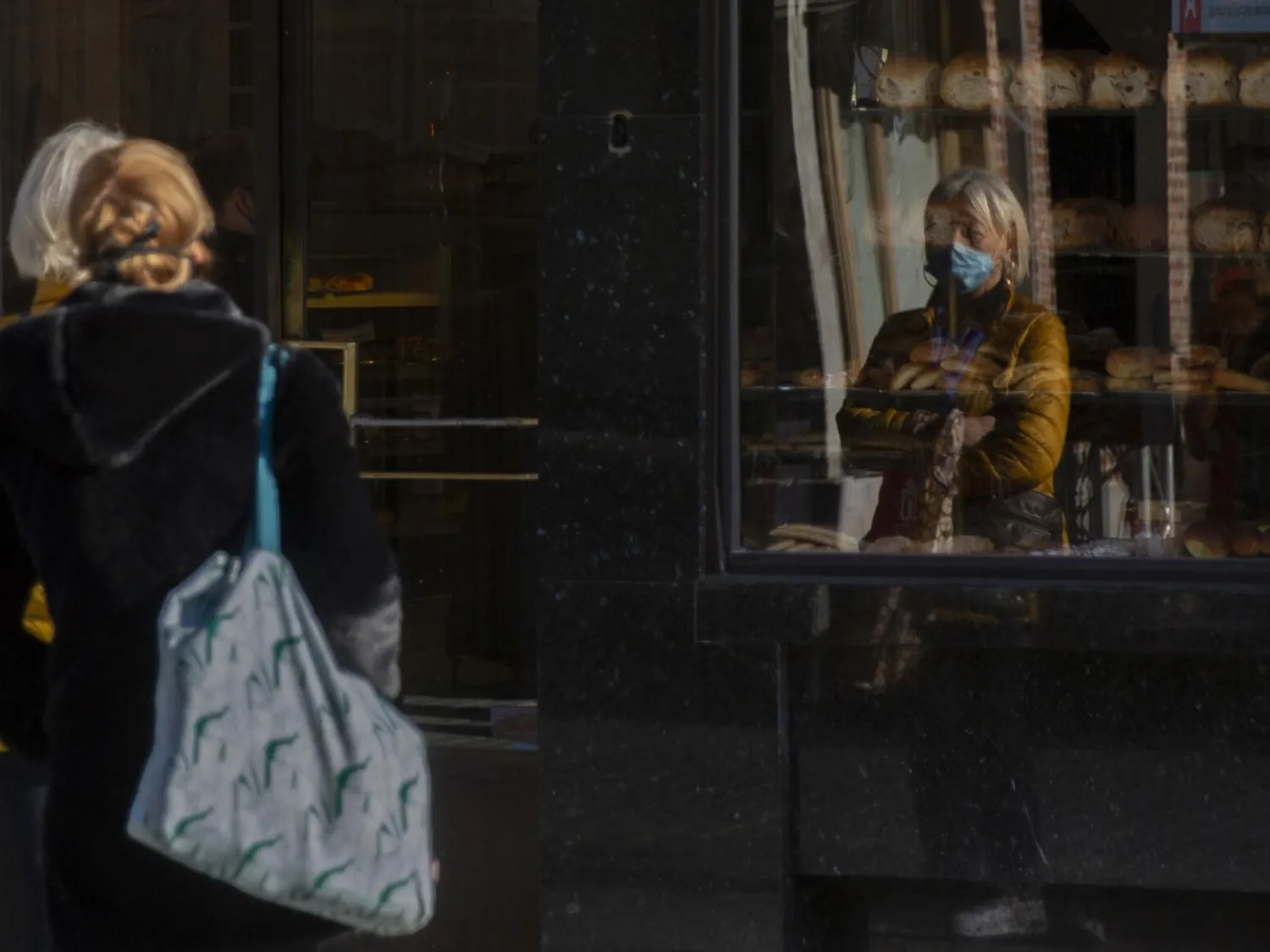
Two women wait in line at a bakery in Antwerp, Belgium, Wednesday, Nov. 4, 2020. Belgium, proportionally still the worst-hit nation in Europe when it comes to coronavirus cases, said Wednesday there increasing signs of that a turning point in the crisis was drawing close. The announcement came in the wake of increased measures over the past weeks with bar and restaurant closures capped by a partial lockdown starting last Monday, which further restricted close contacts and closing non-essential shops. (AP Photo/Virginia Mayo)
TT

EU Cuts 2021 Economic Outlook as Virus Spreads

Two women wait in line at a bakery in Antwerp, Belgium, Wednesday, Nov. 4, 2020. Belgium, proportionally still the worst-hit nation in Europe when it comes to coronavirus cases, said Wednesday there increasing signs of that a turning point in the crisis was drawing close. The announcement came in the wake of increased measures over the past weeks with bar and restaurant closures capped by a partial lockdown starting last Monday, which further restricted close contacts and closing non-essential shops. (AP Photo/Virginia Mayo)

The European Union's executive commission on Thursday lowered its growth forecast for the economic rebound from the coronavirus pandemic next year and said the economy wouldn´t reach pre-virus levels until 2023.

The regular autumn forecast foresees the economy of the 19 countries that use the euro growing only 4.2% in 2021 instead of the previous estimate of 6.1%.

The downgrade comes as governments record increasing numbers of infections, sick people in hospitals, and deaths, leading to renewed restrictions on businesses and activity. The commission added a warning that the situation with the virus means that its growth forecasts "are subject to an extremely high degree of uncertainty."

"Output in both the euro area and the EU is not expected to recover its pre-pandemic level in 2022," the commission said in a statement accompanying the forecast report.

The eurozone and the wider 27-country European Union economy saw a robust rebound in July, August and September, following lockdowns and cautious consumer behavior in the first half of the year that crushed business activity. Third-quarter GDP increased by 12.7% from the previous quarter, the largest increase since statistics started being kept in 1995. That robust re-opening contributed to the commission raising its estimate for output for all of this year, now saying that the economy would shrink by only 7.8% this year instead of the earlier forecast for a drop of 8.7%.

EU Commission Vice-President Valdis Dombrovskis said that "This forecast comes as a second wave of the pandemic is unleashing yet more uncertainty and dashing our hopes for a quick rebound... But through this turbulence, we have shown resolve and solidarity."

Dombrovskis cited the wide-ranging stimulus and economic assistance measures taken at the EU level, led by a recovery package that will dispense 750 billion euros in loans and grants to get the economy going again from 2021.

National governments have also enacted a range of business and worker support measures including tax breaks, loans and paying wages for employees put on short hours so businesses don't lay them off. The European Central Bank is pumping 1.35 trillion euros ($1.58 trillion) into the economy through regular bond purchases, a step aimed at keeping credit flowing affordably to businesses.

The recent darkening of prospects has led ECB President Christine Lagarde to say after the bank's Oct. 28 meeting that there was "little doubt" that a policy review at the Dec. 10 meeting would lead to more central bank action to support the economy.



Saudi Arabia Records Highest Quarterly Non-Oil Exports Since 2017

 Jeddah Islamic Port (SPA) 
 Jeddah Islamic Port (SPA) 
TT

Saudi Arabia Records Highest Quarterly Non-Oil Exports Since 2017

 Jeddah Islamic Port (SPA) 
 Jeddah Islamic Port (SPA) 

Saudi Arabia recorded its highest quarterly level of non-oil exports since 2017 in the fourth quarter of 2025, highlighting a significant structural shift in the Kingdom’s trade dynamics.

Data from the General Authority for Statistics (GASTAT) showed that the merchandise trade surplus rose 26.3 percent year on year in the fourth quarter, driven by strong growth in non-oil exports, which are playing an increasingly pivotal role in strengthening Saudi Arabia’s external balance.

Non-oil exports, including re-exports, climbed a record 18.6 percent to SAR 97 billion ($25.8 billion), marking their highest quarterly level in eight years. These exports covered 39.4 percent of total imports during the period. As a result, the trade surplus widened to SAR 52.5 billion (about $14 billion), its highest level in three years.

Re-exports were the standout performer, surging 67.4 percent to SAR 40 billion ($10.6 billion). The sharp increase was largely fueled by growth in machinery, electrical equipment and appliances, which expanded 79.2 percent and accounted for roughly half of total re-exports.

Overall merchandise exports reached SAR 300 billion ($80 billion) in the fourth quarter, up 7.9 percent compared with the same period in 2024. Oil exports rose 3.5 percent year on year to SAR 203 billion ($54.1 billion). Imports also increased, rising 4.7 percent to SAR 248 billion ($66.1 billion)

Trade data underscored the depth of Saudi Arabia’s commercial ties with major global economies. China remained the Kingdom’s largest trading partner, accounting for 13.1 percent of total exports and 27.2 percent of imports.

The United Arab Emirates ranked second among export destinations, receiving 11.2 percent of Saudi exports.

Other leading export markets included Japan (9.9 percent), followed by India, South Korea, the United States, Bahrain, Egypt, Singapore and Poland. Collectively, these ten countries accounted for 70.9 percent of total Saudi exports.

On the import side, the United States ranked second after China, representing 8.7 percent of total imports. It was followed by the UAE (5.7 percent), Germany, India, Japan, Italy, France, Switzerland and Egypt. Together, these ten countries accounted for 67 percent of the Kingdom’s total imports.

Vision 2030 Driving Diversification

The record performance reflects the goals of Saudi Vision 2030, which aims to position the Kingdom as a global logistics hub linking three continents. The exceptional expansion in re-exports and greater reliance on advanced air cargo infrastructure point to tangible progress in building a platform capable of attracting and redistributing high-tech goods and electrical equipment worldwide.

The figures also demonstrate growing economic resilience. Oil exports accounted for 67.5 percent of total exports in the fourth quarter of 2025, down from 70.4 percent a year earlier. This gradual diversification of the export base has helped reinforce trade stability, supporting the highest surplus recorded in three years.


Gold Ticks Up on Safe‑haven Bids; Markets Eye US-Iran Talks

Gold items are displayed at a jewelry shop in Hanoi, Vietnam, 26 February 2026.  EPA/LUONG THAI LINH
Gold items are displayed at a jewelry shop in Hanoi, Vietnam, 26 February 2026. EPA/LUONG THAI LINH
TT

Gold Ticks Up on Safe‑haven Bids; Markets Eye US-Iran Talks

Gold items are displayed at a jewelry shop in Hanoi, Vietnam, 26 February 2026.  EPA/LUONG THAI LINH
Gold items are displayed at a jewelry shop in Hanoi, Vietnam, 26 February 2026. EPA/LUONG THAI LINH

Gold prices edged up on Thursday as uncertainty over US tariff policy boosted the metal's safe-haven appeal, while investors awaited further details on US-Iran talks later in the day.

Spot gold was up 0.4% at $5,190.01 per ounce, as of 0816 GMT. Bullion had hit a more-than-three-week high on Tuesday.

US gold ‌futures for April ‌delivery were down 0.4% at $5,206.80, said Reuters.

The US dollar ‌eased, ⁠making dollar-denominated commodities more ⁠affordable for holders of other currencies.

"Iran-US persisting tensions and the uncertainty surrounding the global economy with (President Donald) Trump's tariffs are a bullish catalyst," said Carlo Alberto De Casa, external analyst at banking group Swissquote.

US envoy Steve Witkoff and Trump's son-in-law Jared Kushner are due to meet an Iranian delegation for ⁠a third round of nuclear talks later in the ‌day in Geneva.

Trump briefly ‌laid out his case for a possible attack on Iran in his ‌State of the Union speech on Tuesday, saying ‌he would not allow a country he described as the world's biggest sponsor of terrorism to have a nuclear weapon.

Non-yielding gold is seen as a safe store of value during times of geopolitical and ‌economic uncertainty.

The US tariff rate for some countries will rise to 15% or higher from ⁠the newly ⁠imposed 10%, US Trade Representative Jamieson Greer said on Wednesday, without naming any specific trading partners or giving further details.

Gold prices scaled a record high of $5,594.82 on January 29 and were up 20% so far this year.

"The global gold rush does not seem to be over... Overall the sentiment remains positive with strong buys coming from Asia and from Central Banks," De Casa said.

On the data front, investors await the weekly US jobless claims data, due later in the day.

Spot silver fell 1.4% to $88.18 per ounce. Spot platinum added 0.9% to $2,308.11 per ounce, while palladium rose 0.3% to $1,800.14.


IMF Unlocks Around $2.3 Billion for Egypt

Thousands of Muslim students break their fast during the Muslim holy fasting month of Ramadan, at a free meal distributing point in Al-Azhar mosque in Cairo, Egypt, Wednesday, Feb. 25, 2026. (AP Photo/Ahmed Yosri )
TT

IMF Unlocks Around $2.3 Billion for Egypt

Thousands of Muslim students break their fast during the Muslim holy fasting month of Ramadan, at a free meal distributing point in Al-Azhar mosque in Cairo, Egypt, Wednesday, Feb. 25, 2026. (AP Photo/Ahmed Yosri )

The International Monetary Fund (IMF) has unlocked around $2.3 billion for Egypt after its latest program reviews, it said on Wednesday.

Egypt secured an expanded $8 billion package over nearly four years from the IMF in March 2024, contingent on a series of economic reforms.

In March last year, the global lender approved a new loan worth $1.3 billion for Egypt.

After completing the fifth and sixth reviews of the Extended Fund Facility, the IMF said on Wednesday around $2 billion will be unlocked for Egypt.

It will be able to draw an extra $273 million under the Resilience and Sustainability Facility (RSF) after the first review was completed, the IMF said in a statement.

"Egypt's macroeconomic situation has improved amid sustained stabilization efforts," it said. "A broad-based economic recovery has lifted real GDP growth to 4.4 percent in FY2024/25 while inflation declined markedly to 11.9 percent in January 2026, supported by tight monetary and fiscal policies."

"The current account deficit narrowed further to 4.2 percent of GDP, reflecting strong remittances and tourism receipts, while market confidence continued to improve, as evidenced by successful external issuances, foreign direct investment inflows, and record nonresident inflows into domestic debt markets."

"Tight monetary and fiscal policies together with exchange rate flexibility have helped restore macroeconomic stability, reduce inflation, and strengthen the external position."

But the IMF warned that structural reforms under the program have been "uneven.”

"Efforts to reduce the state's footprint, particularly progress on the divestment agenda, have been slower than envisaged, while high public debt and elevated gross financing needs continue to constrain fiscal space and weigh on medium-term growth prospects," the IMF added.