Ankara Sets Up Military Base in Northern Raqqa, US Bolsters Troops in Deir Ezzor

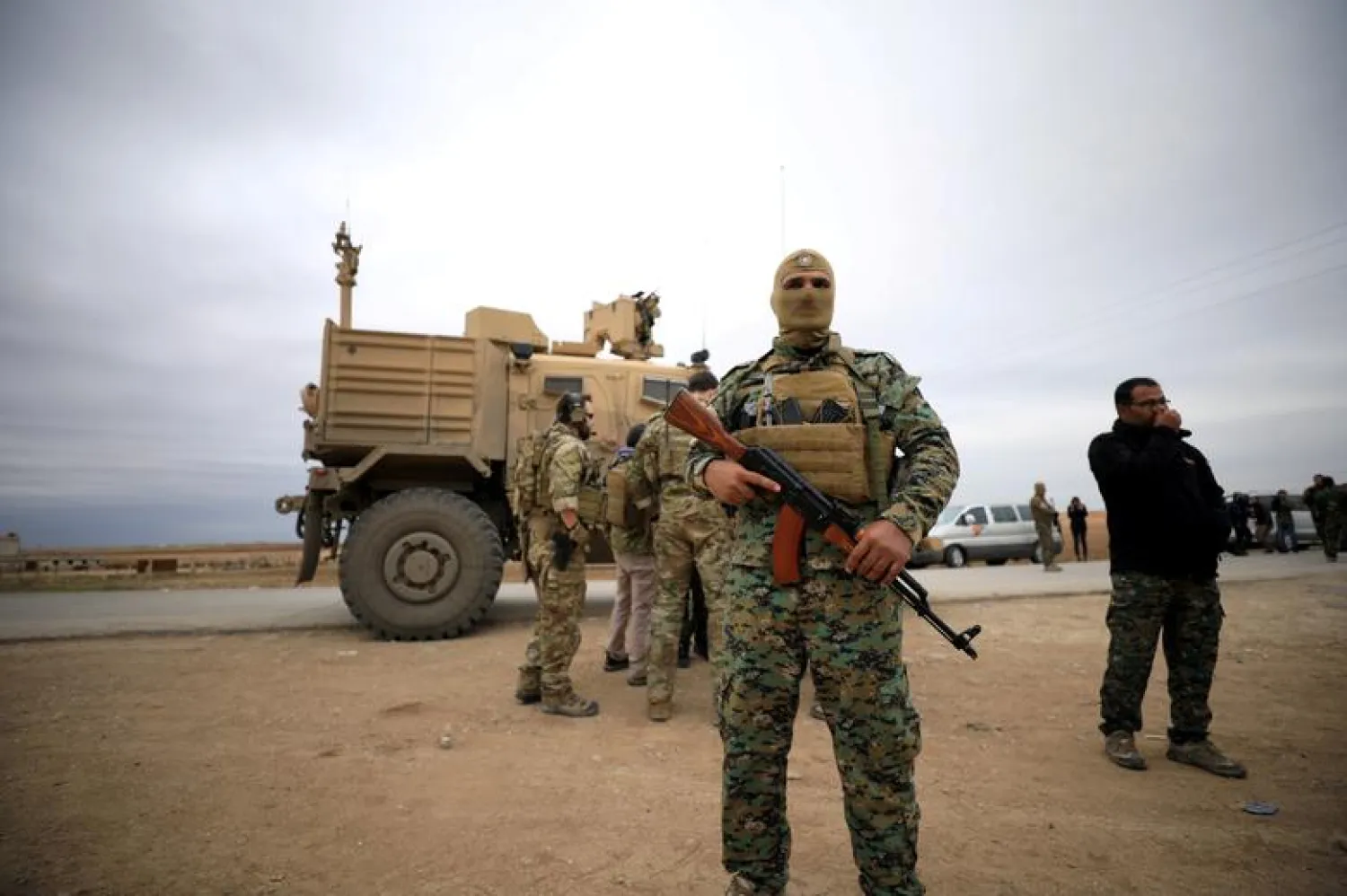
Syrian Democratic Forces and US troops are seen during a patrol near Turkish border in Hasakah, Syria Nov. 4, 2018. REUTERS/Rodi Said/File Photo
TT

Ankara Sets Up Military Base in Northern Raqqa, US Bolsters Troops in Deir Ezzor

Syrian Democratic Forces and US troops are seen during a patrol near Turkish border in Hasakah, Syria Nov. 4, 2018. REUTERS/Rodi Said/File Photo

The Turkish and Russian forces on Thursday conducted a joint military patrol in Syria's Hasakah province while reports claimed that Ankara was establishing a military base in northern Raqqa.

The Syrian Observatory for Human Rights (SOHR) cited sources as reporting that four Turkish vehicles and four Russian ones "set off from Sherik crossing on Turkey border in the west of Al-Darbasiyyah and toured the villages of Dalek, Malak, Zahr Al-Arab and Kasra in Zarkan countryside."

Escorted by two Russian helicopters, the patrol later "headed to the south-western countryside of Al-Darbasiyyah and took Al-Hasakah-Al-Darbasiyyah highway to the city’s southern part and Al-Ghanamiyyah area in the west, then it returned to Sherik."

SOHR has said Turkish forces were setting up a new military base near the M4 road west of Ain Issa area in northern Raqqa province.

According to Observatory sources, Turkish forces are now stationed at five military bases near the M4 road: Kaffifa, Ain Rummana, Tina and Al-Rab’ea on the road between Ain Issa and Istirahat saqr, and the last one in western Ain Issa town.

On October 21, the war-monitor reported that Turkish-backed factions were bringing in military reinforcement to Tel Abyad and Ain Issa countryside.

Meanwhile, the US Army is building a new military base in the town of Baghouz (located in Abu Kamal District, Deir Ezzor), which was the last ISIS stronghold before it was defeated in March.

A high-ranked officer said that the first step in establishing the base was equipping a helipad to secure logistical supplies for the base. The US Army deployed the Syrian Democratic Forces (SDF) to a number of points around the under-construction base to protect it, he added.

This brings the total of US Army military sites to nine, four of them are in Deir Ezzor while five are in the Hasakah countryside.

A prominent officer from SDF deemed these reinforcements as a direct message to Russia to abide by the de-escalation rules agreed upon between the two parties. It is also a message to the countries in the region that are active players in the Syrian war, such as Iran, to abstain from provocative actions in the northeast of Syria.


Egypt Calls for Safe Shelter, Humanitarian Access to Sudanese

Abdel Fattah el-Sisi during the reception of Abdel Fattah al-Burhan in Cairo last month (Egyptian Presidency)
TT

Egypt Calls for Safe Shelter, Humanitarian Access to Sudanese

Abdel Fattah el-Sisi during the reception of Abdel Fattah al-Burhan in Cairo last month (Egyptian Presidency)

Cairo on Wednesday affirmed the need to provide safe shelter and unimpeded humanitarian access to Sudanese, condemning the massacres and serious violations against civilians in El Fasher and North Kordofan.

Egypt’s position was conveyed by Foreign Minister Badr Abdelatty during a phone call with Tom Fletcher, the United Nations (UN) Under-Secretary-General for Humanitarian Affairs and Emergency Relief Coordinator.

Abdelatty called for urgent measures to protect civilians and affirmed Egypt’s full support for the work of the UN Office for the Coordination of Humanitarian Affairs (OCHA) and its central role in strengthening effective responses to humanitarian crises in the region, whether in the occupied Palestinian territories or Sudan.

Recently, Egypt has intensified contacts to support Sudan's sovereignty, protect its national institutions, and push towards a comprehensive ceasefire within the framework of the “Quad Mechanism.”

Last August, the Mechanism, comprising Saudi Arabia, Egypt, United States, and United Arab Emirates, proposed a roadmap in which it called for a three-month initial humanitarian truce, then an inclusive and transparent transition process within nine months to meet the aspirations of the Sudanese people towards smoothly establishing an independent, civilian-led government with broad-based legitimacy and accountability.

During the phone call on Wednesday, Abdelatty stressed the importance of close coordination with the UN and its specialized agencies to ease civilian suffering and support regional stability.

On Dec. 28, the Egyptian Red Crescent (ERC), in coordination with the Sudanese Red Crescent Society, sent a humanitarian aid convoy to support the Sudanese people, carrying around 70 tons of food, medical supplies, and other relief items.

Last month, the Egyptian presidency issued a statement on the war in Sudan outlining three points it described as “red lines.”

Egypt would not allow any of them to be crossed or compromised, as they directly affect Egypt’s national security, which it said is inseparable from Sudan’s national security.

The reference to activating the joint defense agreement between the two countries was seen as a signal that Egypt could bring its military, political, and diplomatic weight in support of the Sudanese army.

President Abdel Fattah el-Sisi had received last month Lt. Gen. Abdel Fattah al-Burhan, Chairman of Sudan’s Transitional Sovereignty Council in Cairo.

El-Sisi reaffirmed Egypt’s “full support for the Sudanese people in overcoming the current critical phase,” stressing his country’s unwavering commitment to Sudan’s unity, sovereignty, security, and stability.

Meanwhile, Egypt’s Foreign Ministry said Abdelatty discussed with Fletcher the humanitarian situation in Gaza.

The minister urged intensified international action to ensure full and unhindered access for humanitarian, medical, and relief aid into Gaza, calling for the removal of Israeli restrictions that he said were blocking sufficient aid deliveries as winter conditions worsen.

He also stressed the need to protect civilians and speed up the entry of essential supplies, including relief materials and mobile housing units, to mitigate civilian suffering in the Gaza Strip.


Yemen’s Al-Alimi Removes Several Officials from their Positions

Yemen’s Presidential Leadership Council (PLC) Chairman Dr. Rashad Al-Alimi. saba
TT

Yemen’s Al-Alimi Removes Several Officials from their Positions

Yemen’s Presidential Leadership Council (PLC) Chairman Dr. Rashad Al-Alimi. saba

Yemen’s Presidential Leadership Council (PLC) Chairman Dr. Rashad Al-Alimi has issued a series of decisions, including dismissals, referrals for investigation, and new appointments to sensitive military, security, and local positions.

The move reflects a firm approach to reassert control over state institutions.

Al-Alimi issued Decree No. 7 of 2026 concerning the dismissal of the Commander of the Second Military Region and the Commander of the Al-Ghaydah Axis and Military Police Brigade in Al-Mahra Governorate.

Article One of the decree stipulates the dismissal of Major General (Staff) Talib Saeed Abdullah Barjash from his position as Commander of the Second Military Region and his referral for investigation in accordance with legally prescribed procedures and regulations.

Article Two stipulates the dismissal of Major General Mohsen Ali Nasser Marsa from his positions as Commander of the Al-Ghaydah Axis and Commander of the Military Police Brigade in Al-Mahra Governorate. It also stipulates his referral for investigation in accordance with legally prescribed procedures and regulations.

In decree No. 5 he appointed Abdulrahman Sheikh Abdulrahman Al-Yafie as Minister of State and Governor of Aden Governorate.

Al-Alimi relieved Ahmed Hamed Lamlas, Minister of State and Governor of Aden Governorate, of his post and referred him for investigation.

He also dismissed Abdul Salam Saleh Humaid Hadi, Minister of Transport, and Waed Abdullah Badeeb, Minister of Planning and International Cooperation, from their posts and referred them for investigation.

Decree No, 9 stipulated the appointment of Salem Ali Sa’ad Ahmed Makhbal Keddah as Commander of the Al-Ghaydah Military Axis, with promotion to the rank of Brigadier General.

In Decree No. 10, Al-Alimi appointed Brigadier General Khaled Yoslam Ali Al-Qathmi as Commander of the Second Presidential Special Guard Brigade.

Earlier, Head of the Southern Transitional Council (STC) Aidrous Al-Zubaidi was expelled from the PLC for high treason, Al-Alimi announced.

In a decree, Al-Alimi referred Al-Zubaidi to the general prosecutor for committing high treason and harming the unity and security of the state.


Yemen Minister Says Efforts Underway to Bring Capital Back to Hadhramaut

 Yemeni National Shield forces during the recapture of military camps in Hadhramaut and Al-Mahrah (Reuters)
Yemeni National Shield forces during the recapture of military camps in Hadhramaut and Al-Mahrah (Reuters)
TT

Yemen Minister Says Efforts Underway to Bring Capital Back to Hadhramaut

 Yemeni National Shield forces during the recapture of military camps in Hadhramaut and Al-Mahrah (Reuters)
Yemeni National Shield forces during the recapture of military camps in Hadhramaut and Al-Mahrah (Reuters)

At a critical moment when the Yemeni government is seeking to rebuild confidence in the national economy, official indicators suggest a tangible improvement in the investment climate, particularly in provinces where the internationally recognized government has regained control, most notably Hadhramaut and Socotra.

These moves come as part of a broader government effort to reassure traders and investors and to create a safe and stable environment for the return of capital that left the country in recent years, amid improving security conditions, the spread of state institutions, and growing interest among local and regional business leaders in resuming investment activity in liberated areas.

Monitoring stocks and price stability

Yemen’s Minister of Industry and Trade Mohammed al-Ashwal told Asharq Al-Awsat that the ministry issued official instructions the day before yesterday aimed at reassuring southern communities about the availability of essential commodities and price stability.

He stated that three separate memoranda were sent to the heads of the ministry’s offices in Mukalla, Seiyun, and al-Mahrah, containing clear directives to closely monitor commodity stocks and continuously track market activity on a daily basis.

Al-Ashwal said the instructions emphasized the importance of ensuring that Saudi aid reaches its intended beneficiaries and is not diverted or sold in markets, underscoring that the ministry gives this issue top priority due to its direct impact on market stability and food security.

Reassurances in three provinces

On security, the minister said conditions were reassuring and that security was stable in Hadhramaut, Seiyun, and Al Mahrah. He said the measures taken had helped boost confidence among citizens and traders alike, creating a sense of stability in market activity.

He pointed to ongoing communication with the Yemeni Saudi Business Council, noting that a meeting in Mecca resulted in a set of joint projects that reflect the strength of economic ties between the two countries and open new horizons for investment and cooperation across several vital sectors.

Normalizing the situation in Aden

Regarding the situation in Aden, the minister stated that the government is currently working to fully normalize conditions until security is firmly established, particularly in the temporary capital.

He added that the deployment of the National Shield forces would lead to the unification of the security authority in charge, which would have a positive impact on security and administrative stability and provide investors and traders with a clear counterpart to deal with.

Capital between flight and resilience

Regarding investors and business leaders in the south, al-Ashwal stated that following the Houthi coup, significant capital left the southern areas; however, some local businessmen remained resilient despite the volatility and challenges, continuing their commercial activities under extremely difficult conditions and helping to preserve a minimum level of economic activity.

He said local business leaders demonstrated honorable positions in the darkest circumstances and played a positive role in maintaining the economic cycle.

He called on traders who had left the country after the Houthi coup to return, especially to Hadhramaut, stating that the province would not be the same as it was before, given the expansion of state institutions and the consolidation of security through the army, security agencies, and local authorities.

Al-Ashwal said the country is witnessing notable economic momentum during a period in which conditions have stabilized in many southern provinces.

He said there is clear interest among business leaders who left Yemen about a decade ago and who now show a desire and readiness to return and invest again, amid improved security and economic conditions and an expanding area of stability.

Progress in Hadhramaut

He added that in recent hours, he had been in contact with the heads of chambers of commerce in Aden, Mukalla, and Taiz, reassuring them about security and stability.

He said he met with the governor of Hadhramaut on Monday, who confirmed that several practical steps had been taken to ensure the smooth functioning of commercial activity in the province.

Al-Ashwal said the impact of these steps is now clearly visible in Hadhramaut, where social and economic life has returned at a good pace, reflecting an improved business environment and a gradual revival of commercial activity.

Confidence signals to investors

Regarding government efforts to strengthen the local economy, al-Ashwal stated that the government, through the Ministry of Industry and Trade, is preparing to launch an industrial zone in Aden as a clear indicator of economic stability, alongside three other industrial zones in Hadhramaut and two in Socotra.

He said signing the contract for the Aden industrial zone would send a practical message that the economic situation is stable and developing dynamically.

Saudi role

In this context, al-Ashwal spoke at length about the importance of Saudi Arabia’s role, thanking the kingdom for its efforts to support stability in Yemen.

He said this support is ongoing and has directly contributed to strengthening economic stability and supporting state institutions.