


Uefa's Ceferin Plays Mayor Vaughn and Ploughs on Regardless Amid Pandemic

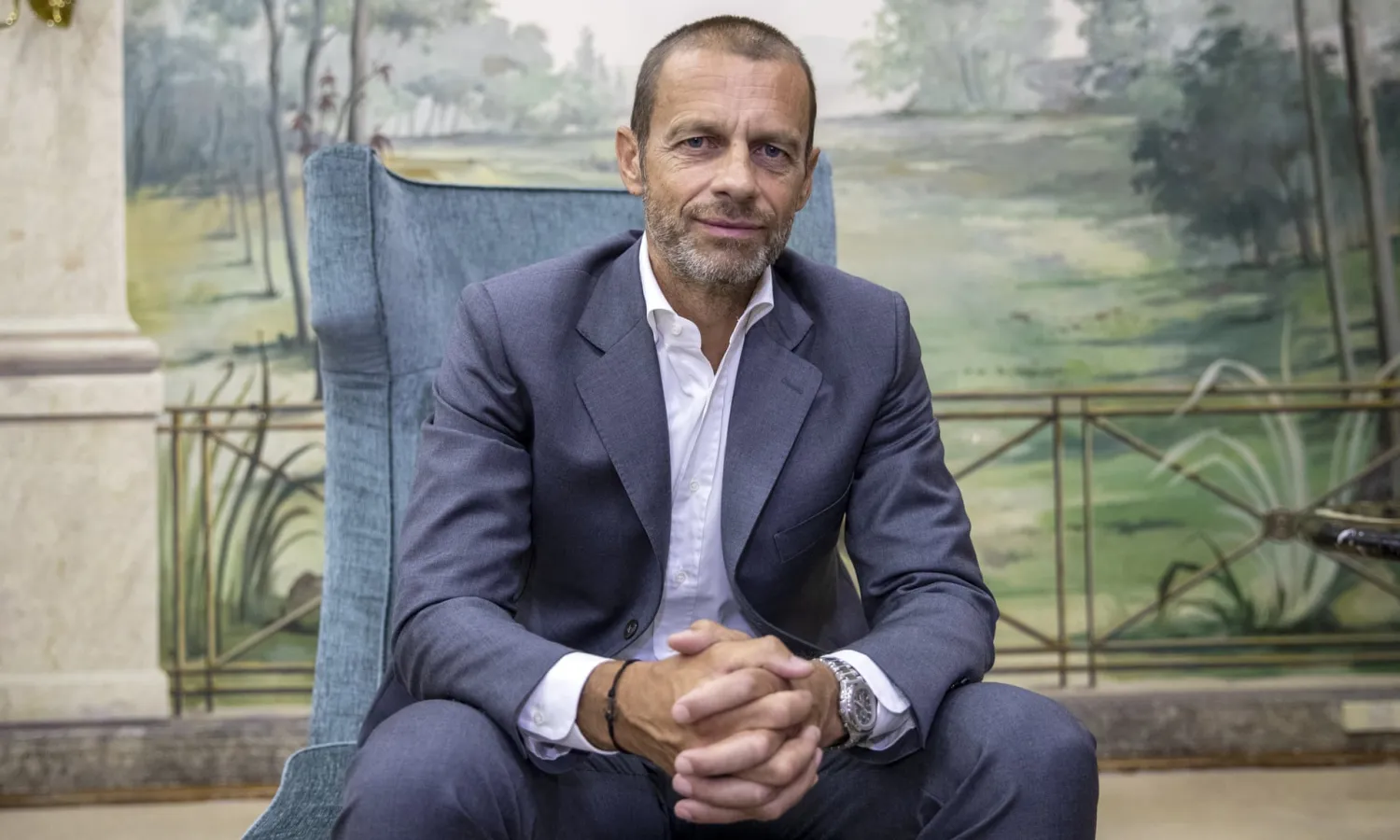
There has not yet been the merest suggestion from Uefa president, Aleksander Ceferin, that the Champions League be postponed or canceled amid a second wave of coronavirus.
Photograph: Manu Fernández/AP
There has not yet been the merest suggestion from Uefa president, Aleksander Ceferin, that the Champions League be postponed or canceled amid a second wave of coronavirus. Photograph: Manu Fernández/AP
TT

Uefa's Ceferin Plays Mayor Vaughn and Ploughs on Regardless Amid Pandemic

There has not yet been the merest suggestion from Uefa president, Aleksander Ceferin, that the Champions League be postponed or canceled amid a second wave of coronavirus.
Photograph: Manu Fernández/AP
There has not yet been the merest suggestion from Uefa president, Aleksander Ceferin, that the Champions League be postponed or canceled amid a second wave of coronavirus. Photograph: Manu Fernández/AP

There is a debate to be had over who is the real villain in the movie Jaws – the shark that patrols the waters off the resort of Amity devouring the appetizing and unwitting, or Larry Vaughn, the wilfully myopic mayor who refuses to close the popular local beaches despite having been alerted to the predator’s presence. Following one such discussion on an episode of an American podcast, a listener felt compelled to contact the Jaws screenwriter, Carl Gottlieb, and the 82-year-old ventured the opinion that neither the maneater nor its human enabler were entirely blameless.

“Well, clearly the shark is the primary villain since he’s the one that actually bites people,” he opined. “But the mayor is a contributing villain because by his failure to take action and his denial, he puts more people in jeopardy and more people get killed.” Gottlieb went on to explain that Mayor Vaughn wasn’t entirely deserving of opprobrium because he was at least trying to serve the greater good in the face of totally “unpredictable uproar”.

You could conceivably say the same for the Uefa president, Aleksander Ceferin, and his executive committee, who moved with commendable speed to fall in line with several major European leagues who put their seasons on hold in March in an effort to halt the spread of coronavirus by postponing the Champions League and Europa League.

Despite later playing them out to a weird bio-hazardous conclusion in two mini-tournaments comprising one-leg ties played behind closed doors, the cost to Uefa in rebates to assorted broadcasters who did not get to show as many matches as they had paid for on the dates they had hoped was more than £500m.

It is small wonder, then, that as the virus continues to ravage Europe, with infection rates across the continent escalating at a greater rate than ever, there has not yet been the merest suggestion that the Champions League, a tournament reported to generate £4bn annually in revenue for Uefa, be postponed or canceled.

On Saturday, our own answer to Mayor Vaughn finally announced that England would be going into what is tantamount to a second lockdown, following the lead of France, Germany, Belgium, and Greece. Increased measures have also been announced in Spain and Italy, with other nations almost certain to follow suit.

Between them, the seven countries listed account for 21 of the 32 clubs in this season’s Champions League and are also well represented in the Europa League. Now in their group stages, the two competitions boast representatives from 40 countries across the length and breadth of a continent currently laid low by a highly contagious and deadly disease that shows no sign of abating.

In centuries to come (if we make it that far), students of history will have no shortage of detailed case studies to pore over as they struggle to come to terms with the mind-boggling ineptitude with which this pandemic has been handled by figures in authority who should have known better.

While fairly insignificant in the cosmic scheme of things, the staging of European tournaments that required 30- or 40-strong traveling parties from elite football clubs to regularly leave the relative safety of their own domestic bubbles to fly into others for no great reason other than financial box-ticking will be filed away in the extremely large cabinet marked “What the hell were they thinking?”

Even at the best of times, the group stages of the Champions League are monotonously predictable, with the richest clubs invariably making the knockout stages apart from odd, notable exceptions. Now played behind paywalls and closed doors, this season’s Champions League seems smothered in a fog of utter pointlessness and futility.

We are all familiar with those “special European nights at Anfield”, but let’s see how special it is when Liverpool have already qualified for the knockout stages of this year’s tournament with two games to spare and are hosting Ajax in a match no one is at and not many people can afford to watch from home on the first day of next month.

Still, come season’s end, a winner will be crowned amid a minimum of fanfare, prize money will be distributed, the record books filled in and Uefa will have turned another huge profit. Never before has football seemed so depressingly and slavishly beholden to the bottom line.

A high-profile player has yet to die because of the virus and it is to be hoped none will, but the pandemic has already contributed to more than its fair share of upheaval in the current season’s infancy. During the recent international break, when players were removed from their club bubbles, joined up with international teammates, and flew across multiple borders in the space of 10 days before returning to their domestic duties, assorted teams were hit hard by the virus.

Last week, Covid saw to it that Lazio were forced to travel to Brussels with the bare bones of a squad that was subsequently put in quarantine before their weekend game against Torino. Should they be able to field a team, the Italian side must now travel to Saint Petersburg for Wednesday, where more than 18,000 positive Covid tests were recorded on Saturday. As sporting scenarios go, it seems irresponsible, feckless, and downright bonkers.

“Six months ago everything was shutting down and now my friends, we are back,” announced Uefa’s president in September. “We cannot say everything is normal but it will be normal soon.” With the benefit of hindsight, Ceferin’s comments call to mind those of a certain movie politician. “It’s a beautiful day, the beaches are open and people are having a wonderful time,” Mayor Vaughn told concerned citizens. His bullishness would prove misguided too.

(The Guardian)


Hospital: Vonn Had Surgery on Broken Leg from Olympics Crash

This handout video grab from IOC/OBS shows US Lindsey Vonn crashing during the women's downhill event at the Milano Cortina 2026 Winter Olympic Games on February 8, 2026. (Photo by Handout / various sources / AFP)
TT

Hospital: Vonn Had Surgery on Broken Leg from Olympics Crash

This handout video grab from IOC/OBS shows US Lindsey Vonn crashing during the women's downhill event at the Milano Cortina 2026 Winter Olympic Games on February 8, 2026. (Photo by Handout / various sources / AFP)

Lindsey Vonn had surgery on a fracture of her left leg following the American's heavy fall in the Winter Olympics downhill, the hospital said in a statement given to Italian media on Sunday.

"In the afternoon, (Vonn) underwent orthopedic surgery to stabilize a fracture of the left leg," the Ca' Foncello hospital in Treviso said.

Vonn, 41, was flown to Treviso after she was strapped into a medical stretcher and winched off the sunlit Olimpia delle Tofane piste in Cortina d'Ampezzo.

Vonn, whose battle to reach the start line despite the serious injury to her left knee dominated the opening days of the Milano Cortina Olympics, saw her unlikely quest halted in screaming agony on the snow.

Wearing bib number 13 and with a brace on the left knee she ⁠injured in a crash at Crans Montana on January 30, Vonn looked pumped up at the start gate.

She tapped her ski poles before setting off in typically aggressive fashion down one of her favorite pistes on a mountain that has rewarded her in the past.

The 2010 gold medalist, the second most successful female World Cup skier of all time with 84 wins, appeared to clip the fourth gate with her shoulder, losing control and being launched into the air.

She then barreled off the course at high speed before coming to rest in a crumpled heap.

Vonn could be heard screaming on television coverage as fans and teammates gasped in horror before a shocked hush fell on the packed finish area.

She was quickly surrounded by several medics and officials before a yellow Falco 2 ⁠Alpine rescue helicopter arrived and winched her away on an orange stretcher.


Meloni Condemns 'Enemies of Italy' after Clashes in Olympics Host City Milan

Demonstrators hold smoke flares during a protest against the environmental, economic and social impact of the Milano-Cortina 2026 Winter Olympics in Milan, Italy, February 7, 2026. REUTERS/Kevin Coombs
TT

Meloni Condemns 'Enemies of Italy' after Clashes in Olympics Host City Milan

Demonstrators hold smoke flares during a protest against the environmental, economic and social impact of the Milano-Cortina 2026 Winter Olympics in Milan, Italy, February 7, 2026. REUTERS/Kevin Coombs

Italian Prime Minister Giorgia Meloni has condemned anti-Olympics protesters as "enemies of Italy" after violence on the fringes of a demonstration in Milan on Saturday night and sabotage attacks on the national rail network.

The incidents happened on the first full day of competition in the Winter Games that Milan, Italy's financial capital, is hosting with the Alpine town of Cortina d'Ampezzo.

Meloni praised the thousands of Italians who she said were working to make the Games run smoothly and present a positive face of Italy.

"Then ⁠there are those who are enemies of Italy and Italians, demonstrating 'against the Olympics' and ensuring that these images are broadcast on television screens around the world. After others cut the railway cables to prevent trains from departing," she wrote on Instagram on Sunday.

A group of around 100 protesters ⁠threw firecrackers, smoke bombs and bottles at police after breaking away from the main body of a demonstration in Milan.

An estimated 10,000 people had taken to the city's streets in a protest over housing costs and environmental concerns linked to the Games.

Police used water cannon to restore order and detained six people.

Also on Saturday, authorities said saboteurs had damaged rail infrastructure near the northern Italian city of Bologna, disrupting train journeys.

Police reported three separate ⁠incidents at different locations, which caused delays of up to 2-1/2 hours for high-speed, Intercity and regional services.

No one has claimed responsibility for the damage.

"Once again, solidarity with the police, the city of Milan, and all those who will see their work undermined by these gangs of criminals," added Meloni, who heads a right-wing coalition.

The Italian police have been given new arrest powers after violence last weekend at a protest by the hard-left in the city of Turin, in which more than 100 police officers were injured.


Liverpool New Signing Jacquet Suffers 'Serious' Injury

Soccer Football - Ligue 1 - RC Lens v Stade Rennes - Stade Bollaert-Delelis, Lens, France - February 7, 2026  Stade Rennes' Jeremy Jacquet in action REUTERS/Benoit Tessier
Soccer Football - Ligue 1 - RC Lens v Stade Rennes - Stade Bollaert-Delelis, Lens, France - February 7, 2026 Stade Rennes' Jeremy Jacquet in action REUTERS/Benoit Tessier
TT

Liverpool New Signing Jacquet Suffers 'Serious' Injury

Soccer Football - Ligue 1 - RC Lens v Stade Rennes - Stade Bollaert-Delelis, Lens, France - February 7, 2026  Stade Rennes' Jeremy Jacquet in action REUTERS/Benoit Tessier
Soccer Football - Ligue 1 - RC Lens v Stade Rennes - Stade Bollaert-Delelis, Lens, France - February 7, 2026 Stade Rennes' Jeremy Jacquet in action REUTERS/Benoit Tessier

Liverpool's new signing Jeremy Jacquet suffered a "serious" shoulder injury while playing for Rennes in their 3-1 Ligue 1 defeat at RC Lens on Saturday, casting doubt over the defender’s availability ahead of his summer move to Anfield.

Jacquet fell awkwardly in the second half of the ⁠French league match and appeared in agony as he left the pitch.

"For Jeremy, it's his shoulder, and for Abdelhamid (Ait Boudlal, another Rennes player injured in the ⁠same match) it's muscular," Rennes head coach Habib Beye told reporters after the match.

"We'll have time to see, but it's definitely quite serious for both of them."
Liverpool agreed a 60-million-pound ($80-million) deal for Jacquet on Monday, but the 20-year-old defender will stay with ⁠the French club until the end of the season.

Liverpool, provisionally sixth in the Premier League table, will face Manchester City on Sunday with four defenders - Giovanni Leoni, Joe Gomez, Jeremie Frimpong and Conor Bradley - sidelined due to injuries.
