Venezuela's Maduro Says Hopes to Restart Dialogue with US under Biden

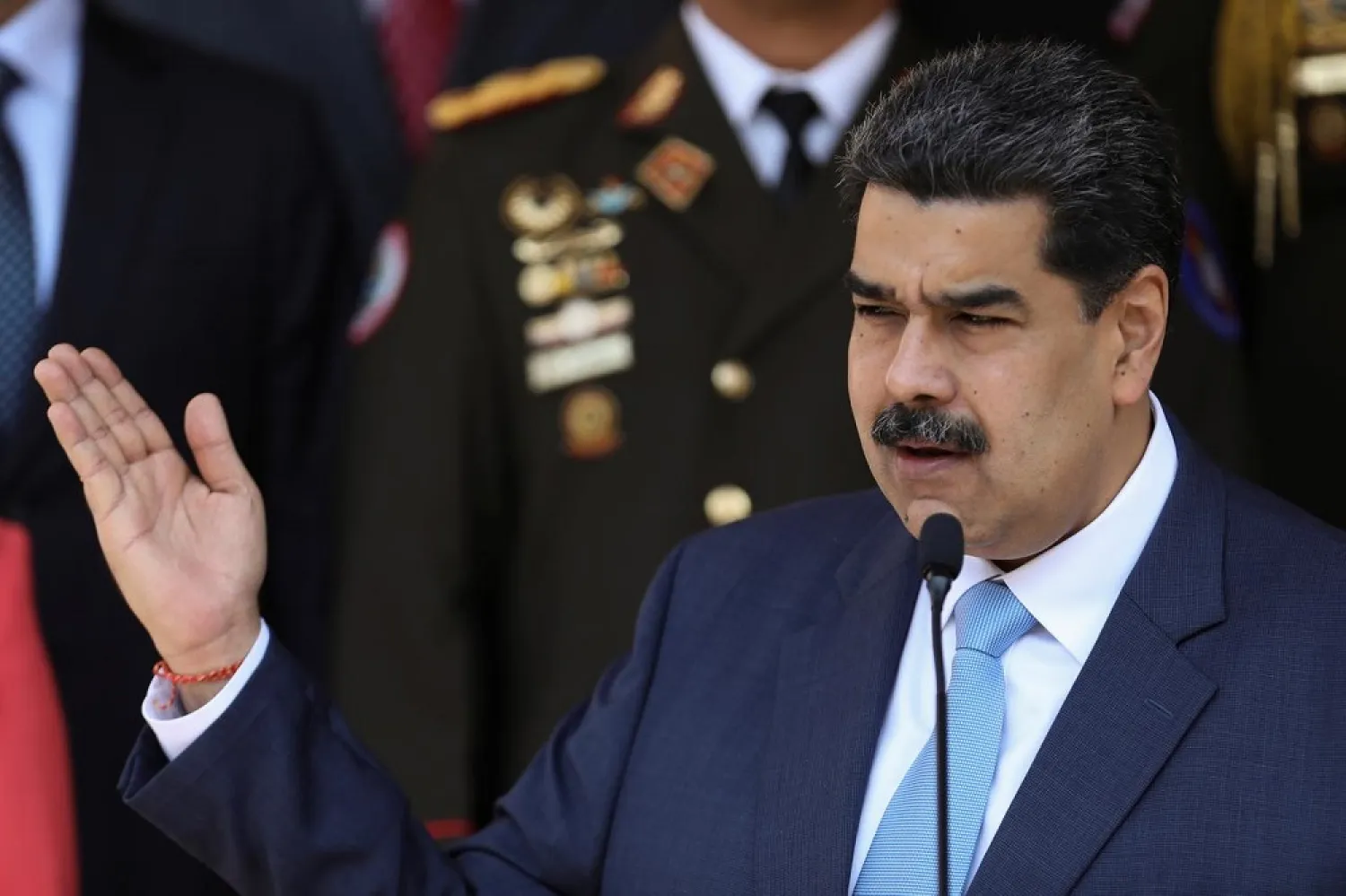
Venezuelan President Nicolas Maduro. (Reuters)
TT

Venezuela's Maduro Says Hopes to Restart Dialogue with US under Biden

Venezuelan President Nicolas Maduro. (Reuters)

Venezuelan President Nicolas Maduro said his government would work to establish dialogue with the United States under President-elect Joe Biden, after relations deteriorated under President Donald Trump.

“I hope we can work to restart sincere and direct channels of decent dialogue between the future government of Joe Biden and the government over which I preside,” Maduro said in a state television address on Sunday, a day after the former US Vice President defeated Trump’s re-election bid.

Trump, a Republican, has used economic sanctions and diplomatic pressure to pressure the socialist Venezuelan leader to resign, accusing him of corruption, human rights violations, and rigging his 2018 re-election win.

Washington closed its Caracas embassy last year and cut off ties with Maduro after recognizing Juan Guaido, the speaker of the opposition-held National Assembly, as Venezuela’s rightful leader. Dozens of other countries have also recognized Guaido, and the United States has also imposed sanctions on the OPEC nation’s oil industry.

Biden advisers have said he would push for humanitarian relief in Venezuela and modify the sanctions framework, without dismantling it entirely. The sanctions have proven popular among opposition supporters in Venezuela, as well as many voters of Venezuelan and Cuban descent in Florida, a battleground state that is closely fought between Democrats and Republicans.

Both Maduro and Guaido congratulated Biden on his victory on Saturday.


Zelensky Says EU's 90 Bn-euro Loan 'Truly Strengthens' Ukraine Defense

Ukraine's President Volodymyr Zelensky speaks during a press conference as part of the European Council meeting in Brussels on December 18, 2025. European Unions leaders meet in Brussels on December 18 and 19, 2025, to discuss in particular the need to support Ukraine, transatlantic relations and the EU's strategic autonomy. (Photo by JOHN THYS / AFP)
TT

Zelensky Says EU's 90 Bn-euro Loan 'Truly Strengthens' Ukraine Defense

Ukraine's President Volodymyr Zelensky speaks during a press conference as part of the European Council meeting in Brussels on December 18, 2025. European Unions leaders meet in Brussels on December 18 and 19, 2025, to discuss in particular the need to support Ukraine, transatlantic relations and the EU's strategic autonomy. (Photo by JOHN THYS / AFP)

Ukrainian President Volodymyr Zelensky on Friday thanked the EU for its 90 billion-euro loan to plug the country's looming budget shortfalls, saying it "truly strengthens" Kyiv's defense.

"This is significant support that truly strengthens our resilience," Zelensky said on X.

"It is important that Russian assets remain immobilized and that Ukraine has received a financial security guarantee for the coming years."

European Union leaders decided on Friday to borrow cash to loan 90 billion euros ($105 billion) to Ukraine to fund its defense against Russia for the next two years rather than use frozen Russian assets, sidestepping divisions over an unprecedented plan to finance Kyiv with Russian sovereign cash.

The leaders also gave the European Commission a mandate to keep working on a so-called reparations loan based on Russian immobilized assets but that option proved unworkable for now, above all due to resistance from Belgium, where the bulk of the assets is held.

"Today we approved a decision to provide 90 billion euros to Ukraine," EU summit chairman Antonio Costa told a press conference early on Friday morning after hours of talks among the leaders in Brussels. "As a matter of urgency, we will provide a loan backed by the European ‌Union budget."


Man Suspected in Brown University Shooting, MIT Professor’s Killing Found Dead

People gather outside a storage facility where a suspect in the shooting at Brown University was found dead, Thursday, Dec. 18, 2025, in Salem, N.H. (AP Photo/Reba Saldanha)
TT

Man Suspected in Brown University Shooting, MIT Professor’s Killing Found Dead

People gather outside a storage facility where a suspect in the shooting at Brown University was found dead, Thursday, Dec. 18, 2025, in Salem, N.H. (AP Photo/Reba Saldanha)

A man suspected in the fatal shootings at Brown University and of a Massachusetts Institute of Technology professor has been found dead in a New Hampshire storage facility after a five-day search that spanned several New England states, US authorities said Thursday.

Claudio Neves Valente, 48, a former Brown student and Portuguese national, was found dead Thursday evening from a self-inflicted gunshot wound, said Col. Oscar Perez, the Providence police chief. Perez said as far as investigators know, the Neves Valente acted alone.

Investigators believe he is responsible for both the shooting at Brown and the killing of a Massachusetts Institute of Technology professor two days later at his Brookline home, nearly 50 miles (80 kilometers) away, US attorney for Massachusetts Leah B. Foley said.

Two students were killed and nine were wounded in the shooting Saturday in a Brown University lecture hall. The investigation had shifted Thursday when authorities said they were looking into a connection between the Brown attack and the fatal shooting of 47-year-old MIT professor Nuno F.G. Loureiro.

Brown University President Christina Paxson said Neves Valente was enrolled at Brown from the fall of 2000 to the spring of 2001. He was admitted to the graduate school to study physics beginning in September 2000. “He has no current affiliation with the university,” The Associated Press quoted her as saying.

Valente and Loureiro attended the same academic program at a university in Portugal between 1995 and 2000, Foley said. Loureiro graduated from the physics program at Instituto Superior Técnico, Portugal’s premier engineering school, in 2000, according to his MIT faculty page. The same year, Neves Valente was let go from a position at the Lisbon university, according to an archive of a termination notice from the school’s then-president in February 2000.

Neves Valente had studied at Brown on an F1 visa. He eventually obtained legal permanent residence status in September 2017, Foley said. His last known residence was in Miami.

President Donald Trump suspended on Thursday the green card lottery program that allowed Neves Valente into the US Homeland Security Secretary Kristi Noem said in a post on the social platform X that at Trump’s direction she is ordering the United States Citizenship and Immigration Services to pause the program. The diversity visa program makes up to 50,000 green cards available each year by lottery to people from countries that are little represented in the United States, many of them in Africa.

The FBI previously said it knew of no links between the two shootings.

How the investigation has unfolded Police credited a Brown University custodian who had several encounters with Neves Valente as providing the crucial tip that led to the shooting suspect.

“When you do crack it, you crack it. And that person led us to the car, which led us to the name,” Rhode Island Attorney General Peter Neronha said.

After police shared images of a person of interest, the janitor recognized him and posted his suspicions on social media forum Reddit, where he was a regular commenter. Other Reddit users urged him tell the FBI, and the witness said he did.

But it took days before police say they interviewed him after publicizing a video where Neves Valente appeared to run away from the other man. The Reddit commenter didn’t respond to questions from The Associated Press earlier week but returned to the forum on Wednesday night to say that he was just interviewed by investigators.

“Respectfully, I have said all I have to say on the matter to the right people,” the Reddit commenter wrote Wednesday night, adding hope that the person of interest “is apprehended soon so the authorities can get to the bottom of this.”

His tip gave investigators a key detail: a Nissan sedan with Florida plates. That enabled Providence police officers to tap into a network of more than 70 street cameras operated around the city by surveillance company Flock Safety. Those cameras track license plates and other vehicle details.

After leaving Rhode Island for Massachusetts, Providence officials said the suspect stuck a Maine license plate over the rental car’s plate to help conceal his identity.

Video footage showed Neves Valente entering an apartment building near Loureiro's. About an hour later, he was seen entering the storage facility where he was found dead, Foley said.

There are still “a lot of unknowns” in regard to motive, Neronha said. “We don’t know why now, why Brown, why these students and why this classroom,” he said.

Frustration had mounted in Providence that the person behind the attack managed to get away and that a clear image of their face hadn’t emerged.

Although Brown officials say there are 1,200 cameras on campus, the attack happened in an older part of the engineering building that has few, if any, cameras.

And investigators believe the shooter entered and left through a door that faces a residential street bordering campus, which might explain why the cameras Brown does have didn’t capture footage of the person.

What happened in past investigations? In such targeted and highly public attacks, the shooters typically kill themselves or are killed or arrested by police, said Katherine Schweit, a retired FBI agent and expert on mass shootings. When they do get away, searches can take time.

In the 2013 Boston Marathon bombing, it took investigators four days to catch up to the two brothers who carried it out. In a 2023 case, Army reservist Robert Card was found dead of an apparent suicide two days after he killed 18 people and wounded 13 others in Lewiston, Maine.

The man accused of killing conservative political figure Charlie Kirk in September turned himself in about a day and a half after the attack on Utah Valley University's campus.

And Luigi Mangione, who has pleaded not guilty to murder charges in the killing of UnitedHealthcare CEO Brian Thompson in Manhattan last year, was arrested five days later at a McDonald's in Pennsylvania.


Iranian President Rejects ‘Humiliating Conditions’ Set by US For Resuming Nuclear Talks

Iranian President Masoud Pezeshkian (IRNA) 
TT

Iranian President Rejects ‘Humiliating Conditions’ Set by US For Resuming Nuclear Talks

Iranian President Masoud Pezeshkian (IRNA) 

Iranian President Masoud Pezeshkian rejected “humiliating conditions” set by the US for resuming nuclear talks, warning against any attempts to exert coercion, bullying, or any process that undermines Iran’s military capacities in the face of Israel.

At a meeting with a group of political elites, prominent figures and secretaries of parties, held Wednesday evening in Tehran, the President said Iran seeks peace but will not accept humiliating impositions.

“Iran had previously negotiated with the United States and had been ready to reach an agreement, but Washington disrupted the deal by resorting to war,” he noted.

Pezeshkian added, “Now, the US is proposing humiliating conditions for the resumption of talks,” which he said Iran is not prepared to accept. “Iran will not submit to humiliation nor accept a weak and fragmented country.”

Iran had passed a law last July to suspend its cooperation with the IAEA, denying UN inspectors access into the country. The suspension came after US and Israeli airstrikes targeted Iran’s nuclear facilities on June 22.

The Iranian President affirmed that his country does not seek confrontation, noting that Tehran has repeatedly declared it is not pursuing the construction of a nuclear bomb and is ready for any form of verification.

Washington had set conditions for the resumption of talks with Iran. The US has insisted that Iran must completely halt its uranium enrichment program. Tehran rejected Washington’s demands, describing them as an “unacceptable infringements on its national sovereignty.”

Speaking on Thursday during a visit to South Khorasan province, Pezeshkian urged national unity to overcome the country’s difficulties and problems.

“If the Muslim communities were united, and rejected differences and conflicts, Israel would not have committed all these atrocities and crimes in the region,” he said.

IRGC Spokesperson

Commenting on the June war with Israel, a spokesperson for the Iranian Revolution Guards Corps (IRGC) said Iran had built up a complete intelligence database on Israeli targets prior to the 12‑day war, enabling Iranian missiles to strike with precise accuracy.

Brigadier General Mohammad Naeini said “based on intelligence collected from within the Israeli occupied territory, Iranian missile strikes destroyed 47 strategic centers, several science and technology parks, and two power plants.”

He said nearly 80% of Iran’s counterstrikes during the war relied on intelligence gathered in previous years, without which the operations would not have been possible.

Araghchi’s Visit to Russia

Amid a crisis in Iran’s relations with the International Atomic Energy Agency (IAEA) and ongoing disagreements with the West over the nuclear deal, Iranian Foreign Minister Abbas Araghchi kicked off a visit on Tuesday to Moscow, where he held talks with his counterpart, Sergei Lavrov.

Prior to Araghchi’s visit, the Russian diplomat had affirmed the need for the IAEA to fully comply with neutrality when dealing with Iran.

On Wednesday, the foreign ministers inked a cooperation document, which comes following the entry into force of a comprehensive strategic partnership treaty ratified by the Russian parliament and president over the summer, and formally adopted in Iran in early October.

On Thursday, Araghchi wrote on X: “Building on our Strategic Partnership Treaty, Iran and Russia's foreign ministries have agreed on a three-year roadmap to regularize and elevate our cooperation and coordination.”

He added that closer collaboration between Moscow and Tehran will enable stronger action against unlawful Western sanctions, promote regional stability, advance infrastructure projects, and block illegal measures in the UN Security Council.