

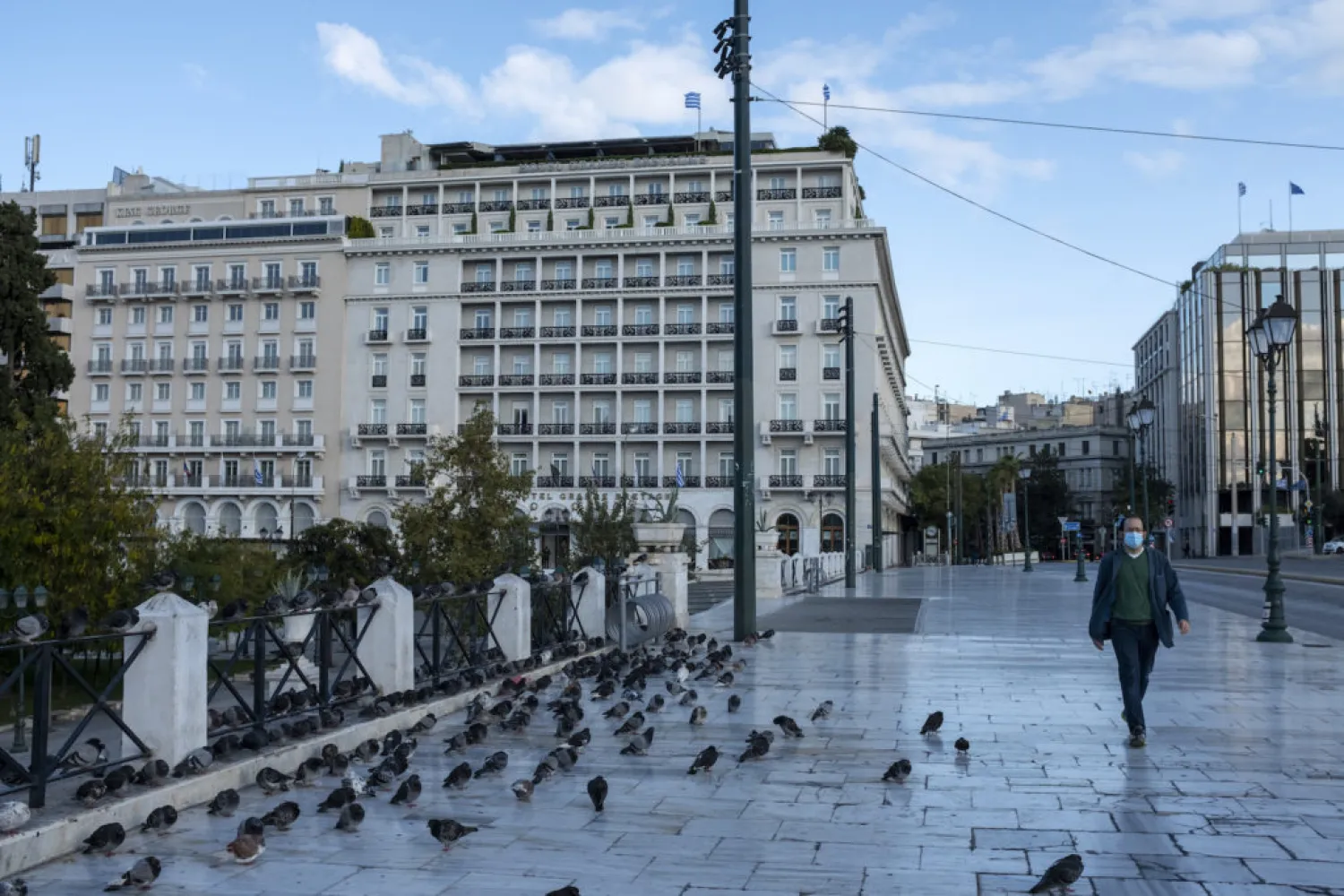

Coronavirus Vaccine Results Fuel Hopes for Return to Normal

A man, wearing a face mask to protect against coronavirus, walks alongside central Syntagma square during the first day of a lockdown, in Athens, Saturday, Nov. 7, 2020. (AP)
TT

Coronavirus Vaccine Results Fuel Hopes for Return to Normal

A man, wearing a face mask to protect against coronavirus, walks alongside central Syntagma square during the first day of a lockdown, in Athens, Saturday, Nov. 7, 2020. (AP)

Hugely promising results from a coronavirus vaccine trial fueled optimism around the world on Tuesday, even as tighter restrictions were imposed in Europe and the Middle East to try and stem the worst pandemic in a century.

The vaccine news brought some relief from an otherwise grim picture worldwide, which included the death of veteran Palestinian negotiator Saeb Erekat from coronavirus complications at the age of 65.

Stocks in some of the industries hit hardest by travel curbs, social distancing and lockdowns rebounded on hopes that the world may return to normal, after pharma giant Pfizer and its German partner BioNTech announced Monday that their vaccine candidate was 90 percent effective in preventing Covid-19.

A vaccine is seen as the best hope to break the cycle of deadly virus surges and severe restrictions across much of the world since Covid-19 first emerged in China late last year and unleashed devastation on the global economy.

"Investors have every right to be more bullish," said Russ Mould, investment director at AJ Bell, an online stockbroker.

Pfizer and BioNTech said they could supply up to 50 million doses of the vaccine globally this year and up to 1.3 billion next year if it receives approval.

The scientific community reacted positively overall -- although the trial is still ongoing and the vaccine candidate would need to be stored in specialist deep freezers, creating potential supply chain complications.

The vaccine candidate is one of more than 40, but no other developer has yet made similar claims about effectiveness.

There was also promising news from Brussels, where the EU parliament and member states struck a deal to pass the bloc's multi-annual budget, unblocking 750 billion euros ($886 billion) in coronavirus recovery funds.

Dacian Ciolos, head of the parliament's centrist Renew Europe Group, called the agreement "a game-changer" for Europeans facing adversity from the pandemic.

'A very dark winter'

The novel coronavirus has infected close to 51 million people worldwide, with more than 1.2 million deaths.

On Tuesday, 6,867 new deaths were recorded worldwide, with the highest daily tolls in France, Spain and the United States.

The US remains the hardest-hit nation at more than 10 million cases and nearly 240,000 deaths, and the pandemic was one of the top issues for voters in this month's presidential election.

Joe Biden, who had slammed President Donald Trump's handling of the crisis, spared no time in announcing a Covid-19 taskforce on Monday after being declared president-elect.

"We're still facing a very dark winter," Biden said.

Trump had clashed repeatedly with his own government experts, often refusing to back restrictions or even wear a mask in public. After the Pfizer announcement, he claimed -- without evidence -- that the news was delayed until after the election to damage him.

There was a separate breakthrough when the US Food and Drug Administration on Monday granted emergency approval to a synthetic antibody treatment developed by the pharma company Eli Lilly.

Bamlanivimab, which was shown to reduce the risk of hospitalization and emergency room visits, is the first major drug to be approved that was designed specifically for the coronavirus.

'Stage of critical danger'
Despite encouraging news on the medical front, rising infection and death rates have left many governments struggling to cope.

In Italy, virus restrictions were increased in five of the country's 20 regions on Tuesday.

Seven regions are now "orange" zones and four more are "red", meaning that most shops, bars and restaurants are shut and residents' movements are restricted.

Hungary, one of the hardest-hit countries in terms of deaths in proportion to the population, has also announced new measures to come into force on Wednesday.

As a result, students at Hungary's top arts university opposing a reform by Prime Minister Viktor Orban's government said they were ending a blockade of the campus that has lasted more than two months.

Elsewhere on the continent, Albania imposed a night-time curfew and Estonian President Kersti Kaljulaid went into self-isolation after coming into contact with someone diagnosed with Covid-19.

In Greece, the government stopped supermarkets from selling "non-essential goods" in order to avoid unfair competition against smaller shops that have been forced to close, following a similar move in France.

In the Middle East, Lebanon on Tuesday announced a fresh two-week lockdown despite a grinding economic crisis that has already battered businesses.

"We've reached a stage of critical danger as private and public hospitals don't have the capacity to receive severe cases," the country's caretaker prime minister, Hassan Diab, said in a televised address.

The region also mourned Erekat -- a long-time architect of plans to end the conflict with Israel through the creation of an independent Palestinian state.

Palestinian President Mahmud Abbas called the passing of "a brother and friend... a great loss for Palestine and our people".



Top Trump Iran Negotiator Says Visits US Aircraft Carrier in Middle East

US Special Envoy Steve Witkoff delivers a press conference upon the signing of the declaration on deploying post-ceasefire force in Ukraine, during the so-called "Coalition of the Willing" summit, at the Elysee Palace in Paris, France, January 6, 2026. (Reuters)
TT

Top Trump Iran Negotiator Says Visits US Aircraft Carrier in Middle East

US Special Envoy Steve Witkoff delivers a press conference upon the signing of the declaration on deploying post-ceasefire force in Ukraine, during the so-called "Coalition of the Willing" summit, at the Elysee Palace in Paris, France, January 6, 2026. (Reuters)

US President Donald Trump's lead Iran negotiator Steve Witkoff on Saturday said he visited the USS Abraham Lincoln aircraft carrier currently in the Arabian Sea, with Washington and Tehran due to hold further talks soon.

"Today, Adm. Brad Cooper, Commander of US Naval Forces Central Command, Jared Kushner, and I met with the brave sailors and Marines aboard the USS Abraham Lincoln, her strike group, and Carrier Air Wing 9 who are keeping us safe and upholding President Trump's message of peace through strength," said Witkoff in a social media post.

Iranian Foreign Minister Abbas Araghchi said on Saturday he hoped talks with the United States would resume soon, while reiterating Tehran's red lines and warning against any American attack.


Israel’s Netanyahu Expected to Meet Trump in US on Wednesday and Discuss Iran

Israeli Prime Minister Benjamin Netanyahu delivers a speech during a special session to mark the 77th anniversary of the Knesset's establishment and the 60th anniversary of the dedication of the current building at the Knesset, the Israeli parliament, in Jerusalem, 02 February 2026. (EPA)
TT

Israel’s Netanyahu Expected to Meet Trump in US on Wednesday and Discuss Iran

Israeli Prime Minister Benjamin Netanyahu delivers a speech during a special session to mark the 77th anniversary of the Knesset's establishment and the 60th anniversary of the dedication of the current building at the Knesset, the Israeli parliament, in Jerusalem, 02 February 2026. (EPA)

Israeli Prime Minister Benjamin Netanyahu is expected to meet US President Donald Trump on Wednesday in Washington, where they will discuss negotiations with Iran, Netanyahu's office said on Saturday.

Iranian and US officials held indirect nuclear ‌talks in the ‌Omani capital ‌Muscat ⁠on Friday. ‌Both sides said more talks were expected to be held again soon.

A regional diplomat briefed by Tehran on the talks told Reuters Iran insisted ⁠on its "right to enrich uranium" ‌during the negotiations with ‍the US, ‍and that Tehran's missile capabilities ‍were not raised in the discussions.

Iranian officials have ruled out putting Iran's missiles - one of the largest such arsenals in the region - up ⁠for discussion, and have said Tehran wants recognition of its right to enrich uranium.

"The Prime Minister believes that any negotiations must include limiting ballistic missiles and halting support for the Iranian axis," Netanyahu's office said in a ‌statement.


Italy FM Rules Out Joining Trump’s ‘Board of Peace’

Italy's Minister for Foreign Affairs Antonio Tajani speaks to the press during the EPP Leaders’ meeting, in Zagreb, Croatia, 30 January 2026. (EPA)
TT

Italy FM Rules Out Joining Trump’s ‘Board of Peace’

Italy's Minister for Foreign Affairs Antonio Tajani speaks to the press during the EPP Leaders’ meeting, in Zagreb, Croatia, 30 January 2026. (EPA)

Italy will not take part in US President Donald Trump's "Board of Peace", Italian Foreign Minister Antonio Tajani said Saturday, citing "insurmountable" constitutional issues.

Trump launched his "Board of Peace" at the World Economic Forum in Davos in January and some 19 countries have signed its founding charter.

But Italy's constitution bars the country from joining an organization led by a single foreign leader.

Prime Minister Giorgia Meloni, a Trump ally, last month noted "constitutional problems" with joining, but suggested Trump could perhaps reopen the framework "to meet the needs not only of Italy, but also of other European countries".

Tajani appeared Saturday to rule that out.

"We cannot participate in the Board of Peace because there is a constitutional limit," he told the ANSA news agency.

"This is insurmountable from a legal standpoint," he said, the day after meeting US Secretary of State Marco Rubio and US Vice President JD Vance at the Olympics in Milan.

Although originally meant to oversee Gaza's rebuilding, the board's charter does not limit its role to the Palestinian territory and appears to want to rival the United Nations.